
Azerbaijan Refugees Vow 'Great Return' to Karabakh

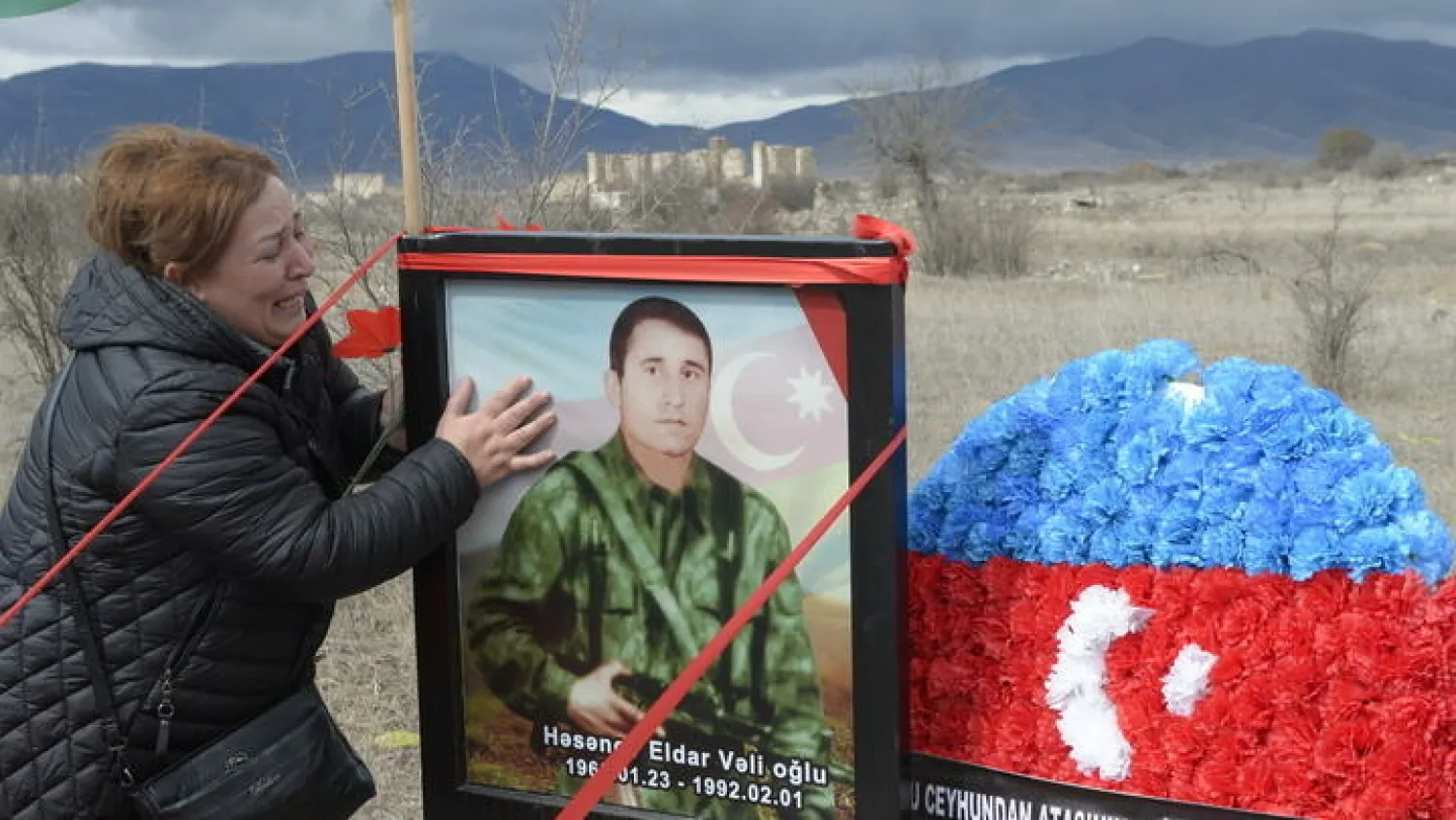
Painful return: Gulbeniz Jafarova, 55, cries at the grave of her brother who died defending Aghdam from Armenian separatists, who held the city for three decades Tofik BABAYEV AFP
TT

Azerbaijan Refugees Vow 'Great Return' to Karabakh

Painful return: Gulbeniz Jafarova, 55, cries at the grave of her brother who died defending Aghdam from Armenian separatists, who held the city for three decades Tofik BABAYEV AFP

Ali Hasanov looked over the overgrown ruins of his hometown in Nagorno-Karabakh and vowed to return and rebuild it.

"Whatever time it might take, we will return to Aghdam," said Hasanov. "We want to live here... we belong here."

Aghdam has been a ghost town since June 1993 when Armenian separatist forces took it from Azerbaijan, sending its entire population of 28,000 people fleeing for their lives, AFP said.

The 65-year-old metalworker returned to the disputed region for the first time since on a Azerbaijan government bus tour of "liberated lands" its army retook from Armenia after six weeks of fighting in 2020.

The latest war -- in which more than 6,500 people were killed -- saw energy-rich Baku take back much of the territory it lost in the conflict in the early 1990s with its old Soviet neighbor in the aftermath of the collapse of the Communism.

Some 30,000 died in that bitter war and hundreds of thousands were forced from their homes.

Hasanov said he "couldn't sleep a wink" the night before he travelled to Aghdam, which was Karabakh's biggest town before it was razed by the Armenians.

He said his "soul was itching to get to Aghdam" ever since he and his family fled the city after it was shelled.

"To me, it was the most beautiful city in the world," he said, standing in the middle of a wasteland that stretched out to the faraway bluish mountains.

The Azeribaijan government began the regular bus trips to the "liberated lands" in January, the first time its former inhabitants have been able to set foot in the mountainous enclave in three decades.

Dream come true
It is the first step in what Baku calls the "Great Return", an ambitious government plan to repopulate remote Karabakh with its former Azerbaijani population.

Escorted by police armed with automatic rifles, buses to Aghdam and Karabakh's recaptured cultural capital, Shusha, depart Baku twice a week for day-long trips that only give visitors two and a half hours to see their former homes.

Hasanov said the visit was a dream come true.

"Our house stood behind that fence," he said as tears welled up in his eyes.

"There was an alley of huge plane trees over there, under which we'd play backgammon or dominoes, and over there -- a football stadium, the favourite place for our neighborhood's lads."

Such was the destruction, that another refugee from Aghdam, Gulbeniz Jafarova, couldn't even find the ruins of her house.

"But (the) native spirit is hovering here. It feels like I spent 30 years in a prison cell and was just freed," the 55-year-old dressmaker added.

At Aghdam's cemetery she visited the grave of her brother who was killed aged 27, defending the town from Armenian separatist forces who controlled the region until the latest war.

"My mother's last words before she died were, 'My son.' I promised her that I would visit his grave."

'We belong here'
Azerbaijan's government has vowed to spend billions of petrodollars on the region's reconstruction, with $1.3 billion allocated in last year's budget for infrastructure projects such as new roads, bridges and airports.

Baku has pledged to transform Aghdam into one of the country's biggest cities and plans to set up an industrial park.

Foreign Minister Jeyhun Bayramov said in January that "very shortly we will witness the first families returning to their homes" in Karabakh.

But the "Great Return" of refugees remains a distant prospect, given the scale of devastation of towns like Aghdam and the dangers from landmines, which were used extensively in the conflict, which regularly flared up over the decades.

"Whatever time it might take, we will return to Aghdam," Hasanov insisted. "We want to live here. My sons say we belong here."


US Sanctions Cuban State Oil Company

An old car drives past debris from a demolished house occupying part of the seaside promenade in the Centro Habana neighborhood, in Havana on June 9, 2026. (Photo by Pablo PORCIUNCULA / AFP)
TT

US Sanctions Cuban State Oil Company

An old car drives past debris from a demolished house occupying part of the seaside promenade in the Centro Habana neighborhood, in Havana on June 9, 2026. (Photo by Pablo PORCIUNCULA / AFP)

The United States issued sanctions against Cuban state oil company Unión Cuba-Petróleo (CUPET), the Treasury Department website showed on Thursday.

The action freezes any US assets of the ⁠company and generally bars ⁠Americans from dealing with it.

"Today, I am designating Cuba's state-owned oil and gas company Union Cuba-Petroleo (CUPET), key assets of which were unlawfully expropriated from American owners years ago," US Secretary of State Marco Rubio said in a statement.

Washington has imposed sanctions on an array of ⁠Cuban entities and people, including the island nation's president, as it seeks to intensify pressure on Cuba's communist leaders.

The sanctions follow the United States' declaration of a national emergency this ⁠year ⁠that would impose tariffs on any country that supplies oil to the island, a move that has resulted in frequent power outages.


Hazardous Materials Incident Prompts Pentagon Lockdown

FILE PHOTO: The Pentagon is seen from the air in Washington, US, March 3, 2022. REUTERS/Joshua Roberts/File Photo
TT

Hazardous Materials Incident Prompts Pentagon Lockdown

FILE PHOTO: The Pentagon is seen from the air in Washington, US, March 3, 2022. REUTERS/Joshua Roberts/File Photo

A hazardous materials incident put the Pentagon on lockdown on Thursday as fire officials investigated the air quality issue, defense and fire officials said.

"The Pentagon has sophisticated systems to ensure the safety of the building and its occupants. Those systems have detected an air quality issue ⁠necessitating precautionary measures ⁠until we determine its significance," Pentagon spokesman Sean Parnell said in an email.

"The Department is executing standard protection protocols, including a shelter-in-place order for the affected area. Response teams are ⁠in place and ready to support building occupants."

The building was under lockdown, with people evacuated from several floors, CNN reported, citing unidentified sources. Floors two through five in corridors four through seven have been locked down, CNN said, citing two sources.

Another source reported seeing emergency responders were wearing full gas ⁠masks ⁠and chemical protection suits, CNN said.

A message sent by the Pentagon’s security team said additional testing was needed to determine the source of the problem, according to CNN.

The five-sided Pentagon building, hit during the Sept. 11, 2001 al Qaeda attacks is one of the world's largest office buildings.


China Sanctions Philippine Defense Chief for 'Irresponsible Remarks'

Philippines' Defence Secretary Gilberto Teodoro Jr speaks at the IISS Shangri-La Dialogue security summit in Singapore, May 31, 2026. REUTERS/Caroline Chia
TT

China Sanctions Philippine Defense Chief for 'Irresponsible Remarks'

Philippines' Defence Secretary Gilberto Teodoro Jr speaks at the IISS Shangri-La Dialogue security summit in Singapore, May 31, 2026. REUTERS/Caroline Chia

China announced on Thursday sanctions against the Philippines' defence minister over "irresponsible remarks", escalating tensions between Beijing and Manila as they grapple with maritime disputes.

Gilberto Teodoro and his spouse and child will be banned from entering China's mainland, Hong Kong and Macau, an unnamed foreign ministry spokesperson said in an online statement.

It added that "organizations and individuals in China" will not be allowed to "engage in any transaction, cooperation or other activities with him and his spouse and child".

Teodoro's rhetoric "undermines China's legitimate interests and sabotages China-Philippines relations", the statement said, without specifying which remarks it was referring to.

The two countries have in recent years often dealt with flare-ups in ongoing confrontations in the disputed South China Sea.

Beijing claims the strategic waterway nearly in its entirety, despite an international ruling that said its assertions are baseless.

China regularly deploys navy and coast guard vessels to bar the Philippines from important reefs and islands in the area.

At a summit in Singapore last month, Teodoro criticised Beijing's activities in the disputed waters, saying Manila "will not sacrifice our territorial integrity and sovereignty".

Asked last week about Teodoro's remarks at the summit, Beijing's foreign ministry spokeswoman Mao Ning said that he "is known to vilify China".

"All he cares is selfish personal gains to the point that he would perform political theatrics even when people's well-being is at stake," Mao said.