


Fierce Fighting in Ukraine's East but Eurovision Win Lifts Spirits

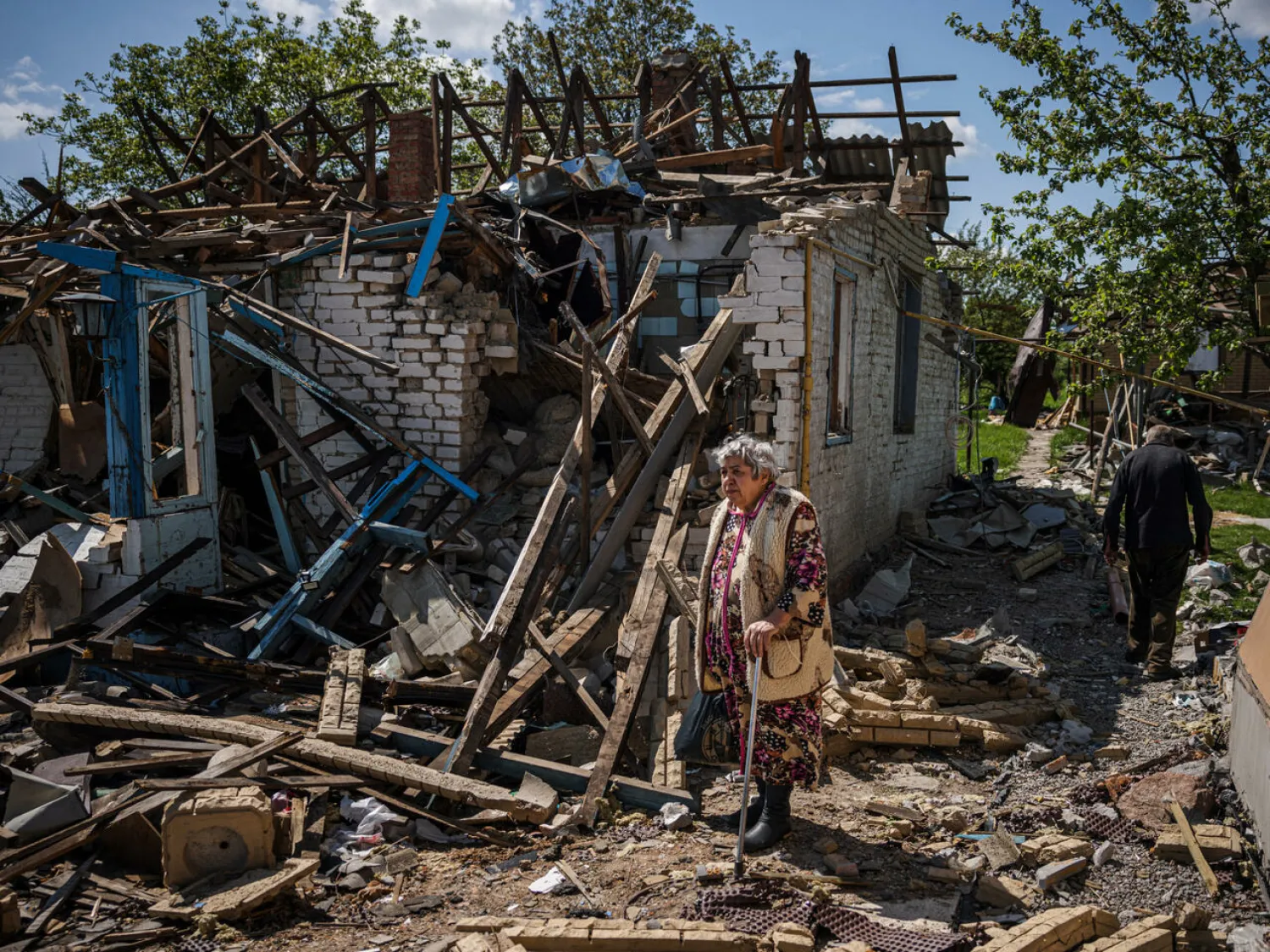
Russia, which sent in troops to Ukraine on February 24, has increasingly turned its attention to eastern Ukraine since the end of March, after failing to take the capital Kyiv Dimitar DILKOFF AFP
TT

Fierce Fighting in Ukraine's East but Eurovision Win Lifts Spirits

Russia, which sent in troops to Ukraine on February 24, has increasingly turned its attention to eastern Ukraine since the end of March, after failing to take the capital Kyiv Dimitar DILKOFF AFP

Ukraine's forces were fighting off a fierce Russian onslaught on the east of the country Sunday, after a Eurovision victory gave the country a much-needed boost of morale.

President Volodymr Zelensky warned on Saturday that the war in his country risked triggering global food shortages, adding that the situation in Ukraine's Donbas is "very difficult".

Russia, which invaded Ukraine on February 24, has increasingly turned its attention to the country's east since the end of March, after failing to take the capital Kyiv, AFP said.

Western analysts believe President Vladimir Putin has his sights on annexing southern and eastern Ukraine in the months ahead but his troops have appeared to be encountering stiff resistance.

Russia's war in Ukraine is increasingly shifting the balance of power in Europe, with Finland and Sweden poised to jettison decades of military non-alignment to join NATO as a defense against feared further aggression from Moscow.

Helsinki is set to formally announce its bid for membership on Sunday.

But as a conflict that has displaced millions dragged towards its third month, Ukrainians were offered a much-needed boost of optimism as a rap lullaby combining folk and modern hip-hop rhythms won the Eurovision song contest.

"Stefania", which beat out a host of over-the-top acts at the quirky annual musical event, was written by frontman Oleh Psiuk as a tribute to his mother before the war -- but its nostalgic lyrics have taken on outsized meaning because of the conflict.

"Please help Ukraine and Mariupol! Help Azоvstal right now," Psiuk said in English from the stage, referring to the port city's underground steelworks where Ukrainian soldiers are surrounded by Russian forces.

There was also optimism from Kyiv's head of military intelligence, who told the UK's Sky News on Saturday that the war could reach a "breaking point" by August and end in defeat for Russia before the end of the year.

Major General Kyrylo Budanov told the news network that he was "optimistic" about the current trajectory of the conflict.

- 'Heavy fighting' -
On the ground, the governor of the eastern Lugansk region, Serhiy Gaidai, said Ukrainian forces had prevented Russian attempts to cross a river and encircle the city of Severodonetsk.

"There's heavy fighting on the border with Donetsk region," Gaidai said, reporting major Russian losses of equipment and personnel.

"From interceptions (of phone calls), we understand that a whole (Russian) battalion has refused to attack, because they see what's happening."

Aerial images showed dozens of destroyed armored vehicles on the river bank and wrecked pontoon bridges.

UK military intelligence also said Russian forces had sustained heavy losses as they attempted the river crossing.

The highly risky maneuver reflected "the pressure the Russian commanders are under to make progress in their operations in eastern Ukraine", it added.

But Moscow's forces had "failed to make any significant advances despite concentrating forces in this area", it said.

In Washington, a senior US defense official said most of the activity was now in the Donbas area.

Kharkiv regional governor Oleh Synegubov meanwhile said in a video on Telegram that Ukrainian forces were counter-attacking in the direction of the northeastern city of Izium.

And the Ukrainian General Staff said troops had managed to push Russian troops out of Kharkiv, a priority target for Moscow.

"The enemy's main efforts are focused on ensuring the withdrawal of its units from the city of Kharkiv," a spokesman said.

On Friday, Zelensky said his troops would fight to recapture all occupied territory, and those under siege, including in the devastated southern port city of Mariupol.

There, the last defenders of the city are holed up in a warren of underground tunnels and bunkers at the vast Azovstal steelworks under heavy bombardment.

The United Nations and Red Cross helped to evacuate women, children and the elderly from the plant whey there were sheltering earlier this month.

Petro Andryushchenko, an advisor to the mayor of the city, said on Telegram that a "huge convoy" of 500 to a thousand cars had arrived in the city of Zaporizhia.

"Finally, we are waiting for our relatives from Mariupol at home," he said.

- Balance of power -
Poised to join NATO are Sweden and Finland, whose grid operator said Russia halted electricity supplies overnight.

Finnish officials said power supplied by Sweden had made up for the losses.

Ahead of talks with NATO members in Berlin, Finnish Foreign Minister Pekka Haavisto said he was "confident that in the end we will find a solution and Finland (and) Sweden will become members of NATO".

Earlier, in a phone call initiated by Helsinki, President Sauli Niinisto had a "direct and straightforward" conversation with Putin.

"Avoiding tensions was considered important," Niinisto's office said.

Putin, however, told him that Finland joining NATO would be a "mistake", insisting that Russia posed "no threat to Finland's security", the Kremlin said.

Ukraine's Zelensky also met with a delegation of senior US lawmakers Saturday, with Senate Republican leader Mitch McConnell reaffirming Washington's support for the country.

"The Ukrainians are fighting bravely against a deranged invader and have already succeeded beyond skeptics' wildest dreams," McConnell said in a statement.

"They are willing and determined to keep fighting to victory."

- Food crisis -
The war is also having deep ripple effects on the global economy, with wheat prices soaring in the wake of the invasion.

"Now support for Ukraine -- and especially with weapons -- means working to prevent global famine," Zelensky said in his address.

"The sooner we liberate our land and guarantee Ukraine's security, the sooner the normal state of the food market can be restored," he said.

Before the invasion, Ukraine exported 4.5 million tonnes of agricultural produce per month through its ports -– 12 percent of the planet's wheat, 15 percent of its corn and half of its sunflower oil.

But with the ports of Odessa, Chornomorsk and others cut off from the world by Russian warships, the supply can only travel on congested land routes that are much less efficient.

India had previously said it was ready to help fill some of the supply shortages caused by the war.

But on Saturday the country banned wheat exports without government approval, drawing sharp criticism from the G7's agriculture ministers meeting in Germany, who said that such measures "would worsen the crisis".

G7 ministers urged countries not to take restrictive action that could pile further stress on the produce markets.

They "spoke out against export stops and call as well for markets to be kept open", said German Agriculture Minister Cem Ozdemir, whose nation holds the rotating presidency of the group.



Iranian Traders and Shopkeepers Protest as Currency Hits Record Low

 People shop at Tajrish Bazaar in the Iranian capital Tehran on December 29, 2025. (AFP)
People shop at Tajrish Bazaar in the Iranian capital Tehran on December 29, 2025. (AFP)
TT

Iranian Traders and Shopkeepers Protest as Currency Hits Record Low

 People shop at Tajrish Bazaar in the Iranian capital Tehran on December 29, 2025. (AFP)
People shop at Tajrish Bazaar in the Iranian capital Tehran on December 29, 2025. (AFP)

Iranian traders and shopkeepers staged a second day of protests Monday after the country’s currency plummeted to a new record low against the US dollar.

Videos on social media showed hundreds taking part in rallies in Saadi Street in downtown Tehran, as well as in the Shush neighborhood near Tehran's main Grand Bazaar, which played a crucial role in the 1979 revolution that ousted the monarchy and brought clerics to power.

Witnesses told The Associated Press that traders shut their shops and asked others to do the same. The semiofficial ILNA news agency said many businesses and merchants stopped trading even though some kept their shops open.

There was no reports of police raids though security was tight at the protests, according to witnesses.

On Sunday, protest gatherings were limited to two major mobile market in downtown Tehran, where the demonstrators chanted anti-government slogans.

Iran's rial on Sunday plunged to 1.42 million to the dollar. On Monday, it traded at 1.38 million rials to the dollar.

The rapid depreciation is compounding inflationary pressure, pushing up prices of food and other daily necessities and further straining household budgets, a trend that could worsen by a gasoline price change introduced in recent days.

According to the state statistics center, inflation rate in December rose to 42.2% from the same period last year, and is 1.8% higher than in November. Foodstuff prices rose 72% and health and medical items were up 50% from December last year, according to the statistics center. Many critics see the rate a sign of an approaching hyperinflation.

Reports in official Iranian media said that the government plans to increase taxes in the Iranian new year that begins March 21 have caused more concern.

Iran’s currency was trading at 32,000 rials to the dollar at the time of the 2015 nuclear accord that lifted international sanctions in exchange for tight controls on Iran’s nuclear program. That deal unraveled after US President Donald Trump unilaterally withdrew the United States from it in 2018.

There is also uncertainty over the risk of renewed conflict following June’s 12-day war involving Iran and Israel. Many Iranians also fear the possibility of a broader confrontation that could draw in the United States, adding to market anxiety.

In September, the United Nations reimposed nuclear-related sanctions on Iran through what diplomats described as the “snapback” mechanism. Those measures once again froze Iranian assets abroad, halted arms transactions with Tehran and imposed penalties tied to Iran’s ballistic missile program.


Israel’s Supreme Court Suspends Govt Move to Shut Army Radio

Israeli troops during a military operation in the Palestinian village of Qabatiya, near the West Bank city of Jenin, 27 December 2025. (EPA)
TT

Israel’s Supreme Court Suspends Govt Move to Shut Army Radio

Israeli troops during a military operation in the Palestinian village of Qabatiya, near the West Bank city of Jenin, 27 December 2025. (EPA)

Israel's Supreme Court has issued an interim order suspending a government decision to shut down Galei Tsahal, the country's decades-old and widely listened-to military radio station.

In a ruling issued late Sunday, Supreme Court President Isaac Amit said the suspension was partly because the government "did not provide a clear commitment not to take irreversible steps before the court reaches a final decision".

He added that Attorney General Gali Baharav-Miara supported the suspension.

The cabinet last week approved the closure of Galei Tsahal, with the shutdown scheduled to take effect before March 1, 2026.

Founded in 1950, Galei Tsahal is widely known for its flagship news programs and has long been followed by both domestic and foreign correspondents.

A government audience survey ranks it as Israel's third most listened-to radio station, with a market share of 17.7 percent.

Prime Minister Benjamin Netanyahu had urged ministers to back the closure, saying there had been repeated proposals over the years to remove the station from the military, abolish it or privatize it.

But Baharav-Miara, who also serves as the government's legal adviser and is facing dismissal proceedings initiated by the premier, has warned that closing the station raised "concerns about possible political interference in public broadcasting".

She added that it "poses questions regarding an infringement on freedom of expression and of the press".

Defense Minister Israel Katz said last week that Galei Tsahal broadcasts "political and divisive content" that does not align with military values.

He said soldiers, civilians and bereaved families had complained that the station did not represent them and undermined morale and the war effort.

Katz also argued that a military-run radio station serving the general public is an anomaly in democratic countries.

Opposition leader Yair Lapid had condemned the closure decision, calling it part of the government's effort to suppress freedom of expression ahead of elections.

Israel is due to hold parliamentary elections in 2026, and Netanyahu has said he will seek another term as prime minister.


Thai Army Accuses Cambodia of Violating Truce with over 250 Drones

Displaced residents rest in a bunker in Thailand's Surin province on December 11, 2025, amid clashes along the Thai-Cambodia border. (AFP)
TT

Thai Army Accuses Cambodia of Violating Truce with over 250 Drones

Displaced residents rest in a bunker in Thailand's Surin province on December 11, 2025, amid clashes along the Thai-Cambodia border. (AFP)

Thailand's army on Monday accused Cambodia of violating a newly signed ceasefire agreement, reached after weeks of deadly border clashes, by flying more than 250 drones over its territory.

The Thai army said "more than 250 unmanned aerial vehicles (UAVs) were detected flying from the Cambodian side, intruding into Thailand's sovereign territory" on Sunday night, according to a statement.

"Such actions constitute provocation and a violation of measures aimed at reducing tensions, which are inconsistent with the Joint Statement agreed" during a bilateral border committee meeting on Saturday, it added.

Cambodian Foreign Minister Prak Sokhonn said in remarks aired on state television on Monday that the two sides had discussed the incident and agreed to investigate and "resolve it immediately".

Prak Sokhonn described it as "a small issue related to flying drones seen by both sides along the border line".

Thailand and Cambodia agreed to the "immediate" ceasefire on Saturday, pledging to end renewed border clashes that killed dozens of people and displaced more than a million this month.

The reignited fighting spread to nearly every border province on both sides, shattering an earlier truce for which US President Donald Trump took credit.

Under the agreement signed on Saturday, the Southeast Asian neighbors agreed to cease fire, freeze troop movements and cooperate on demining efforts and combatting cybercrime.