


Russian Sanctions Hurting Small Italian Fashion Producers

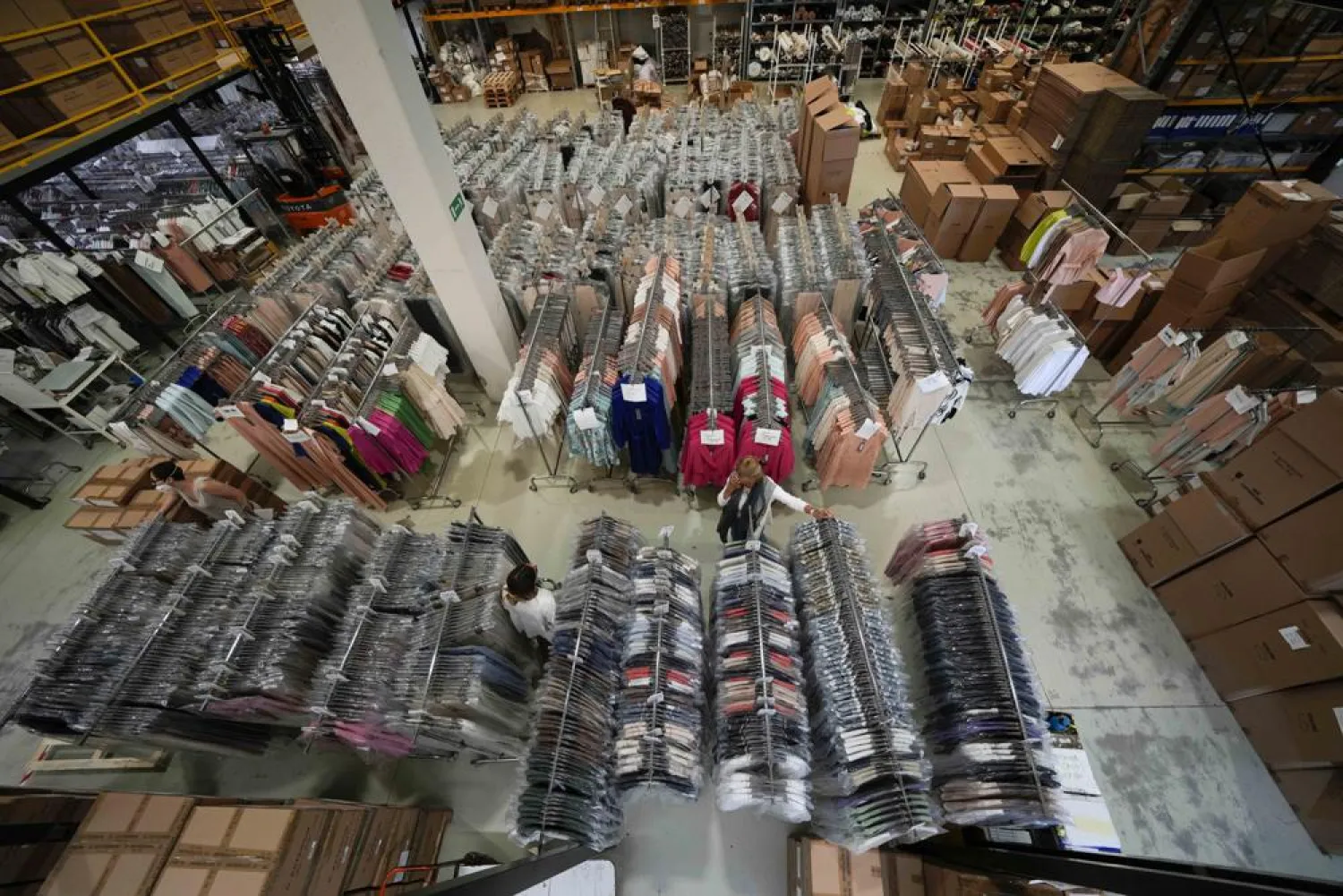
Nadia Zanola, right, chairman of the 'Cose di Maglia' factory, goes through racks of clothing at a warehouse section of unsold clothes, in Brescia, Italy, Tuesday, June 14, 2022. (AP Photo/Luca Bruno)
TT

Russian Sanctions Hurting Small Italian Fashion Producers

Nadia Zanola, right, chairman of the 'Cose di Maglia' factory, goes through racks of clothing at a warehouse section of unsold clothes, in Brescia, Italy, Tuesday, June 14, 2022. (AP Photo/Luca Bruno)

Fine Italian knitwear packed in boxes addressed to retailers in Moscow, St. Petersburg and Kursk sit stacked in a Lombardy warehouse awaiting dispatch. Although not subject to sanctions to punish Russia for invading Ukraine, the garments are not likely to ship any time soon.

Missing payments from the Russian retailers who ordered the garments are piling up due to restrictions tied to the banking sector, putting pressure on small fashion producers like D. Exterior, a high-end knitwear company with 50 workers in the northern city of Brescia, The Associated Press said.

“This is very painful. I have 2 million euros worth of merchandise in the warehouse, and if they cannot pay for it, I will be on my knees,” said D.

Exterior owner Nadia Zanola, surveying the warehouse for the brand she founded in 1997 from the knitwear company created by her parents in 1952.

Italy is the largest producer of global luxury goods in the world, making 40% of high-end apparel, footwear and accessories. While Russia generates just about 3% of Italian luxury’s 97 billion euros ($101 billion) in annual revenue, it is a significant slice of business for some of the 80,000 small and medium companies that make up the backbone of Italian fashion, according to industry officials.

“We are talking about eliminating 80% to 100% of revenues for these companies,’’ said Fabio Pietrella, president of the Confartigianato fashion craftsman federation.

Districts producing footwear in the Marche and Veneto regions, and knitwear makers in Umbria and Emilia-Romagna have grown particularly reliant on Russia.

“These are districts that connect the supply chain, and if it is interrupted, not only is the company that closes harmed, but an entire system that help make this country an economic powerhouse,’’ Pietrella said.

The Italian fashion world is best known for luxury houses like Gucci, Versace and Armani, which unveil their menswear collections in Milan this week. And some of the biggest names appear on a list compiled by Yale University professor Jeffrey Sonnenberg of major companies doing business in Russia since the war in Ukraine began.

“There are companies that kept selling to Nazi Germany after the outbreak of World War II — we don't celebrate them for that,” Sonnenberg said, labeling as “greedy” any enterprise that continues to do business in Russia today.

He also underlined that fashion companies don’t have the grounds to make humanitarian appeals to bypass sanctions, voluntary or otherwise, as has been the case with agricultural firms and pharmaceutical companies.

Among those receiving a failing grade from Sonnenberg is Italy's Benetton, which in a statement condemned the war but said it would continue its commercial activities in Russia, including longstanding commercial and logistic partnerships and a network of stores that sustain 600 families.

French conglomerate LVMH, meanwhile, has temporarily closed 124 stores in Russia, while continuing to pay its 3,500 employees in Russia. The Spanish group Inditex, which owns the fast-fashion chain Zara, also temporarily closed 502 stores in Russia as well as its online sales, accounting for 8.5% of group pre-tax earnings.

Pietrella fears a sort of Russia-phobia is taking hold that is demonizing business owners for trying to keep up ties with a longer-term vision.

He characterized as a “witch-hunt” criticism of some 40 shoe producers from the Marche region on Italy’s Adriatic coast for traveling to Russia for a trade fair during the war.

European Union sanctions against Russia sharpened after the Ukraine invasion, setting a 300-euro wholesale maximum for each item shipped, taking super-luxury items out of circulation but still targeting the upper-middle-class or wealthy Russians.

“Without a doubt, we as the fashion federation have expressed our extreme concern over the aggression in Ukraine,’’ Pietrella said. “From an ethical point of view, it is out of discussion. But we have to think of our companies. Ethics are one thing. The market is another. Workers in a company are paid by the market, not by ethics.”

He said the 300-euro limit on sales was a gambit by European politicians that on paper allows trade with Russia despite accompanying bureaucratic and financial hurdles, while also shielding governments from having to provide bailout funds to the industry. He also dismissed as overly facile government suggestions to find alternative markets to Russia.

“If there was another market, we would be there already,’’ Pietrella said.

At D. Exterior, exposure to Russia grew gradually over the years to now represent 35% to 40% of revenue that hit 22 million euros before the pandemic, a stream that is also under new pressure from higher energy and raw material costs.

The company was already delivering its summer collection and taking orders for winter when Russia invaded on Feb. 24. By March, Russian retailers were having trouble making payments.

Not only is Zanola stuck with some 4,000 spring and summer garments that she has little hope of shipping to Russian clients, she said she was contractually required to keep producing the winter orders, risking 100,000 euros in labor and materials costs if those are unable to ship.

Over the years, her Russian clients have proven to be ideal customers, Zanola said. Not only do they pay on time, but they are appreciative of the workmanship in D. Exterior’s knitwear creations.

After working so hard to build up her Russian customer base, she loathes to give it up and doesn't see a quick long-term replacement.

“If Russia were Putin, I wouldn’t go there. But since Russia is not only Putin, one hopes that the poor Russians manage to raise themselves up,'' she said.



French Designer Threads a Path in London Fashion Week

This photo taken on February 6, 2026 shows French fashion designer Pauline Dujancourt posing for a photograph in her studio in south London. (Photo by Ben STANSALL / AFP)
TT

French Designer Threads a Path in London Fashion Week

This photo taken on February 6, 2026 shows French fashion designer Pauline Dujancourt posing for a photograph in her studio in south London. (Photo by Ben STANSALL / AFP)

Just days before her third runway show, French designer Pauline Dujancourt was riding a wave of excitement and nerves.

The 31-year-old admitted she had begun having strange, nightmarish dreams ahead of her big moment at London Fashion Week on Sunday.

The British capital will once again host its Autumn/Winter fashion week from Thursday to Monday, after New York's bonanza and before the catwalk carousel moves to Milan and Paris.

London, known for its raw creative energy and rising talents, is where Dujancourt launched her label in April 2022 after training at the renowned arts and design school Ecole Duperre in Paris, and fashion hub Central Saint Martins in London.

She and her team began work in November on her autumn-winter 2026/27 collection to be unveiled before some 450 guests -- journalists, buyers and VIP clients.

For designers, everything comes down to those few precious minutes on the catwalk. It's no wonder nervousness mixes with the creative buzz.

"I go through every emotion," Dujancourt told AFP with a smile. "Some days I'm super excited, full of ideas, and others I'm like: why did I pick this color, this fabric?"

The questions and worries snowball: "Will everyone be on time? Will there be last-minute hitches on the day?"

In recent weeks, she has been running her daily schedule with military precision.
Dujancourt works year-round with four assistant designers, but the team swells to around 50 people ahead of the show.

And she works with a community of knitters in Lima, Peru, with handknitting -- "something that my grandmother taught me as a child" -- being a hallmark of her garments.

"She was so skillful and so humble about it. And no one really realized how much work it takes and how much technique it takes," she said.

Known for her sensual, airy knitwear, Dujancourt was a finalist for the LVMH Prize, won Elle UK's young talent award, and is supported by the British Fashion Council.

Her clients span the globe from Japan to the United States, France and the UK, with regular requests for wedding dresses.

Her new collection pays tribute to women persecuted during historical witch hunts.

"I really want to celebrate the fact that there are so many women around the world who are working so humbly on domestic skills ... like sewing, hand knitting," she said.

Two weeks before the show, young seamstresses were crocheting floral motifs in mohair and Japanese metallic thread at a south London studio overlooking the Thames river and Big Ben.

Workers were hunched over their desks pouring over designs, with the looks still "in pieces".

Then comes the moment when everything is assembled. "It's the magical stage, when the clothes start to come alive," she said, her blue eyes lighting up her face framed by long dark hair.

Less than a week before the show, fittings begin with an in-house model, followed by the castings to find the right models.

On the eve of the show come final fittings, hair and make-up tests. And finally, on Sunday morning, the full rehearsal.

Show day always brings surprises. At Dujancourt's last catwalk in September, several models arrived extremely late, held up by another show.

"They turned up still wearing the other show's make-up. We had to dress them and redo everything ... I nearly died," she recalled.

What is her worst nightmare? A model tripping or garments ripping in front of the cameras.

"I once dreamt I'd forgotten to get dressed before coming out to greet the audience -- that would be a bit embarrassing," she joked.

Around 25 outfits will strut the catwalk on Sunday, a moment that "goes by in a flash".
Afterwards comes the crash.

"We barely see it happening ... because we are backstage in the madness and the chaos of it," she said.

But then it's finished "and there's a bit of baby blues afterwards," as she comes down off the adrenaline rush.

Dujancourt heads to Paris after London Fashion Week to meet buyers, before work begins again for her next show, in September.


Fashion Commission, Saudi Retail Academy to Develop National Talent 

Fashion Commission, Saudi Retail Academy to Develop National Talent 
TT

Fashion Commission, Saudi Retail Academy to Develop National Talent 

Fashion Commission, Saudi Retail Academy to Develop National Talent 

The Saudi Fashion Commission signed a memorandum of understanding (MoU) with the Saudi Retail Academy to develop national capabilities and boosting specialized skills in the fashion and retail sectors, reported the Saudi Press Agency on Monday.

The MoU aims to support local talent and the creation of sustainable employment opportunities in this vital industry. It stems from the two sides’ keenness to cooperate in the fields of training and professional development.

The agreement was signed on the sidelines of the graduation ceremony of the academy’s first cohort.

The Fashion Commission focuses on developing local talent, transferring global expertise, and advancing the fashion sector in the Kingdom, while the Saudi Retail Academy is a non-profit institute and a specialized entity in training and development in the retail field and in building professional competencies and skills related to retail and sales.

The MoU aims to establish a framework for cooperation to design and implement specialized training programs that boost the readiness of national cadres and qualify them according to the highest professional standards, with a focus on developing skills in sales, customer experience, and store management to meet labor market requirement and the needs of the growing fashion sector.

Fashion Commission chief executive Burak Cakmak said that developing human capital is a fundamental pillar for the long-term growth of the Kingdom’s fashion sector.

The partnership reflects the commitment to strengthening the capabilities that form the foundation of a competitive and sustainable industry through investment in specialized skills within retail and customer experience, enabling brands to grow and supporting the sector’s confident evolution, he added.

Saudi Retail Academy chief executive Hend Al-Dhaban stressed that the partnership embodies a shared vision to empower national talent and elevate professionalism in the retail sector.

The agreement will help channel training expertise to meet the specialized needs of the fashion sector and equip young men and women with the practical skills required to succeed in the labor market, thereby boosting service quality and supporting localization targets and economic growth, she explained.

This cooperation is part of the Fashion Commission’s ongoing efforts to develop the fashion value chain through building strategic partnerships with specialized training and education entities, expanding professional opportunities for national talent, and linking education and training outputs with labor-market needs.

Through their partnership, the commission and the academy will help in building an integrated ecosystem that connects education, vocational qualification, and employment, bolstering the competitiveness of the fashion and retail sectors and supporting the objectives of Saudi Vision 2030 in empowering national cadres, localizing jobs, and improving quality of life.


Saudi 100 Brands Debuts Landmark Fashion Presentation at Saudi Cup 2026

The experience introduced global audiences to Saudi Arabia’s dynamic and growing fashion ecosystem - SPA
TT

Saudi 100 Brands Debuts Landmark Fashion Presentation at Saudi Cup 2026

The experience introduced global audiences to Saudi Arabia’s dynamic and growing fashion ecosystem - SPA

The Fashion Commission launched its Saudi 100 Brands showcase at the Saudi Cup 2026, marking a historic milestone for the world-renowned equestrian event at King Abdulaziz Racecourse in Riyadh.
The collections celebrate Saudi heritage by blending traditional and contemporary design. Jewelry and accessory brands also exhibited throughout, providing Saudi designers with a platform to reach a broader global audience. These showcases emphasize the fusion of heritage and modern design, offering a new perspective on the Kingdom's creative identity.
The Saudi 100 Brands program, a flagship initiative of the Fashion Commission, supports emerging designers by providing tools, expertise, and platforms to grow their global presence. This collaboration with the Saudi Cup underscores the importance of celebrating cultural heritage while advancing design innovation.

Each piece in the exhibition incorporates heritage motifs, textiles, and storytelling, reimagined through innovative design to appeal to modern and international audiences.

The exhibition aims to celebrate national identity, highlight local creative talent, and present the evolving direction of Saudi fashion, SPA reported.

Visitors explored the intersection of craftsmanship and cultural expression, discovering how designers honor tradition while advancing fashion design.

The experience also introduced global audiences to Saudi Arabia’s dynamic and growing fashion ecosystem.

This participation reflects the Fashion Commission’s vision to develop a thriving fashion sector rooted in cultural heritage and global ambition. By combining cultural narratives with innovative design, the commission enables Saudi fashion to contribute to global creative industries, nurture talent, and position Saudi brands for sustained success.