


Oil Minister Says Iraq to Act to Annul Kurdish Oil Deals

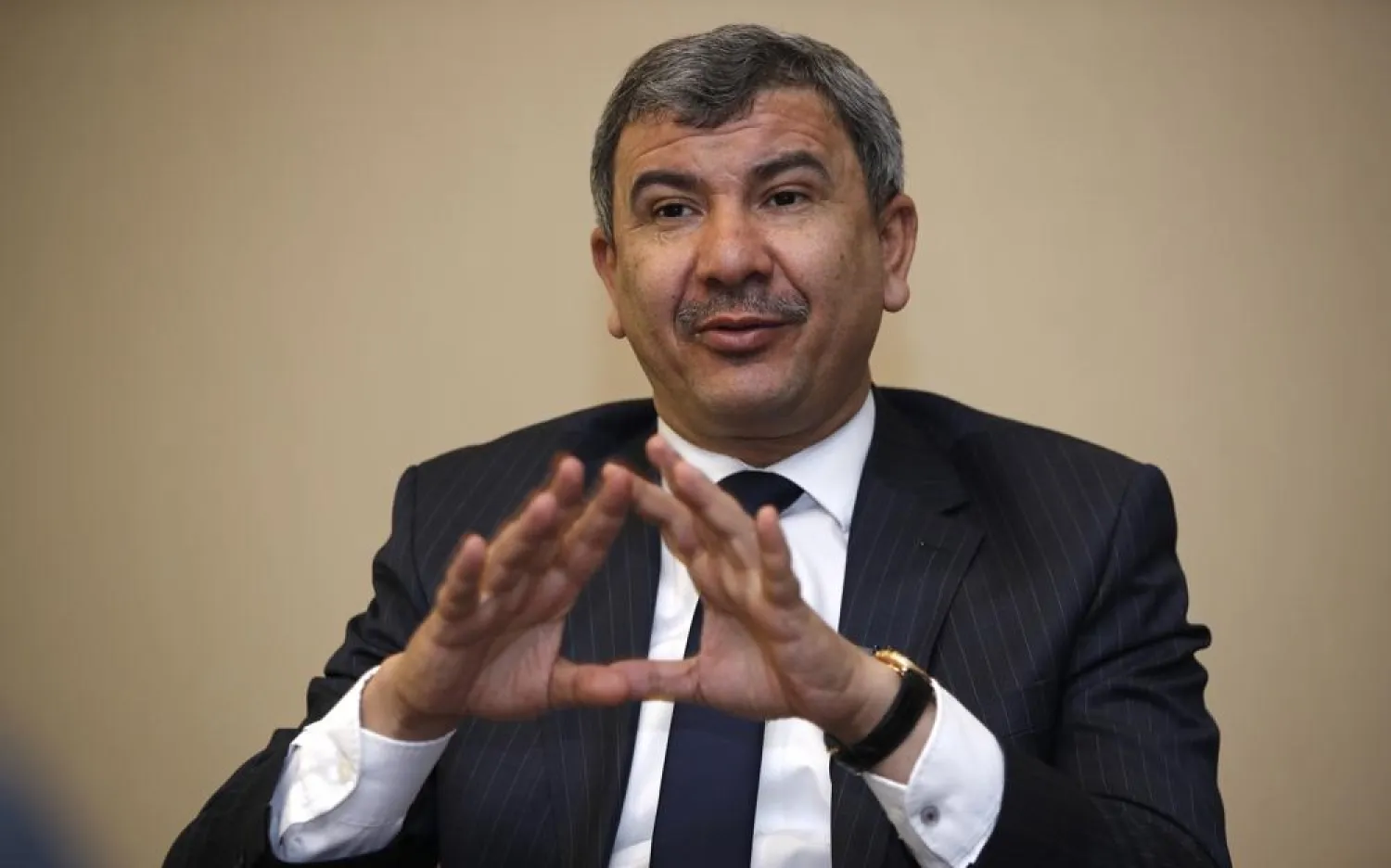
Ihsan Abdul-Jabbar Ismail, Iraq Oil minister speaks during an interview with The Associated Press in Baghdad, Iraq, Friday, June 11, 2021.(AP)
TT

Oil Minister Says Iraq to Act to Annul Kurdish Oil Deals

Ihsan Abdul-Jabbar Ismail, Iraq Oil minister speaks during an interview with The Associated Press in Baghdad, Iraq, Friday, June 11, 2021.(AP)

Iraq’s oil minister said on Thursday the government will take steps to enforce a recent court decision to annul oil contracts the semiautonomous northern Iraqi Kurdish region made with international companies.

The minister, Ihsan Abdul-Jabbar Ismail, told The Associated Press the deals, which circumvent the government in Baghdad, are illegal and amount to oil smuggling.

His remarks were the strongest yet by a senior government official since Iraq’s Supreme Federal Court issued a landmark ruling in February against the northern region’s independent oil sector. Ismail said in total 17 oil companies will be targeted for their dealings with the Iraqi Kurdish region.

Ismail said the international companies that have signed these deals would first receive a cautionary note.

"We will give them a soft message: ‘You are working in the smuggling of oil.' If they are a respectful company they will listen to us," Ismail told the AP in the exclusive interview.

Kurdish officials, including the ruling Kurdistan Democratic Party in Erbil, have dismissed the court ruling as politicized and claim the supreme court itself is unconstitutional.

The ruling came against the backdrop of political upheaval in Baghdad, where Iran-backed groups are pressuring Kurdish parties to join their efforts and proceed with the forming of a government after influential Shiite cleric Moqtada al-Sadr, the winner of the parliamentary elections last year, stepped down from the political process because he could not corral enough lawmakers in the 329-seat house. The Kurdistan Democratic Party was allied with Sadr.

The Iraqi Kurdish region has also faced a rising number of attacks targeting its energy infrastructure. Rocket and mortar fire repeatedly struck a gas field while others targeted a pumping station and refineries last month.

For years, Iraqi Kurdish authorities exploited a constitutional loophole, and managed to exports crude and maintain a modicum of financial independence from the federal government in Baghdad. They have kept details of their operations secret, including their production rates. Iraq Oil Report, an oil industry publication, estimates this to be 440,000 barrels per day.

Now, Baghdad officials are looking to close that door, Ismail said.

The February court ruling effectively rejected the Iraqi Kurdish oil law as a legal basis that the region had used to carry on with independent exports and contracts. Many questioned the timing of that ruling, given that it had been delayed for years. At the time, the Kurdistan Democratic Party and Sadr had tried to form a government without Iran-backed parties.

Ismail agreed the ruling came during a politically sensitive time but denied that it was a politicized decision. After the ruling, the Oil Ministry launched lawsuits against seven international companies, including Norway's DNO, Canada's Western Zagros and the UK-listed Gulf Keystone.

This week, Baghdad’s Commercial Court issued rulings invalidating four of the seven contracts, the oil minister said, with the other three to be decided on by the court at a July 17 session.

Ismail said the overall goal is to invalidate a total of 17 contracts. Some of the contracts are with companies from the United Arab Emirates, others are with Chinese and some with Russian companies, he said.

Caretaker Iraqi Prime Minister Mustafa al-Kadhimi has so far maintained distance from the recent developments, issuing conciliatory statements over the fraught relations between Baghdad and the Kurdish authorities.

But Ismail said the ministry has a plan to also act on the commercial court ruling and would give foreign companies the option to cancel their contracts, request that Iraq's federal government grant them a waiver - or transfer them from Kurdistan’s Ministry of Natural Resources to the federal government's Oil Ministry in Baghdad, he said.

He dismissed claims that it would be technically impossible to transfer contracts from one authority to another, saying it's a matter of "just paperwork.” The Kurdish region uses a production sharing contract model that is incompatible with the federal government's preference for technical service contracts.

If the companies do not comply, Ismail said the government would resort to "the law and banks” to enforce decisions.

"We also have the Oil Police, but we haven’t asked to use them,” he said.

Key oil service companies, including Baker Hughes, Haliburton and Schlumberger pledged to obey the ministry's blacklist policy and have said they will not seek new tenders with the Iraqi Kurdish authorities. For years, international companies have been operating in the Kurdish region with assurances from Kurdish officials that they would not face legal risks.

Oil companies contracted with the Kurdish region operate in territory de facto outside the federal government’s control. Sending federal police to physically shut down the operations in the Iraqi Kurdish region would amount to an unprecedented escalation.



The Full Story of Lebanon’s Initiative for Negotiations with Israel and its Challenges

President Joseph Aoun meets with French Ambassador to Lebanon Herve Magro at the Baabda presidential palace. (Lebanese Presidency)
TT

The Full Story of Lebanon’s Initiative for Negotiations with Israel and its Challenges

President Joseph Aoun meets with French Ambassador to Lebanon Herve Magro at the Baabda presidential palace. (Lebanese Presidency)

Authorities in Lebanon now see little option but to seek a humanitarian truce during the upcoming Eid al-Fitr, after ceasefire efforts in the war between Israel and Hezbollah collapsed against entrenched positions on both sides.

Israel is demanding Hezbollah’s “complete surrender” before halting operations in Lebanon. The party, in turn, has tied its stance to Iran’s position, after entering the wider conflict involving Tehran, Washington, and Tel Aviv.

A senior Lebanese official told Asharq Al-Awsat that Israeli Prime Minister Benjamin Netanyahu sent a ceasefire proposal, relayed by French President Emmanuel Macron, to Lebanese President Joseph Aoun 10 days ago.

Hezbollah’s decision to cut communication channels, followed by its launch of its “Al-Asf Al-Maakoul” (Eaten Straw) a wide military operation, derailed the initiative and led to Israel hardening its position.

Hezbollah’s posture remains the main domestic obstacle to ending the war. The group has yet to present a clear political position outlining its readiness to stop the fighting or its objectives, even as it escalates militarily in parallel with diplomatic efforts.

Lebanese delegation

The Lebanese source said no date or venue has been set for talks with Israel, and no formal Israeli response has been received. Messages conveyed through Macron and United Nations Special Coordinator for Lebanon Jeanine Hennis-Plasschaert have, however, raised a central question still unanswered by Beirut: if fighting stops, will Hezbollah stop firing rockets?

Lebanon, the source said, cannot afford a delay. Aoun is moving to finalize a negotiating delegation expected to include four figures representing the country’s main sects.

Named so far are former ambassador Simon Karam, a Christian who took part in “mechanism” committee meetings, Foreign Ministry Secretary-General Ambassador Abdel Sattar Issa, a Sunni nominated by Prime Minister Nawaf Salam, and Shawki Bou Nassar, a Druze figure named by senior Druze leader Walid Jumblatt.

Parliament Speaker Nabih Berri is still refusing to name a Shiite representative, conditioning this on a ceasefire and the return of displaced people.

He has also yet to respond to a proposal to appoint a member to a parallel “shadow delegation” to accompany the talks. The source said Israel is insisting, through indirect messages, on the inclusion of a Shiite member.

The source said Berri could prove pivotal, as the only figure capable of exerting pressure on Hezbollah at this stage and beyond.

Israel’s Maariv newspaper, citing Israeli sources, said Tel Aviv sees Berri as able to either back or block any move. While he opposes negotiations under fire and insists on a ceasefire first, Israeli assessments suggest he could later endorse any understandings that align with Lebanon’s interests and internal balance, providing political cover for Hezbollah to accept them.

United States

The source said Washington’s silence should not be read as negative. The US is fully focused on its conflict with Iran, but has not given Israel a free hand in Lebanon, otherwise the situation would look different.

He added that Aoun’s initiative has been well received in Washington, with President Donald Trump’s adviser for African affairs, Massad Boulos, and the president’s son-in-law, Jared Kushner, officially tasked with following the file and leading the expected negotiations.

Negotiations under fire

The source ruled out a near-term end to Israeli operations, saying Aoun is pressing ahead on the basis that negotiations under fire are better than negotiations after devastation.

The president fears what Israel may be preparing for Lebanon in the coming period and is seeking to avert it before it is too late, the source said.

The displacement crisis is placing severe strain on state institutions amid a lack of external support. The source questioned who would fund reconstruction given regional instability and global economic pressures.

During a visit to Beirut last week, United Nations Secretary-General Antonio Guterres launched a $308 million humanitarian appeal for displaced people, but only about $100 million has been raised, far short of the needs of 1.3 million displaced.

Hezbollah's weapons

Aoun’s initiative does not aim at a peace deal with Israel, but at technical talks starting with a ceasefire, an Israeli withdrawal, prisoner releases, and border demarcation, the source said.

Hezbollah’s weapons would then become an inevitable issue, with no remaining justification, to be handled firmly in line with government decisions and Lebanon’s interest that arms be held exclusively by the state.

Aoun and the government had opted to address the issue through dialogue, but tougher measures would be a last resort if Hezbollah fails to respond to what serves Lebanon’s interests, particularly those of the Shiite community, which the source said has paid a heavy price for entering a new “support war” with an unfavorable balance of power and no clear military horizon.

The Lebanese army has already begun tightening its grip on armed Hezbollah members, who can no longer move weapons or fighters freely through checkpoints in the south. The army is now aware of multiple sites it could target after the war ends.

The source rejected claims that the war is existential for Lebanon’s Shiites, describing them as a founding community with strong representation across state institutions and parliament, never marginalized.

He said they are expected to play a central role in rebuilding Lebanon and supporting its stability and prosperity, adding that reducing the community to a single party or movement is not realistic.


Sudan Clinics Could Run Out of Supplies in Weeks Due to Middle East War, Warns NGO

Sudanese women lie in beds as they receive treatment for dengue fever at Omdurman Hospital, as Sudan grapples with outbreaks of dengue and cholera amid the annual rainy season and a collapsed healthcare and infrastructure system, in Khartoum, Sudan, September 23, 2025. (Reuters)
TT

Sudan Clinics Could Run Out of Supplies in Weeks Due to Middle East War, Warns NGO

Sudanese women lie in beds as they receive treatment for dengue fever at Omdurman Hospital, as Sudan grapples with outbreaks of dengue and cholera amid the annual rainy season and a collapsed healthcare and infrastructure system, in Khartoum, Sudan, September 23, 2025. (Reuters)

Medical supplies to clinics dealing with the humanitarian crisis in Sudan could run out within two weeks unless shipments are rapidly rerouted after disruptions due to the conflict in the Middle East, the charity Save the Children said.

The expanding US-Israeli war on Iran has shaken global supply chains, with airspace closures and the halt of shipping through the Strait of Hormuz.

Some $600,000 worth of essential medicines are stuck in ports in Dubai, the charity said. About ‌90 Sudanese government-run ‌clinics serving roughly 400,000 patients rely on the ‌charity's ⁠supply of medicines, ⁠vaccines and nutritional treatment, with no in-country alternative, Save the Children's global director of supply chain, Willem Zuidema, told Reuters.

Sudan's three-year conflict has displaced millions of people and triggered one of the world's largest humanitarian crises.

"We have a couple of weeks to do this rerouting before the country's stocks run out. The clock is ticking," Zuidema said, adding that once buffer stocks are ⁠exhausted patients would not be able to access basic ‌healthcare support.

The medicines, which include antibiotics, ‌antimalarials, pain and fever medication, and pediatric injectable drugs, normally enter via Port Sudan ‌and travel by road to areas including Darfur.

UN aid chief Tom Fletcher ‌said last week the Middle East conflict is straining humanitarian supply chains, with sub-Saharan Africa and Gaza under particular pressure.

RISING COSTS, DONOR CUTS COMPOUND CRISIS

The World Health Organization also warned of growing medical supply shortages in Sudan.

"There's a huge ‌crunch in Sudan, of course, and there's also a bigger crunch in medical commodities going into certain provinces," WHO ⁠regional director ⁠Hanan Balkhy said.

Rising transport costs are impacting aid budgets heavily constrained by major donor cuts, Save the Children said, with container freight rates rising about 25–30% as some shipping firms reroute vessels around the Cape of Good Hope, adding weeks to delivery times.

The level of disruption to freight and subsequent cost impact may be worse than in the initial stages of the Ukraine war and COVID pandemic, because there is little buffer in the system after the aid cuts, Zuidema said.

"Demand will go up, but the means for us to respond - especially with the increasing fuel prices driving up cost - will go down. That's extremely worrying."

Save the Children's country budget for Sudan this year has been slashed by $4 million to $98 million.


Lebanon Transfers More Than 130 Syrian Prisoners Under Bilateral Agreement

 The Masnaa border crossing between Lebanon and Syria. (AFP file)
The Masnaa border crossing between Lebanon and Syria. (AFP file)
TT

Lebanon Transfers More Than 130 Syrian Prisoners Under Bilateral Agreement

 The Masnaa border crossing between Lebanon and Syria. (AFP file)
The Masnaa border crossing between Lebanon and Syria. (AFP file)

Lebanon transferred more than 130 Syrian detainees to their home country on Tuesday, a Lebanese judicial official and Syrian state media said, as part of an agreement the two sides signed last month.

Overcrowded Lebanese prisons host more than 2,200 Syrians held on various charges.

Many are still awaiting trial, while hundreds have been brought before military courts on charges of "terrorism" or related offences, including attacks on Lebanese forces.

Others are in custody for alleged membership in extremist or armed groups that were opposed to now ousted Syrian president Bashar al-Assad, who was supported by Lebanon's Hezbollah group during the Syrian civil war.

The judicial official told AFP that "106 convicted inmates were released from Roumieh Prison (north of Beirut), in addition to 31 others from Qobbeh Prison in Tripoli" in the country's north.

"The convoy headed to the Masnaa crossing to hand them over to the Syrian side," the official added.

Syrian state news agency SANA later reported that the detainees had reached the Syrian side of the border crossing.

It is the first batch of prisoners to be transferred under an agreement signed between the two countries in February, which will cover almost 300 convicts who have served 10 years or more in Lebanese prisons.

Under the agreement, they will be required to complete the remainder of their sentences in Syria.

"Today, the implementation of the agreement on the Syrian detainees in Lebanon and the mechanism to transport them to Syrian territory has begun," SANA quoted the charge d'affaires at Syria's embassy in Beirut, Iyad al-Hazzaa, as saying.

He said 136 detainees were among the first group, with those remaining to follow "upon completion of the necessary procedures for their release".

It was not immediately clear why there was a discrepancy in the reported number of detainees.

The issue of the detainees had been a sticking point in Beirut-Damascus relations following Assad's overthrow in December 2024.

Over the past year, both sides have repeatedly expressed their determination to open a new chapter in bilateral ties.