


Iran Urges ‘Realistic’ US Response to Revive Nuclear Deal

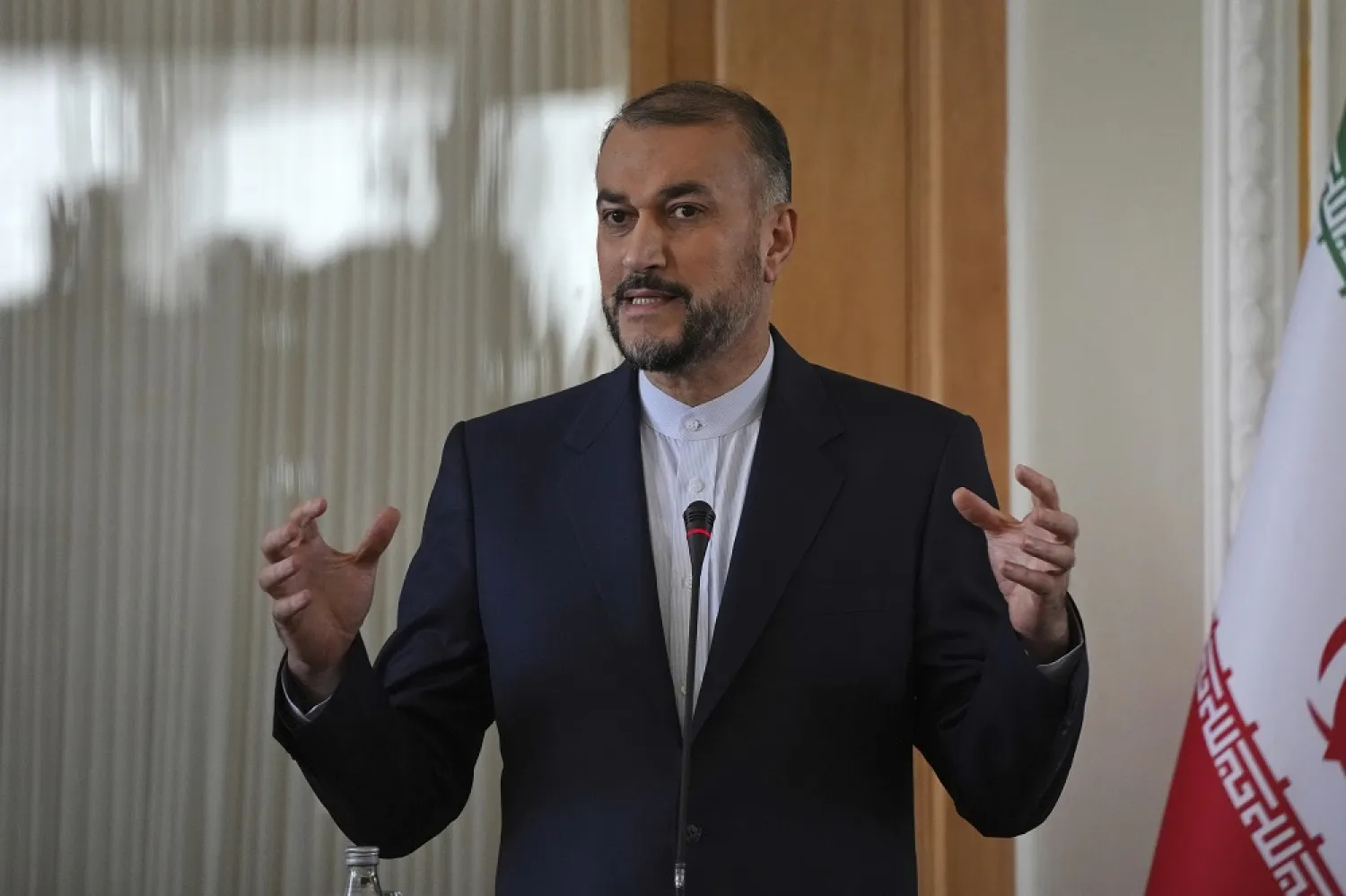
Iranian Foreign Minister Hossein Amirabdollahian speaks during a joint news briefing with his Pakistani counterpart Bilawal Bhutto Zardari in Tehran, Iran, Tuesday, June 14, 2022. (AP)
TT

Iran Urges ‘Realistic’ US Response to Revive Nuclear Deal

Iranian Foreign Minister Hossein Amirabdollahian speaks during a joint news briefing with his Pakistani counterpart Bilawal Bhutto Zardari in Tehran, Iran, Tuesday, June 14, 2022. (AP)

Iran's foreign minister called on Saturday for a "realistic response" from the United States to Iranian proposals at indirect talks in Vienna aimed at reviving Tehran's 2015 nuclear deal with world powers, state media reported.

The comments came as talks continued for a third day on Saturday with few expecting a breakthrough compromise while Tehran's disputed uranium enrichment program surges forward.

"Hossein Amirabdollahian... stressed the need for a realistic US response to Iran's constructive proposals on various issues to make the deal work," state media reported, without providing details on the proposals.

Little remains of the 2015 pact between Iran and the United States, Britain, France, Germany, Russia and China, which lifted sanctions against Tehran in exchange for curbs on Iranian enrichment activity the West fears could yield atomic bombs.

In 2018, then-US President Donald Trump ditched the deal and reimposed harsh sanctions. In response, Tehran - which says its nuclear program is for power generation and other peaceful purposes - breached the agreement in several ways including rebuilding stocks of enriched uranium.

Iranian media suggested a sticking point in the talks to revive the pact may be over Iran's refusal to address alleged unexplained uranium traces as demanded by the UN nuclear watchdog (IAEA), with Tehran insisting that the nuclear deal had cleared its nuclear program of alleged possible military dimensions.

In June, the International Atomic Energy Agency's Board of Governors passed a resolution criticizing Iran for failing to explain uranium traces found at undeclared sites. But a senior Iranian presidential aide said Tehran demanded the issue be closed before it would agree to resume compliance with the pact.

Claims, demands

"In all of (President Ebrahim) Raisi's telephone calls with the presidents of France, Russia and China, his firm position has been that a final agreement could be reached only when safeguards claims were resolved and closed," state media on Saturday quoted the deputy head of Raisi's office as saying.

The European parties to the deal on Friday urged Iran "not to make unrealistic demands outside the scope of the JCPoA (nuclear deal), including on IAEA safeguards”.

"The text is on the table. There will be no re-opening of negotiations. Iran must now decide to conclude the deal while this is still possible," a European statement said.

Indirect talks between Tehran and Washington restarted in Vienna on Thursday with a meeting between Iran's chief nuclear negotiator Ali Bagheri Kani and European Union coordinator Enrique Mora.

Reuters, citing one Iranian and one European official, reported in June that Tehran had dropped a major stumbling block - its demand for the removal of its Revolutionary Guards from a US sanctions list.

A senior Iranian official suggested that the issue might not be a sticking point anymore, telling Reuters on Thursday: "We have our own suggestions that will be discussed in the Vienna talks, such as lifting sanctions on the Guards gradually."



Kremlin Says US Has Not Responded to Its Nuclear Arms Control Offer

Russian President Vladimir Putin delivers his traditional televised New Year's Address to the people of Russia, in Moscow, Russia, 31 December 2025.  EPA/MIKHAIL METZEL/SPUTNIK/KREMLIN POOL
Russian President Vladimir Putin delivers his traditional televised New Year's Address to the people of Russia, in Moscow, Russia, 31 December 2025. EPA/MIKHAIL METZEL/SPUTNIK/KREMLIN POOL
TT

Kremlin Says US Has Not Responded to Its Nuclear Arms Control Offer

Russian President Vladimir Putin delivers his traditional televised New Year's Address to the people of Russia, in Moscow, Russia, 31 December 2025.  EPA/MIKHAIL METZEL/SPUTNIK/KREMLIN POOL
Russian President Vladimir Putin delivers his traditional televised New Year's Address to the people of Russia, in Moscow, Russia, 31 December 2025. EPA/MIKHAIL METZEL/SPUTNIK/KREMLIN POOL

The Kremlin said on Thursday that the United States had not responded to President Vladimir Putin's proposal to informally extend for ‌a year ‌the ‌provisions of ⁠the last ‌remaining nuclear arms pact between Moscow and Washington, the New START treaty, which is ⁠due to expire ‌in three weeks.

Kremlin spokesman ‍Dmitry ‍Peskov was responding ‍to a question about comments made by US President Donald Trump, who has said that he ⁠instead wants a more ambitious nuclear arms control treaty which includes China - something Beijing has so far shown no interest in.


German Air Traffic Control Advises Avoiding Iranian Airspace until Feb 10

Reuters file photo of an IranAir plane
TT

German Air Traffic Control Advises Avoiding Iranian Airspace until Feb 10

Reuters file photo of an IranAir plane

Germany's air traffic control authority said Thursday it was recommending planes avoid Iranian airspace after the United States has in recent days warned of a possible military intervention in Iran.

A spokesman for Germany's Flight Safety Office told AFP in a statement it had issued a recommendation "that Iranian airspace not be overflown... until February 10," adding that the advice had been issued "on the instruction of the transport ministry".


Türkiye Calls for Dialogue to Resolve Iran Unrest

Turkish Foreign Minister Hakan Fidan speaks during an interview with Reuters at the 23rd edition of the annual Doha Forum, in Doha, Qatar, December 6, 2025. REUTERS/Ibraheem Abu Mustafa
TT

Türkiye Calls for Dialogue to Resolve Iran Unrest

Turkish Foreign Minister Hakan Fidan speaks during an interview with Reuters at the 23rd edition of the annual Doha Forum, in Doha, Qatar, December 6, 2025. REUTERS/Ibraheem Abu Mustafa

Türkiye's top diplomat on Thursday called for dialogue to the crisis in Iran, rocked by mass protests which rights group say have left thousands dead and which prompted US warnings to Tehran.

"We absolutely want problems to be resolved through dialogue," Foreign Minister Hakan Fidan told journalists in Istanbul.

"Hopefully, the United States and Iran will resolve this issue among themselves -- whether through mediators, other actors, or direct dialogue. We are closely following these developments."