


African Migratory Birds Threatened by Hot, Dry Weather

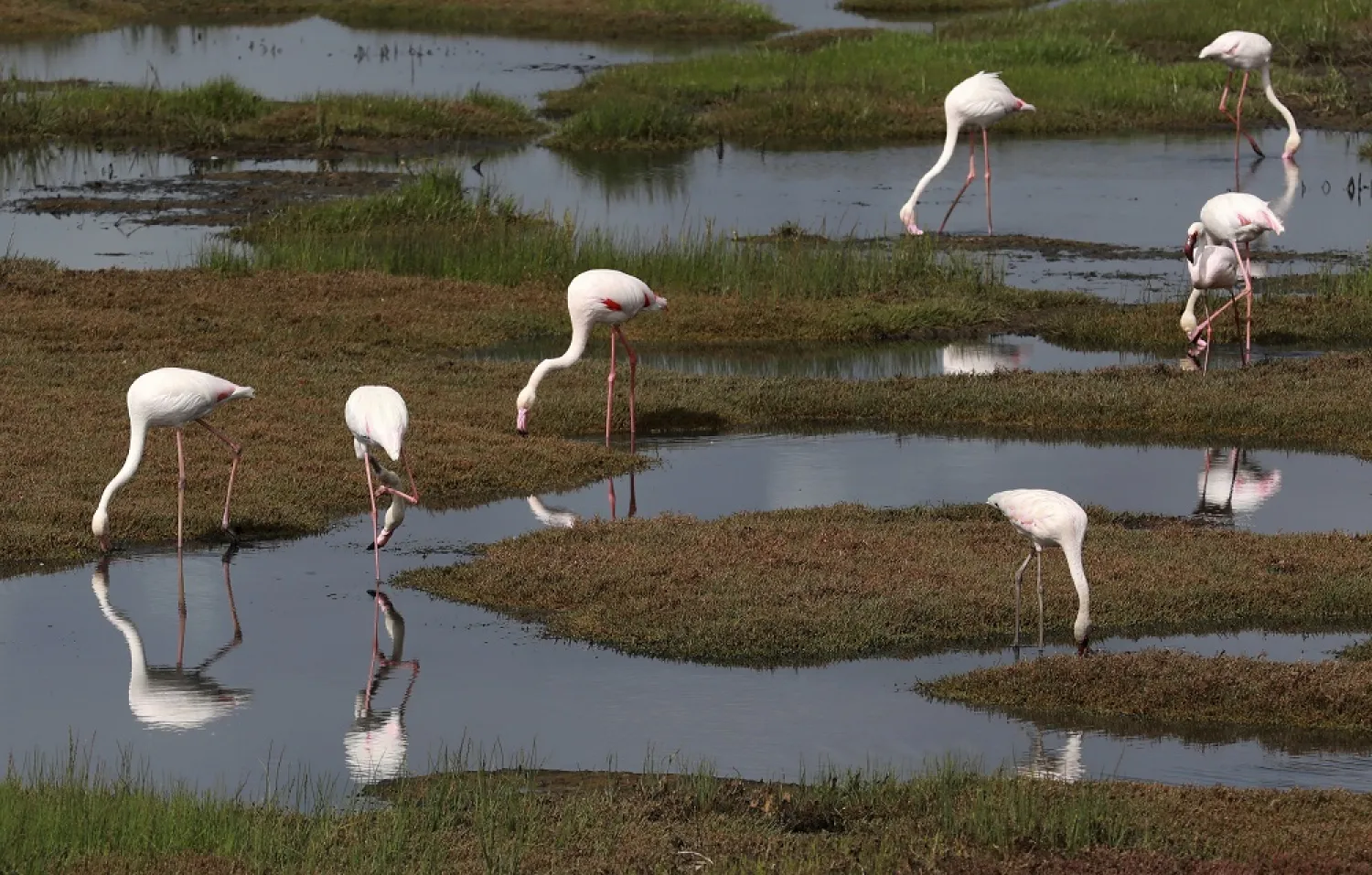
Flamingoes feed in the popular Berg River estuary in Velddrif, South Africa, Monday Sept. 14, 2020. (AP)
TT

African Migratory Birds Threatened by Hot, Dry Weather

Flamingoes feed in the popular Berg River estuary in Velddrif, South Africa, Monday Sept. 14, 2020. (AP)

Africa's migratory birds are threatened by changing weather patterns in the center and east of the continent that have depleted natural water systems and caused a devastating drought.

Hotter and drier conditions due to climate change make it difficult for traveling species who are losing their water sources and breeding grounds, with many now endangered or forced to alter their migration patterns entirely by settling in cooler northern areas.

Roughly 10% of Africa's more than 2,000 bird species, including dozens of migratory birds, are threatened, with 28 species — such as the Madagascar fish eagle, the Taita falcon and hooded vultures — classed as "critically endangered." Over one-third of them are especially vulnerable to climate change and extreme weather, an analysis by environmental group BirdLife International said.

"Birds are being affected by climate change just like any other species," BirdLife policy coordinator Ken Mwathe said. "Migratory birds are affected more than other groups of birds because they must keep on moving," which makes it more likely that a site they rely on during their journey has degraded in some way.

The African-Eurasian flyway, the flight corridor for birds that travel south through the Mediterranean Sea and Sahara Desert for the winter, harbors over 2,600 sites for migrating birds. An estimated 87% of African sites are at risk from climate change, a greater proportion than in Europe or Asia, a study by the United Nations environment agency and conservation group Wetlands International found.

Africa is more vulnerable to climate change because it is less able to adapt, said Evans Mukolwe, a retired meteorologist and science director at the World Meteorological Organization.

"Poverty, biodiversity degradation, extreme weather events, lack of capital and access to new technologies" make it more difficult for the continent to protect habitats for wild species, Mukolwe said.

Hotter temperatures due to human-caused climate change and less rainfall shrink key wetland areas and water sources, which birds rely on during migratory journeys.

"Lake Chad is an example," Mwathe said. "Before birds cross the Sahara, they stop by Lake Chad, and then move to the Northern or Southern hemisphere. But Lake Chad has been shrinking over the years," which compromises its ability to support birds, he said.

Parched birds means tougher journeys, which has an impact on their ability to breed, said Paul Matiku, executive director of Nature Kenya.

Flamingoes, for example, which normally breed in Lake Natron in Tanzania are unlikely to be able to "if the migration journey is too rough," Matiku said.

He added that "not having water in those wetlands means breeding will not take place" since flamingoes need water to create mud nests that keep their eggs away from the intense heat of dry ground.

Non-migratory birds are also struggling with the changing climate. African fish eagles, found throughout sub-Saharan Africa, are now forced to travel further in search of food. The number of South African Cape Rockjumpers and Protea canaries is severely declining.

Bird species living in the hottest and driest areas, like in the Kalahari Desert that spans Botswana, Namibia and South Africa, are approaching their "physiological limits," the most recent assessment by the UN’s expert climate panel said. It added that birds are less able to find food and are losing body mass, causing large-scale deaths for those living in extreme heat.

"Forest habitats get hotter with climate change and ... dryland habitats get drier and savannah birds lack food because grass never seeds, flowers never fruit, and insects never emerge as they do when it rains," Matiku said.

Other threats, such as the illegal wildlife trade, agriculture, the growth of urban areas and pollution are also stunting bird populations like African fish eagles and vultures, he said.

Better land management projects that help restore degraded wetlands and forests and protect areas from infrastructure, poaching or logging will help preserve the most vulnerable species, the UN environmental agency said.

Birds and other species would benefit from concerted efforts to improve water access and food security, especially as sea level rise and extreme weather events are set to continue, said Amos Makarau, the Africa regional director of the UN weather agency.

Scientists say that curbing emissions of planet-warming gasses, especially in high-emitting nations, could also limit future weather-related catastrophes.



Three Million Pounds to Save Polar Explorer Shackleton's Villa

A person taking a photo of Ernest Shackleton's grave, polar explorer, who died after a heart attach in 1922 (Shutterstock)
TT

Three Million Pounds to Save Polar Explorer Shackleton's Villa

A person taking a photo of Ernest Shackleton's grave, polar explorer, who died after a heart attach in 1922 (Shutterstock)

Work is under way on a South Atlantic island to preserve a key building in the story of polar explorer Ernest Shackleton.

Shackleton famosly reached the whaling station of Stromness on South Georgia in 1916 after spending 18 months stranded on Antarctica with his crew.

The now-dilapidated Stromness Manager's Villa was used as a base by Shackleton while he orchestrated the rescue of his men.

The Dundee-based South Georgia Heritage Trust have been working to stabilize the structure, with plans to create a digital “twin” of the building for people around the world to see it.

A 2022 survey found the building was very close to collapse.

Alison Neil, chief executive of the South Georgia Heritage Trust, said: “The reason for that is rotting timbers. This is an old-fashioned version of a flat-pack house. They would've been brought down from Norway on ships and then assembled on the island.”

The trust raised more than £3 million to send a team to South Georgia.
They arrived in October and have been working on stabilizing the structure.

Alison said: “It's in the middle of a whaling station that's full of asbestos, dangerous debris, and is not accessible to the public. Our plan is not to open it up to the public, our plan is to maintain it for the future.”

Shackleton's extraordinary story of survival has fascinated and inspired people for more than a century.

His most famous mission was his plan to cross Antarctica through the South Pole after travelling on board his ship The Endurance.

In 1915, The Endurance became trapped in ice, and his crew abandoned ship, crossing onto floating ice, which they hoped would drift towards land.

But by April 1916, the ice floes were breaking up, so Shackleton took his crew in lifeboats first to Elephant Island, then led a smaller group to find help for the others.

They crossed about 800 miles (1,300km) of ocean in the open boat before reaching the island of South Georgia.

Leaving three of the men behind with the boat, Shackleton, Frank Worsley and Tom Crean trekked across the island for three days until they reached Stromness whaling station on the far side of the island.

Alison said the men made it to the villa in a dishevelled state.

She said: “No-one recognized them, they must've looked terrifying. They knocked on the door of the villa and famously the whaling manager opened the door and said, 'who the hell are you?' Shackleton allegedly said: 'My name is Shackleton'.”

It was the men's first contact with the outside world for 17 months.

Shackleton, Worsley and Crean were invited in to the villa where they had a hot meal and a bath, before immediately starting the rescue of the rest of their crew with the help of the whalers.

Alison said: “That's a really important part of The Endurance story and it effectively is the next chapter on from the sinking of the vessel.”


James Cameron Describes Strategy for Surviving Titanic Disaster

Titanic ocean liner after it struck an iceberg in 1912 off the coast of Newfoundland in the Atlantic Ocean (Shutterstock/3d illustration)
TT

James Cameron Describes Strategy for Surviving Titanic Disaster

Titanic ocean liner after it struck an iceberg in 1912 off the coast of Newfoundland in the Atlantic Ocean (Shutterstock/3d illustration)

James Cameron, the filmmaker behind the hit 1997 disaster movie Titanic, has revealed his strategy for hypothetically surviving the famed 1912 cruise liner sinking.

Titanic starred Leonardo DiCaprio and Kate Winslet and is one of the highest-grossing films of all time. The film was set during the sinking of the RMS Titanic, which claimed the lives of more than 1,500 people.

In a new interview with The Hollywood Reporter, Cameron was asked: “If you were traveling by yourself as a second-class passenger on Titanic when it hit an iceberg, what would you have done?”

As the filmmaker explained, third-class passengers were trapped below decks, while first-class passengers were more likely to secure a spot on the lifeboats, according to the interview reported by The Independent.

“I think there were interesting ways to what-if or second-guess the whole thing,” Cameron replied. “One I like to play with my Titanic experts is – with what we know now, and if you had the captain’s ear – how could you save everybody?

“The other is: What if you’re a time traveler, you go back and want to experience the sinking, and your little time-travel thing that gets you back fails, and you’re like, ‘I’m really on the ship, I’ve got to get off it.'”

In this latter scenario, Cameron argued that the best thing to do would be to stand by the edge of the deck, and wait for a lifeboat to launch during the early stages of the evacuation. At this point, he would jump off, and swim to the boat, relying on the passengers to pull him aboard.

“Most people wouldn’t have had the courage to jump into the water,” he continued. “They couldn’t quite believe that the ship was really going to sink. But if you knew for sure it was going to sink and you weren’t on a lifeboat, you jump in the water next to the boat the second it casts off."


Hiker Killed in Rare Suspected Mountain Lion Attack in Colorado

FILE - The General Store is seen Oct. 24, 2006, in Glen Haven, Colo. (AP Photo/The Denver Post, Karl Gehring, File)
TT

Hiker Killed in Rare Suspected Mountain Lion Attack in Colorado

FILE - The General Store is seen Oct. 24, 2006, in Glen Haven, Colo. (AP Photo/The Denver Post, Karl Gehring, File)

A hiker in Colorado has died in the state's first suspected fatal mountain lion attack in over 25 years, authorities said.

The woman was found unresponsive by other hikers on the Crosier Mountain trail northeast of Estes Park around noon on Thursday.

The hikers saw a mountain lion near the woman's body and scared it away by throwing rocks. A doctor was among the hikers and attended to the woman but found no pulse, Colorado Parks and Wildlife spokesperson Kara Van Hoose told reporters, according to Reuters.

CPW officers responded to the ⁠scene and shot dead two lions in the area. It is not known whether one or multiple animals were involved in the suspected attack, the agency said in a statement. It is believed the woman was hiking alone.

“There were signs that this was consistent with a mountain lion attack,” Van Hoose told a press ⁠conference.

Mountain lion attacks on humans in Colorado are rare, with 28 reported to CPW since 1990. The last fatal attack was in 1999.

CPW pathologists are performing necropsies on the dead animals to check for abnormalities and neurological diseases like rabies and avian influenza, as well as human DNA, Van Hoose said.

CPW policy mandates the killing of any mountain lion involved in an attack on a human so as to prevent repeat incidents. If human DNA is not found on either dead lion, authorities will continue to ⁠search for animals that may have been involved, Van Hoose said.

Larimer County Coroner will release the identity of the victim and cause of death, she said.

Colorado has a healthy mountain lion population, estimated by CPW to be between 3,800 and 4,400 adults. Conservation efforts have brought the species back from near extinction in the 1960s due to bounty hunting.

Mountain lions are common in the Front Range area where the woman was found, Van Hoose said. The animals go down to lower elevations in winter in search of prey like deer and elk, increasing chances of encounters with humans.