


Ali Saleh to Saddam: War is Happening... Goal is to Destroy the Iraqi Army

Asharq Al-Awsat Releases Excerpts from the Memoirs of Former Iraqi Minister of Trade Muhammad Al-Rawi

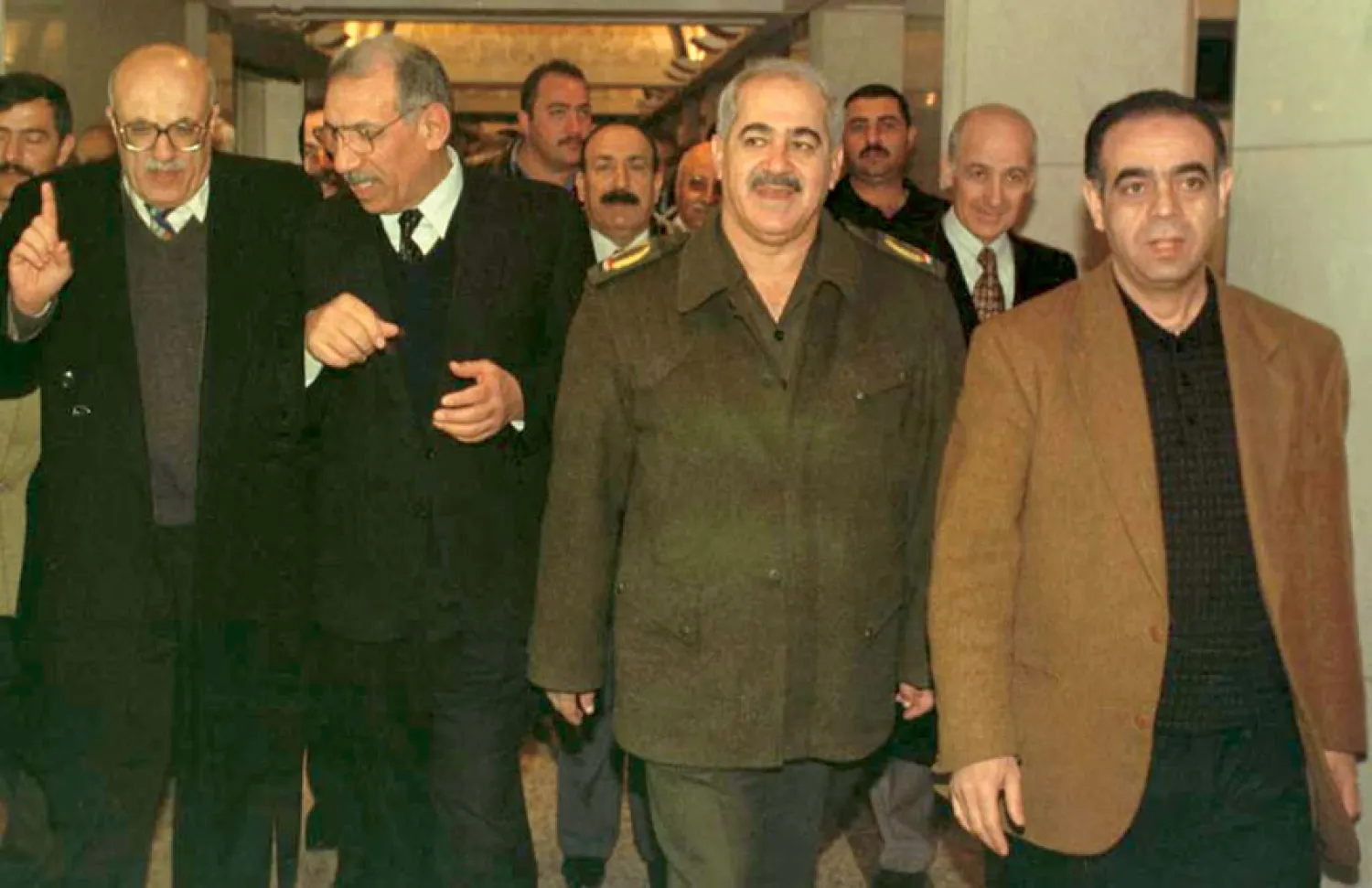
Al-Rawi with Iraqi and Jordanian officials in Baghdad in 2000 (Getty Images)
TT

Ali Saleh to Saddam: War is Happening... Goal is to Destroy the Iraqi Army

Al-Rawi with Iraqi and Jordanian officials in Baghdad in 2000 (Getty Images)

Dr. Muhammad Mahdi Salih Al-Rawi, former Iraqi Minister of Trade, presents in his new book - “Preventing Famine in Iraq - My Memoirs of the Years of the Siege 1990-2003” (to be published soon by Al-Maaref Forum) a detailed account of the efforts he made at the head of his ministry to address the sanctions imposed on Iraq in the wake of its invasion of Kuwait in 1990, which continued until the US invasion of the country in 2003.

The author talks with remarkable frankness about the differences that were plaguing Saddam Hussein’s regime, part of which is related to Lieutenant-General Hussein Kamel, the son-in-law of the Iraqi president before he split with his uncle in 1995.

Al-Rawi has worked in the Iraqi presidential office since 1982, and was, as he says, in “direct contact” with Saddam Hussein for seven years, until his appointment as Minister of Trade in 1987.

After the US invasion in 2003, Al-Rawi was arrested in Camp Cropper and was on the most wanted list of the leaders of the collapsed regime. He was detained until 2012 and is currently living in Jordan.

Asharq Al-Awsat publishes, in two episodes, excerpts from Al-Rawi’s book before its publication.

He recounts that during the rule of the late President Abdel-Rahman Aref, relations with the United States of America were severed for its support of the Israeli aggression in 1967… The rupture remained after the revolution of July 1968, until 1982, when Donald Rumsfeld visited Baghdad, as an envoy of US President Ronald Reagan.

Diplomatic relations were already restored in 1986, but soon collapsed after the end of the Iran-Iraq war.

Al-Rawi says: “In the midst of the Iraqi people’s celebrations of victory over Iran, the US House of Representatives, under pressure from the anti-Iraq Zionist lobby, agreed to impose sanctions on Iraq on Sept. 22, 1988, forty-five days after the war stopped.”

Al-Rawi talks about Iraq’s oil power before and after the war with Iran. He says: “Iraq did not need loans and credit facilities in the seventies, especially after the nationalization of oil… Oil revenues increased from one billion dollars annually to USD 26.4 billion in 1980...”

However, he explains: “The increased military spending throughout the eight-year period of the Iraq-Iran war was not the only reason for the accumulation of debts, which began in mid-1984. It was also due to the significant decline in oil revenues due to the cessation of oil trades through the southern port that Iraq used for nearly two-thirds of its exports specified by OPEC.”

He noted that the mentioned port became within the target of daily Iranian bombing. Moreover, in 1982, Syria halted its export activity through the pipeline passing through its territory to the Mediterranean, in support of Iran.

These developments have contributed to the accumulation of half of Iraq’s debts of USD 42 billion (excluding Gulf debt) at the end of the war in 1988, leaving only the Turkish oil pipeline with a capacity of half a million barrels per day.

He added that the drop in oil prices in the mid-1980s had a “significant impact on the economic situation”, as “austerity measures” were taken in many sectors with the aim of ensuring that “food and medicine insurance plans and expenditures to support the war effort were not affected.”

He continued that the Military Industrialization Command, represented by Lieutenant-General Hussein Kamel, adopted a policy of expanding the military industrial base…

“These numerous, large and ambitious goals (…) required not a few financial resources,” Al-Rawi said.

He explained: “Oil revenues did not meet the previously mentioned goals. A sharp competition emerged between the Military Industrialization Authority, and the rest of the ministries... Lieutenant-General Hussein Kamel had the last say in the state, due to the reputation he gained in developing military production in the last years of the war with Iran, and his relationship of kinship and affinity with the late president…”

The invasion of Kuwait and the sanctions

The author talked about the period after the Iraqi invasion of Kuwait in 1990:

He said that when President Georges Bush imposed a comprehensive American embargo on Iraq and froze its assets and properties in the United States, he went on the morning of Aug. 3, 1990 to the Central Bank to look at Iraq’s hard currency assets in foreign banks and central bank reserves, in his capacity as minister of Trade and acting Finance minister.

Al-Rawi noted that he asked the Central Bank governor to ​​immediately begin transferring Iraq’s foreign deposits to the Central Bank of Jordan, but he refrained, saying that the Central Bank did not report to the Minister of Finance, but to the Presidential Diwan.

On the Iraqi preparations for the war to liberate Kuwait in 1991, the author said that the needs of all governorates to prevent any food shortage during the war.

“The strategic storage was focused on the governorates of Karbala and Najaf, because they are two religious governorates that are unlikely to be subjected to aerial bombardment. The same is true for the autonomous provinces, which are also considered safe provinces. In addition, the owners of mills and kilns in Baghdad and the governorates were informed to secure sufficient storage of fuel to continue their work if the oil installations were targeted by bombing (…)”

“A week before the expiry of the deadline set by the Security Council, I traveled to Amman, and from there to Yemen to meet the late President Ali Abdullah Saleh…

Al-Rawi said that during a lunch invitation, the Yemeni leadership told him that the war would take place, and that the coalition’s military had a main goal to destroy the Iraqi army.

Al-Rawi talked about the start of the US strikes in January 1991, saying: “The aerial attack of the coalition forces has exceeded the goal of removing the Iraqi forces from Kuwait to bear a destructive plan for Iraq and to undermine all the achievements that the country has made and which have nothing to do with the war.”



Israeli Military Says Detained Suspected ISIS Militant in Syria

FILE PHOTO: Israeli military vehicles manoeuvre along the Israel-Lebanon border, as seen from northern Israel, November 24, 2025. REUTERS/Shir Torem/File Photo
TT

Israeli Military Says Detained Suspected ISIS Militant in Syria

FILE PHOTO: Israeli military vehicles manoeuvre along the Israel-Lebanon border, as seen from northern Israel, November 24, 2025. REUTERS/Shir Torem/File Photo

The Israeli military said on Saturday its forces had arrested a suspected ISIS militant in Syria earlier this week and taken him back to Israel.

In a statement, the military said that on Wednesday "soldiers completed an operation in the area of Rafid in southern Syria to apprehend a suspected terrorist affiliated with ISIS.”

"The suspect was transferred for further processing in Israeli territory," the statement said.


Report: Colombian Mercenaries in Sudan ‘Recruited by UK-registered Firms’

(COMBO) This combination of satellite images released by Planet Labs PBC on December 19, 2025, shows from top left to bottom right:- the graves near the United Nations Children's Fund (UNICEF) headquarters in El-Fasher, taken on the following dates: on October 8, 2025, on October 27, 2025, on January 15, 2025, and on December 14, 2025. (Photo by Handout / Planet Labs / AFP)
TT

Report: Colombian Mercenaries in Sudan ‘Recruited by UK-registered Firms’

(COMBO) This combination of satellite images released by Planet Labs PBC on December 19, 2025, shows from top left to bottom right:- the graves near the United Nations Children's Fund (UNICEF) headquarters in El-Fasher, taken on the following dates: on October 8, 2025, on October 27, 2025, on January 15, 2025, and on December 14, 2025. (Photo by Handout / Planet Labs / AFP)

An exclusive investigation by UK’s The Guardian has found companies hiring hundreds of Colombian fighters for Sudan’s Rapid Support Forces.

A one-bedroom flat off north London’s Creighton Road in Tottenham is, according to UK government records, tied to a transnational network of companies involved in the mass recruitment of mercenaries to fight in Sudan alongside the RSF, said the report.

Colombian mercenaries were directly involved in the RSF’s seizure of the southwestern Sudanese city of El Fasher in late October, which prompted a killing frenzy that analysts say has cost at least 60,000 lives.

“The flat in Tottenham is registered to a company called Zeuz Global, set up by two individuals named and sanctioned last week by the US treasury for hiring Colombian mercenaries to fight for the RSF,” said The Guardian.

“Both figures – Colombian nationals in their 50s – are described in documents at Companies House, the government register of firms operating in the UK, as living in Britain,” it said.

“The day after the US treasury announced sanctions on those behind the Colombian mercenary operation –December 9 – Zeuz Global abruptly moved its operation to the very heart of London. On 10 December the firm shared “new address details” Its new postcode matches One Aldwych, a five-star hotel in Covent Garden,” the report added.

Yet the first line of Zeuz Global’s new address is, confusingly, “4dd Aldwych,” which corresponds to the Waldorf Hilton hotel 100 meters away, according to The Guardian.

Both hotels said they had no link to Zeuz Global and had no idea why the firm had used their postcodes.

“It is of major concern that the key individuals the US government claims are directing this mercenary supply have been able to set up a UK company operating from a flat in north London, and even to claim that they’re resident in the UK,” said Mike Lewis, a researcher and former member of the UN panel of experts on Sudan.

When Companies House was asked if it had any knowledge of what Zeuz Global actually did, or is doing, it did not respond. The government agency would also not confirm whether the sanctioned individuals were, in fact, resident in the UK.

Contacting Zeuz proved fruitless; its website, set up in May, was labelled as “under construction” with no contact details provided.


Egyptian President Urges UN Security Council Reforms for Africa's Larger Role

In this photo, provided by Egypt's presidency media office, Egyptian President Abdel-Fattah el-Sisi, front right, greets Russian Foreign Minister Sergei Lavrov, left, before their meeting at the Presidential Palace in Cairo, Egypt, Saturday, Dec. 20, 2025. (Egyptian Presidency Media Office via AP)
TT

Egyptian President Urges UN Security Council Reforms for Africa's Larger Role

In this photo, provided by Egypt's presidency media office, Egyptian President Abdel-Fattah el-Sisi, front right, greets Russian Foreign Minister Sergei Lavrov, left, before their meeting at the Presidential Palace in Cairo, Egypt, Saturday, Dec. 20, 2025. (Egyptian Presidency Media Office via AP)

Egypt’s President Abdel-Fattah el-Sisi on Saturday reiterated calls for structural changes in the UN Security Council to grant Africa a larger role in shaping global decisions.

El-Sisi made the plea for a “more pluralistic” world order at a conference of the Russia-Africa partnership held in Cairo, which was attended by Russian Foreign Minister Sergei Lavrov and ministers from more than 50 African countries along with representatives from several African and regional organizations.

“The voice of Africa should be present and influential in making global decisions given the continent’s human, economic, political and demographic weight,” el-Sisi said in a statement read out by his foreign minister at the plenary session of the conference.

According to The Associated Press, he added that international financial institutions need to undergo similar reforms to ensure Africa an equitable representation.

Since 2005, the African Union has been demanding that Africa be granted two permanent seats with veto powers in the Security Council, arguing that such reforms would contribute to achieving peace and stability on the continent, which has been struggling with wars for decades.

The Security Council, which is charged with maintaining international peace and security, has not changed from its 1945 configuration: 10 non-permanent members from all regions of the world elected for two-year terms without veto power, and five countries that were dominant powers at the end of World War II are permanent members with veto power: The United States, Russia, China, Britain and France.

In his statement, el-Sisi said that the Russia-Africa ministerial conference will develop a plan to consolidate the partnership ahead of next year’s summit of heads of state.

“We remain a reliable partner for African states in strengthening their national sovereignty, both politically and in matters of security, as well as in other dimensions,” Lavrov said at the plenary session. “We’re committed to further unlocking the existing enormous potential of our practical cooperation.”