

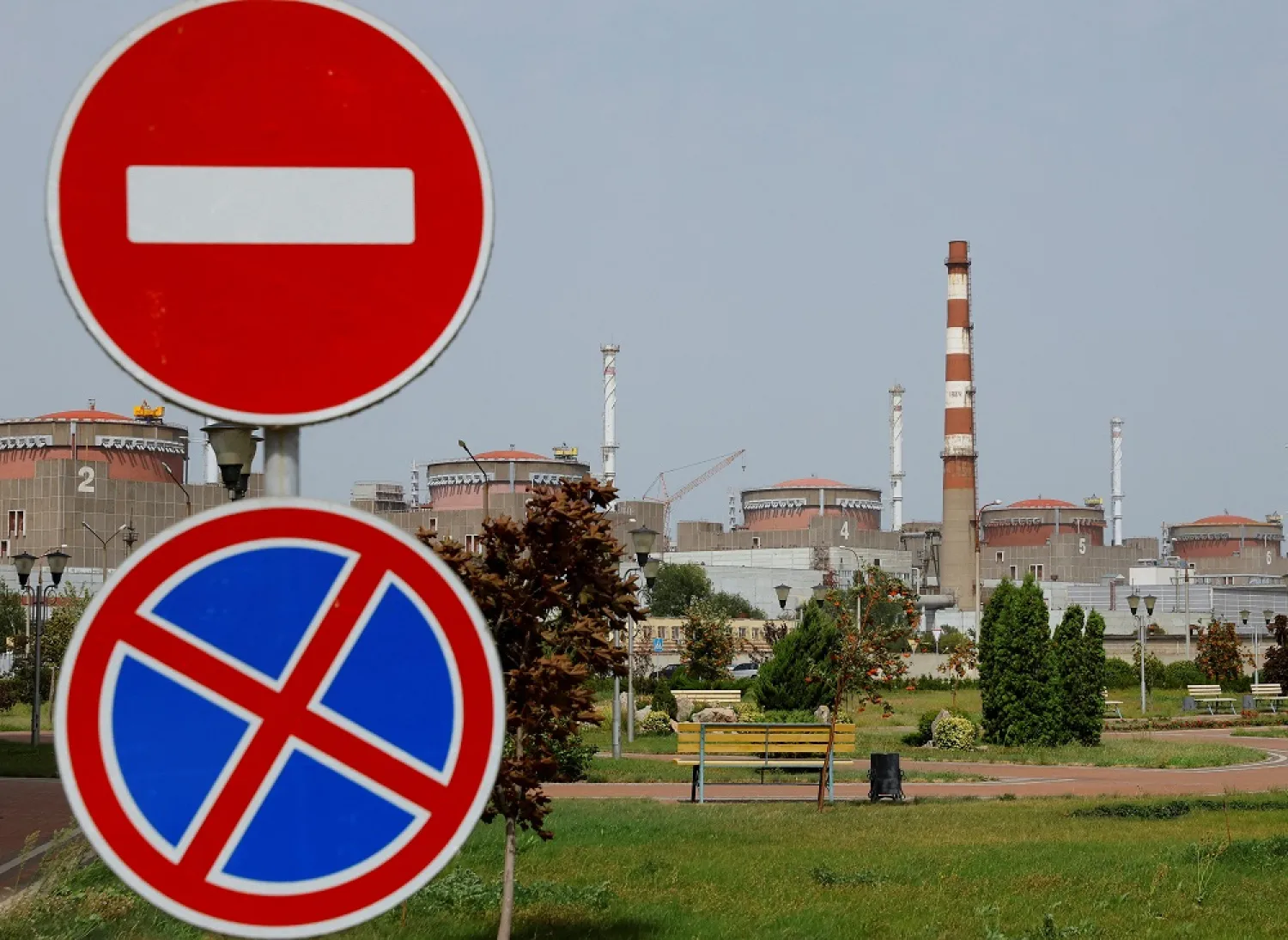

Fears of a Radiation Leak Mount Near Ukrainian Nuclear Plant

A view shows the Zaporizhzhia Nuclear Power Plant in the course of Ukraine-Russia conflict outside the Russian-controlled city of Enerhodar in Zaporizhzhia region, Ukraine August 22, 2022. (Reuters)
TT

Fears of a Radiation Leak Mount Near Ukrainian Nuclear Plant

A view shows the Zaporizhzhia Nuclear Power Plant in the course of Ukraine-Russia conflict outside the Russian-controlled city of Enerhodar in Zaporizhzhia region, Ukraine August 22, 2022. (Reuters)

Authorities began distributing iodine tablets to residents near Ukraine's Zaporizhzhia nuclear power plant Friday in case of a radiation leak, amid mounting fears that the fighting around the complex could trigger a catastrophe.

The move came a day after the plant was temporarily knocked offline because of what officials said was fire damage to a transmission line. The incident heightened dread of a nuclear disaster in a country still haunted by the 1986 explosion at Chernobyl.

Continued shelling was reported in the area overnight, and satellite images from Planet Labs showed fires burning around the complex — Europe's biggest nuclear plant — over the last several days.

Iodine tablets, which help block the absorption of radioactive iodine by the thyroid gland in a nuclear accident, were issued in the Ukrainian-controlled city of Zaporizhzhia, about 45 kilometers (27 miles) from the plant. A woman and her small daughter were among those receiving the pills.

The UN's atomic energy agency has been trying to send a team in to inspect and help secure the plant. Officials said preparations for the trip were underway, but it remained unclear when it might take place.

The Zaporizhzhia plant has been occupied by Russian forces and run by Ukrainian workers since the early days of the 6-month-old war. The two sides have repeatedly accused each other of shelling the site.

In Thursday's incident, Ukraine and Russia blamed one another for the transmission-line damage that knocked the plant off the power grid.

Exactly what went wrong was not clear, but Ukrainian President Volodymr Zelenskyy said the plant's emergency backup diesel generators had to be activated to supply electricity to operate the complex.

The plant requires power to run the reactors' vital cooling systems. A loss of cooling could lead to a nuclear meltdown.

Ukrenergo, Ukraine’s transmission system operator, reported Friday that two damaged main lines supplying the plant with electricity had resumed operation, ensuring a stable power supply.

The country's nuclear power agency, Energoatom, said the plant had been reconnected to the grid and was producing electricity “for Ukraine’s needs.”

“The nuclear workers of Zaporizhzhia power plant are real heroes! They tirelessly and firmly uphold the nuclear and radiation safety of Ukraine and the whole of Europe on their shoulders," the agency said in a statement.

Russia-installed officials in the Zaporizhzhia region, however, said that the plant was supplying electricity only to Russia-controlled areas of the country and not the rest of Ukraine.

Concerns about the site have reverberated across Europe.

French President Emmanuel Macron said a visit by the UN's International Atomic Energy Agency should be allowed to take place “very quickly,” warning: “Civilian nuclear power must not be an instrument of war.”

Lana Zerkal, an adviser to Ukraine's energy minister, told Ukrainian media that the logistics for an IAEA visit were still being worked out. Zerkal accused Russia of trying to sabotage the visit.

Ukraine has claimed Russia is using the plant as a shield by storing weapons there and launching attacks from around it. Moscow, for its part, accuses Ukraine of recklessly firing on the place.

Zaporizhzhia’s reactors are protected by thick, reinforced concrete containment domes that experts say can withstand an errant artillery shell. Many of the fears center instead on a possible loss of the cooling system, and also the risk that an attack on the cooling ponds where spent fuel rods are kept could scatter radioactive material.

Continued Russian shelling of Nikopol, a city across the Dnieper River from the Zaporizhzhia plant, damaged 10 houses, a school and a health care facility but caused no injuries, Dnipropetrovsk Gov. Valentyn Reznichenko said.



Trump Says Sending Hospital Boat to Greenland

US President Donald Trump (Reuters)
TT

Trump Says Sending Hospital Boat to Greenland

US President Donald Trump (Reuters)

US President Donald Trump said Saturday he was sending a hospital boat to Greenland, an autonomous Danish territory that he has long coveted and threatened to seize by force.

Trump's rhetoric has ratcheted up tensions between the United States and Denmark, while putting the global spotlight on the Arctic as he insists mineral-rich Greenland is vital for US and NATO security against Russia and China.

He said the boat would treat many "sick" people in Greenland, without providing any details on who he was referring to or the number of people the vessel would help.

"We are going to send a great hospital boat to Greenland to take care of the many people who are sick, and not being taken care of there," Trump wrote in a social media post.

"It's on the way!!!," he added, according to AFP.

The post on his Truth Social platform carried an apparent AI image that depicted the USNS Mercy -- an 894-foot (272-meter) vessel that is typically stationed in southern California -- sailing toward snowcapped mountains on the horizon.

It was unclear if that was the actual vessel being sent to Greenland.

Trump said in the post that the ship would be sent in coordination with Gov. Jeff Landry (R-LA), who was named as Trump's envoy to the Arctic island in December.

During Mardi Gras celebrations in New Orleans this month, Landry posted an image of himself and two men at one of the city's famous balls, holding a flag of Greenland together.

"Great to host some of the wonderful people of Greenland," he wrote.

Earlier this week Denmark's King Frederik X visited Greenland, where he has long enjoyed popularity, as anxieties mount over Trump's interest.

Trump backed off repeated threats to seize the territory last month, after striking a "framework" deal with NATO chief Mark Rutte to ensure greater US influence.


Ukraine Strikes Ballistic Missile Producer Deep Inside Russia, Kyiv Says

Ukrainian firefighters work at the scene of a recent multiple Russian drone strike on a gas station in Kramatorsk, Ukraine, 09 February 2026. (EPA)
TT

Ukraine Strikes Ballistic Missile Producer Deep Inside Russia, Kyiv Says

Ukrainian firefighters work at the scene of a recent multiple Russian drone strike on a gas station in Kramatorsk, Ukraine, 09 February 2026. (EPA)

Ukraine hit a Russian plant manufacturing ballistic missiles in a missile strike in the remote Udmurtia region, the Ukrainian General Staff said on Saturday.

Ukraine said its forces attacked the plant manufacturing Russian missiles, including the short-range Iskander and intercontinental Topol-M, in Votkinsk, east of Moscow and about 1,400 km (800 miles) from Ukraine.

It said in a statement on the Telegram messaging app that the Ukrainian forces used ‌domestically produced ground-launched ‌Flamingo cruise missiles. The attack caused ‌a fire ⁠on the site, ⁠the Ukrainian military said.

Alexander Brechalov, the governor of the Udmurtia region in Russia, had earlier said a site there had been attacked overnight with drones.

"There has been damage and injuries as a result," Brechalov said in a video posted on the Telegram ⁠app. He provided no other details.

The airport ‌in Udmurtia's main city, ‌Izhevsk, and those in cities in nearby regions suspended ‌operations, the civil aviation authority Rosaviatsiya said.

The unofficial Russian ‌Telegram channel SHOT, which often quotes contacts in the security services, said residents in Votkinsk reported hearing at least three explosions and the humming of drones.

Russia uses its ballistic ‌missiles to reinforce its drone attacks on the Ukrainian energy infrastructure, knocking out electricity ⁠and heating ⁠supplies for millions across Ukraine during the cold winter months.

Ukraine is increasingly targeting military and energy infrastructure deep inside Russia. Kyiv says that hitting the weapons producers and the energy system that fuels Russia's military is the best way to gain leverage over its bigger enemy as the war enters its fifth year next week.

The Ukrainian military said it also hit a gas processing plant in the Russian Samara region. Russian officials in the Samara region issued no report of such an attack.


Iranian Students Chant Anti-Government Slogans, as US Threats Loom

This video grab taken from UGC images posted on social media and verified by AFPTV teams in Paris on February 21, 2026, shows Iranians clashing near the Department of Aerospace Engineering of Sharif University in Tehran. (UGC / AFP)
TT

Iranian Students Chant Anti-Government Slogans, as US Threats Loom

This video grab taken from UGC images posted on social media and verified by AFPTV teams in Paris on February 21, 2026, shows Iranians clashing near the Department of Aerospace Engineering of Sharif University in Tehran. (UGC / AFP)

Iranian students chanted anti-government slogans and scuffled with counter-protesters on Saturday in the latest display of anger at the country's clerical leaders, who also face a US military build-up aimed at pressuring them into a nuclear deal.

The gatherings at universities, which were reported by both local and diaspora media outlets, followed a mass protest movement that was met with a government crackdown last month that left thousands dead.

The crackdown had prompted US President Donald Trump to threaten to intervene militarily, though the focus of his threats eventually shifted to Iran's nuclear program, which Western governments fear is aimed at producing a bomb.

The US and Iran recently resumed Oman-mediated talks aimed at securing a deal, but Washington has simultaneously increased its military presence in the region, dispatching two aircraft carriers, jets and weaponry to back its warnings.

Videos geolocated by AFP to Tehran's top engineering university showed fights breaking out in a crowd on Saturday as people shouted "bi sharaf", or "disgraceful" in Farsi.

Footage posted by the Persian-language TV channel Iran International, which is based outside the country, also showed a large crowd chanting anti-government slogans at Sharif University of Technology.

Iranians had reprised their protest slogans earlier this week to mark the 40th day since thousands of people were killed as a wave of demonstrations was peaking on January 8 and 9.

They gathered again at several universities in the capital on Saturday, local media reported.

The unrest first broke out in December over prolonged financial strain, but exploded into mass anti-government demonstrations that were suppressed in a violent crackdown by security forces.

The clerical authorities acknowledge more than 3,000 deaths, but say the violence was caused by "terrorist acts" fueled by Iran's enemies.

The US-based Human Rights Activists News Agency (HRANA), however, has recorded more than 7,000 killings in the crackdown, the vast majority protesters, though the toll may be far higher.

Iranian authorities had initially acknowledged the legitimacy of the protesters' economic demands, but as the movement took on an overtly anti-government tone, they accused archenemies the United States and Israel of whipping up "riots".

Local news outlet Fars said that what was supposed to be a "silent and peaceful sit-in" on Saturday of students commemorating those killed was disrupted by people chanting slogans including "death to the dictator" -- a reference to Iran's supreme leader.

A video posted by Fars showed a group chanting and waving Iranian flags facing off with a crowd wearing masks and being held back by men in suits.

Both groups were holding what appeared to be memorial photographs.

- Talks and threats -

Ever since the initial wave of protests, the United States and Iran have been trading threats of military action.

Trump sent the aircraft carrier USS Abraham Lincoln to the region, accompanied by a flotilla of 12 support ships, while a second carrier group attached to the USS Gerald R Ford is en route to the area via the Mediterranean.

The US has also redeployed dozens of other warplanes to the Middle East -- where it maintains several bases -- while boosting its land-based air defenses.

The build-up is aimed at pressuring Iran's authorities to cut a deal on the country's nuclear program, even as the two sides have pursued talks on the subject.

Iranian Foreign Minister Abbas Araghchi told US media this week that following the latest round of negotiations in Geneva, Iran would be submitting a draft proposal for an agreement, saying "in the next two, three days, that would be ready".

Araghchi also said the "US side has not asked for zero enrichment" of uranium, contradicting statements from American officials.

Trump had suggested on Thursday that "bad things" would happen if Tehran did not strike a deal within 10 days, a period which he subsequently extended to 15.

Iran denies it is trying to produce nuclear weapons and says its program is peaceful, but insists on its right to enrich uranium for civilian purposes.

The US media outlet Axios reported this week, citing an unnamed senior US official, that the US was prepared to consider a proposed deal that only permitted "small, token enrichment".

A previous round of nuclear diplomacy between the US and Iran last year was interrupted by Israel's surprise bombing campaign against country.

The United States ultimately joined its ally, striking key nuclear facilities before declaring a ceasefire.