Judicial Division Threatens to Close Probe into Beirut Deadly Port Explosion

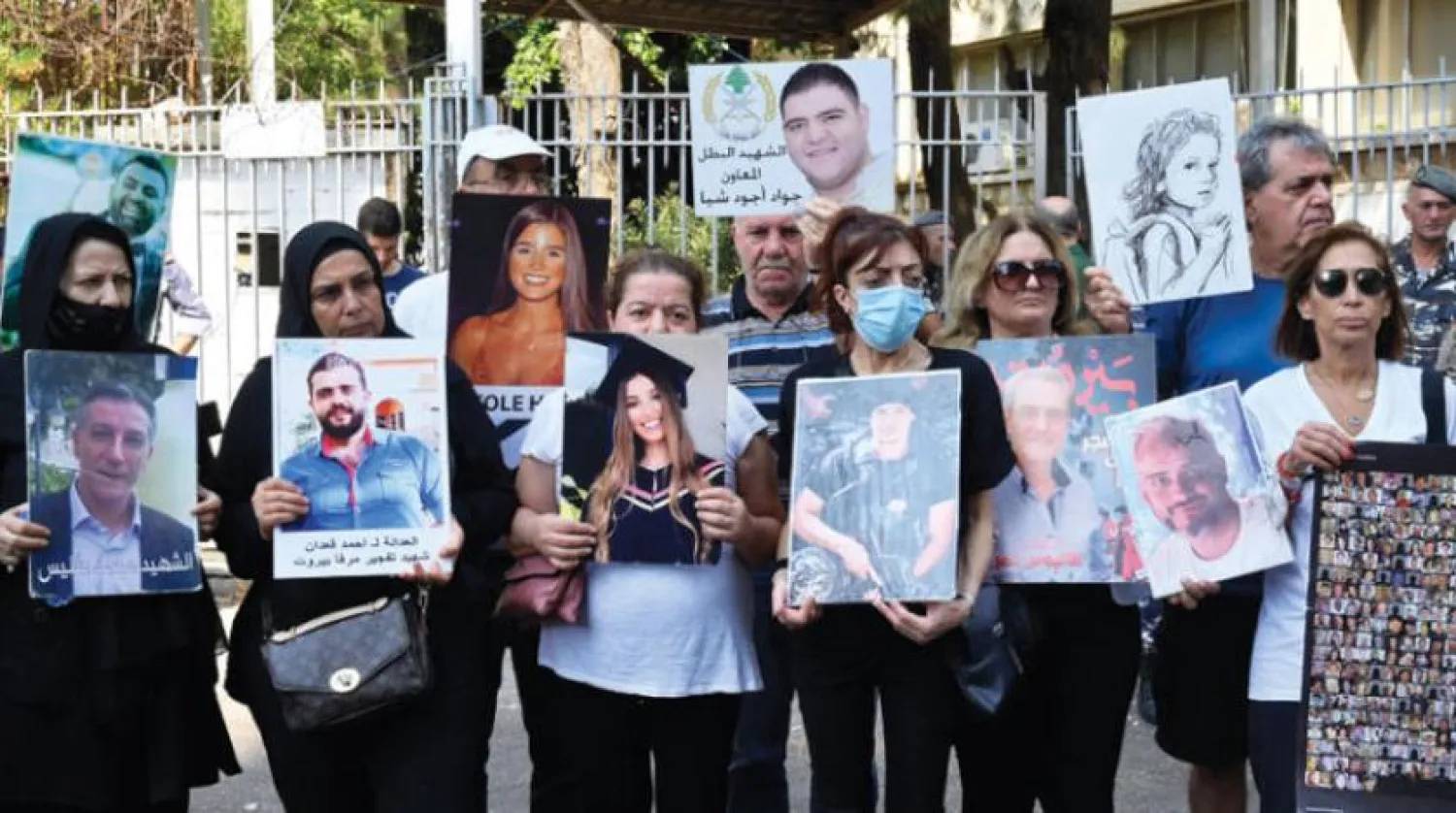
Relatives of some of the victims of the August 2020 Beirut port blast carry their pictures and banners during a protest outside the Justice Palace, in Beirut, Lebanon September 7, 2022 (EPA)
TT

Judicial Division Threatens to Close Probe into Beirut Deadly Port Explosion

Relatives of some of the victims of the August 2020 Beirut port blast carry their pictures and banners during a protest outside the Justice Palace, in Beirut, Lebanon September 7, 2022 (EPA)

Lebanese authorities, at the start of next week, will try to appoint a second judge to the stalled inquiry into the deadly August 2020 Beirut port blast, a move which is anticipated to further complicate the probe.

Judge Tarek Bitar's investigation into the 2020 explosion, which flattened swathes of the city when hundreds of tons of stored ammonium nitrate detonated, has been suspended since late 2021 by lawsuits brought by politicians whom he has sought to question.

Bitar has categorically rejected the decision to appoint a second judge.

Sources close to Bitar revealed to Asharq Al-Awsat that he is “working on developing a legal study that would enable him to resume investigations regardless of the lawsuits filed against him.”

“Bitar will take a legal position in the interest of the investigation, and just as the other team fabricated legal jurisprudence to appoint an additional judicial investigator, he will adopt a jurisprudence in line with the law and allow the resumption of his work,” sources added.

According to the sources, who spoke under the conditions of anonymity, Bitar will seek exhausting all means of legal confrontation.

“If legal means are inaccessible, then Bitar may consider resignation,” sources explained.

Relatives of some of the victims of the massive explosion, which killed at least 218 people, on Wednesday protested the judiciary’s plan to appoint a new judge to the official investigation.

They denounced the move as an attempt by the country’s political class to avoid justice.

William Noun, whose brother died in the blast, said: “The families of the victims want the investigations to be conducted again. We also want Judge Bitar to carry out his duties away from the political rivalries.”

“Lawyers are studying the decision to appoint a new investigator, and its negative repercussions on the course of justice,” a prominent lawyer told Asharq Al-Awsat.

“After more than two years of effort and fatigue, we will not accept wasting the truth,” added the lawyer, who preferred to remain anonymous.


Sudan's Prime Minister Takes His Peace Plan to the UN, but US Urges Humanitarian Truce Now

In this image grab taken from handout video footage released by the Sudanese paramilitary Rapid Support Forces (RSF) on April 23, 2023, fighters wave assault rifles as they cross a street in the East Nile district of greater Khartoum.  (Photo by Rapid Support Forces (RSF) / AFP)
In this image grab taken from handout video footage released by the Sudanese paramilitary Rapid Support Forces (RSF) on April 23, 2023, fighters wave assault rifles as they cross a street in the East Nile district of greater Khartoum. (Photo by Rapid Support Forces (RSF) / AFP)
TT

Sudan's Prime Minister Takes His Peace Plan to the UN, but US Urges Humanitarian Truce Now

In this image grab taken from handout video footage released by the Sudanese paramilitary Rapid Support Forces (RSF) on April 23, 2023, fighters wave assault rifles as they cross a street in the East Nile district of greater Khartoum.  (Photo by Rapid Support Forces (RSF) / AFP)
In this image grab taken from handout video footage released by the Sudanese paramilitary Rapid Support Forces (RSF) on April 23, 2023, fighters wave assault rifles as they cross a street in the East Nile district of greater Khartoum. (Photo by Rapid Support Forces (RSF) / AFP)

Sudan’s prime minister on Monday proposed a wide-ranging peace initiative to end a nearly 1,000-day war with a rival paramilitary force, but the United States urged both sides to accept the Trump administration’s call for an immediate humanitarian truce.

Kamil Idris, who heads Sudan’s transitional civilian government, told the Security Council his plan calls for a ceasefire monitored by the United Nations, African Union and Arab League, and the withdrawal of paramilitary forces from all areas they occupy, their placement in supervised camps and their disarmament, the Associated Press said.

Sudan plunged into chaos in April 2023 when a power struggle between the military and the powerful paramilitary Rapid Support Forces exploded into open fighting, with widespread mass killings and rapes, and ethnically motivated violence. This has amounted to war crimes and crimes against humanity, according to the UN and international rights groups.

It seemed highly unlikely the RSF would support the prime minister’s proposal, which would essentially give government forces a victory and take away their military power.

Idris stressed to the UN Security Council that the government’s proposal is “homemade -- not imposed on us.”

In early November, the Rapid Support Forces agreed to a humanitarian truce. At that time, a Sudanese military official told The Associated Press the army would only agree to a truce when the RSF completely withdraws from civilian areas and gives up their weapons — key provisions in the plan Idris put forward on Monday.

Idris said unless the paramilitary forces were confined to camps, a truce had “no chance for success.” He challenged the 15 members of the Security Council to back his proposal.

“This initiative can mark the moment when Sudan steps back from the edge and the international community — You! You! — stood on the right side of history," the Sudanese prime minister said. He said the council should “be remembered not as a witness to collapse, but as a partner in recovery.”

US deputy ambassador Jeffrey Bartos, who spoke to the council before Idris, said the Trump administration has offered a humanitarian truce as a way forward and “We urge both belligerents to accept this plan without preconditions immediately.”

Bartos said the Trump administration strongly condemns the horrific violence across Darfur and the Kordofan region — and the atrocities committed by both the Sudanese Armed Forces and the Rapid Support Forces, who must be held accountable.

The devastating war in Sudan has killed more than 40,000 people according to UN figures, but aid groups say the true number could be many times higher. The conflict has created the world’s largest humanitarian crisis, with over 14 million people displaced, disease outbreaks and famine spreading in parts of the country.


Netanyahu to Discuss Iran, Next Phase of Gaza Plan with Trump

Israeli Prime Minister Benjamin Netanyahu (C), Cypriot President Nikos Christodoulides (L) and Greek Prime Minister Kyriakos Mitsotakis (R) hold a joint press conference after a trilateral meeting at the Citadel of David Hotel in Jerusalem, 22 December 2025. EPA/ABIR SULTAN / POOL
TT

Netanyahu to Discuss Iran, Next Phase of Gaza Plan with Trump

Israeli Prime Minister Benjamin Netanyahu (C), Cypriot President Nikos Christodoulides (L) and Greek Prime Minister Kyriakos Mitsotakis (R) hold a joint press conference after a trilateral meeting at the Citadel of David Hotel in Jerusalem, 22 December 2025. EPA/ABIR SULTAN / POOL

Prime Minister Benjamin Netanyahu said on Monday he will discuss Iran's nuclear activities during his visit next week with US President Donald Trump.

Speaking at a joint press conference with Greek Prime Minister Kyriakos Mitsotakis and Cypriot President Nikos Christodoulides in Jerusalem, Netanyahu said Israel was aware Iran had been conducting "exercises" recently, without elaborating. Earlier on Monday, Iranian state media reported Iran had held missile drills in various cities during the day, the second such reported exercise in a ‌month.

Western powers regard ‌Iran's ballistic missile arsenal as both a conventional ‌military ⁠threat to Middle ‌East stability and a possible delivery mechanism for nuclear weapons should Tehran develop them. It denies any intent to build atomic bombs, Reuters reported.

Relations between eastern Mediterranean neighbors Israel, Greece and Cyprus have grown stronger over the past decade, with shared concerns over Türkiye’s influence in the region.

ISRAEL NOT SEEKING CONFRONTATION: NETANYAHU

Despite "great achievements" during a 12-day war with Iran in June, Netanyahu said basic Israeli and US ⁠expectations of Iran were unchanged, including lowering its uranium enrichment level.

"Obviously it will be an item ‌in our discussions," he said of his meeting ‍with Trump next week, adding, "We are ‍not seeking confrontation with" Iran but rather, "stability, prosperity and peace."

Still, Netanyahu said the ‍focus of his discussions with Trump in Washington will be on moving to the next phase of Trump's Gaza plan as well as dealing with Lebanon's Iran-based Hezbollah militants.

He cited Israel's "desire to see a stable sovereign Lebanon" and efforts to prevent the blocking of international shipping by Yemen's Iran-aligned Houthi forces.

Netanyahu, Mitsotakis and Christodoulides agreed to deepen security cooperation, while Netanyahu said the three ⁠countries intended to advance an initiative to connect India to Europe via the Middle East by sea and rail.

Christodoulides described the projects as offering a "southeastern gateway connecting Europe with the Middle East and beyond."

The three countries said they would seek to advance an undersea power cable project to integrate their electricity grids with Europe and the Arabian Peninsula.

Mitsotakis said Greece was a gateway for liquefied natural gas. "(It) is a new energy hub in southeastern Europe." Interconnection projects, he said, remained a key priority for the three countries.

Israeli Energy Minister Eli Cohen told Reuters after the press conference the trilateral meeting was important since it comes ‌when there are “countries that are working to uproot regional stability." He did not identify the countries.


Lebanon: Salam Urges Swift Approval of Law Aimed at Paying Back Depositors amid Objections

Lebanese Prime Minister Nawaf Salam. (Reuters)
TT

Lebanon: Salam Urges Swift Approval of Law Aimed at Paying Back Depositors amid Objections

Lebanese Prime Minister Nawaf Salam. (Reuters)

Lebanese Prime Minister Nawaf Salam urged cabinet to swiftly approve a draft law allowing depositors to gradually recover funds frozen in the banking system since a financial collapse in 2019, a move critical to reviving the economy.

The collapse - the result of decades of unsustainable financial policies, waste and corruption - led the state to default on its sovereign debt and sank the Lebanese pound.

The draft law marks the first time Beirut has put forward legislation aimed at addressing a vast funding shortfall - estimated at $70 billion in 2022 but now believed to be higher.

LAW AIMS TO BRING JUSTICE TO DEPOSITORS SAYS PM

The cabinet approved several articles on Monday. Discussions would continue on Tuesday, Information Minister Paul Morcos said. Lebanon's divided parliament must pass the law after cabinet approval.

Salam said the law is realistic and its goal is to ‌do "justice to depositors", ‌also spurring recovery in the banking sector.

Finance Minister Yassine Jaber told Reuters ‌implementation of ⁠the law would ‌boost the economy, pumping deposits of $3-$4 billion annually into the system.

REPAYMENTS DIFFER FOR SMALL, LARGE DEPOSITS

The draft, published on Friday, foresees repayments to small depositors – those with deposits valued at less than $100,000 – in monthly or quarterly instalments over four years.

Deposits larger than $100,000 will be repaid via tradable, asset-backed securities to be issued by the central bank or Banque du Liban (BDL), with no less than 2% of the value paid annually.

The maturity period will be set at 10 years for deposits valued at up to $1 million, at 15 years for deposits valued from $1 million to $5 million, and ⁠at 20 years for deposits valued at more than $5 million.

The securities will be backed by the income, revenues and returns of BDL-owned assets and ‌any proceeds from the sale of assets, if any occur. The ‍draft mentions precious metals, which have soared in value ‍this year, as one possible source of income.

It says commercial banks will bear 20% of the responsibility for ‍payments for the asset-backed securities. It says BDL and commercial banks will jointly finance the payments of the small deposits, with BDL's share not exceeding 60%.

Debt owed by the state to BDL will be converted into a bond whose maturity and interest rate would be agreed between the finance ministry and BDL.

The Association of Banks in Lebanon has objected to the draft, saying on Sunday that the proposals do not reflect banks' ability to meet "their obligations towards depositors" and that the state was not "fulfilling its outstanding debts to BDL".

UNANSWERED QUESTIONS

Mike Azar, an ⁠expert on the financial system, said the law appeared to be intentionally vague on politically sensitive but critical questions.

"For example, what happens if the BDL or the banks can’t pay what they owe to depositors," he said.

Swapping deposits for asset-backed securities issued by BDL could imply a big "contingent state debt," he said. The government has yet to provide quantitative analysis underpinning the plan, including deposit repayment amounts, sources of funding, and bank recapitalization needs, he added.

Jaber noted that the value of BDL's gold assets had risen with the price of gold since 2020, which would help provide confidence in the asset-backed securities.

The law requires an international auditing firm to evaluate BDL's assets within one month to determine the size of the funding shortfall. Banks must also conduct an asset quality review and recapitalize.

The law would write off some dollar deposits.

These would include deposits that resulted from funds being converted into dollars from pounds at ‌the official exchange rate long after it had collapsed as well as deposits containing illicit funds, in accordance with a law to counter money-laundering and financing for terrorism.