

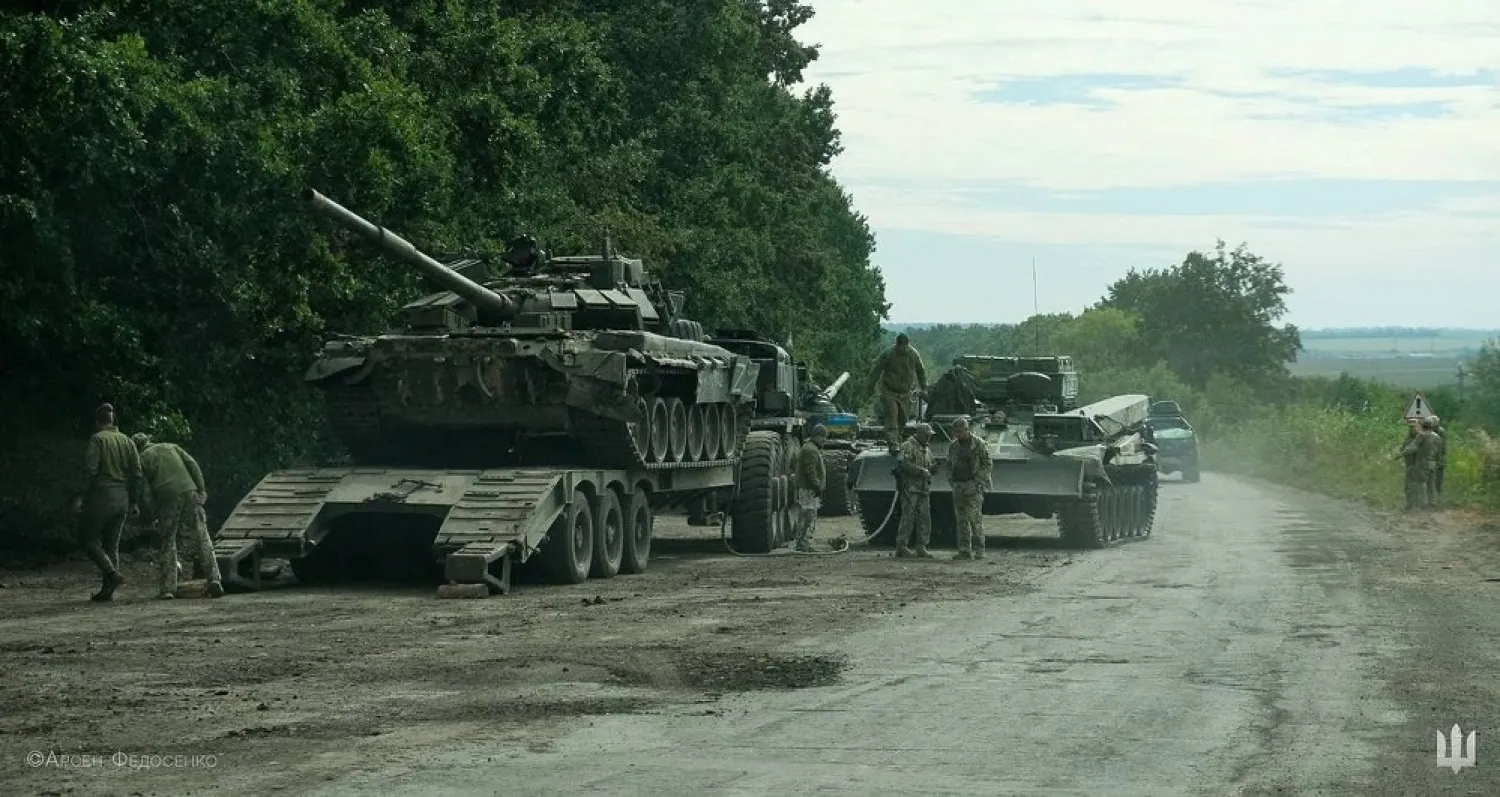

Russian Forces Retreat amid Ukrainian Counteroffensive

Ukrainian service members prepare to transport a Russian tank captured during a counteroffensive operation, amid Russia's attack on Ukraine, in Kharkiv region, Ukraine, in this handout picture released September 11, 2022. (Press service of the Commander-in-Chief of the Armed Forces of Ukraine/Handout via Reuters)
TT

Russian Forces Retreat amid Ukrainian Counteroffensive

Ukrainian service members prepare to transport a Russian tank captured during a counteroffensive operation, amid Russia's attack on Ukraine, in Kharkiv region, Ukraine, in this handout picture released September 11, 2022. (Press service of the Commander-in-Chief of the Armed Forces of Ukraine/Handout via Reuters)

Ukrainian troops on Sunday successfully pressed their swift counteroffensive in the northeastern part of the country, even as a nuclear power plant in the Russia-occupied south completely shut down in a bid to prevent a radiation disaster as fighting raged nearby.

Kyiv's action to reclaim Russia-occupied areas in the Kharkiv region forced Moscow to withdraw its troops to prevent them from being surrounded, leaving behind significant numbers of weapons and munitions in a hasty retreat as the war marked its 200th day on Sunday.

A jubilant Ukrainian President Volodymyr Zelenskyy mocked the Russians in a video address Saturday night, saying that "the Russian army in these days is demonstrating the best that it can do — showing its back."

He posted a video of Ukrainian soldiers hoisting the national flag over Chkalovske, another town reclaimed in the counteroffensive.

While most attention was focused on the counteroffensive, Ukraine's nuclear energy operator said the Zaporizhzhia nuclear power plant, Europe’s largest, was reconnected to Ukraine’s electricity grid, allowing engineers to shut down its last operational reactor to safeguard the plant amid the fighting.

The plant, one of the 10 biggest atomic power stations in the world, has been occupied by Russian forces since the early days of the war. Ukraine and Russia have traded blame for shelling around it.

Since a Sept. 5 fire caused by shelling knocked the plant off transmission lines, the reactor was powering crucial safety equipment in so-called "island mode" — an unreliable regime that left the plant increasingly vulnerable to a potential nuclear accident.

Russian President Vladimir Putin discussed the situation at the plant in a call Sunday with French President Emmanuel Macron, the Kremlin said.

Ukraine's military chief, Gen. Valerii Zaluzhnyy, announced that its forces had recaptured about 3,000 square kilometers (about 1,160 square miles) since the counteroffensive began in early September. He noted that Ukrainian troops are only 50 kilometers (about 30 miles) from the border with Russia.

Kharkiv Gov. Oleh Syniehubov said Ukrainian troops have reclaimed control of more than 40 settlements in the Kharkiv region, noting he couldn't give a precise number because the operation is still unfolding.

Defense Minister Anna Malyar said Ukrainian forces are firing shells containing propaganda into areas where they seek to advance.

"One of the ways of informational work with the enemy in areas where there is no Internet is launching propaganda shells," she wrote on Facebook. "Before moving forward, our defenders say hello to the Russian invaders and give them the last opportunity to surrender. Otherwise, only death awaits them on Ukrainian soil."

The Russian pullback marked the biggest battlefield success for Ukrainian forces since they thwarted a Russian attempt to seize the capital, Kyiv, at the start of the nearly seven-month war. The Kharkiv campaign came as a surprise for Moscow, which had relocated many of its troops from the region to the south in expectation of a counteroffensive there.

In an awkward attempt to save face, the Russian Defense Ministry said Saturday the troops' withdrawal from Izyum and other areas was intended to strengthen Moscow's forces in the neighboring Donetsk region to the south.

The explanation sounded similar to the justification Russia gave for pulling back from the Kyiv region earlier this year when they failed to take the capital.

The Russian forces around Izyum have been key for Moscow's effort to capture the Donetsk region, and their pullback will dramatically weaken its capability to press its offensive on Ukrainian strongholds of Sloviansk and Kramatorsk to the south.

A map released by the Russian Defense Ministry on Sunday showed its forces retreating to a narrow patch of land along the border.

Igor Strelkov, who led Russia-backed forces when the separatist conflict in the Donbas erupted in 2014, mocked the Russian Defense Ministry's explanation of the retreat, suggesting that handing over Russia's own territory near the border was a "contribution to a Ukrainian settlement."

The retreat drew an angry response from Russian military bloggers and nationalist commentators, who bemoaned it as a major defeat and urged the Kremlin to step up its war efforts. Many scathingly criticized Russian authorities for continuing with fireworks and other lavish festivities in Moscow that marked a city holiday on Saturday despite the debacle in Ukraine.

Just as the Russian forces were hastily pulling back from Izyum under Ukrainian fire on Saturday, Putin attended the opening of a huge Ferris wheel at a Moscow park, although it reportedly closed for repairs soon thereafter. He also inaugurated a new transport link and a sports arena.

The action underlined the Kremlin's narrative that the war it calls a "special military operation" was going according to plan without affecting Russians' everyday lives.

Pro-Kremlin political analyst Sergei Markov criticized the Moscow festivities as a grave mistake.

"The fireworks in Moscow on a tragic day of Russia’s military defeat will have extremely serious political consequences," Markov wrote on his messaging app channel. "Authorities mustn’t celebrate when people are mourning."

In a sign of a potential rift in the Russian leadership, Ramzan Kadyrov, the Kremlin-backed head of Chechnya, said the retreat resulted from blunders by the Russian military leadership.

"They have made mistakes and I think they will draw the necessary conclusions," Kadyrov said. "If they don’t make changes in the strategy of conducting the special military operation in the next day or two, I will be forced to contact the leadership of the Defense Ministry and the leadership of the country to explain the real situation on the ground."

Despite Ukraine’s gains, US Secretary of State Antony Blinken and the head of NATO warned Friday the war would likely drag on for months. Blinken said the conflict was entering a critical period and urged the West to keep supporting Ukraine through what could be a difficult winter.

The US and its NATO allies have been working to make sure that Ukrainian forces have "the things that they most need right on the moment," said Sen. Tim Kaine, a Virginia Democrat on the Senate Foreign Relations Committee.

"And we are seeing the Ukrainians with a tremendous patriotic resolve -- but also after eight years of joint training with the US military, going back to 2014 with the Crimea invasion -- we’re seeing the combined effect of collaborative training and resources that are right on time right at the moment, showing that Vladimir Putin’s grandiose dissolutions about what he might do in Ukraine are hollow and they’re failing," he told CNN.



US Intelligence Indicates Putin's War Aims in Ukraine are Unchanged

TOPSHOT - Russia's President Vladimir Putin gestures as he speaks during his annual end-of-year press conference, in Moscow, on December 19, 2025.  (Photo by Alexander NEMENOV / AFP)
TOPSHOT - Russia's President Vladimir Putin gestures as he speaks during his annual end-of-year press conference, in Moscow, on December 19, 2025. (Photo by Alexander NEMENOV / AFP)
TT

US Intelligence Indicates Putin's War Aims in Ukraine are Unchanged

TOPSHOT - Russia's President Vladimir Putin gestures as he speaks during his annual end-of-year press conference, in Moscow, on December 19, 2025.  (Photo by Alexander NEMENOV / AFP)
TOPSHOT - Russia's President Vladimir Putin gestures as he speaks during his annual end-of-year press conference, in Moscow, on December 19, 2025. (Photo by Alexander NEMENOV / AFP)

US intelligence reports continue to warn that Russian President Vladimir Putin has not abandoned his aims of capturing all of Ukraine and reclaiming parts of Europe that belonged to the former Soviet empire, six sources familiar with US intelligence said, even as negotiators seek an end to the war that would leave Russia with far less territory.
The reports present a starkly different picture from that painted by US President Donald Trump and his Ukraine peace negotiators, who have said Putin wants to end the conflict. The most recent of the reports dates from late September, according to one of the sources.
The intelligence also contradicts the Russian leader’s denials that he is a threat to Europe.
The US findings have been consistent since Putin launched his full-scale invasion in 2022. They largely align with the views of European leaders and spy agencies that he covets all of Ukraine and territories of former Soviet bloc states, including members of the NATO alliance, according to the sources.
"The intelligence has always been that Putin wants more," Mike Quigley, a Democratic member of the House Intelligence Committee, said in a Reuters ‌interview. "The Europeans are convinced ‌of it. The Poles are absolutely convinced of it. The Baltics think they're first.”
Russia controls about 20% ‌of ⁠Ukraine’s territory, including the bulk ‌of Luhansk and Donetsk, the provinces that comprise the industrial heartland of the Donbas, parts of Zaporizhzhia and Kherson provinces and Crimea, the strategic Black Sea peninsula.
Putin claims Crimea and all four provinces as belonging to Russia. Trump is pressuring Kyiv to withdraw its forces from the small part of Donetsk they control as part of a proposed peace deal, according to two sources familiar with the matter, a demand that Ukrainian President Volodymyr Zelenskiy and most Ukrainians reject.
“The president’s team has made tremendous progress with respect to ending the war" and Trump has stated that a peace deal "is closer than ever before," said a White House official without addressing the intelligence reports.
In an X post on Saturday, Director of National Intelligence Tulsi Gabbard said intelligence officers have briefed lawmakers that "Russia seeks to avoid a larger war with Europe" and that its ⁠troops' performance in Ukraine shows it currently lacks the capacity to overrun "all of Ukraine, let alone Europe."
The Office of the Director of National Intelligence, the CIA and the Russian embassy did not immediately respond ‌to requests for comment.
PROGRESS ON SECURITY GUARANTEES
Trump’s negotiators - his son-in-law Jared Kushner and billionaire real estate developer ‍Steve Witkoff - have for weeks been negotiating the 20-point peace plan with ‍Ukrainian, Russian and European officials.
While US officials say they have made progress, major differences remain on the issues of territory.
Kushner and Witkoff were meeting on ‍Friday with Ukrainian negotiators in Miami and were to hold talks with Russian representatives this weekend, said a White House official.
US, Ukrainian and European negotiators reached a broad consensus on Monday in talks in Berlin on what four European diplomats and the two sources familiar with the matter said are robust US-backed guarantees of Ukraine’s security against future Russian aggression.
One source and a diplomat said that those guarantees hinge on Zelenskiy agreeing to cede territory to Russia. But other diplomats said that was not the case and alternatives were still being examined as Zelenskiy has ruled out ceding territory.
The diplomats said the guarantees, which would take effect after the signing of a peace agreement, call for the deployment of a mostly European security force in neighboring countries and in Ukraine away from the ⁠front lines to aid in repulsing any future Russian attack.
Ukraine's military would be capped at 800,000, said the source. But several diplomats said Russia seeks a lower cap to which the Americans are open.
The US would provide intelligence and other support, and the package would be ratified by the US Senate, they said. According to two sources familiar with the talks, Washington's plan would also include US-backed air patrols over Ukraine.
Zelenskiy on Thursday appeared cautious on the proposals, saying "There's a question I still can't get an answer to: What will these security guarantees actually do?"
And it is deeply uncertain whether Putin will agree to such guarantees as he has repeatedly rejected the deployment of foreign troops in Ukraine.
RUSSIA STILL PUSHING TERRITORIAL DEMANDS
Putin on Friday offered no compromises, although he told an annual news conference that he was ready to discuss peace.
He said his terms would have to be met as his forces have advanced 6,000 square km (2,300 square miles) this year.
It is unclear how US officials have responded to Putin's demands. Witkoff has previously suggested that Russia has a right to claim the four provinces and Crimea.
Some Trump administration officials have acknowledged that Putin may be unwilling to settle for less than his initial goal of conquering Ukraine.
"I don't know if Putin wants to do a deal or Putin wants to take ‌the whole country. These are things that he has said openly," Secretary of State Marco Rubio said on Friday at a press conference.
"We know what they wanted to achieve initially when the war began. They haven't achieved those objectives."


US Again Seizes Oil Tanker Off Coast of Venezuela

US Homeland Security Secretary Kristi Noem confirmed Washington had seized a second crude oil tanker in international waters off the coast of Venezuela. Handout / US Secretary of Homeland Security Kristi Noem's X account/AFP
TT

US Again Seizes Oil Tanker Off Coast of Venezuela

US Homeland Security Secretary Kristi Noem confirmed Washington had seized a second crude oil tanker in international waters off the coast of Venezuela. Handout / US Secretary of Homeland Security Kristi Noem's X account/AFP

The United States "apprehended" an oil tanker off Venezuela on Saturday, a move Caracas deemed a "theft and kidnapping," in the latest salvo of a pressure campaign by Washington, the US government said.

It was the second time in two weeks that US forces have interdicted a tanker in the region, and comes days after President Donald Trump announced a blockade of "sanctioned oil vessels" heading to and leaving Venezuela.

"In a pre-dawn action early this morning on Dec. 20, the US Coast Guard with the support of the Department of War apprehended an oil tanker that was last docked in Venezuela," US Homeland Security chief Kristi Noem said in a post on X.

The post was accompanied by a nearly eight-minute video of aerial footage that showed a helicopter hovering just above the deck of a large tanker at sea.

Caracas slammed the seizure as theft and kidnapping, saying "those responsible for these serious events will answer to justice and to history for their criminal conduct."

A post from Homeland Security identified the vessel as the Centuries and said it was "suspected of carrying oil subject to US sanctions."

Centuries is a Chinese-owned, Panama-flagged oil tanker, according to TankerTrackers, an online service monitoring oil shipments and storage.

It said that Centuries loaded 1.8 million barrels of crude oil at a Venezuelan port earlier this month before being escorted out of Venezuela's exclusive economic zone on December 18. The VesselFinder database also listed the ship's last recorded location as off the Venezuelan coast.

An AFP review found that Centuries does not appear on the US Treasury Department's list of sanctioned companies and individuals.

White House deputy spokeswoman Anna Kelly said in a post on X the tanker "contained sanctioned PDVSA oil," in reference to Venezuela's state oil company, and charged the ship as being "a falsely flagged vessel operating as part of the Venezuelan shadow fleet."

'Waging a battle against lies'

On December 10, US forces seized a large oil tanker off the coast of Venezuela, which the attorney general said was involved in carrying sanctioned oil from Venezuela to Iran.

The United States has for months been building a major military deployment in the Caribbean with the stated goal of combatting Latin American drug trafficking, but taking particular aim at Venezuela.

Venezuelan Defense Minister Vladimir Padrino Lopez voiced defiance in comments at a public event in Caracas broadcast Saturday on state TV -- although he made no mention of the interdicted ship.

"We are waging a battle against lies, manipulation, interference, military threats, and psychological warfare," the defense minister said, adding "that will not intimidate us."

Venezuelan Foreign Minister Yvan Gil also said Iran, one of Caracas's largest international allies, was offering support "in all areas" to combat "piracy and international terrorism" by the United States.

There are currently 11 US warships in the Caribbean: the world's largest aircraft carrier, an amphibious assault ship, two amphibious transport dock ships, two cruisers and five destroyers.

Caracas views the operation as a campaign to push out leftist strongman Nicolas Maduro -- whom Washington and many nations view as an illegitimate president -- and to "steal" Venezuelan oil.

The US military has also conducted a series of air strikes on alleged drug trafficking boats in the Caribbean Sea and eastern Pacific Ocean since September. Critics have questioned the legality of the attacks, which have killed more than 100 people.

The ship interception occurred as South American leaders gathered for a summit of the Mercosur bloc, where tensions over suspended member Venezuela overshadowed discussions of a future trade deal with the European Union.

At the gathering, Brazilian President Luiz Inacio Lula da Silva clashed with his Argentinian counterpart Javier Milei, arguing that an outbreak armed conflict over Venezuela could cause a "humanitarian catastrophe."

Milei, a Trump ally, countered by saying Argentina "welcomes the pressure from the United States and Donald Trump to free the Venezuelan people."


Thai Border Clashes Displace over Half a Million in Cambodia

A village security volunteer splashes water to control a fire at a house after what a Thai soldier said was a Cambodian artillery strike in the area in Sisaket province, Thailand, Sunday, Dec. 14, 2025. (AP Photo/Sakchai Lalit)
TT

Thai Border Clashes Displace over Half a Million in Cambodia

A village security volunteer splashes water to control a fire at a house after what a Thai soldier said was a Cambodian artillery strike in the area in Sisaket province, Thailand, Sunday, Dec. 14, 2025. (AP Photo/Sakchai Lalit)

More than half a million people in Cambodia have been displaced from their homes by two weeks of deadly border clashes with neighboring Thailand, Phnom Penh's interior ministry said Sunday.

The renewed fighting between the Southeast Asian neighbors this month, including with tanks, drones and artillery, has killed at least 22 people in Thailand and 19 in Cambodia, according to officials.

The conflict stems from a territorial dispute over the colonial-era demarcation of their 800-kilometer (500-mile) border and a smattering of ancient temple ruins situated on the frontier.

"At present, more than half a million Cambodian people, including women and children, are suffering severe hardship due to forced displacement from their homes and schools to escape artillery shells, rockets, and aerial bombardments carried out by Thailand's F-16 aircraft," Cambodia's interior ministry said in a statement, giving the total number of people evacuated as 518,611.

Around 400,000 people have been displaced in Thailand due to the reignited border conflict, Bangkok has said.

Each side has blamed the other for instigating the fresh fighting and traded accusations of attacks on civilians, after five days of clashes in July killed dozens, AFP said.

The United States, China and Malaysia brokered a truce to end that round of fighting, but the ceasefire was short-lived.

Border temple clashes

In October, US President Donald Trump backed a follow-on joint declaration between Thailand and Cambodia, touting new trade deals after they agreed in Kuala Lumpur to prolong their truce.

But Thailand suspended the agreement the following month, after Thai soldiers were wounded by landmines while on patrol at the border.

Bangkok has accused Cambodia of laying fresh mines, an allegation denied by Phnom Penh.

Trump, who has placed the conflict between Cambodia and Thailand on a list of wars he said he solved, this month claimed the two countries had agreed to a new ceasefire.

But Bangkok denied any truce had been agreed, and fighting has continued daily since a border skirmish on December 7 sparked the latest clashes.

US Secretary of State Marco Rubio said on Friday that Washington was hoping Cambodia and Thailand would reach a new ceasefire by Monday or Tuesday.

Foreign ministers of ASEAN nations, including Cambodia and Thailand, are set to meet on Monday in Kuala Lumpur for talks aimed at finding a diplomatic solution.

China sent its special envoy for Asian affairs to Cambodia and Thailand last week, with Beijing aiming to "rebuild peace".

Cambodia's foreign ministry said in a statement on Saturday that the Chinese envoy, Deng Xijun, met with Prime Minister Hun Manet in Phnom Penh the day before, urging a truce.

Cambodia, which is outgunned and outspent by Bangkok's military, said Sunday that Thai forces had continued to attack since dawn, with fighting occurring on the border near the 900-year-old Preah Vihear temple.

A patch of contested land next to the UNESCO-listed heritage site was the site of military clashes in 2008, and sporadic violence for several years led to the deaths of two dozen people.

A UN court ruling in Phnom Penh's favor in 2013 settled the matter for more than a decade, but this year's crisis erupted in May when a Cambodian soldier was killed in a new clash.