


Iran President Defiant as 8 Reported Dead in Protests over Woman’s Death

A picture obtained by AFP outside Iran shows a bin burning in the middle of an intersection during a protest for Mahsa Amini, a woman who died after being arrested by the country's "morality police", in Tehran on September 20, 2022. (AFP)
TT

Iran President Defiant as 8 Reported Dead in Protests over Woman’s Death

A picture obtained by AFP outside Iran shows a bin burning in the middle of an intersection during a protest for Mahsa Amini, a woman who died after being arrested by the country's "morality police", in Tehran on September 20, 2022. (AFP)

Iran's president on Wednesday accused the West of hypocrisy in its criticism of Tehran as eight people were reported dead in growing protests over the death of a young woman arrested by morality police.

President Ebrahim Raisi struck a defiant tone on a visit to the United Nations, with demonstrators also trailing him on the streets of New York and dissidents filing a human rights lawsuit against the hardline cleric.

Public anger has flared in the country since authorities on Friday announced the death of 22-year-old Mahsa Amini, who had been held for allegedly wearing a hijab headscarf in an "improper" way.

Activists said the woman, whose Kurdish first name is Jhina, had suffered a fatal blow to the head, a claim denied by officials, who have announced an investigation.

Some women demonstrators have defiantly taken off their hijabs and burned them in bonfires or symbolically cut their hair before cheering crowds, video footage spread on social media has shown.

"No to the headscarf, no to the turban, yes to freedom and equality!" protesters in Tehran were heard chanting in a rally that has been echoed by solidarity protests abroad.

Iranian state media reported Wednesday that, in a fifth night of street rallies that had spread to 15 cities, police used tear gas and made arrests to disperse crowds of up to 1,000 people.

London-based rights group Article 19 said it was "deeply concerned by reports of the unlawful use of force by Iranian police and security forces," including the use of live ammunition.

Demonstrators hurled stones at security forces, set fire to police vehicles and garbage bins and chanted anti-government slogans, the official IRNA news agency said, adding that rallies were held in cities including Mashhad, Tabriz, Isfahan and Shiraz.

"Death to the dictator" and "Woman, life, freedom," protesters could be heard shouting in video footage that spread beyond Iran, despite online restrictions reported by internet access monitor Netblocks.

At the United Nations, British Foreign Secretary James Cleverly told AFP that "the Iranian leadership should notice that the people are unhappy with the direction that they have taken."

"They could abandon their nuclear weapons aspirations. They could stop the repression of voices within their own country. They could stop their destabilizing activities," he said.

"A different path is possible. That is the path that we want Iran to take and that is the path that will see them with a stronger economy, a more happy society and a more active part in the international community."

'Double standards'
Raisi, addressing the UN General Assembly, pointed to the deaths of Indigenous women in Canada as well as Israeli actions in the Palestinian territories and the ISIS' group's "savagery" against women from religious minority groups.

"So long as we have this double standard, where attention is solely focused on one side and not all equally, we will not have true justice and fairness," Raisi said.

He also pushed back on Western terms to revive a 2015 nuclear accord, insisting that Iran "is not seeking to build or obtain nuclear weapons and such weapons have no place in our doctrine."

But attention has quickly shifted to the protests, which are among the most serious in Iran since November 2019 unrest over fuel price rises.

French President Emmanuel Macron said he asked Raisi in a meeting Tuesday to show "respect for women's rights."

'Significant shock'

The wave of protests over Amini's death "is a very significant shock, it is a societal crisis," said Iran expert David Rigoulet-Roze of the French Institute for International and Strategic Affairs.

"It is difficult to know the outcome but there is a disconnect between the authorities with their DNA of the revolution of 1979 and an increasingly secularized society," he said.

"It is a whole social project that is being called into question. There is a hesitation among the authorities on the way forward with regard to this movement."

Protests first erupted Friday in Amini's home province of Kurdistan, where governor Ismail Zarei Koosha said Tuesday three people had been killed in "a plot by the enemy."

Kurdistan police commander Ali Azadi on Wednesday announced the death of another person, according to Tasnim news agency.

Two more protesters "were killed during the riots" in Kermanshah province, the region's prosecutor Shahram Karami was quoted as saying by Fars news agency, blaming "counter-revolutionary agents."

Additionally, Norway-based Kurdish rights group Hengaw said two protesters, aged 16 and 23, had been killed overnight in West Azerbaijan province.

An additional 450 people had been wounded and 500 arrested, the group said -- figures that could not be independently verified.

Video spread online showing security forces opening fire on protesters in the southern city of Shiraz.
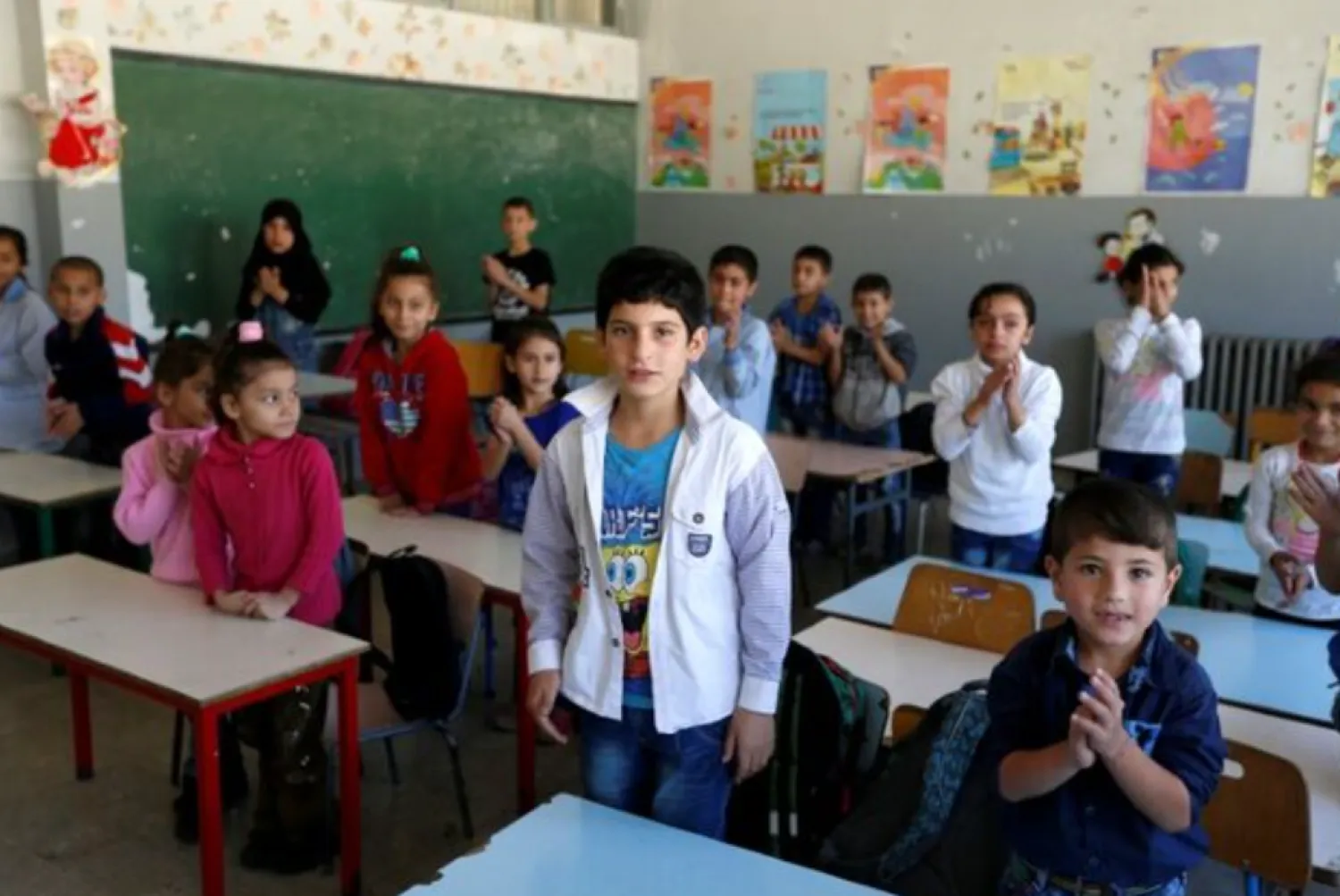



UN Says 5.8 mn Refugee Children Out of School

Syrian refugee children attend a class at a school in Mount Lebanon, October 7, 2016. REUTERS/Mohamed Azaki
TT

UN Says 5.8 mn Refugee Children Out of School

Syrian refugee children attend a class at a school in Mount Lebanon, October 7, 2016. REUTERS/Mohamed Azaki

Some 5.8 million refugee children were out of school in 2025, the United Nations said Friday, warning that funding cuts threatened to make the situation worse.

UNHCR, the UN refugee agency, said 44 percent of the world's 13.1 million school-age refugee children were out of school last year.

"Education is protection. But it is also a pathway to opportunity and self-reliance," said Barham Salih, the UN high commissioner for refugees, AFP reported.

"At a time of severe pressure on humanitarian and development financing, cuts to education risk reversing decades of collective investment and closing opportunities for a generation of young people."

The former Iraqi president, who was a refugee, said that looking back on his own life, "education gave me opportunities that displacement might otherwise have denied me".

"Displacement should not determine the limits of a child's life."

UNHCR said that while 65 percent of refugee children of primary school age were enrolled in education in 2025, only 32 percent were enrolled in secondary.

Refugee tertiary education enrolment reached a record 11 percent in 2025.

Earlier this week, UNHCR said its available funding had fallen from $5.2 billion in 2024 to $3.9 billion in 2025, while the number of people it is mandated to protect is hovering around historically high levels.

UNHCR said it needed $8.5 billion this year to protect refugees, but by the end of July had received only 32 percent of that amount ($2.7 billion).

UNHCR said nearly 8.3 million refugees and other forcibly displaced people faced losing vital assistance from the agency as protection services crumble due to the "severe" funding cuts.


Iran: Strait of Hormuz Will Not Reopen Until Conditions Are Met

Iran: Strait of Hormuz Will Not Reopen Until Conditions Are Met
TT

Iran: Strait of Hormuz Will Not Reopen Until Conditions Are Met

Iran: Strait of Hormuz Will Not Reopen Until Conditions Are Met

The Strait of Hormuz will not reopen until seven Iranian conditions set out in a June interim agreement with the US are met, Nournews reported Iran's parliament speaker Mohammad Baqer Qalibaf as saying on Sunday, a few days after Tehran received Washington's reply to its diplomatic proposal.

“The Americans, who say something different in the media, have recently put forward proposals through a mediator. ⁠But they must understand that ⁠the period of dragging out the process and dictating one-sided demands is over," Qalibaf was quoted as saying.

"The position of the Islamic Republic of Iran is completely clear and firm, and the Strait of Hormuz ⁠will not be opened until our seven conditions, based on the Islamabad Memorandum of Understanding, are met."

Meanwhile, army spokesperson Mohammad Akraminia told Fars news on Sunday that Iran will upgrade the range of its missiles following the war with the US as American forces are now ⁠positioned as much ⁠as 1,000 km (621 miles) away from the Iranian ⁠coast.

"During this war, we concluded that we absolutely must increase the ⁠range of ⁠our missiles, and we have now moved in that direction," he said.


Iran Tells US There is No Military Solution to Mideast War

(FILES) Vehicles drive past a giant billboard reading 'The Strait of Hormuz remains closed' at the Revolution Square in Tehran on April 28, 2026. (Photo by ATTA KENARE / AFP)
TT

Iran Tells US There is No Military Solution to Mideast War

(FILES) Vehicles drive past a giant billboard reading 'The Strait of Hormuz remains closed' at the Revolution Square in Tehran on April 28, 2026. (Photo by ATTA KENARE / AFP)

Iran's top diplomat insisted on Sunday that there would be no military solution to the United States' war against Iran, with talks on ending the conflict apparently at an impasse.

A campaign of heavy bombardment failed to bring a decisive close to the war launched by the US and Israel in late February, and Washington in recent weeks has dialed back military operations in favor of economic pressure.

The main point of contention remains Iran's attempt to blockade the Strait of Hormuz where a UK maritime agency reported on Sunday another tanker struck by an unknown projectile.

"If our enemies again choose the path of military confrontation, our response will be stronger than before, and we will defend ourselves with even more force," Iranian Foreign Minister Abbas Araghchi said at a gathering of foreign ambassadors.

"There is no military solution, nor any solution based on new sanctions," he continued, adding "only negotiations based on justice and fairness" could end the conflict.

The two sides agreed a memorandum of understanding in June that spelled out a framework for a permanent resolution, but Iranian attacks on vessels in the Hormuz prompted a return to US military operations.

On Sunday, the British maritime security agency UKMTO said a tanker in the Hormuz "reported being struck by an unknown projectile, causing damage to the engine room", though the crew were reported safe and no environmental impact was recorded.

The agency did not specify the date of the incident, the vessel's origin or destination, or whether it was an oil tanker or LNG carrier.

Iranian and US officials last week held indirect talks on the sidelines of the UN General Assembly, with Tehran saying it presented seven conditions for reopening the strait.

Iran has demanded, among other things, a ceasefire across the Middle East, the unfreezing of its assets abroad, the lifting of sanctions on its oil sector and an end to the US naval blockade.

Trump, however, rejected the proposal, while leaving the door open both to further talks or renewed military operations.

Iranian foreign ministry spokesman Esmaeil Baqaei on Sunday characterized the latest US counterproposal as being "in line with their previous proposals concerning nuclear issues".

"We have clearly indicated that we are focusing on the issue of the Strait of Hormuz," he said, adding that reopening the waterway required "an end to the disruptions to Iranian commercial maritime traffic and the lifting of sanctions".