
Turkish Opposition Calls New Media Law ‘Censorship’, Will Appeal to Top Court

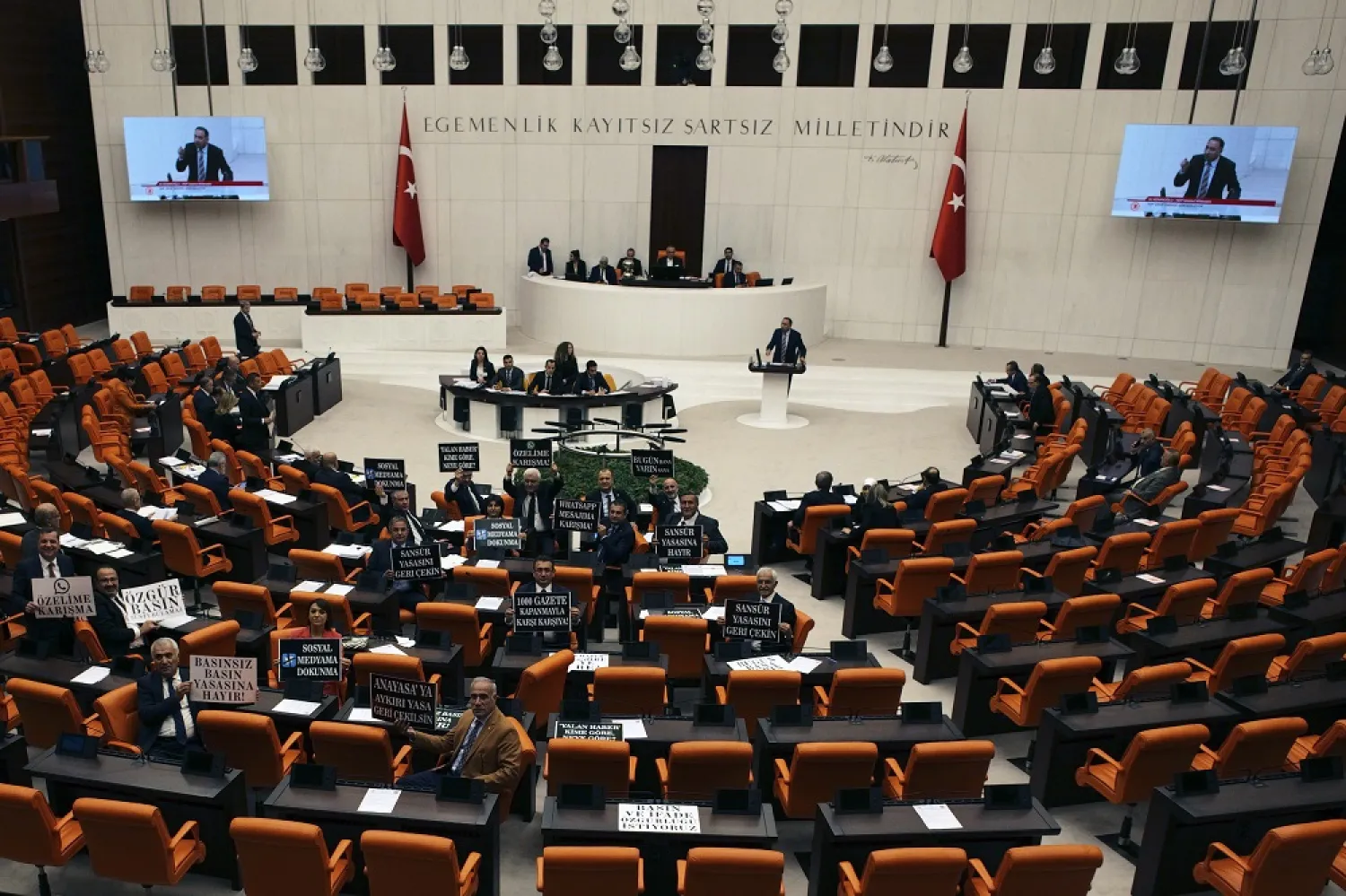
Lawmakers from Türkiye's main opposition Republican People's Party hold up placards protesting against the passing of a new bill at the parliament, in Ankara, Türkiye, Tuesday, Oct. 11, 2022. (AP)
TT

Turkish Opposition Calls New Media Law ‘Censorship’, Will Appeal to Top Court

Lawmakers from Türkiye's main opposition Republican People's Party hold up placards protesting against the passing of a new bill at the parliament, in Ankara, Türkiye, Tuesday, Oct. 11, 2022. (AP)

Türkiye’s main opposition group said on Friday it would ask the top court to throw out new media legislation that would jail people for spreading "misinformation", calling the measures unprecedented censorship.

Parliament adopted the law late on Thursday after it was proposed by President Tayyip Erdogan's ruling AK Party (AKP), which says it aims to regulate online publications, protect the country and combat disinformation.

The bill had drawn criticism from Türkiye’s Western allies and rights groups who said its vague reference to "false or misleading information" can be interpreted differently by courts to punish those critical of the government.

The law's Article 29 says those who spread false information about Türkiye’s security to "create fear and disturb public order" will face a prison sentence of one to three years. The bill still needs to be approved by the president.

"We are talking about a law that is the most oppressive in our history and the law that contains the most censorship," Burak Erbay, a member of the opposition Republican People's Party (CHP), said.

He said the party would file an application to the Constitutional Court as soon as the "Law on Amending the Press Law" was published in the Official Gazette.

"We believe the biggest censorship law in history will be reversed by the Constitutional Court and this law will be annulled. It is a regulation that takes us down to the level of underdeveloped societies," Erbay told Reuters.

The AKP's nationalist allies MHP joined it in voting to approve the bill, while opposition parties opposed it.

The AKP has dismissed the criticism and says it opposes censorship, adding the law aims to protect everyone from false accusations on social media.

The pro-government Sabah newspaper said a "safe era" in social media had begun. It said the regulations would improve national safety by allowing the immediate removal of content that would endanger public peace.

Tight election

Hundreds of journalists have been jailed in a crackdown following a 2016 coup attempt, mainly on terrorism charges. Ankara has defended the measures as a necessary response to the scale of the security threat facing Türkiye.

People have also been tried over social media posts including ones that criticize Türkiye’s incursions in Syria or are seen as insulting the president, considered a crime in Türkiye.

Ozgur Ogret, Türkiye representative for the Committee to Protect Journalists, said the new law poses a danger not only for journalists but all citizens and could increase self-censorship ahead of elections set for next year.

"This law will hinder the free flow of information in the election atmosphere," he said after a press freedom event organized by the International Press Institute in Istanbul.

"Freedom of expression is always important but in an election atmosphere, it is really crucial for everybody to speak their minds and voters to decide on solid information".

Election polls show Erdogan could lose to an opposition candidate if a presidential election were held today - and that the opposition bloc would win a majority in parliament.

Arda Guzel, a student in Ankara, said the new law aimed to stifle dissenting voices on social media and prevent the opposition from garnering more votes.

"Because people nowadays look at social media more than mainstream media, they can access negative news about the government faster," he said.

"They passed this law to counter these news stories."


IAEA Says Unable to Verify Whether Iran Has Suspended All Uranium Enrichment

A combination picture of satellite images shows Shiraz South Missile Base in Shiraz South, Iran, before reconstruction, July 3, 2025 (LEFT), and after reconstruction and clearance efforts, January 30, 2026. Planet Labs PBC/Handout via REUTERS
TT

IAEA Says Unable to Verify Whether Iran Has Suspended All Uranium Enrichment

A combination picture of satellite images shows Shiraz South Missile Base in Shiraz South, Iran, before reconstruction, July 3, 2025 (LEFT), and after reconstruction and clearance efforts, January 30, 2026. Planet Labs PBC/Handout via REUTERS

Iran has not allowed the United Nations nuclear agency access to its nuclear facilities bombed by Iran and the United States during a 12-day war in June, according to a confidential report by the watchdog circulated to member states and seen Friday by The Associated Press.

The report from the International Atomic Energy Agency stressed that it “cannot verify whether Iran has suspended all enrichment-related activities,” or the “size of Iran’s uranium stockpile at the affected nuclear facilities.”

The IAEA report on Friday warned that due to the continued lack of access to any of Iran’s four declared enrichment facilities, the agency “cannot provide any information on the current size, composition or whereabouts of the stockpile of enriched uranium in Iran.”

The agency also said that Iran has not provided access to IAEA inspectors to the Isfahan Fuel Enrichment Plant since Iran first made available information about the new facility over eight months ago. The confidential report warned that therefore the agency does not know whether this facility “contains nuclear material or is operational.”

The report stressed that the “loss of continuity of knowledge over all previously declared nuclear material at affected facilities in Iran needs to be addressed with the utmost urgency.”

Iran has long insisted its program is peaceful, but the IAEA and Western nations say Tehran had an organized nuclear weapons program up until 2003.

The IAEA reported that Iran had informed the agency in a letter dated Feb. 2 that “the conditions resulting from acts of aggression and the continuation of threats have created a situation in which the normal implementation of safeguards is legally untenable and materially impracticable,” adding that it would be “inconsistent with Iran’s essential security considerations."

The confidential IAEA report also said Friday that Iran did provide access to its inspectors “to each of the unaffected nuclear facilities at least once since the military attacks of June 2025, with the exception of Karun Nuclear Power Plant, which is in the early stages of construction and does not contain nuclear material.”

Iran suspended all cooperation with the IAEA after the war with Israel. Iran is legally obliged to cooperate with the IAEA under the Treaty on the Non-Proliferation of Nuclear Weapons.

Highly enriched material should be verified regularly According to the IAEA, Iran maintains a stockpile of 440.9 kilograms (972 pounds) of uranium enriched up to 60% purity — a short, technical step away from weapons-grade levels of 90%.

That stockpile could allow Iran to build as many as 10 nuclear bombs, should it decide to weaponize its program, IAEA director general Rafael Grossi warned in a recent interview with the AP. He added that it doesn’t mean that Iran has such a weapon.

Such highly enriched nuclear material should normally be verified every month, according to the IAEA’s guidelines.

The IAEA also reported that it had observed, through the analysis of commercially available satellite imagery, “regular vehicular activity around the entrance to the tunnel complex at Isfahan.”

The facility in Isfahan, some 350 kilometers (215 miles) southeast of Tehran, was mainly known for producing the uranium gas that is fed into centrifuges to be spun and purified.

Both Israel and Iran struck the Isfahan site in June.

The IAEA also reported that through the analysis of commercially available satellite imagery, it has observed “activities being conducted at some of the affected nuclear facilities, including the enrichment facilities at Natanz and Fordow,” but it added that “without access to these facilities it is not possible for the Agency to confirm the nature and the purpose of the activities.”

The IAEA reported on Friday that Grossi attended negotiations between the US and Iran on Feb. 17 and Feb. 26 in Geneva at which he “provided advice on issues relevant to the verification of Iran’s nuclear program.” The report said that those negotiations are “ongoing."

The Trump administration has held three rounds of nuclear talks this year with Iran under Omani mediation. Thursday's talks in Geneva ended without a deal, leaving the danger of another Mideast war on the table as the US has gathered a massive fleet of aircraft and warships in the region.

Oman’s Foreign Minister Badr al-Busaidi, who mediated in the Geneva talks, said technical discussions involving lower-level representatives would continue next week in Vienna, the home of the IAEA. The agency is likely to be critical in any deal.

The US is seeking a deal to limit Iran’s nuclear program and ensure it does not develop nuclear weapons.

If the talks fail, uncertainty hangs over the timing of any possible attack, as well as its mission and goals.

Iran says it is not pursuing weapons and has so far resisted demands that it halt uranium enrichment on its soil or hand over its stockpile of highly enriched uranium.

Similar talks last year between the US and Iran about Iran’s nuclear program broke down after the start of the war in June. Before then, Iran had been enriching uranium up to 60% purity.


Afghan Taliban Open to Talks after Pakistan Bombs Kabul, Kandahar

Taliban soldiers carry a box containing weapons, following exchanges of fire between Pakistan and Afghanistan forces, near Torkham border in Afghanistan, February 27, 2026. REUTERS/Stringer
TT

Afghan Taliban Open to Talks after Pakistan Bombs Kabul, Kandahar

Taliban soldiers carry a box containing weapons, following exchanges of fire between Pakistan and Afghanistan forces, near Torkham border in Afghanistan, February 27, 2026. REUTERS/Stringer

Afghanistan's Taliban rulers said on Friday they were willing to negotiate after Pakistan bombed its forces in major cities and dozens of troops were killed in the most serious clashes between the allies-turned-foes.

The strikes by Pakistan were the first time it had directly targeted its former allies over allegations they are harbouring militants; it described the situation as "open war".

Targets in the capital Kabul and the city of Kandahar, where Taliban leaders are based, were hit, signalling a stark rupture in ties between the Islamic neighbors.

Security sources in Pakistan said the strikes involved air-to-ground missile attacks on Taliban military offices and posts in response to Afghan attacks on Thursday.

The Taliban said Afghan forces had used drones to hit Pakistani military targets. Pakistan said all the drones had been brought down and there was no damage.

The Taliban, which denies sponsoring militant attacks on Pakistan and makes similar accusations against its neighbor, said it had launched what it described as retaliatory attacks on Pakistani military installations on Thursday but was ready to negotiate.

"Afghanistan has never been a supporter of violence and has always preferred to resolve issues based on mutual understanding and respect," the Afghan foreign ministry quoted Foreign Minister Amir Khan Muttaqi as telling Qatar's junior Foreign Minister Mohammed bin Abdulaziz Al-Khalifi by telephone.

"However, this approach will be effective only if the other party demonstrates a practical and sincere willingness to find solutions."

Qatar, which helped stop the fighting between the two countries last year, is working with other countries to help resolve the latest crisis, the statement added. The strikes threaten to unleash a protracted conflict along the 2,600-km (1,615-mile) frontier.

"Our cup of patience has overflowed. Now it is open war between us and you (Afghanistan)," Pakistani Defense Minister Khawaja Muhammad Asif said on Friday.

Pakistan's foreign ministry warned that any new provocations by the Taliban, or attempts by any "terrorist group" to target Pakistanis, will be met with a "measured, decisive and befitting response". Pakistan is nuclear-armed and its military capabilities are vastly superior to Afghanistan. However, the Taliban are adept at guerrilla warfare, hardened by decades of fighting with US-led forces, before returning to power in 2021.


Afghan Returnees, Residents Fear Violence at Key Pakistan Crossing

Afghan Taliban soldiers aim rifles at the Pakistani side of the Torkham border crossing with Afghanistan, February 27, 2026. © Wahidullah Kakar, AP
TT

Afghan Returnees, Residents Fear Violence at Key Pakistan Crossing

Afghan Taliban soldiers aim rifles at the Pakistani side of the Torkham border crossing with Afghanistan, February 27, 2026. © Wahidullah Kakar, AP

Afghans who recently returned from Pakistan and residents near a key crossing expressed their fears of deadly border clashes on Friday, as smoke billowed from the mountains.

AFP journalists heard shellfire and gunfire in Torkham, with Afghan soldiers heading towards the frontier after overnight bombardment by Pakistan, in a major escalation following months of tit-for-tat clashes.

Fighting overnight hit a camp for Afghans who had just crossed from Pakistan, killing one and wounding several others, according to a provincial health official.

Gander Khan, a 65-year-old returnee, described how "children, women and old people were running".

"I saw blood. It wounded two or three children and two or three women," he told AFP, standing in front of rows of tents.

The Torkham crossing has remained open for Afghans returning en masse from Pakistan, despite the land border being otherwise largely shut since fighting between the neighbours in October.

The Omari camp accommodates returnees near the crossing and was hit by a mortar shell overnight, Nangarhar provincial official Qureshi Badlun said.

Zarghon, a 44-year-old returnee who only gave one name, said two or three children went missing in the panic.

"Some have left their papers, and just escaped. They didn't even take their money, they didn't take their aid which they received. Because of fear, everyone left," he told AFP.

In the provincial capital Jalalabad, an AFP photographer saw several women who were wounded in Omari camp receiving treatment.

Naqibullah Rahimi, Nangarhar's public health spokesman, said nine women and five men had been hospitalized.

"A woman, among others wounded, passed away after she was brought to the hospital," he told AFP.

Back near the border, returnees sat in the open air after fleeing the violence.

A ground offensive was launched by Afghan forces late Thursday, in what the Taliban authorities said was retaliation for deadly Pakistani airstrikes days earlier.

The outbreak of cross-border fighting was followed by Pakistan launching airstrikes on the Afghan capital, Kabul, and the key city of Kandahar, which were heard by AFP journalists.

On a Torkham roadside, resident Waqas Shinwari indicated shells being fired in the distance.

"There should be peace and reconciliation on both sides, because people are in great suffering," he told AFP.

The United Nations refugee agency, UNHCR, said it had "temporarily paused operations" at Omari camp as it assesses the situation.

"Reports of a mortar impact last night... underscore the urgent need for safety, restraint, and international protection for vulnerable populations," the agency said in a statement.

Although returnees have been able to cross the frontier in recent months, the broader closure has hit Torkham residents hard.

Muhammad Kareem said he and every neighbour "earns a living because of this border".

"If there is peace on this border, we can have a life. But if there is no peace on the border, then we will leave," he told AFP.