

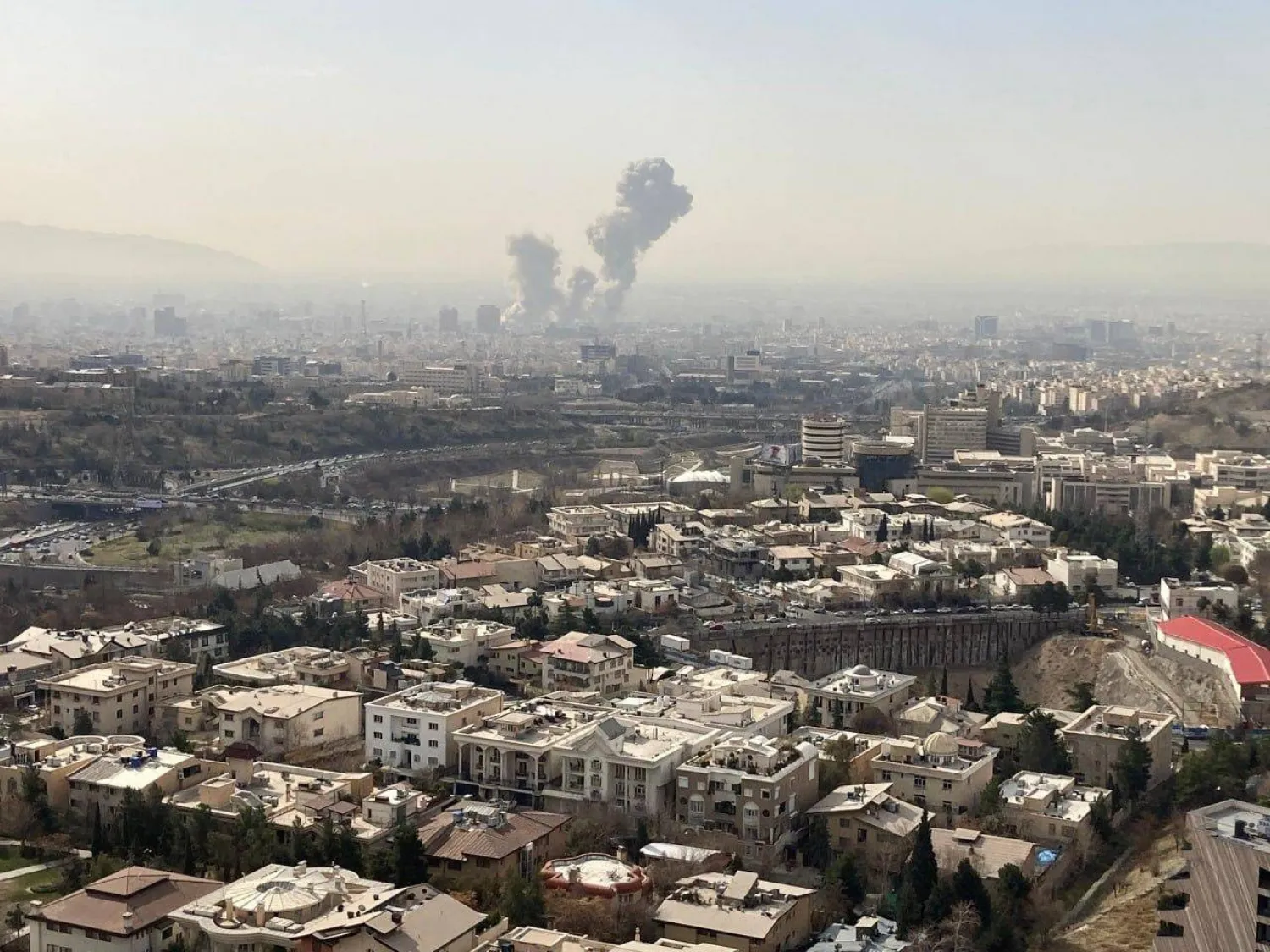

Airlines Cancel Flights after US, Israel Strikes on Iran

28 February 2026, Iran, Tehran: Smoke billows following an explosion in Tehran. Photo: Tasnim News Agency/ZUMA Press Wire/dpa
TT

Airlines Cancel Flights after US, Israel Strikes on Iran

28 February 2026, Iran, Tehran: Smoke billows following an explosion in Tehran. Photo: Tasnim News Agency/ZUMA Press Wire/dpa

Global airlines cancelled flights across the Middle East on Saturday after the United States and Israel launched strikes on Iran, plunging the region into a new conflict, Reuters reported.

Airspace over Iran and Iraq was empty on Saturday morning, maps by flight-tracking service Flightradar24 showed.

Below is the latest on flights listed by airline in alphabetical order:

AIR FRANCE KLM Air France cancelled flights to and from Tel Aviv in Israel and Beirut in Lebanon for Saturday. KLM brought forward the suspension of its Amsterdam–Tel Aviv service, cancelling the flight scheduled for Saturday.

The Dutch arm of Air France-KLM had announced on Wednesday that flights would be halted from Sunday, but has now advanced that date.

Only one flight to Tel Aviv had ⁠been scheduled for ⁠Saturday.

IBERIA EXPRESS The Spanish airline owned by Iberia Group cancelled a flight to Tel Aviv scheduled for Saturday at 5 p.m. local time.

INDIGO The airline said it was monitoring regional updates.

JAPAN AIRLINES Japan Airlines cancelled a flight on Saturday from Tokyo Haneda to Doha as well as a return flight on March 1, Nikkei said.

LOT POLISH AIRLINES LOT Polish Airlines returned its flight LO121 from Warsaw to Dubai ⁠to Warsaw.

LUFTHANSA The German airline suspended flights to and from Tel Aviv in Israel, Beirut in Lebanon, and Oman until March 7 and flights to and from Dubai on Saturday and Sunday. They also said they would not fly through Israeli, Lebanese, Jordanian, Iraqi and Iranian airspace until March 7.

NORWEGIAN AIR The Nordic airline suspended all flights to and from Dubai on Saturday, a company spokesperson said. The carrier did not suspend flights to Tel Aviv in Israel or Beirut in Lebanon as these destinations are only active in summer, he added.

SCANDINAVIAN AIRLINES The airline told Reuters it had suspended its flight to Tel Aviv from ⁠Copenhagen on Saturday. ⁠No decision had been made regarding flights on later dates.

TURKISH AIRLINES The airline cancelled flights to Qatar, Kuwait, Bahrain, the United Arab Emirates and Oman on Saturday and flights to Lebanon, Syria, Iraq, Iran and Jordan until March 2.

VIRGIN ATLANTIC Virgin Atlantic said it will temporarily avoid Iraqi airspace, resulting in some pre-planned rerouting of its flights and cancelled its VS400 service from London Heathrow to Dubai on Saturday.

QATAR AIRWAYS The airline said it has temporarily suspended flights to and from Doha due to the closure of Qatari airspace.

WIZZ AIR The airline halted flights to and from Israel, Dubai, Abu Dhabi and Amman with immediate effect until March 7.

It added that operational decisions would continue to be reviewed, and the flight schedule could be adjusted as the situation evolves.



Iran President, 2 Officials to Lead Transition after Khamenei's Death

People react as they gather at the Enghelab Square, after Iran's Supreme Leader Ali Khamenei was killed in Israeli and US strikes on Saturday, in Tehran, Iran, March 1, 2026. Majid Asgaripour/WANA (West Asia News Agency) via REUTERS
TT

Iran President, 2 Officials to Lead Transition after Khamenei's Death

People react as they gather at the Enghelab Square, after Iran's Supreme Leader Ali Khamenei was killed in Israeli and US strikes on Saturday, in Tehran, Iran, March 1, 2026. Majid Asgaripour/WANA (West Asia News Agency) via REUTERS

Iranian President Masoud Pezeshkian and two top other officials will lead Iran in the transitional period following the death of supreme leader Ali Khamenei, state television reported on Sunday.

Judiciary chief Gholamhossein Mohseni Ejei and another official from the country's legal council will be part of the trio overseeing the transition, according to state television which cited Mohammad Mokhber, one of Khamenei's advisors.

The United States and Israel launched waves of strikes Saturday against targets in Iran, sparking swift retaliation by the Iranian republic.

US President Donald Trump said that Iran's supreme leader Ali Khamenei was dead. Iranian state television confirmed the news early Sunday.


World Leaders React Cautiously to US and Israeli Strikes and Death of Iran Leader Khamenei

 A view shows the aftermath of an Israel and the US strike on a building in Tehran, Iran, February 28, 2026. Amir Kholousi/ISNA/WANA (West Asia News Agency) via Reuters
A view shows the aftermath of an Israel and the US strike on a building in Tehran, Iran, February 28, 2026. Amir Kholousi/ISNA/WANA (West Asia News Agency) via Reuters
TT

World Leaders React Cautiously to US and Israeli Strikes and Death of Iran Leader Khamenei

 A view shows the aftermath of an Israel and the US strike on a building in Tehran, Iran, February 28, 2026. Amir Kholousi/ISNA/WANA (West Asia News Agency) via Reuters
A view shows the aftermath of an Israel and the US strike on a building in Tehran, Iran, February 28, 2026. Amir Kholousi/ISNA/WANA (West Asia News Agency) via Reuters

How long will it last? Will it grow? What will the conflict and the reported death of Iran's Supreme Leader Ali Khamenei mean to us, and to global security overall? Those questions echoed across the Middle East and the planet Saturday as world leaders reacted warily to US and Israeli strikes on Iran.

US President Donald Trump said on social media that Khamenei was dead, calling it “the single greatest chance for the Iranian people to take back their Country.” Iranian state media said early Sunday the 86-year-old leader had died without elaborating on a cause.

Israeli officials previously told The Associated Press on condition of anonymity that Khamenei was dead. And Israeli Prime Minister Benjamin Netanyahu, in a televised address, said there were “growing signs” that Khamenei had been killed when Israel struck his compound early Saturday.

The apparent demise of the second leader of the country, who had no designated successor, would likely throw its future into uncertainty and exacerbate already growing concerns of a broader conflict. The UN Security Council scheduled an emergency meeting.

Perhaps cautious about upsetting already strained relations with Trump, many nations abstained from commenting directly or pointedly on the joint strikes but condemned Tehran’s retaliation. Similarly to Europeans, governments across the Middle East condemned Iran’s strikes on Arab neighbors while staying silent on the US and Israeli military action.

Other countries were more explicit: Australia and Canada expressed open support for the US strikes, while Russia and China responded with direct criticism.

The US and Israel launched a major attack against Iran on Saturday, and Trump called on the Iranian public to “seize control of your destiny” by rising up against the theocracy that has ruled the nation since 1979. Iran retaliated by firing missiles and drones toward Israel and US military bases in the Middle East.

Some leaders urge resumption of talks. In a statement, British Prime Minister Keir Starmer, French President Emmanuel Macron and German Chancellor Friedrich Merz called on the US and Iran to resume talks and said they favored a negotiated settlement. They said their countries didn’t take part in the strikes on Iran but are in close contact with the US, Israel and partners in the region.

The three countries have led efforts to reach a negotiated solution over Iran’s nuclear program.

“We condemn Iranian attacks on countries in the region in the strongest terms. Iran must refrain from indiscriminate military strikes," they said. "Ultimately, the Iranian people must be allowed to determine their future,” they said.

Later, at an emergency security meeting, Macron said France was “neither warned nor involved” in the strikes. He called for intensified efforts for a negotiated solution, saying “no one can think that the questions of Iran’s nuclear program, ballistic activity, regional destabilization will be settled by strikes alone.”

The 22-nation Arab League called the Iranian attacks “a blatant violation of the sovereignty of countries that advocate for peace and strive for stability.” That coalition of nations has historically condemned both Israel and Iran for actions it says risk destabilizing the region.

Morocco, Jordan, Syria and the United Arab Emirates denounced Iranian strikes targeting US military bases in the region including in Kuwait, Bahrain, Qatar and the United Arab Emirates.

Under former President Bashar al-Assad, Syria was among Iran’s closest regional allies and a staunch critic of Israel, yet a statement from its foreign ministry singularly condemned Iran, reflecting the new government's efforts to rebuild ties with regional economic heavyweights and the United States.

Saudi Arabia said it “condemns and denounces in the strongest terms the treacherous Iranian aggression and the blatant violation of sovereignty.” Oman, which has been mediating the talks between Iran and the US, said in a statement that the US action “constitutes a violation of the rules of international law and the principle of settling disputes through peaceful means, rather than through hostility and the shedding of blood.”

Careful wording is (mostly) the order of the day. New Zealand refrained from full-throated support but acknowledged Saturday that the US and Israeli attacks were keeping the Iranian regime from remaining an ongoing threat. “The legitimacy of a government rests on the support of its people,” New Zealand Prime Minister Christopher Luxon and Foreign Minister Winston Peters said in a joint statement. “The Iranian regime has long since lost that support."

Countries in Europe and the Middle East used careful wording, avoiding perceptions that they either support unilateral American action or are directly condemning the United States.

Others were more blunt. Russia’s Foreign Ministry called the strikes “a pre-planned and unprovoked act of armed aggression against a sovereign and independent UN member state.” The ministry accused Washington and Tel Aviv of “hiding behind” concerns about Iran’s nuclear program while actually pursuing regime change.

Similarly, China’s government said it was “highly concerned” about the US and Israeli strikes on Iran and called for an immediate halt to the military action and a return to negotiations. “Iran’s sovereignty, security and territorial integrity should be respected,” a Chinese Foreign Ministry statement said.

Despite recent tensions with the US, Canada too expressed its support for the military action. “Iran is the principal source of instability and terror throughout the Middle East,” Prime Minister Mark Carney said.

Concerns expressed of ‘new, extensive’ war

Palestinians in the occupied West Bank said they were largely unfazed as war erupted Saturday, barely pausing as booms echoed across the sky from Israel’s Iron Dome intercepting missiles overhead.

Unlike Israel, Palestinian cities have no warning sirens or bomb shelters, despite the risk of falling debris or errant missiles. As people sheltered less than 10 miles (16 kilometers) away in Jerusalem, streets in Ramallah swarmed with shoppers browsing meat counters, vegetable stalls and Ramadan sweets, some stopping to record the sounds of distant sirens and missile interceptions.

But as Israel closed checkpoints to the movement of people and goods on Saturday, gas stations saw longer-than-usual lines as residents filled spare canisters in case of supply disruptions.

The Palestinian Authority, in a statement, condemned the Iranian attacks on Arab nations.

Nervousness is perceptible across multiple countries. Norwegian Foreign Minister Espen Barth Eide told Norwegian broadcaster NRK that he was concerned the failure of negotiations between the US and Iran meant a “new, extensive war in the Middle East."

The Nobel Peace Prize-winning International Campaign to Abolish Nuclear Weapons condemned the US and Israeli strikes on Iran in harsher words. “These attacks are totally irresponsible and risk provoking further escalation as well as increasing the danger of nuclear proliferation and the use of nuclear weapons,” said its executive director, Melissa Parke.

EU leaders issued a joint statement Saturday calling for restraint and engaging in regional diplomacy in hopes of “ensuring nuclear safety.” The Arab League, too, appealed to all international parties “to work towards de-escalation as soon as possible, to spare the region the scourge of instability and violence, and to return to dialogue.”


Trump Warns Iran Not to Escalate Attacks, Saying US Will Strike Back with Force

A plume of smoke rises following a reported explosion in Tehran on February 28, 2026. (AFP)
TT

Trump Warns Iran Not to Escalate Attacks, Saying US Will Strike Back with Force

A plume of smoke rises following a reported explosion in Tehran on February 28, 2026. (AFP)

US President Donald Trump warned Iran on Sunday not to escalate its attacks, writing online that America will strike back ’WITH A FORCE THAT HAS NEVER BEEN SEEN BEFORE!”

Trump’s comments on Truth Social follow Iranian threats on Sunday morning after acknowledging the killing of Supreme Leader Ali Khamenei.

“Iran just stated that they are going to hit very hard today, harder than they have ever hit before,” Trump wrote. “THEY BETTER NOT DO THAT, HOWEVER, BECAUSE IF THEY DO, WE WILL HIT THEM WITH A FORCE THAT HAS NEVER BEEN SEEN BEFORE!”

Iran’s parliament speaker on Sunday called the leaders of the United States and Israel “filthy criminals” who will face “devastating blows” for their ongoing attacks on the country.

Mohammad Bagher Qalibaf made the comment in a televised address.

Qalibaf is the highest-ranking official to appear on camera since the attacks began Saturday.

“You have crossed our red line and must pay the price,” he said. “We will deliver such devastating blows that you yourselves will be driven to beg.”