


Egypt Establishes Platform for Carbon Certificates Trading

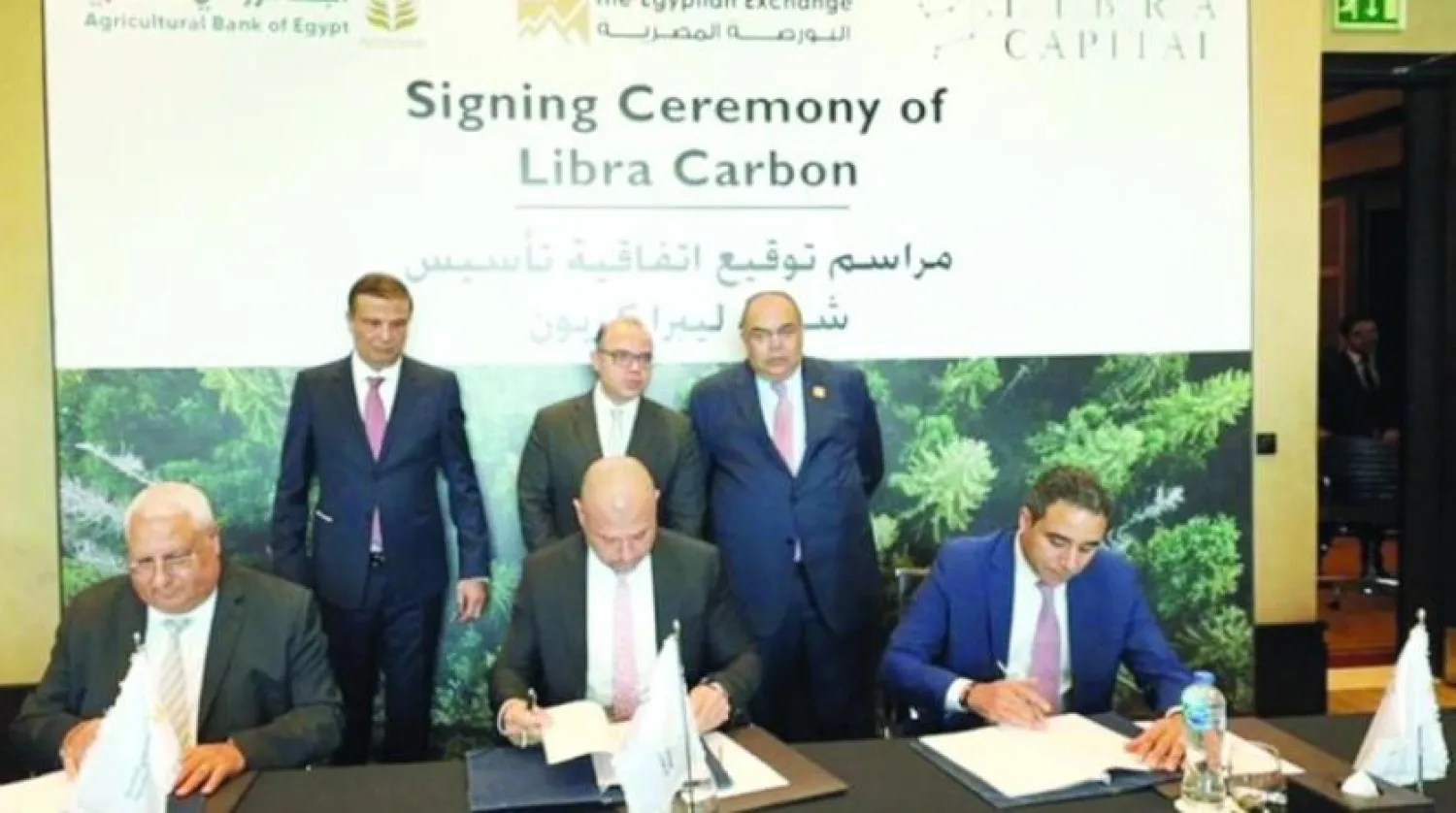
A signing ceremony to establish Libra Capital Group (Asharq Al-Awsat)
TT

Egypt Establishes Platform for Carbon Certificates Trading

A signing ceremony to establish Libra Capital Group (Asharq Al-Awsat)

The Egyptian Exchange (EGX) Holding Company for Capital Markets Development, the Agricultural Bank of Egypt, and Libra Capital Group signed a framework to establish a Carbon Certificates Trading Company.

The company will develop, manage, and issue carbon certificates and environmental products.

The platform is scheduled to determine the number of carbon emissions targeted to be reduced for each company or sector separately and the target price per ton during the coming period.

The signing ceremony was attended by the climate leader for the Egyptian presidency of the COP27 summit Mahmoud Mohieldin, chairperson of the Financial Regulatory Authority (FRA) Mohamed Farid, and a group of representatives of major international renewable energy companies.

The agreement was signed by EGX Chairman Ramy el-Dakany, Deputy Chairman of the Agricultural Bank of Egypt Sami Abdel-Sadek, and director of Libra Capital Sherif Magdy el-Gabaly.

The cooperation was announced on the sidelines of the Dii Desert Energy conference and comes within the framework of the Egyptian Stock Exchange's efforts to diversify investment options for investors, especially financial products that positively impact climate change.

Mohieldin announced an African Carbon Market Initiative with the support of several institutions to set standards and regulatory systems and adapt international rules in carbon markets to African needs, noting that it is possible to acquire added value within African countries.

He explained that Europe is the best in terms of standards and activity in carbon markets, and China has benefited from it and adapted it to its needs, hoping the market will be active in Africa and Egypt.

The official indicated that several European, Asian, and Gulf companies are trying to cooperate in setting standards and rules for transparency.

In turn, Farid expressed his happiness at the progress being made by all actors and players that play an essential role in developing a clear framework to be the primary nucleus for announcing the birth of an organized market for the trading of carbon certificates, which includes all the necessary and sufficient components, not only For trading and even issuance.

He stressed that the countries' response to climate change is a necessity to protect the world from the devastating effects due to the impact of global warming levels on human life.

Farid asserted the need to increase awareness levels by spreading the principle of carbon neutrality among various economic entities, focusing on introducing them to the advantages of commercial reductions.

Carbon reduction will enable the issuance of certificates that can be sold or traded, leading to a decrease in its price, which is consistent with the objectives of the UN Climate Summit, namely mitigation and adaptation, and providing the necessary funds, said Farid.

EGX Chairman explained that the framework agreement aims to establish a leading regional company to create new horizons for cooperation at the continental and regional levels to encourage green investment and diversify investment options.

Dakany explained that enhancing Egypt's competitiveness as a major financial center for African markets comes within EGX's efforts to develop and establish an African voluntary platform for trading carbon certificates.

The Chairman of the Agricultural Bank of Egypt, Alaa Farouk, which deals with 3.5 million customers nationwide, said that trading carbon credits is essential to help agricultural land owners.

The alliance seeks to achieve agricultural sustainability, reduce carbon emissions, and sustainability, said Farouk, adding that Libra Carbon will have a practical impact on Egypt in executing the plan to reduce carbon emissions.

For his part, Gabaly explained that the agreement enhances the company's efforts in green energy, reducing emissions, and preserving the environment, primarily that the Enara group has implemented several solar power plants inside Egypt.

He stated that establishing the first entity to manage and develop the environmental products and carbon market in Egypt enhances the company's efforts in green energy, reducing emissions, and preserving the environment.

CEO of Dii Desert Energy, Cornelius Matthes, said there is significant global interest in the carbon certificates trading market.

According to Matthes, Egypt can lead this field given its many renewable energy projects and the trend towards implementing more green hydrogen production projects.


US Hosts G20 Finance Talks with Growth, Iran Pressure on Agenda

 A member of law enforcement works a checkpoint at the Omni Grove Park Inn before finance ministers and central bank governors from G20 countries meet in Asheville, North Carolina, US, August 29, 2026. (Reuters)
A member of law enforcement works a checkpoint at the Omni Grove Park Inn before finance ministers and central bank governors from G20 countries meet in Asheville, North Carolina, US, August 29, 2026. (Reuters)
TT

US Hosts G20 Finance Talks with Growth, Iran Pressure on Agenda

 A member of law enforcement works a checkpoint at the Omni Grove Park Inn before finance ministers and central bank governors from G20 countries meet in Asheville, North Carolina, US, August 29, 2026. (Reuters)
A member of law enforcement works a checkpoint at the Omni Grove Park Inn before finance ministers and central bank governors from G20 countries meet in Asheville, North Carolina, US, August 29, 2026. (Reuters)

Finance leaders from the Group of 20 major economies open talks Monday at a US-hosted gathering, as the Trump administration seeks consensus on lifting global growth while ramping up economic pressure on Iran.

The gathering of G20 finance ministers and central bank governors takes place Monday and Tuesday in the Blue Ridge Mountains city of Asheville, North Carolina.

But looming over the meetings are fallout from the US-Israeli war on Iran, a tightening of US trade barriers and questions on whether the group can still work together to address key economic challenges.

US Treasury Secretary Scott Bessent skipped last year's meeting led by South Africa, which has been excluded from the group by the US. Washington holds the rotating presidency this year.

Instead, US officials invited Poland to the table, although it is not a permanent G20 member.

Brazil's finance minister is shunning the gathering amid tensions with the Trump administration.

A Russian representative is participating too. A European official speaking on condition of anonymity expressed disapproval that Moscow -- at war with Ukraine since its 2022 invasion -- was not excluded.

Besides promoting economic growth, US priorities this year include dealing with "global imbalances" and sovereign debt challenges, a senior US Treasury official told reporters ahead of talks.

G20 discussions will seek to ensure economies avoid policies that push excess production and capacity into global markets, the official added.

The official noted that some G20 partners have seen dumping on their shores while Trump raised US trade barriers -- echoing criticism of China's excess industrial capacity, which critics say drives down prices and causes unfair competition.

- 'Difficult conversations' -

"Those are difficult conversations to have," Josh Lipsky of the Atlantic Council told AFP, referring to the issue of imbalances.

He added that an ongoing US-Canada trade war weighs on unity among the Group of Seven advanced economies as countries broach tough topics in the wider grouping.

G7 finance ministers are also expected to meet on the margins of the Asheville talks.

But certain reporters from major US newsrooms, including the New York Times and Bloomberg News, were not granted credentials to cover the gathering.

Bloomberg News said it did not receive accreditation while the Times said its economic policy reporter was excluded. Another Times reporter, covering Europe, was allowed access.

A Times spokesperson said this was "not just another disturbing effort by the administration to undermine independent journalism, but a blatant attempt to evade public scrutiny."

A Treasury spokesperson said it plans to welcome nearly 300 media representatives from around a dozen countries, including a New York Times reporter and others including from NPR and the Washington Post.

"Members of the media will have a high level of access to policymakers throughout the event, and with that access comes a responsibility to report factual information consistent with established journalistic standards," the Treasury official added.

Coverage should not prioritize "clicks, engagement, or sensationalism," the spokesperson said.

All eyes will be on bilateral meetings on the sidelines of the summit too, where Bessent is set to make direct appeals to counterparts as Washington pushes to isolate Iran economically.

A Treasury official said Bessent will deliver a strong statement to the G20 to urge compliance with US sanctions if they want to continue operating in the dollar-based financial system.

Business leaders will also be present at G20 discussions this year on barriers to investment, innovation and productivity.

On worries over higher Treasury bond yields, closely monitored as a proxy for interest rates, the official said interest costs are expected to cool as inflation eases over time.

The G20 comprises 19 nations plus the European Union and the African Union. It was established in the wake of the 1997-1998 Asian financial crisis to boost global economic and financial stability.


Mawani Updates MSC’s 'JADE' Service Route via Bab Al-Mandab, Suez Canal

TT

Mawani Updates MSC’s 'JADE' Service Route via Bab Al-Mandab, Suez Canal

The Saudi Ports Authority (Mawani) announced an update to the route of MSC’s JADE shipping service, which will now transit the Bab Al-Mandab Strait and the Suez Canal, passing through King Abdullah Port in Rabigh, the Saudi Press Agency reported on Sunday.

The update will help reduce cargo transit times and enhance trade efficiency and the reliability of supply chains to and from the Kingdom of Saudi Arabia.

The JADE shipping service connects King Abdullah Port with several regional and international ports. These include Fos-sur-Mer in France; Barcelona and Valencia in Spain; Gioia Tauro in Italy; Singapore; Nansha, Yantian, Xiamen, Ningbo, Shanghai, and Qingdao in China; and Busan in South Korea. The service has a capacity of up to 15,000 TEUs.

Updating the service route via the Bab Al-Mandab Strait and the Suez Canal shortens the shipping route, speeds up the delivery of goods and commodities to markets, and improves the efficiency of export and import flows. This supports the smooth operation of supply chains and strengthens the Kingdom’s position as a major hub in the global trade and maritime network.

The route update reflects the readiness and operational capabilities of Saudi ports, as well as their strategic location along major maritime trade routes. It strengthens Saudi Arabia’s connectivity with global markets and supports the objectives of the National Transport and Logistics Strategy to establish the Kingdom as a global logistics hub connecting three continents.


Chinese Factory Slump Eases, but Weak Services Signal Uneven Recovery

Workers install a tunnel‑boring machine at a factory in Jinhu county in eastern China's Jiangsu province on Aug. 25, 2026. (Chinatopix via AP)
TT

Chinese Factory Slump Eases, but Weak Services Signal Uneven Recovery

Workers install a tunnel‑boring machine at a factory in Jinhu county in eastern China's Jiangsu province on Aug. 25, 2026. (Chinatopix via AP)

China's factory activity improved in August on stronger demand but remained in contraction, while services activity stayed weak, underscoring deepening imbalances in the economy and fueling calls for policy measures to boost the economy.

The divergence between manufacturing and service sectors suggests that China will continue to rely on manufacturing and exports to drive growth as momentum remains under pressure from lackluster domestic consumption and investment.

The official manufacturing purchasing managers' index (PMI) picked up to 49.8 from 49.2 in July, remaining below the 50-mark separating growth from contraction, a survey by the National Bureau of Statistics showed on Monday. It beat the median forecast of 49.6 in a Reuters poll.

NBS data showed both demand and output improved in August, with sub-indexes ‌for new orders ‌and production returning to expansion territory above 50.

TOO EARLY TO PREDICT ECONOMIC ‌RECOVERY

"Domestic ⁠demand seems to ⁠be coming back, although it's more likely to have been driven by AI and exports than by policy expansion," said Xu Tianchen, senior economist at the Economist Intelligence Unit.

Zhiwei Zhang, president and chief economist at Pinpoint Asset Management, said it was too early to conclude the economy had rebounded.

The non-manufacturing purchasing managers' index (PMI), which covers services and construction, remained unchanged at 49.0, matching July's reading, the weakest since December 2022.

"Because China's services sector is primarily domestically focused, this suggests domestic demand remained relatively sluggish in August," Lynn Song, ING's Greater China chief economist, said in a note. "For ⁠now, the PMI data suggests that we are due for another month of ‌relatively sluggish domestic activity data in August, with any potential rebound ‌likely to be limited."

The August PMIs for equipment manufacturing and high-tech manufacturing both came in above 51, while consumer goods ‌and high-energy-consuming industries stayed in contraction, according to data released by the NBS.

Zhang Liqun, an analyst with the ‌China Federation of Logistics & Purchasing, said that with the manufacturing PMI reading still in contraction, business confidence remained unstable.

"Continued government investment in public goods should be strengthened to effectively drive increased orders for businesses, continuously consolidate and enhance business confidence, and further strengthen factors contributing to economic stabilization and recovery."

SIGNS OF PREVAILING WEAKNESS

Economic data released earlier this month showed that growth remained under ‌pressure at the start of the second half, with goods consumption and industrial output both slowing.

Fixed-asset investment extended declines and the property market is still ⁠struggling to find a ⁠bottom more than five years into a slump.

Exports remained a growth driver, helped by robust demand for AI-related shipments that lifted prices for Chinese-made high-tech goods, but the profit squeeze felt by manufacturers relying on domestic demand weighed on overall industrial profits.

China's top leaders pledged in late July to introduce additional policies to support the economy as growth slowed to a more-than-three-year low of 4.3% in the second quarter, and vowed to accelerate fiscal spending on already-budgeted infrastructure projects for the remainder of the year.

The finance ministry recently expanded loan interest subsidies for small private firms and consumers to spur demand, while the central bank said this month it would roll out measures without signaling explicit cuts to policy rates or banks' reserve-requirement ratio.

ING's Song said the positive impact from interest subsidies "may be relatively marginal," and expects more measures in the weeks ahead.

In a sign the government will not unveil large-scale stimulus, an article published this month in the People's Daily, the Communist Party's official newspaper, said China is not excessively reliant on strong policy stimulus and that it is capable of achieving its annual economic growth target.
