


World Leaders Gather to Talk Climate at Sharm el-Sheikh

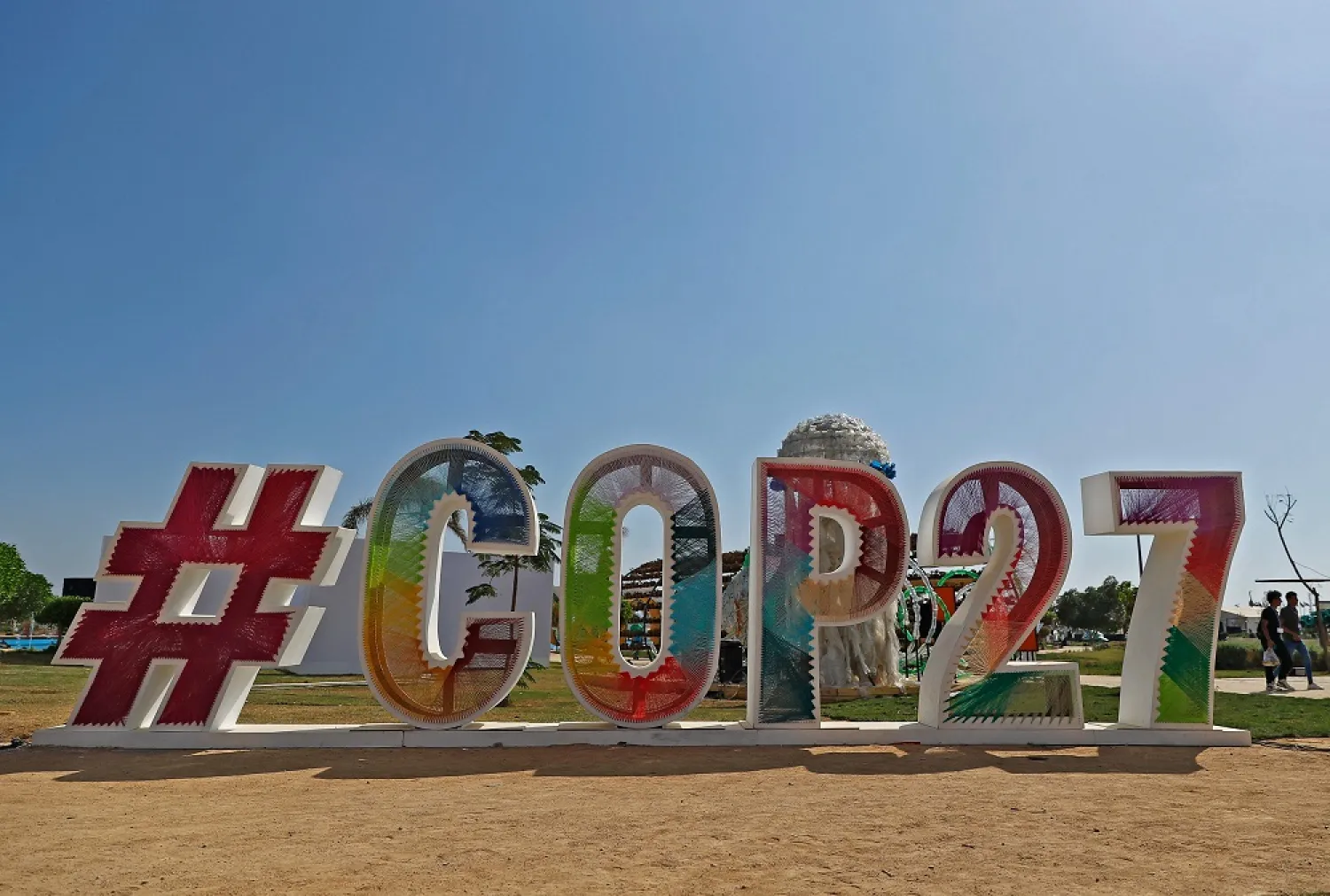
A picture shows an artwork at the Green Zone during the COP27 climate summit at the Sharm el-Sheikh International Convention Center, in Egypt's Red Sea resort of the same name, on November 7, 2022. (AFP)
TT

World Leaders Gather to Talk Climate at Sharm el-Sheikh

A picture shows an artwork at the Green Zone during the COP27 climate summit at the Sharm el-Sheikh International Convention Center, in Egypt's Red Sea resort of the same name, on November 7, 2022. (AFP)

More than 100 world leaders are about to discuss a worsening problem that scientists’ call Earth’s biggest challenge.

Nearly 50 heads of states or governments on Monday will take the stage in the first day of high-level international climate talks in Egypt with more to come in the following days.

Much of the focus will be on national leaders telling their stories of being devastated by climate disasters, culminating on Tuesday with a speech by Pakistan Prime Minister Muhammad Sharif, whose country’s summer flood caused at least $40 billion in damage and displaced millions of people.

Host leader, Egyptian President Abdel Fattah al-Sisi, and United Nations Secretary-General Antonio Guterres will kick off the leaders' speeches.

Among the lineup for Monday will be the heads of big oil producers Saudi Arabia and UAE; untested right-leaning prime ministers from the UK and Italy wary of government overreach; and leaders from poor climate-vulnerable nations like Niger and Palau keen for international funding.

Scores of other heads of state will speak in a parade of climate oratory that will spill into Tuesday, but many of the world's biggest emitters will be left until next week or have been left off the schedule entirely.

US President Joe Biden will arrive next week, as will newly elected Brazilian President Luiz Inacio Lula da Silva. Chinese President Xi Jinping is not scheduled to attend COP27, but he will have an envoy at the conference. India is not on the list, and no representatives from Russia, the target of western sanctions for its war on Ukraine, are currently on the schedule.

Egypt has officially taken the reins as COP host from the UK and has billed the conference as one that will turn the pledges made at the 2021 climate talks in Glasgow into action.

Delegates on Sunday set a positive tone by agreeing to add discussion of compensating poor nations for climate damage to the conference agenda for the first time ever, something that will usher in rounds of tough negotiations.

Other things to watch will include a World Trade Organization report expected Monday about the role of trade policy in climate change, and some expected announcements about forests as climate sinks.



Glitch Delays Restart of World's Biggest Nuclear Plant in Japan

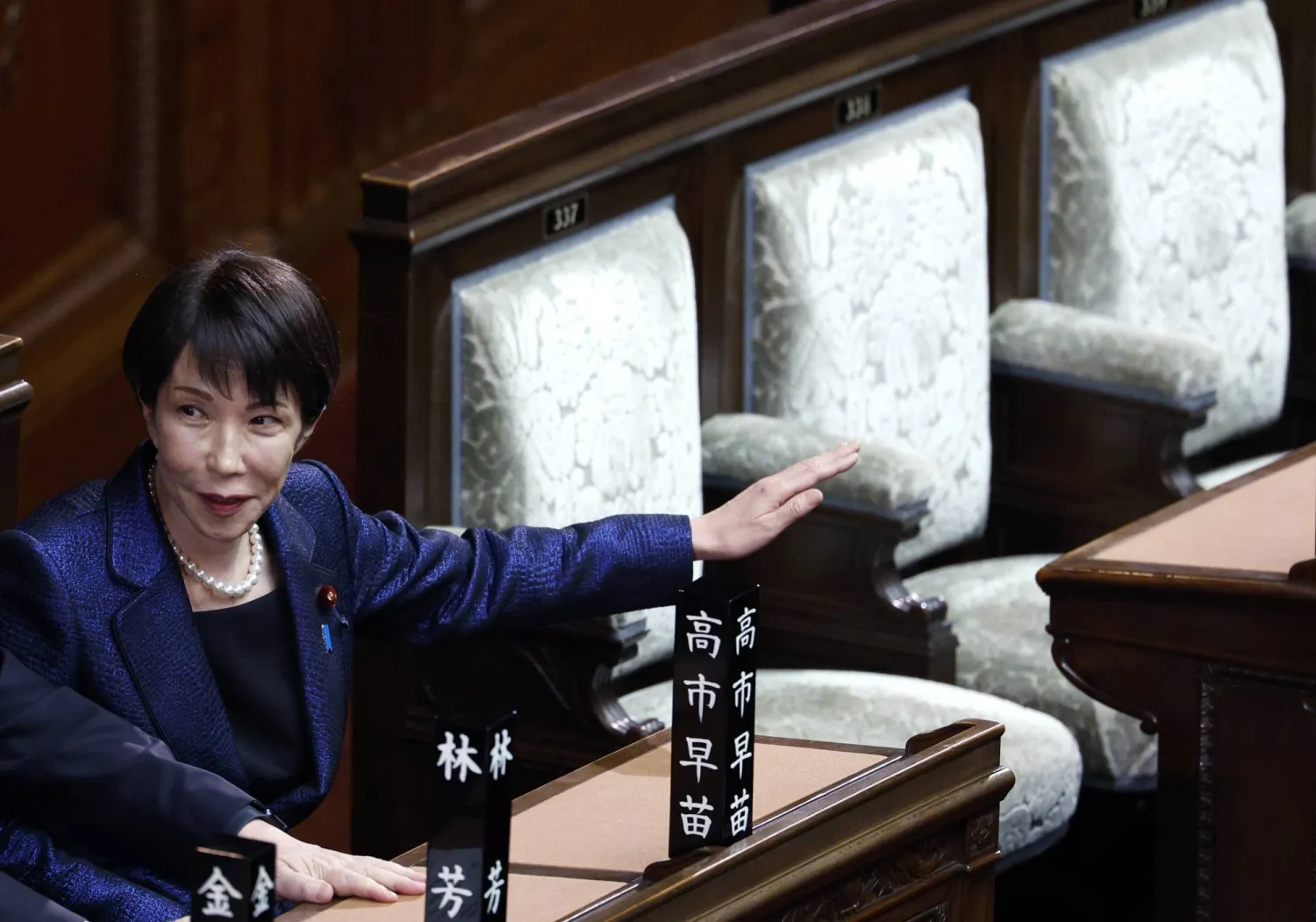
Local Japanese authorities have approved the restart of the world's biggest nuclear power facility, the Kashiwazaki-Kariwa Nuclear Power Plant, for the first time since the 2011 Fukushima disaster. STR / JIJI Press/AFP
TT

Glitch Delays Restart of World's Biggest Nuclear Plant in Japan

Local Japanese authorities have approved the restart of the world's biggest nuclear power facility, the Kashiwazaki-Kariwa Nuclear Power Plant, for the first time since the 2011 Fukushima disaster. STR / JIJI Press/AFP

A technical glitch pushed back the restart of the world's biggest nuclear reactor in Japan, its operator said on Monday, a day before local media reported it would go online.

Tokyo Electric Power Company (TEPCO) said it would need another day of two to check the equipment at the Kashiwazaki-Kariwa plant, which media reports said was set to restart on Tuesday.

The plant was taken offline when Japan pulled the plug on nuclear power after a colossal earthquake and tsunami sent three reactors at the Fukushima plant into meltdown in 2011.

The Kashiwazaki-Kariwa facility would be the first nuclear plant that Fukushima operator TEPCO restarts since the disaster.

The company has never publicly announced a date to switch on the plant.

TEPCO has decided to run more checks after detecting a technical issue on Saturday related to an alarm linked to one of the reactors at Kashiwazaki-Kariwa, company spokesman Isao Ito told AFP.

The alarm issue had been fixed by Sunday, he added.

After the final checks, the utility will explain to nuclear authorities what had happened and proceed to restart the plant, the spokesman said, without providing an exact timeline.

More than a decade since the Fukushima accident, Japan now wants to revive atomic energy to reduce its dependence on fossil fuels, achieve carbon neutrality by 2050 and meet growing energy needs from artificial intelligence.

But it is a divisive issue, with many residents worried about nuclear safety.

About 50 people gathered Monday outside TEPCO's headquarters in the capital Tokyo, chanting "No to the restart of Kashiwazaki-Kariwa!"

"TEPCO only mentions a possible delay. But that's not enough," said Takeshi Sakagami, president of the Citizens' Nuclear Regulatory Watchdog Group.

"A full investigation is needed, and if a major flaw is confirmed, the reactor should be permanently shut down," he said at the rally.

The reactor has cleared the nation's nuclear safety standard.

Prime Minister Sanae Takaichi has voiced her support for the use of nuclear power.

Japan is the world's fifth-largest single-country emitter of carbon dioxide, and is heavily dependent on imported fossil fuels.


Trump Says 'World Is Not Secure' Unless US Controls Greenland

Danish soldiers walk in front of Joint Arctic Command in Nuuk, Greenland, January 16, 2026. REUTERS/Marko Djurica
TT

Trump Says 'World Is Not Secure' Unless US Controls Greenland

Danish soldiers walk in front of Joint Arctic Command in Nuuk, Greenland, January 16, 2026. REUTERS/Marko Djurica

President Donald Trump told the Norwegian prime minister in a message published Monday that the world would not be secure unless the US controlled the Danish autonomous territory of Greenland.

"The World is not secure unless we have Complete and Total Control of Greenland," Trump said in the message to Jonas Gahr Store.

The authenticity of the message was confirmed to AFP by Store's office.


Death Toll in Spanish Train Collision Rises to at Least 39 as Rescue Efforts Continue

Members of the Spanish Civil Guard, along with other emergency personnel, work next to one of the trains involved in the accident, at the site of a deadly derailment of two high-speed trains near Adamuz, in Cordoba, Spain, January 19, 2026. (Reuters)
TT

Death Toll in Spanish Train Collision Rises to at Least 39 as Rescue Efforts Continue

Members of the Spanish Civil Guard, along with other emergency personnel, work next to one of the trains involved in the accident, at the site of a deadly derailment of two high-speed trains near Adamuz, in Cordoba, Spain, January 19, 2026. (Reuters)

Spanish police said Monday that at least 39 people are confirmed dead in a high-speed train collision the previous night in the south of the country, and rescue efforts were continuing.

Video and photos showed twisted train cars lying on their sides under floodlights. Passengers reported climbing out of smashed windows, with some using emergency hammers to break the windows, according to Salvador Jiménez, a journalist for Spanish broadcaster RTVE, who was on board one of the derailed trains.

He told the network by phone Sunday that “there was a moment when it felt like an earthquake and the train had indeed derailed.”

The crash occurred when the tail end of a train carrying some 300 passengers on the route from Malaga to the capital, Madrid, went off the rails at 7:45 p.m. It slammed into an incoming train traveling from Madrid to Huelva, another southern Spanish city, according to rail operator Adif.

The collision took place near Adamuz, a town in the province of Cordoba, about 370 kilometers (about 230 miles) south of Madrid.

Spanish police said 159 people were injured, of whom five were in critical condition. A further 24 were in serious condition, authorities said. Transport Minister Óscar Puente said the death toll was not final.

In Adamuz, a sports center was turned into a makeshift hospital and the Spanish Red Cross set up a help center offering assistance to emergency services and people seeking information. Members of Spain’s civil guard and civil defense worked on site throughout the night.

Puente early Monday said the cause of the crash was unknown.

He called it “a truly strange” incident because it happened on a flat stretch of track that had been renovated in May. He also said the train that jumped the track was less than 4 years old. That train belonged to the private company Iryo, while the second train, which took the brunt of the impact, was part of Spain’s public train company, Renfe.

According to Puente, the back part of the first train derailed and crashed into the head of the other train, knocking its first two carriages off the track and down a 4-meter (13-foot) slope. He said the worst damage was to the front section of the Renfe train.

When asked by reporters how long an inquiry into the crash’s cause could take, he said it could be a month.

Spanish Prime Minister Pedro Sánchez expressed his condolences to the victims' families. “Tonight is a night of deep pain for our country,” he wrote on X.

Spain has the largest rail network in Europe for trains moving over 250 kph (155 mph), with more than 3,100 kilometers (1,900 miles) of track, according to the European Union.

The network is a popular, competitively priced and safe mode of transport. Renfe said more than 25 million passengers took one of its high-speed trains in 2024.

Train services Monday between Madrid and cities in Andalusia were canceled.

Spain’s worst train accident this century occurred in 2013, when 80 people died after a train derailed in the country’s northwest. An investigation concluded the train was traveling 179 kph (111 mph) on a stretch with an 80 kph (50 mph) speed limit when it left the tracks.