


Russian Missiles Pound Ukraine Power Supply, Fighting Rages in East

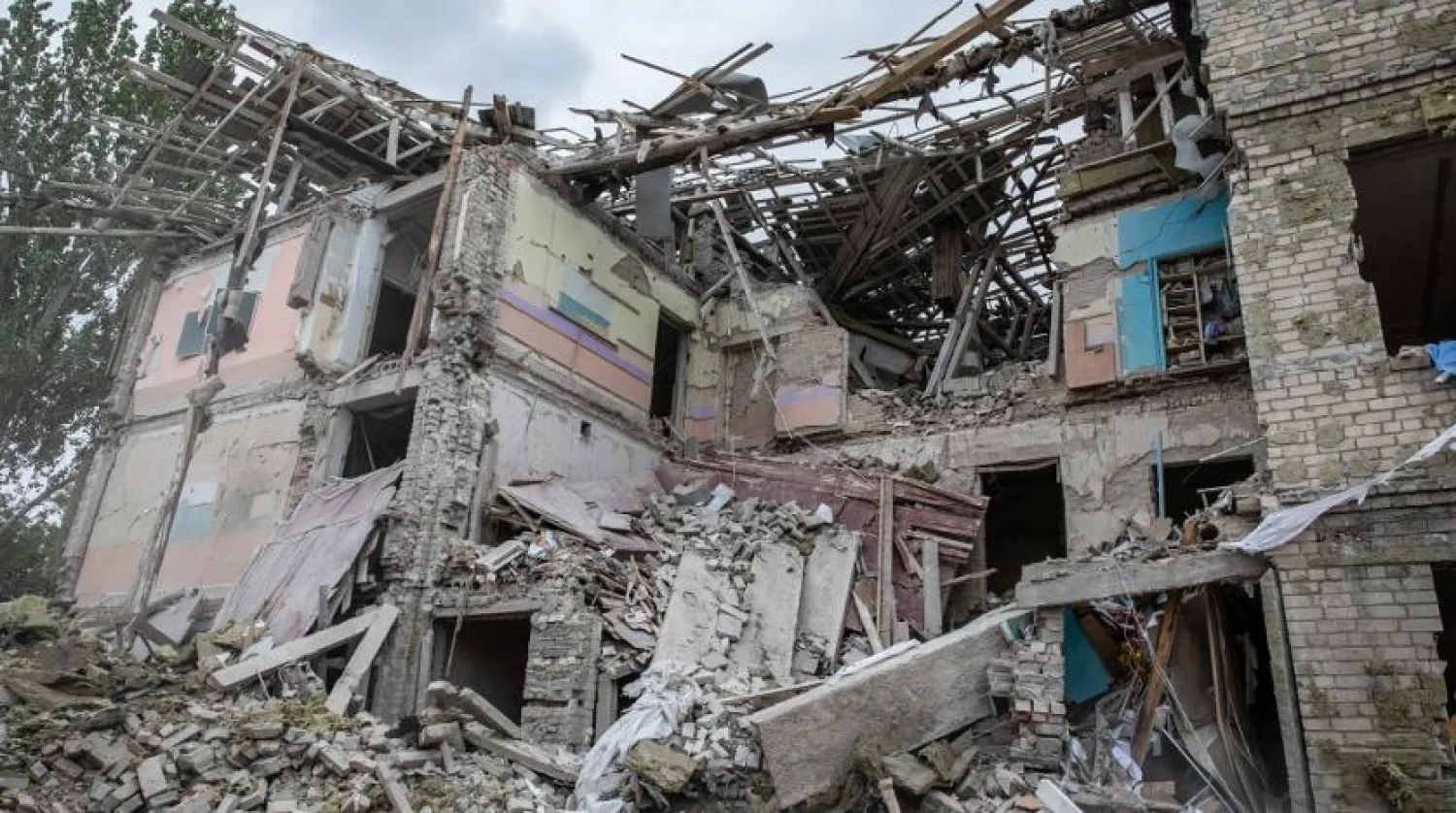
21 July 2022, Ukraine, Kramatorsk: A general view of the destroyed school building in Kramatorsk. (dpa)
TT

Russian Missiles Pound Ukraine Power Supply, Fighting Rages in East

21 July 2022, Ukraine, Kramatorsk: A general view of the destroyed school building in Kramatorsk. (dpa)

Missiles rained down on Ukrainian energy facilities on Thursday, as Russian forces stepped up attacks in eastern Ukraine, reinforced by troops pulled from Kherson city in the south which Kyiv recaptured last week. 

Explosions resounded in cities including the capital Kyiv, the southern port of Odesa, the central city of Dnipro and the southeastern region of Zaporizhzhia. 

"Punishment for all Russian atrocities - both present and past - will be unavoidable," President Volodymyr Zelenskiy wrote on Twitter, as news came that a Dutch court had ruled a passenger airliner shot down over eastern Ukraine in 2014 was hit by a Russian-made missile. 

The court sentenced two former Russian intelligence agents and a Ukrainian separatist leader to life in prison for the downing of Malaysian Airlines Flight MH17 on July 17, 2014, killing all 298 passengers and crew. 

The court also said Russia had "overall control" of the separatist forces in eastern Ukraine at the time. 

A deal aimed at easing global food shortages by facilitating Ukraine's agricultural exports from its southern Black Sea ports was extended for 120 days, though Moscow said its own demands had yet to be fully addressed. 

As the winter's first snow fell in Kyiv, authorities said they were working to restore power nationwide after Russia earlier this week unleashed what Ukraine said was the heaviest bombardment of civilian infrastructure of the nine-month war. 

Zelenskiy posted video footage, apparently shot from a car cam, showing a huge blast in Dnipro that sent flames and black smoke pouring into the sky. 

At least 15 people were wounded in Dnipro, three were hurt in the northeastern city of Kharkiv and at least one was injured in Odesa, officials said. 

State energy company Naftogaz said gas production facilities in eastern Ukraine had been damaged or destroyed. Other sites struck included the huge Pivdenmash defense plant in Dnipro. 

The United Nations' humanitarian office (OCHA) warned of a serious humanitarian crisis in Ukraine this winter, with millions facing "constant power cuts". 

Polish blast 

NATO and Poland concluded that a missile that crashed in Poland on Tuesday, killing two people, was probably a stray fired by Ukraine's air defenses and not Russian. Zelenskiy contested this view in a rare public disagreement with his Western allies. 

Polish President Andrzej Duda said the missile, the war's first deadly extension into NATO territory, appeared to be a Soviet-made S-300 rocket most likely fired accidentally "by Ukrainian anti-aircraft defense", not by Russia. Russia and Ukraine both use the missile. 

An adviser to Duda said Ukraine was likely to get access to the site of the blast that it has requested. 

US President Joe Biden disputed Zelenskiy's assertion that the missile was not Ukrainian, telling reporters at the White House on Thursday: "That's not the evidence." 

Moscow had denied responsibility. Russia's Foreign Ministry said accusations of Russian involvement in the blast were "part of a systematic anti-Russian campaign by the West". 

Patriotism and uncertainty in Kherson 

Officials reported heavy fighting in the eastern Donetsk and Luhansk regions, which Russia claims to have annexed along with the southern Kherson and Zaporizhzhia regions after holding what it called referendums condemned as a sham by Kyiv and the West. 

Vladimir Rogov, a Russian-installed official in the Russian-controlled part of Zaporizhzhia, said a Ukrainian missile struck a village there, killing two people and wounding nine. 

Moscow's forces retreated from the city of Kherson last week after a Ukrainian counteroffensive. It was the only regional capital Russia had captured since its Feb. 24 invasion, and the pullback was the third major Russian retreat of the war. 

Ukrainian and Russian gunners on Thursday traded shellfire across the Dnipro River that bisects the Kherson region, the thumps echoing as a freezing rain drenched the city. 

Investigators in recaptured territory in the area uncovered 63 bodies bearing signs of torture after Russian forces left, Ukraine's interior minister was quoted as saying on Thursday. 

Russia denies its troops target civilians or have committed atrocities. Mass burial sites have been found in other parts previously occupied by Russian troops, including some with civilian bodies showing signs of torture. 

Kherson's central square on Thursday was a frenetic melee of humanitarian aid queues and displays of patriotic celebration tinged with uncertainty about the future. 

At one end, a man played the Ukrainian anthem on the accordion as bystanders sang along; a man strummed out popular Ukrainian rock songs on the other. Children and teenagers asked a soldier to sign flags draped around their shoulders. 

Hundreds of people stood in a queue for humanitarian aid, but said they had no idea what they might receive. 

"We're fine, but we don't know what to expect. Nothing is over yet. On that bank of the river, the forces are gathering. On this side, they are gathering. We are in the middle. I’m afraid we'll end up like Mariupol," said Ihor, 48, an unemployed builder, referring to the devastated Ukrainian city now in Russian hands. 


Indonesia Flood Death Toll Passes 1,000

The deadly torrential rains are one of the worst recent disasters to strike Sumatra. (AFP)
TT

Indonesia Flood Death Toll Passes 1,000

The deadly torrential rains are one of the worst recent disasters to strike Sumatra. (AFP)

Devastating floods and landslides have killed 1,003 people in Indonesia, rescuers said Saturday as the Southeast Asian nation grapples with relief efforts.

The disaster, which has hit the northwestern island of Sumatra over the past fortnight, has also injured more than 5,400, the National Disaster Mitigation Agency said in its latest toll.

The deadly torrential rains are one of the worst recent disasters to strike Sumatra, where a tsunami wreaked havoc in 2004 in Aceh province, which lies at the northern tip of the island.

The final toll is expected to rise, with the disaster agency reporting 218 people are still missing.

With vast tracts of territory hit, 1.2 million residents have been forced to take refuge in temporary shelters.

Frustration has grown among flood victims, who have complained about the pace of relief efforts.

President Prabowo Subianto said Saturday the situation has improved, with several areas which had been cut off now accessible.

"Here and there, due to natural and physical conditions, there have been slight delays, but I checked all the evacuation sites: their conditions are good, services for them are adequate, and food supplies are sufficient," Prabowo said after visiting Langkat in North Sumatra province.

Costs to rebuild after the disaster could reach 51.82 trillion rupiah ($3.1 billion) and the Indonesian government has so far shrugged off suggestions that it call for international assistance.


Moscow, Tehran ‘Working Closely’ on Nuclear Program

Russian President Vladimir Putin and Iranian President Masoud Pezeshkian on the sidelines of the Peace Summit in Ashgabat, Turkmenistan, on Friday (Tasnim). 
TT

Moscow, Tehran ‘Working Closely’ on Nuclear Program

Russian President Vladimir Putin and Iranian President Masoud Pezeshkian on the sidelines of the Peace Summit in Ashgabat, Turkmenistan, on Friday (Tasnim). 

Russian President Vladimir Putin said on Friday that relations between Moscow and Tehran are “developing very positively,” stressing that the two countries are working in close coordination at the United Nations on Iran’s nuclear program.

He made the remarks during talks with Iranian President Masoud Pezeshkian on the sidelines of the International Peace and Trust Summit in Ashgabat.

According to Russian media, Putin said Russia is cooperating with Iran at the Bushehr nuclear power plant and on major infrastructure projects, including the North–South Transport Corridor.

He added that the two sides are also exploring cooperation in the gas and electricity sectors.

Pezeshkian, quoted by Iranian and Russian media, reaffirmed Tehran’s commitment to implementing the comprehensive strategic partnership agreement with Moscow.

He said Iran is “determined to activate the agreement” and expects Russia to accelerate implementation of joint understandings, particularly in energy, transport and strategic transit corridors.

The Iranian president said Iran would complete its share of the groundwork for the North–South Corridor by the end of the year, noting growing economic and trade cooperation between the two countries.

He also called for strengthening multilateral partnerships within frameworks such as the Shanghai Cooperation Organization and BRICS to counter what he described as “unilateralism.”

Russia and Iran aim to expand economic ties through projects such as the International North–South Transport Corridor, a multimodal route linking northern and southern Asia via sea, rail and road networks.

The corridor is intended to speed up cargo transport between Russia and India through Iran and other countries while reducing costs compared with traditional routes. The project is seen as part of Moscow’s efforts to deepen trade links with Central Asia and Europe and to lessen reliance on longer maritime routes.

Putin said bilateral trade between Russia and Iran increased by 13 percent last year and by 8 percent in the first nine months of the current year, underscoring continued cooperation in energy and infrastructure. He added that coordination between Moscow and Tehran on international issues remains “close and ongoing.”

On the sidelines of the summit, Pezeshkian also met Pakistani Prime Minister Shehbaz Sharif, with both sides agreeing on the need to accelerate implementation of bilateral agreements and enhance cooperation in transport, transit, energy and border infrastructure, according to Iran’s Mehr News Agency.


US Says Mexico Agrees to Water Treaty Obligations

FILE PHOTO: The sun sets over the Rio Grande River in Salineno, Texas, US, February 18, 2025. REUTERS/Cheney Orr/File Photo
TT

US Says Mexico Agrees to Water Treaty Obligations

FILE PHOTO: The sun sets over the Rio Grande River in Salineno, Texas, US, February 18, 2025. REUTERS/Cheney Orr/File Photo

The United States and Mexico reached an agreement on water-sharing on Friday, after President Donald Trump threatened new sanctions.

Trump said Mexico owed 800,000 acre-feet of water to the US and demanded it release a quarter of this amount by December 31 or be hit with a new five percent tariff, AFP said.

The Republican leader accused Mexico of violating a 1944 treaty under which the US shares water from the Colorado River in exchange for flows from the Rio Grande, which forms part of the border between the two countries.

"The United States and Mexico reached an understanding to meet the current water obligations of American farmers and ranchers," the US Department of Agriculture agency said in a statement.

It said the agreement includes both the current water cycle and the deficit from the previous cycle.

The two countries are expected to finalize the plan at the end of January.

The agreement as it stands would have Mexico releasing 202,000 acre-feet of water starting next week.

US Agriculture Secretary Brooke Rollins said in a statement on Friday that Mexico "has delivered more water in the last year than in the previous four years combined," but fallen short of their obligations.

"Farmers across South Texas have been reeling from the uncertainty caused by the lack of water. Now they can expect the resources promised to them," Rollins added.

Rollins echoed Trump's threat saying that if "Mexico continues to violate its commitments, the United States reserves the right and will impose five percent tariffs on Mexican products."

Mexican President Claudia Sheinbaum has not commented on the agreement, but on Tuesday expressed confidence in reaching a solution.

At the time, she also cautioned it would be physically impossible to meet the December 31 deadline because of limitations on the pumping equipment, but said: "We have the best will to deliver the amount of water that is owed."

Mexico acknowledged that it has been behind in its water deliveries to the US over the past five years, citing drought in 2022 and 2023.

Trump had previously threatened Mexico in April with economic repercussions over the water dispute, prompting Mexico at the time to immediately send water.

Mexican goods currently face a 25 percent tariff unless they fall under the United States-Mexico-Canada Agreement (USMCA), a free trade deal struck during Trump's first term and which Washington is aiming to renegotiate in 2026.
