

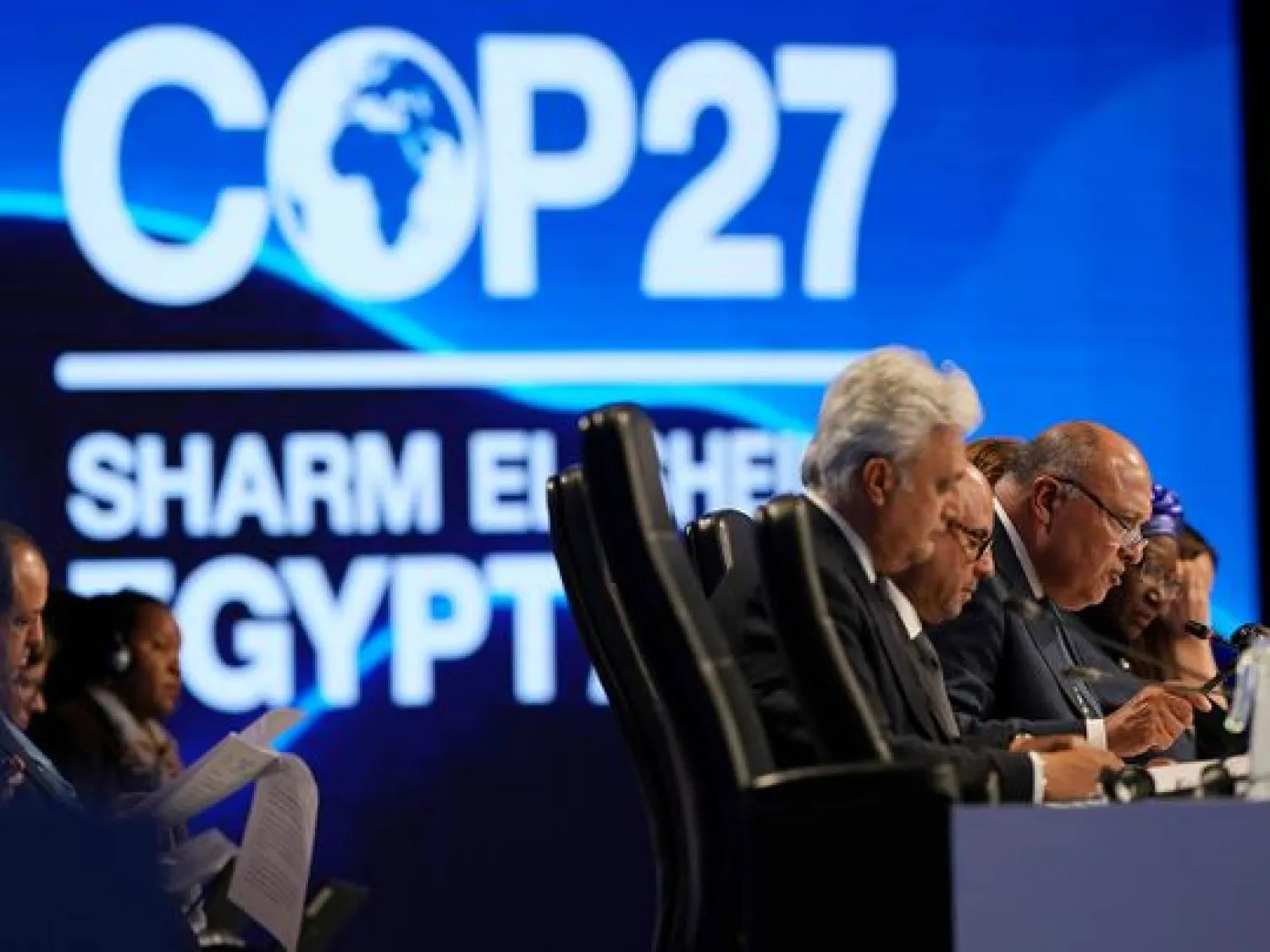

COP27 Summit Strikes Historic Deal to Fund Climate Damages

Sameh Shoukry, president of the COP27 climate summit, right, speaks during a closing plenary session at the UN Climate Summit. Image Credit: AP
TT

COP27 Summit Strikes Historic Deal to Fund Climate Damages

Sameh Shoukry, president of the COP27 climate summit, right, speaks during a closing plenary session at the UN Climate Summit. Image Credit: AP

An often fraught UN climate summit wrapped up on Sunday with sweeping agreement on how to tackle global warming and a "historic" deal to create a special fund to cover the damages suffered by vulnerable nations.

The two-week talks, which at times appeared to teeter on the brink of collapse, delivered a major breakthrough on a fund for climate "loss and damage" but left some disappointed over a failure to push further ambition on cutting emissions.

Delegates applauded after the loss and damage fund was adopted as the sun came up Sunday following days of marathon negotiations over the proposal.

Collins Nzovu, Zambia's minister of green economy and environment, said he was "excited, very, very excited."

"This is a very positive result from 1.3 billion Africans," he told AFP.

"Very exciting because for us, success in Egypt was going to be based on what we get from loss and damage."

A final COP27 statement covering the broad array of the world's efforts to grapple with a warming planet held the line on the aspirational goal of limiting global warming to 1.5 degrees Celsius from pre-industrial levels.

It also included language on renewable energy for the first time, while reiterating previous calls to accelerate "efforts towards the phasedown of unabated coal power and phase-out of inefficient fossil fuel subsidies".

But that failed to go much further than a similar decision from last year's meeting in Glasgow on key issues around, disappointing observers.

"New calls to accelerate deployment of renewable energy were very welcome," said Ani Dasgupta, head of the World Resources Institute.

"But it is mind-boggling that countries did not muster the courage to call for phasing down fossil fuels, which are the biggest driver of climate change."

As the final session stretched until sunrise after crunch talks went overnight, some delegates slept in their chairs, others struggled to keep their eyes open.

UN chief Antonio Guterres said the UN climate talks had "taken an important step towards justice" with the loss and damage fund.

"Clearly, this won't be enough, but it is a much needed political signal to rebuild broken trust. The voices of those on the frontline of the climate crisis must be heard," he said in a recorded message.

- 'Historic' deal -
A statement from the Alliance of Small Island States, comprised of islands whose very existence is threatened by sea level rise, said the loss and damage deal was a "historic" deal 30 years in the making.

"The agreements made at COP27 are a win for our entire world," said Molwyn Joseph, of Antigua and Barbuda and chair of AOSIS.

"We have shown those who have felt neglected that we hear you, we see you, and we are giving you the respect and care you deserve."

Conversely the deal on loss and damage -- which barely made it onto the negotiation agenda -- gathered critical momentum during the talks.

Developing nations relentlessly pushed for the fund during the summit, finally succeeding in getting the backing of wealthy polluters long fearful of open-ended liability.

With around 1.2C of warming so far, the world has seen a cascade of climate-driven extremes in recent months, shining a spotlight on the plight of developing countries faced with escalating disasters, as well as an energy and food price crisis and ballooning debt.

The World Bank estimated that devastating floods in Pakistan this year caused $30 billion in damage and economic loss.

Pakistan's Climate Minister Sherry Rehman said prior to the fund's approval that its creation would be "a historic reminder to vulnerable people all over the world that they have a voice and that if they unite... we can actually start breaking down barriers that we thought were impossible".

The fund will be geared towards developing nations "that are particularly vulnerable to the adverse effects of climate change" -- language that had been requested by the EU.

The EU had pushed for the wording with the aim of ensuring that wealthier developing countries such as China, which has grown into the world's second biggest economy, are not beneficiaries of the fund.

- 'On the brink' -
The Europeans had also wanted to broaden the funder base to cough up cash -- code for China and other better-off emerging countries.

The final loss and damage text left many of the thornier questions to be dealt with by a transitional committee, which will report to next year's climate meeting in Dubai to get the funding operational.

On Saturday morning, with the talks already in overtime, the European Union said it was prepared to have "no result" rather than a bad one over concerns around ambition on emissions cuts.

Scientists say limiting warming to 1.5C is a far safer guardrail against catastrophic climate impacts, with the world currently far off track and heading for around 2.5C under current commitments and plans.

"The historic outcome on loss and damage at COP27 shows international cooperation is possible," said Mary Robinson, former president of Ireland and Chair of The Elders.

"Equally, the renewed commitment on the 1.5C global warming limit was a source of relief. However, none of this changes the fact that the world remains on the brink of climate catastrophe."



Trump Moves to Block Courts from Seizing Venezuelan Oil Revenue in US Accounts

 The sun rises in Caracas, Venezuela, Saturday, Jan. 10, 2026, a week after US forces captured Venezuelan President Nicolas Maduro. (AP)
The sun rises in Caracas, Venezuela, Saturday, Jan. 10, 2026, a week after US forces captured Venezuelan President Nicolas Maduro. (AP)
TT

Trump Moves to Block Courts from Seizing Venezuelan Oil Revenue in US Accounts

 The sun rises in Caracas, Venezuela, Saturday, Jan. 10, 2026, a week after US forces captured Venezuelan President Nicolas Maduro. (AP)
The sun rises in Caracas, Venezuela, Saturday, Jan. 10, 2026, a week after US forces captured Venezuelan President Nicolas Maduro. (AP)

US President Donald Trump signed an executive order aimed at blocking courts or creditors from impounding revenue tied to the sale of Venezuelan oil held in US Treasury accounts, the White House said on Saturday.

The emergency order said the revenue, held in foreign government deposit funds, should be used in Venezuela to help create "peace, prosperity and stability."

The order was signed on ‌Friday, less ‌than a week after US ‌forces ⁠captured Venezuelan leader ‌Nicolas Maduro in Caracas. Several companies have longstanding claims against the country. Exxon Mobil and ConocoPhillips, for example, left Venezuela nearly 20 years ago after their assets were nationalized. Both are still owed billions of dollars.

The order does not mention any ⁠specific company. It declares that the money is the sovereign ‌property of Venezuela held in US ‍custody for governmental and ‍diplomatic purposes and is not subject to private ‍claims.

"President Trump is preventing the seizure of Venezuelan oil revenue that could undermine critical US efforts to ensure economic and political stability in Venezuela," the White House said in a fact sheet.

A US agreement with Venezuela's interim leaders would provide ⁠up to the US, where numerous refineries are specially equipped to refine it.

Trump cited the 1977 International Emergency Economic Powers Act and the 1976 National Emergencies Act as a legal justification.

Trump signed the order the same day he met in Washington with executives from Exxon, Conoco, Chevron and other oil companies as part of a bid to encourage them to invest $100 billion in Venezuela's oil ‌industry.


As Protests Rage, Iran Pulls the Plug on Contact with the World

 This frame grab from a video released Friday, Jan. 9, 2026, by Iranian state television shows a man holding a device to document burning vehicles during a night of mass protests in Zanjan, Iran. (Iranian state TV via AP)
This frame grab from a video released Friday, Jan. 9, 2026, by Iranian state television shows a man holding a device to document burning vehicles during a night of mass protests in Zanjan, Iran. (Iranian state TV via AP)
TT

As Protests Rage, Iran Pulls the Plug on Contact with the World

 This frame grab from a video released Friday, Jan. 9, 2026, by Iranian state television shows a man holding a device to document burning vehicles during a night of mass protests in Zanjan, Iran. (Iranian state TV via AP)
This frame grab from a video released Friday, Jan. 9, 2026, by Iranian state television shows a man holding a device to document burning vehicles during a night of mass protests in Zanjan, Iran. (Iranian state TV via AP)

Just after 8 p.m. Thursday, Iran's theocracy pulled the plug and disconnected the country's 85 million people from the rest of the world.

Following a playbook used both in demonstrations and in war, Iran severed the internet connections and telephone lines that connect its people to the vast diaspora in the United States, Europe and elsewhere. Until now, even while facing strict sanctions over the country's nuclear program, Iranians still could access mobile phone apps and even websites blocked by the theocracy, using virtual private networks to circumvent restrictions.

Thursday's decision sharply limits people from sharing images and witness accounts of the nationwide protests over Iran's ailing economy that have grown to pose the biggest challenge to the government in years. It also could provide cover for a violent crackdown after the Trump administration warned Iran's government about consequences for further deaths among demonstrators.

As the country effectively goes dark, loved ones abroad are frantic for any scrap of news, especially as Iran’s attorney general warned on Saturday that anyone taking part in protests will be considered an “enemy of God,” a death-penalty charge

“You can’t understand our feelings. My brothers, my cousins, they will go on the street. You can’t imagine the anxiety of the Iranian diaspora,” said Azam Jangravi, a cybersecurity expert in Toronto who opposes Iran's government. “I couldn’t work yesterday. I had meetings but I postponed them because I couldn’t focus. I was thinking of my family and friends.”

Her voice cracked as she added: “A lot of people are being killing and injured by Iran, and we don’t know who.”

Even Starlink is likely being jammed

This is the third time Iran has shut down the internet from the outside world. The first was in 2019, when demonstrators angry about a spike in government-subsidized gasoline prices took to the streets. Over 300 people reportedly were killed.

Then came the protests over the 2022 death of Mahsa Amini following her arrest by the country’s morality police over allegedly not wearing her hijab, or headscarf, to the liking of authorities. A monthslong crackdown killed more than 500 people.

While the connectivity offered by Starlink played a role in the Amini demonstrations, the deployment of its receivers is now far greater in Iran. That's despite the government never authorizing Starlink to function, making the service illegal to possess and use.

A year ago, an Iranian official estimated tens of thousands of Starlink receivers in the country, a figure that Los Angeles-based internet freedom activist Mehdi Yahyanejad said sounded right.

While many receivers likely are in the hands of business people and others wanting to stay in touch with the outside world for their livelihoods, Yahyanejad said some are now being used to share videos, photos and other reporting on the protests.

“In this case, because all those things have been disrupted, Starlink is playing the key for getting all these videos out,” Yahyanejad said.

However, Starlink receivers are facing challenges. Since its 12-day war with Israel last June, Iran has been disrupting GPS signals, likely in a bid to make drones less effective. Starlink receivers use GPS signals to position themselves to connect to a constellation of low-orbit satellites.

Amir Rashidi, director of digital rights and security at the Miaan Group and an expert on Iran, said that since Thursday he had seen about a 30% loss in packets being sent by Starlink devices — basically units of data that transmit across the internet. In some areas of Iran, Rashidi said there had been an 80% loss in packets.

“I believe the Iranian government is doing something beyond GPS jamming, like in Ukraine where Russia tried to jam Starlink,” Rashidi said. He suggested Iran may be using a mobile jammer, like it did in previous decades to disrupt satellite television receivers.

The International Telecommunication Union, a United Nations agency, has called on Iran to stop jamming in the past.

Meanwhile, Iran has been advocating at the ITU for Starlink service to the country to be stopped.

Help ‘needs to come soon’

It appears that the majority of information coming out of Iran since Thursday night is being transmitted via Starlink, which is now illegal. That carries dangers for those possessing the devices.

“It’s really hard to use it because if they arrest a person, they can execute the person and say this person is working for Israel or the United States,” Jangravi said.

Not using it, however, means the world knows even less about what's happening inside Iran at a pivotal moment.

“This sort of nonviolent protest is not sustainable when the violence (by security forces) is so extreme,” Yahyanejad said. “Unless something changes in the next two or three days, these protests can die down, too. If there’s any help, it needs to come soon.”


One Dead, Seven Missing After Migrant Boat Sinks off Türkiye

This photograph shows the oil tanker the "Maridive 703" sailing in the search-and-rescue zone of the international waters between Malta and Tunisia, on December 31, 2025. (AFP)
TT

One Dead, Seven Missing After Migrant Boat Sinks off Türkiye

This photograph shows the oil tanker the "Maridive 703" sailing in the search-and-rescue zone of the international waters between Malta and Tunisia, on December 31, 2025. (AFP)

One person died and seven others were missing Saturday after a migrant boat sank in the Aegean Sea off the coast of Türkiye, the Turkish coast guard said.

Thirty-seven passengers on a rubber dinghy which took on water before dawn off the western city of Dikili, north of Izmir, were rescued alive, the coast guard stated.

Dikili, a small seaside resort, faces the Greek island of Lesbos, some 20 kilometers (12 miles) away.

"Search operations ... are continuing to find the seven missing irregular migrants," the coast guard said.

Shipwrecks are common for perilous crossings to the Greek islands, which are a gateway to the European Union.

Nearly 1,900 migrants either disappeared or were found drowned in the Mediterranean in 2025, according to the International Organization for Migration.