

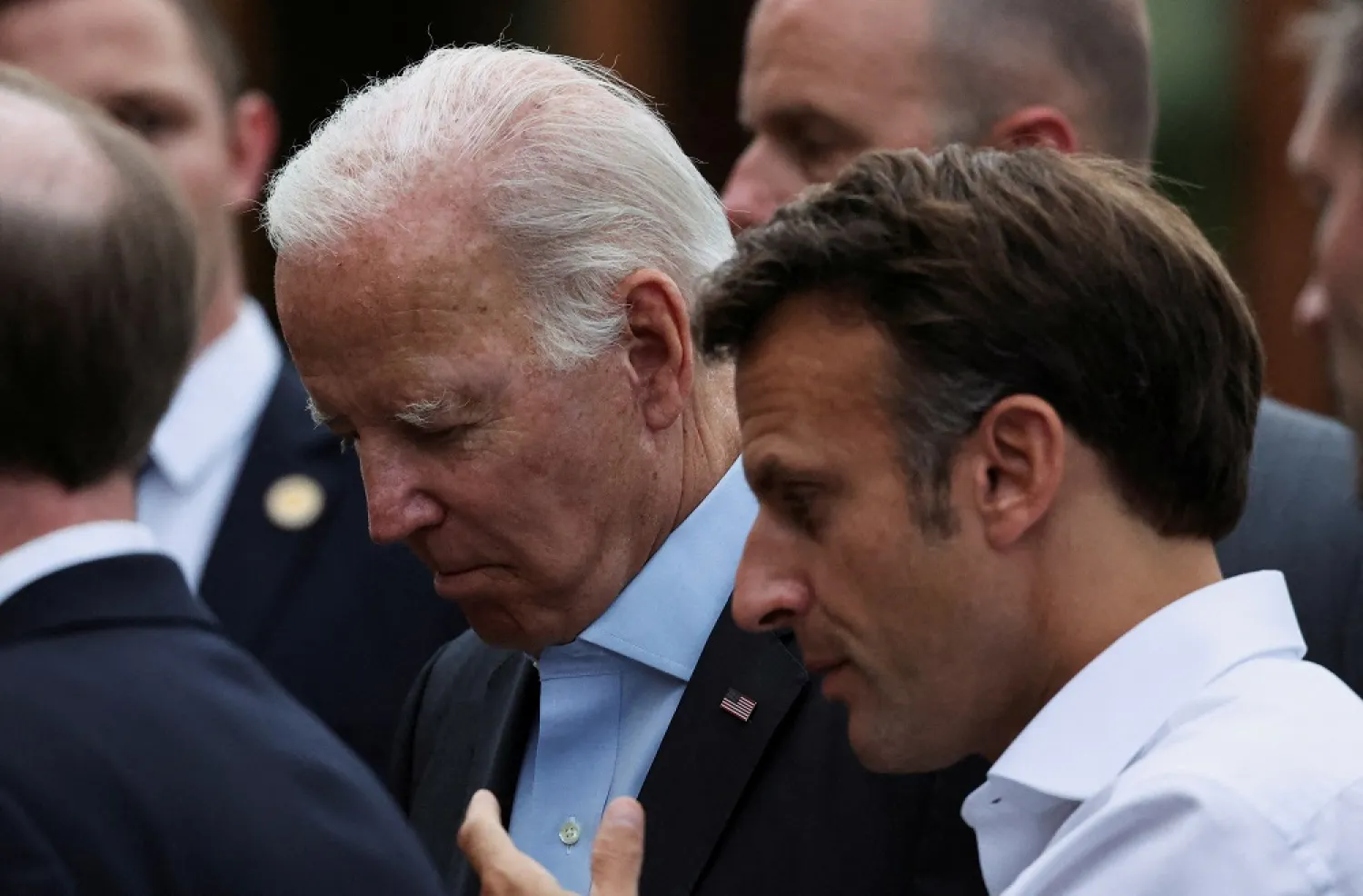

Biden, Macron Ready to Talk Ukraine, Trade in State Visit

US President Joe Biden and French President Emmanuel Macron attend the G7 leaders summit at the Bavarian resort of Schloss Elmau castle, near Garmisch-Partenkirchen, Germany, June 27, 2022. (Reuters)
TT

Biden, Macron Ready to Talk Ukraine, Trade in State Visit

US President Joe Biden and French President Emmanuel Macron attend the G7 leaders summit at the Bavarian resort of Schloss Elmau castle, near Garmisch-Partenkirchen, Germany, June 27, 2022. (Reuters)

French President Emmanuel Macron is headed to Washington for the first state visit of Joe Biden's presidency — a revival of diplomatic pageantry that had been put on hold because of the COVID-19 pandemic.

The Biden-Macron relationship had a choppy start. Macron briefly recalled France's ambassador to the United States last year after the White House announced a deal to sell nuclear submarines to Australia, undermining a contract for France to sell diesel-powered submarines.

But the relationship has turned around with Macron emerging as one of Biden's most forward-facing European allies in the Western response to Russia's invasion of Ukraine. This week's visit — it will include Oval Office talks, a glitzy dinner, a news conference and more — comes at a critical moment for both leaders.

The leaders have a long agenda for their Thursday meeting at the White House, including Iran's nuclear program, China's increasing assertiveness in the Indo-Pacific and growing concerns about security and stability in Africa's Sahel region, according to US and French officials. But front and center during their Oval Office meeting will be Russia's war in Ukraine, as both Biden and Macron work to maintain economic and military support for Kyiv as it tries to repel Russian forces.

In Washington, Republicans are set to take control of the House, where GOP leader Kevin McCarthy says Republicans will not write a “blank check” for Ukraine. Across the Atlantic, Macron's efforts to keep Europe united will be tested by the mounting costs of supporting Ukraine in the nine-month war and as Europe battles rising energy prices that threaten to derail the post-pandemic economic recovery.

White House National Security Council spokesman John Kirby on Monday described Macron as the “dynamic leader” of America's oldest ally while explaining Biden's decision to honor the French president with the first state visit of his presidency.

The US tradition of honoring foreign heads of state dates back to Ulysses S. Grant, who hosted King David Kalakaua of the Kingdom of Hawaii for a more than 20-course White House dinner, but the tradition has been on hold since 2019 because of COVID-19 concerns.

“If you look at what’s going on in Ukraine, look at what’s going on in the Indo Pacific and the tensions with China, France is really at the center of all those things,” Kirby said. “And so, the president felt that this was exactly the right and the most appropriate country to start with for state visits.”

Macron was also Republican Donald Trump's pick as the first foreign leader to be honored with a state visit during his term. The 2018 state visit included a jaunt by the two leaders to Mount Vernon, the Virginia estate of George Washington, America’s founding president.

Macron was scheduled to arrive in Washington on Tuesday evening ahead of a packed day of meetings and appearances in and around Washington on Wednesday — including a visit to NASA headquarters with Vice President Kamala Harris and talks with Biden administration officials on nuclear energy.

On Thursday, Macron will have his private meeting with Biden followed by a joint news conference and visits to the State Department and Capitol Hill before Macron and his wife, Brigitte Macron, are feted at the state dinner. Grammy winner Jon Batiste is to provide the entertainment.

Macron will head to New Orleans on Friday, where he is to announce plans to expand programming to support French language education in US schools, according to French officials.

For all of that, there are still areas of tension in the US-French relationship.

Biden has steered clear of embracing Macron’s calls on Ukraine to resume peace talks with Russia, something Biden has repeatedly said is a decision solely in the hands of Ukraine's leadership.

Perhaps more pressing are differences that France and other European Union leaders have raised about Biden's Inflation Reduction Act, sweeping legislation passed in August that includes historic spending on climate and energy initiatives. Macron and other leaders have been rankled by a provision in the bill that provides tax credits to consumers who buy electric vehicles manufactured in North America.

The French president, in making his case against the subsidies, will underscore that it's crucial for “Europe, like the US, to come out stronger ... not weaker” as the world emerges from the tumult of the pandemic and Russia's invasion of Ukraine, according to a senior French government official who briefed reporters on the condition of anonymity to preview private talks.

Macron earlier this month said the subsidies could upend the “level playing field” on trade with the EU and called aspects of the Biden legislation “unfriendly."

The White House, meanwhile, plans to counter that the legislation goes a long way in helping the US meet global efforts to curb climate change. The president and aides will also impress on the French that the legislation will also create new opportunities for French companies and others in Europe, according to a senior Biden administration official who briefed reporters on the condition of anonymity to preview the talks.

Macron's visit comes about 14 months after the relationship hit its nadir after the US announced its deal to sell nuclear submarines to Australia.

After the announcement of the deal, which had been negotiated in secret, France briefly recalled its ambassador to Washington. A few weeks later Macron met Biden in Rome ahead of the Group of 20 summit, where the US president sought to patch things up by acknowledging his administration had been “clumsy” in how it handled the issue.

Macron's visit with Harris to NASA headquarters on Wednesday will offer the two countries a chance to spotlight their cooperation on space.

France in June signed the Artemis Accords, a blueprint for space cooperation and supporting NASA’s plans to return humans to the moon by 2024 and to launch a historic human mission to Mars.

The same month, the US joined a French initiative to develop new tools for adapting to climate change, the Space for Climate Observatory.



Iranians Chant Slogans Against Supreme Leader at Memorials for Slain Protesters

An Iranian man holds the Iranian national flag during a memorial ceremony for those killed in anti-government protests earlier last month, at the Mosalla mosque in Tehran, Iran, 17 February 2026. (EPA)
TT

Iranians Chant Slogans Against Supreme Leader at Memorials for Slain Protesters

An Iranian man holds the Iranian national flag during a memorial ceremony for those killed in anti-government protests earlier last month, at the Mosalla mosque in Tehran, Iran, 17 February 2026. (EPA)

Iranians shouted slogans against Supreme Leader Ali Khamenei on Tuesday as they gathered to commemorate protesters killed in a crackdown on nationwide demonstrations that rights groups said left thousands dead, according to videos verified by AFP.

The country's clerical authorities also staged a commemoration in the capital Tehran to mark the 40th day since the deaths at the peak of the protests on January 8 and 9.

Officials acknowledge more than 3,000 people died during the unrest, but attribute the violence to "terrorist acts", while rights groups say many more thousands of people were killed, shot dead by security forces in a violent crackdown.

The protests, sparked by anger over the rising cost of living before exploding in size and anti-government fervor, subsided after the crackdown, but in recent days Iranians have chanted slogans from the relative safety of homes and rooftops at night.

On Tuesday, videos verified by AFP showed crowds gathering at memorials for some of those killed again shouting slogans against the theocratic government in place since the 1979 revolution.

In videos geolocated by AFP shared on social media, a crowd in Abadan in western Iran holds up flowers and commemorative photos of a young man as they shout "death to Khamenei" and "long live the shah", in support of the ousted monarchy.

Another video from the same city shows people running in panic from the sounds of shots, though it wasn't immediately clear if they were from live fire.

In the northeastern city of Mashhad a crowd in the street chanted, "One person killed, thousands have his back", another verified video showed.

Gatherings also took place in other parts of the country, according to videos shared by rights groups.

- Official commemorations -

At the government-organized memorial in Tehran crowds carried Iranian flags and portraits of those killed as nationalist songs played and chants of "Death to America" and "Death to Israel" echoed through the Khomeini Grand Mosalla mosque.

Iranian President Masoud Pezeshkian attended a similar event at the Imam Reza shrine in Mashhad.

Authorities have accused sworn enemies the United States and Israel of fueling "foreign-instigated riots", saying they hijacked peaceful protests with killings and vandalism.

Senior officials, including First Vice President Mohammad Reza Aref and Revolutionary Guards commander Esmail Qaani, attended the ceremony.

"Those who supported rioters and terrorists are criminals and will face the consequences," Qaani said, according to Tasnim news agency.

International organizations have said evidence shows Iranian security forces targeted protesters with live fire under the cover of an internet blackout.

The US-based Human Rights Activists News Agency (HRANA) has recorded more than 7,000 killings in the crackdown, the vast majority protesters, though rights groups warn the toll is likely far higher.

More than 53,500 people have been arrested in the ongoing crackdown, HRANA added, with rights groups warning protesters could face execution.

Tuesday's gatherings coincided with a second round of nuclear negotiations between Iran and the United States in Geneva, amid heightened tensions after Washington deployed an aircraft carrier group to the Middle East following Iran's crackdown on the protests.


Independent UN Body Condemns ‘Vicious Attacks’ on UN Expert on Palestinian Rights

United Nations (UN) Special Rapporteur on the occupied Palestinian territories Francesca Albanese looks on at the end of a press conference on the human rights situation in Gaza in Geneva on September 15, 2025. (AFP)
TT

Independent UN Body Condemns ‘Vicious Attacks’ on UN Expert on Palestinian Rights

United Nations (UN) Special Rapporteur on the occupied Palestinian territories Francesca Albanese looks on at the end of a press conference on the human rights situation in Gaza in Geneva on September 15, 2025. (AFP)

An ‌independent United Nations body on Tuesday condemned what it described as vicious attacks based on disinformation by several European ministers against the organization's special rapporteur for Palestine, Francesca Albanese.

In the past week several European countries, including Germany, France and Italy, called for Albanese’s resignation over her alleged criticism of Israel. Albanese, an Italian lawyer, denies making the remarks.

On Friday, the Czech Republic's Foreign Minister Petr Macinka quoted Albanese on X as having called Israel a "common enemy of humanity", and he ‌also called for ‌her resignation.

A transcript of Albanese's remarks ‌made ⁠in Doha on ⁠February 7 seen by Reuters did not characterize Israel in this way, although she has consistently criticized the country in the past over the Gaza conflict.

The UN Coordination Committee - a body of six independent experts which coordinates and facilitates the work of Special Rapporteurs - accused European ministers of relying on "manufactured ⁠facts".

"Instead of demanding Ms. Albanese's resignation ‌for performing her mandate...these government representatives ‌should join forces to hold accountable, including before the International Criminal Court, ‌leaders and officials accused of committing war crimes and ‌crimes against humanity in Gaza," the Committee said.

It said the pressure exerted on Albanese was part of an increasing trend of politically motivated and malicious attacks against independent human rights experts, UN officials ‌and judges of international courts.

US President Donald Trump's administration imposed sanctions on Albanese after she wrote ⁠letters ⁠to US companies accusing them of contributing to gross human rights violations by Israel in Gaza and the West Bank.

UN experts are commissioned by the Geneva-based Human Rights Council to monitor and document specific human rights crises but are independent of the organization itself.

There is no precedent for removing a special rapporteur during their term, although diplomats said that states on the 47-member council could in theory propose a motion to do so.

However, they said strong support for Palestinian rights within the body means that such a motion was unlikely to pass.


US Plans to Deploy More Missile Launchers to the Philippines Despite China’s Alarm 

A US M142 High Mobility Artillery Rocket System (HIMARS) fires a missile during a Combined Joint Littoral Live Fire Exercise at the joint military exercise called "Balikatan", Tagalog for shoulder-to-shoulder in a Naval station in Zambales province, northern Philippines on Wednesday, April 26, 2023. (AP)
TT

US Plans to Deploy More Missile Launchers to the Philippines Despite China’s Alarm 

A US M142 High Mobility Artillery Rocket System (HIMARS) fires a missile during a Combined Joint Littoral Live Fire Exercise at the joint military exercise called "Balikatan", Tagalog for shoulder-to-shoulder in a Naval station in Zambales province, northern Philippines on Wednesday, April 26, 2023. (AP)

The United States plans to deploy more high-tech missile systems to the Philippines to help deter aggression in the South China Sea, where the treaty allies on Tuesday condemned what they called China’s "illegal, coercive, aggressive, and deceptive activities."

Beijing has repeatedly expressed alarm over the installation in the northern Philippines of a US mid-range missile system called the Typhon in 2024 and of an anti-ship missile launcher last year. It said the US weapons were aimed at containing China’s rise and warned that these were a threat to regional stability.

China has asked the Philippines to withdraw the missile launchers from its territory, but officials led by President Ferdinand Marcos Jr. have rejected the demand.

US and Philippine officials held annual talks Monday in Manila on broadening security, political and economic engagements and boosting collaboration with regional security allies.

The US and the Philippines outlined in a joint statement Tuesday specific defense and security plans for this year, including joint military exercises, Washington's support to help modernize the Philippine military and efforts "to increase deployments of US cutting-edge missile and unmanned systems to the Philippines."

The longtime allies "underscored their support for preserving freedom of navigation and overflight, unimpeded lawful commerce and other lawful uses of the sea for all nations," the statement said.

"Both sides condemned China’s illegal, coercive, aggressive and deceptive activities in the South China Sea, recognizing their adverse effects on regional peace and stability and the economies of the Indo-Pacific and beyond," it added.

Confrontations between Chinese and Philippine coast guard forces have spiked in the disputed waters in recent years. Vietnam, Malaysia, Brunei and Taiwan are also involved in the territorial standoffs.

Neither side elaborated on the planned missile deployments but Philippine ambassador to Washington, Jose Manuel Romualdez, who took part in Monday’s talks, said US and Filipino defense officials discussed the possible deployment this year of "upgraded" types of US missile launchers that the Philippines may eventually decide to purchase.

"It’s a kind of system that’s really very sophisticated and will be deployed here in the hope that, down the road, we will be able to get our own," Romualdez told The Associated Press.

The Typhon missile system that the US Army deployed to the main northern Philippine region of Luzon in April 2024 and an anti-missile launcher called the Navy Marine Expeditionary Ship Interdiction System that was deployed in April last year also to Luzon have remained in the Philippines, Romualdez said.

During joint drills, US forces have exhibited the missile systems to batches of Filipino forces to familiarize them with the weapons’ capabilities and usage, military officials said.

Romualdez said the US missile deployments to the Philippines did not aim to antagonize any country.

"It’s purely for deterrence," he said. "Every time the Chinese show any kind of aggression, it only strengthens our resolve to have these types."

The Typhon missile launchers, a land-based weapon, can fire the Standard Missile-6 and the Tomahawk Land Attack Missile. Tomahawk missiles can travel over 1,000 miles (1,600 kilometers), which places China within their target range, from the northern Philippine region of Luzon.

Last year, the US Marines deployed the anti-ship missile launcher, the Navy Marine Expeditionary Ship Interdiction System, to Batan island in the northernmost Philippine province of Batanes, which faces the Bashi Channel just south of Taiwan.

The sea passage is a critical trade and military route that the US and Chinese militaries have tried to gain strategic control of.