


China Sends Ships into Pacific amid Japan Security Moves

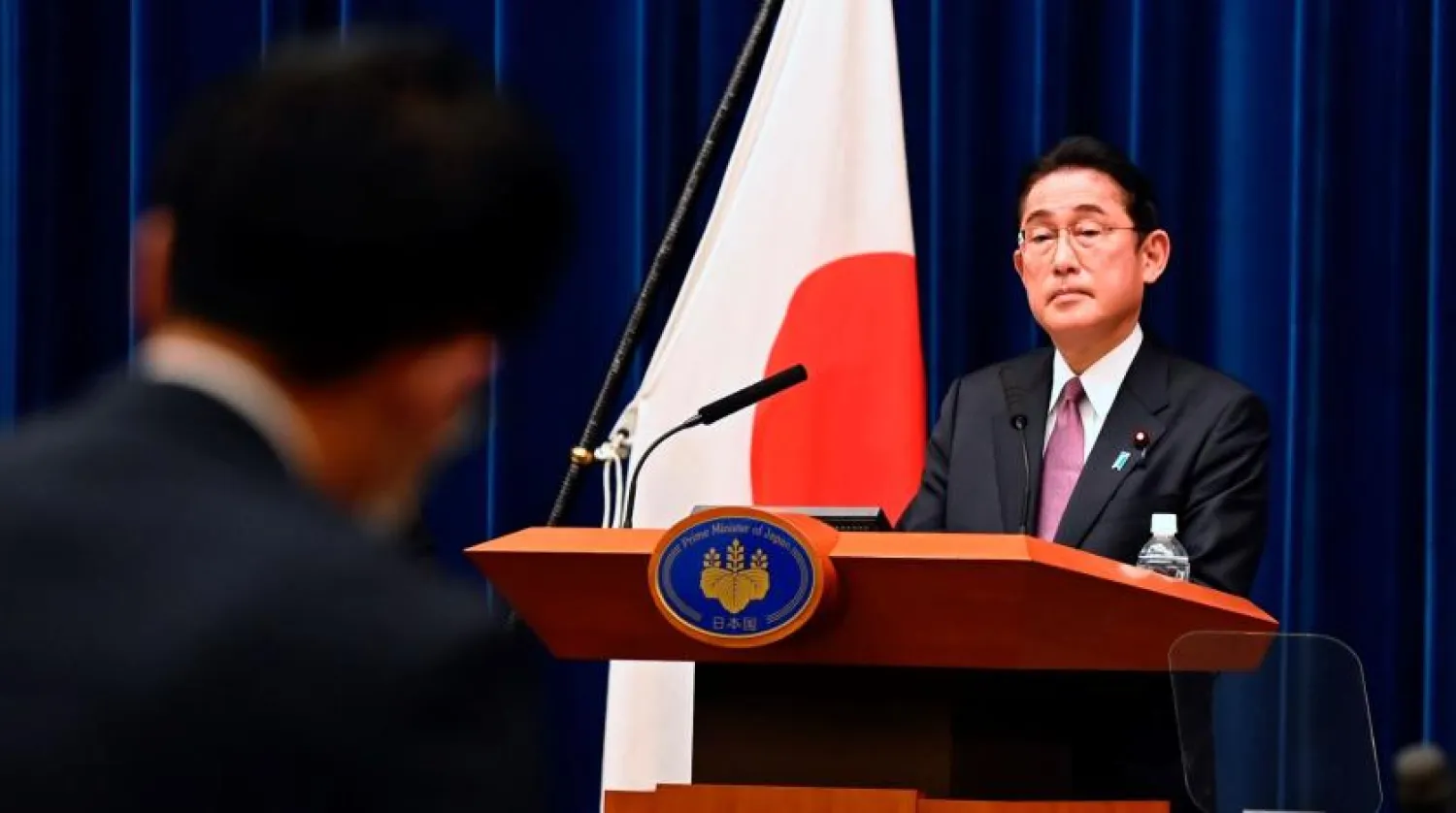
Japanese Prime Minister Fumio Kishida speaks in Tokyo (EPA)
TT

China Sends Ships into Pacific amid Japan Security Moves

Japanese Prime Minister Fumio Kishida speaks in Tokyo (EPA)

A squadron of Chinese Navy ships sailed through straits near Japan into the Western Pacific this week, while Beijing on Friday blasted Tokyo's adoption of a new national security strategy putting itself on a more offensive footing — largely as a result of the perceived threat from China.

The destroyers Lhasa and Kaifeng, and a replenishment ship, sailed through the Osumi Strait in southern Japan, while a Dongdiao-class surveillance ship with the hull number 796 sailed through the Miyako Strait south of Okinawa, all arriving in the Western Pacific by Thursday.

Japan’s Defense Ministry said the craft were closely shadowed by Japanese ships and planes throughout, The Associated Press said.

The Communist Party newspaper Global Times on Friday cited unidentified experts saying the mission “sent a signal amid Japan’s recent militaristic moves” that will display the People's Liberation Army's “capabilities in safeguarding China’s national sovereignty, territorial integrity and development interests."

China routinely sends warships through straits between Japanese islands, even while it vehemently objects to the presence of foreign navy ships in the Taiwan Strait. All are classified as international waters.

Late last month, Russian and Chinese strategic bombers also flew over the Sea of Japan and the East China Sea during an eight-hour mission in a show of increasingly close defense ties between the two countries.

Facing challenges from North Korea, China and Russia, Japan on Friday adopted a national security strategy declaring plans to possess preemptive strike capability and cruise missiles within years.

The strategy named China “the biggest strategic challenge” to Japan’s effort toward ensuring peace, safety and stability for itself and international society.

Japan’s post-World War II policy prioritized economic growth while keeping its security light by relying on American troops stationed in Japan under their bilateral security agreement.

But experts say China’s growing influence, Russia’s invasion of Ukraine and fear of Taiwan emergency prompted many Japanese to support increased capability and spending. China also says a group of tiny, uninhabited East China Sea islands controlled by Japan and Beijing regularly stokes resentment over Japan's brutal occupation of much of China more than 75 years ago.

Japan plans to spend 5 trillion yen ($37 billion) to deploy foreign-developed standoff missiles as early as 2026, including Lockheed Martin’s Tomahawk and Joint Air-to-Surface Standoff Missile, while Japan’s Mitsubishi Heavy Industry develops a surface-to-ship guided missile.

Chinese Foreign Ministry spokesperson Wang Wenbin reiterated accusations Japan was “ignoring facts, deviating from its commitment to China-Japan relations and the common understandings between the two countries, and groundlessly discrediting China."

"Hyping up the so-called China threat to find an excuse for its military build-up is doomed to fail," Wang said at a daily news briefing.



Australia Rejects Report it is Repatriating Families of ISIS Militants from Syrian Camp

FILE PHOTO: Members of Australian families believed to be linked to ISIS militants leave Roj camp near Derik, Syria February 16, 2026. REUTERS/Orhan Qereman/File Photo
TT

Australia Rejects Report it is Repatriating Families of ISIS Militants from Syrian Camp

FILE PHOTO: Members of Australian families believed to be linked to ISIS militants leave Roj camp near Derik, Syria February 16, 2026. REUTERS/Orhan Qereman/File Photo

Australia's center-left government ‌on Sunday rejected a local media report that said it was working to repatriate Australians in a Syrian camp holding families of suspected ISIS militants.

The 34 women and children were released on Monday from the camp in northern Syria, but returned to the detention center due to technical reasons. The group is expected to travel to ‌Damascus before eventually returning ‌to Australia, despite objections from ‌ruling ⁠and opposition lawmakers.

On ⁠Sunday, Home Affairs Minister Tony Burke rejected claims made in a report in the Sunday Telegraph, asserting that official preparations were under way for the cohort’s return.

"In that report, it makes a claim that ⁠we are conducting a repatriation. We are ‌not," Burke told ‌Australian Broadcasting Corp television.

"It claims we have been ‌meeting with the states for the purposes of ‌a repatriation. We have not," Burke added.

Prime Minister Anthony Albanese, who leads Australia's Labor Party, said this week his government would not help ‌the group return to Australia.

The return of relatives of suspected ISIS ⁠militants ⁠is a political issue in Australia, which has seen a surge in popularity of the right-wing, anti-immigration One Nation party led by Pauline Hanson.


US, Iran to Meet in Geneva Thursday for Crucial Talks

US fighter jets prepare to take off from the aircraft carrier "USS Abraham Lincoln" in the Arabian Sea last week (US Navy)
TT

US, Iran to Meet in Geneva Thursday for Crucial Talks

US fighter jets prepare to take off from the aircraft carrier "USS Abraham Lincoln" in the Arabian Sea last week (US Navy)

Oman’s Foreign Minister Badr Albusaidi said talks between the United States and Iran would resume on Thursday in Geneva "with a positive push to go the extra mile towards finalizing” a deal on Tehran's nuclear program.

Speaking to CBS News on Sunday, Iran's Foreign Minister Abbas Araghchi said details of a possible deal were being drawn up ahead of the renewed talks, after Washington's envoy Steve Witkoff had publicly wondered why Tehran had not yet "capitulated.”

Witkoff said in a Fox News interview broadcast Saturday that US President Donald Trump was questioning why Iran had not yet given in to the pressure.

"He's curious as to why they haven't... I don't want to use the word 'capitulated', but why they haven't capitulated," he said.

"Why haven't they come to us and said, 'We profess we don't want a weapon, so here's what we're prepared to do'?"

Meanwhile, US threats of military action have multiplied.

"If the US attacks us, then we have every right to defend ourselves," Araghchi said, alluding to American interests in the region as potential targets.

Still, he said, "there is a good chance to have a diplomatic solution.”

Their comments came after a senior US official told Axios that the Trump administration is prepared to consider a proposal that allows Iran “token” nuclear enrichment if it leaves no possible path to a bomb.

This suggests there could be an opening, if only a small one, between the red lines set by the US and Iran for a deal to constrain Iran's nuclear capabilities and prevent war, according to Axios.

A senior Iranian official also told Reuters that Tehran could seriously ⁠consider a combination of ⁠exporting part of its highly enriched uranium (HEU) stockpile, diluting the purity of its HEU and a regional consortium for enriching uranium, but in return Iran's ⁠right to "peaceful nuclear enrichment" must be recognized.

"The negotiations continue and the possibility of reaching an interim agreement exists," the official said.

The senior official said Tehran will not hand over control of its oil and mineral resources but US companies can always participate as contractors in Iran’s oil and gas fields.


Mexican Army Kills Leader of Jalisco New Generation Cartel

A vehicle sits charred after being set on fire, on a road in Guadalajara, Jalisco state, Mexico, Sunday, Feb. 22, 2026, after the death of the leader of the Jalisco New Generation Cartel, "El Mencho." (AP Photo/Alejandra Leyva)
TT

Mexican Army Kills Leader of Jalisco New Generation Cartel

A vehicle sits charred after being set on fire, on a road in Guadalajara, Jalisco state, Mexico, Sunday, Feb. 22, 2026, after the death of the leader of the Jalisco New Generation Cartel, "El Mencho." (AP Photo/Alejandra Leyva)

The Mexican army killed the leader of the Jalisco New Generation Cartel, Nemesio Rubén Oseguera Cervantes, “El Mencho,” in an operation Sunday, a federal official said.

The official, who requested anonymity because they were not authorized to speak publicly, said it happened during a military operation in the western state of Jalisco.

It followed several hours of roadblocks with burning vehicles in Jalisco and other states, The Associated Press reported. Such tactics are commonly used by the cartels to block military operations.

Videos circulating social media showed plumes of smoke billowing over the city of Puerto Vallarta, a major city in Jalisco, and sprinting through the airport of the state's capital in panic.

The US State Department had offered a reward of up to $15 million for information leading to the arrest of El Mencho. The Jalisco New Generation Cartel is one of the most powerful and fasted growing criminal organizations in Mexico.

In February, the Trump administration designated the cartel as a foreign terrorist organization.

It has been one of the most aggressive cartels in its attacks on the military—including helicopters—and a pioneer in launching explosives from drones and installing mines. In 2020, it carried out a spectacular assassination attempt with grenades and high-powered rifles in the heart of Mexico City against the then head of the capital’s police force and now head of federal security.

The DEA considers this cartel to be as powerful as the Sinaloa cartel, one of Mexico's most infamous criminal groups, with a presence in all 50 US states where it distributes tons of drugs. It is one of the main suppliers of cocaine to the US market and, like the Sinaloa cartel, earns billions from the production of fentanyl and methamphetamines.