Algerian President to Visit Moscow, Sign Strategic Partnership

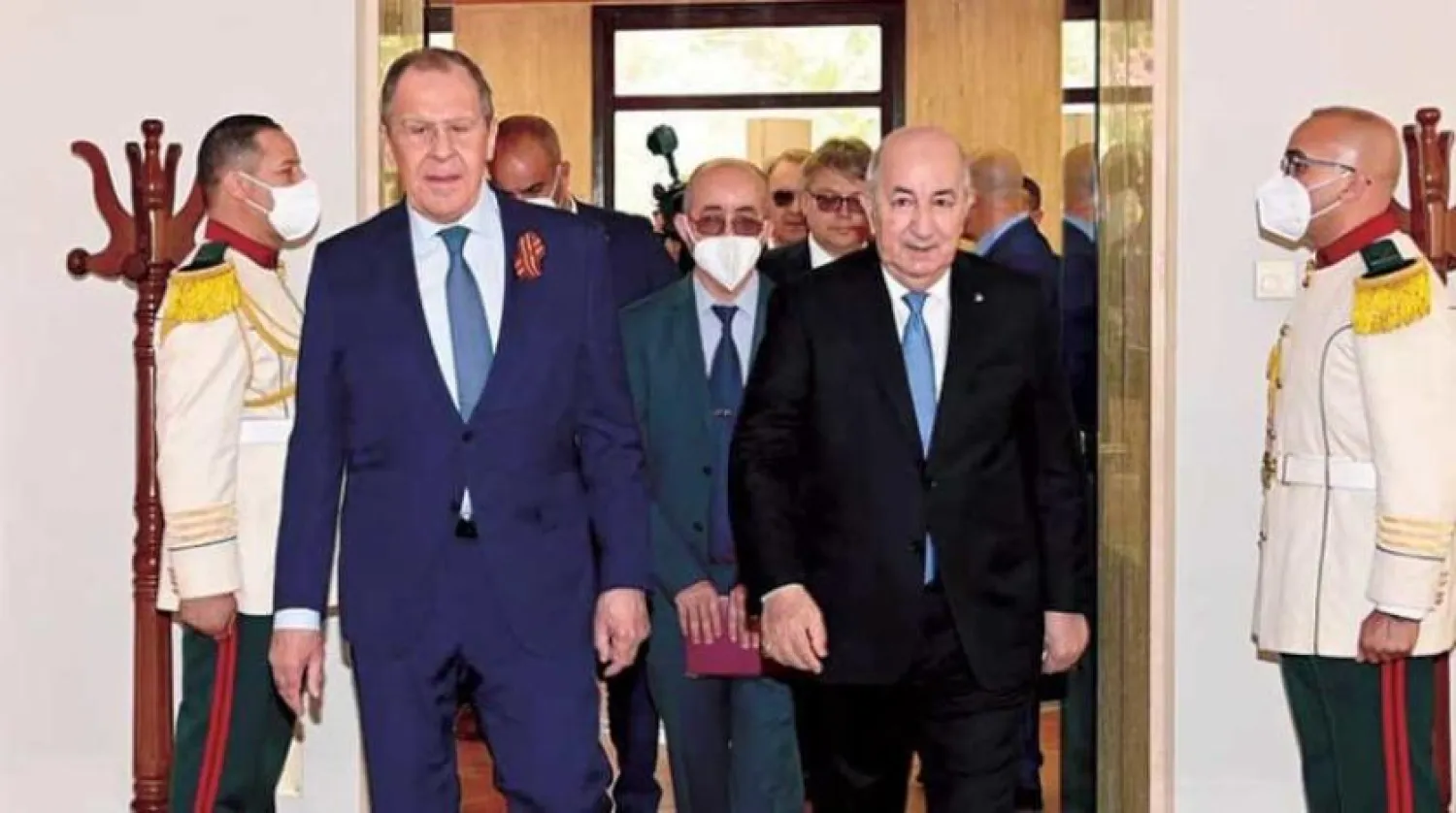
President Abdelmadjid Tebboune and Russian Foreign Minister Sergei Lavrov seen last May (Algerian Presidency)
TT

Algerian President to Visit Moscow, Sign Strategic Partnership

President Abdelmadjid Tebboune and Russian Foreign Minister Sergei Lavrov seen last May (Algerian Presidency)

Algeria and Russia are setting the stage to sign a strategic partnership agreement on economic and military affairs during President Abdelmadjid Tebboune’s upcoming visit to Moscow this month.

In May 2020, Russian President Vladimir Putin invited his Algerian counterpart to visit Moscow, but the Covid-19 pandemic stopped him from making the trip. Russia renewed the invitation in July during a phone call between the two presidents.

Algiers has not yet confirmed whether Tebboune’s visit will take place soon. Authorities are keen to complete the arrangements for the Russian-Algerian partnership agreements before announcing the trip’s exact date.

On November 8, Russia’s Special Presidential Envoy for the Middle East and Africa and Deputy Foreign Minister Mikhail Bogdanov told reporters that Moscow was awaiting the decision on Tebboune’s trip, revealing that the visit might take place by the end of the year.

Later, the Algerian foreign minister said on the sidelines of the Paris Peace Forum: “We hope that the visit will take place before the end of the year, and now preparations are underway for this visit.”

“We have a wide-ranging and long-term cooperation program. Algeria and Russia are important partners, and we are conducting a high-level political dialogue. We hope that President Abdelmadjid Tebboune’s visit to Russia will be the beginning of a new phase in our relations,” Ramtane Lamamra said.

During his visit, Tebboune is expected to seal several deals, sources said.

Algerian officers are especially keen to acquire submarines, Su-57 (Sukhoi) stealth aircraft, Su-34 bombers, and Su-30 fighters.

Algeria also hopes to acquire new air defense systems, such as the S-400, the Viking, and the Antey-4000.

Algeria's military budget could increase by 130 percent, reaching $22.6 billion, as per the draft finance law of 2023.

This would make it Africa's largest military budget, according to RT.


US to Hand Over Center at Baghdad Airport, Says Iraqi FM

A man walks past a billboard displaying the Iraqi flag in Baghdad's central Tahrir Square on September 22, 2026. (AFP)
TT

US to Hand Over Center at Baghdad Airport, Says Iraqi FM

A man walks past a billboard displaying the Iraqi flag in Baghdad's central Tahrir Square on September 22, 2026. (AFP)

The United States will transfer to Iraq a diplomatic and logistics hub at Baghdad airport that was repeatedly targeted by Iran-backed groups during the Middle East war, the foreign ministry said Thursday.

It said an agreement was signed with the US charge d'affaires Steven Fagin "to hand over the diplomatic support center affiliated with the US embassy at Baghdad International Airport to the Iraqi government".

The move, it added, was part of efforts to end the US-led coalition's military presence in Iraq, with the remaining troops set to complete their exit by September 30.

For years, Iran-backed armed groups that have long called for the withdrawal of foreign troops have targeted US facilities and coalition forces in Iraq.

During the Middle East war, those groups targeted US sites more than 600 times, including the Baghdad airport facility.

An Iraqi security official and a diplomatic source told AFP earlier this month that US troops have already evacuated the site.

Baghdad and Washington agreed in 2024 to end the coalition's mission against the ISIS group in Iraq.

Coalition forces are now only present at Erbil airport after having withdrawn from other bases.

The coalition's presence, especially after the defeat of ISIS, has been a persistent point of friction between Iraqi authorities and Tehran-backed factions in the country.

Since taking office this year, Prime Minister Ali al-Zaidi has pledged to reinforce the state's monopoly on arms and ensure that armed factions hand over their arms to the state.

Authorities say that ending the coalition's mission removes a key justification used by those groups to keep their weapons.


Ground Fighting Eases in Sudan as Drone Warfare Intensifies

Sudanese army chief Abdel Fattah al-Burhan inside the presidential palace on March 26, 2025. (Reuters)
TT

Ground Fighting Eases in Sudan as Drone Warfare Intensifies

Sudanese army chief Abdel Fattah al-Burhan inside the presidential palace on March 26, 2025. (Reuters)

Ground fighting has eased on Sudan’s main fronts after army advances and a retreat by the Rapid Support Forces (RSF) in North Kordofan in recent days. Drone attacks have increased, while limited skirmishes continue on several fronts.

Witnesses and field sources said the lull followed heavy fighting that significantly changed the areas held by each side in North Kordofan.

The army captured several towns, strengthened its hold on Bara and the surrounding area, and secured the export road. It also opened a supply route from Omdurman through White Nile and North Kordofan states to El Obeid.

The RSF withdrew to the north and northwest.

The sources said the army’s advance west of El Obeid stopped abruptly when its forces reached Umm Sumaymah. A counterattack forced them back toward the outskirts of El Obeid. No further major attempt to advance has been reported on that front.

Activists said the army also pulled back from around Sodari and Mazrub after extending its defensive lines through several nearby towns. The RSF returned to the strategic town of Mazrub, which it had left during the army’s wider offensive.

In Blue Nile state, the army held its positions. Pro-army sources said its forces repelled RSF attacks and inflicted casualties and equipment losses, preventing the RSF from making further gains. The RSF and its allies still control Kurmuk and Geissan.

Direct ground fighting there has also eased in recent days, though both sides have continued attacks with drones and artillery.

Drone warfare

The army said on Thursday that its air defenses had shot down a long-range FH-95 drone it described as hostile. The announcement came days after intensive drone attacks on military sites in El Obeid.

North Kordofan residents said the RSF had stepped up drone attacks on government-held cities in the state, disrupting daily life and deepening their sense of insecurity.

Reuters recorded footage of the aftermath of major attacks this month on two cities along the front line. Residents described them as part of a new wave of strikes, following weeks in which the RSF appeared to have reduced its drone use under international pressure.

Drone use has increased sharply during Sudan’s three-and-a-half-year war. Both the army and the RSF use technology that has become central to other conflicts, including the war in Ukraine.

The United Nations says drone attacks by both sides killed more than 1,000 civilians in the first half of this year. The toll highlights the growing cost to civilians as such attacks spread beyond traditional front lines.

On September 8, a drone struck a crowded courtroom in the government-held city of Umm Rawaba. The city is in North Kordofan, a central Sudanese state that has become one of the war’s main fronts.

Emergency Lawyers, which describes itself as an independent volunteer professional group defending rights, said about 10 people were killed and dozens wounded. The courthouse was extensively damaged, with columns from its facade and debris from one of the city’s prominent buildings strewn around the site.

A day later, a drone struck the College of Development and Technological Sciences in El Obeid, the capital of North Kordofan. The strike destroyed its roof and extensively damaged its buildings.

Standing amid the wreckage as workers cleared debris, the college’s dean, Abdelaziz al-Sheikh, said a security guard had been killed and eight lecture halls badly damaged.

“We lost the college guard. Eight halls were targeted and completely destroyed,” he said. Other parts of the college had also sustained extensive damage, he added.

Omnia Abulgasim, a student who had taken an exam at the college the day before the attack, stood beside the rubble. “The whole college was destroyed. We feel our dreams and our future have been destroyed,” she said.

At a hospital in Umm Rawaba, Salah Bakhit said his arm had been crushed and his body struck by shrapnel in the courthouse attack. He had fled El Obeid for safety after months of drone attacks on the city earlier this year, as the RSF sought to increase pressure on it.

As ground fighting eases on several fronts, drones are playing a growing role in attacks on military positions, as well as on cities and civilian facilities relatively far from the fighting. Residents and vital infrastructure are bearing an increasing share of the war’s cost.


Thousands of Syrians Face Legal Fallout From Assad-Era Cases

Syrians queue at Aleppo International Airport. (Civil Aviation Authority)
TT

Thousands of Syrians Face Legal Fallout From Assad-Era Cases

Syrians queue at Aleppo International Airport. (Civil Aviation Authority)

For many Syrians, the fall of Bashar al-Assad’s government did not end the cases against them. Activists and politicians are still discovering convictions issued in their absence and criminal wanted notices that remain in force, despite government measures to end security prosecutions of opponents.

Syria’s People’s Assembly has taken a leading role in transitional justice, repealing exceptional laws, including the law establishing the terrorism court.

But criminal cases brought during the conflict remain unresolved. Some Syrians returning by land or air discover the problem only when they reach the border.

Successive decisions and decrees have sought to dismantle the former government’s legacy. Yet thousands still face legal complications. Rights advocates say implementation has lagged behind legislative change, leaving people caught between promises of justice and institutional bureaucracy.

In March 2025, the Interior Ministry canceled travel-ban notices covering requests for arrest, notification or reporting, as well as failure to perform compulsory or reserve military service.

It said more than eight million people, roughly a third of Syrians, had been wanted by the former government’s intelligence and security agencies.

Last December, Justice Minister Mazhar al-Wais announced the abolition of exceptional courts and their rulings, in line with the repeal of Law No. 22 of 2012, which established the Court of Terrorism Cases. The judges who ran the court were removed.

The measure covered political cases, cases involving expressions of opinion and malicious charges. It excluded serious felonies involving personal rights, such as causing a person’s death, and organized crimes such as drug trafficking.

Those cases were referred to the regular military judiciary for consideration under fair legal procedures, leaving criminal prosecutions in place.

Repeal does not erase charges

People’s Assembly member Aqil Hussein says the assembly must legislate to repeal the terrorism and military courts and the “exceptional” security decisions and decrees issued against Syrians during the uprising. That must include canceling all resulting decisions and rulings, he said.

The measure does not cover criminal convictions, which the relevant institutions must resolve, Hussein said. But it could speed up that work and end the suffering of those affected. Agencies are working together on a mechanism to process cases faster and respond directly, he added.

Security sources told Asharq Al-Awsat that the former government used criminal charges, among other means, to pressure Syrians. It focused on terrorism allegations because of their international sensitivity, they said.

A large share of those allegations has been resolved, the sources said. Criminal charges and cases involving personal claims are harder to untangle because of technical complications and the number of agencies involved.

The sources acknowledged delays caused by the volume of cases and their links to complex civil matters. Claims brought by individuals can create further difficulties.

They said people affected by exceptional problems, such as a wanted notice that remains active after a case has been closed, or a lost case file, can approach the relevant offices in Damascus.

Records that outlast the cases

For many people still listed as wanted, settling their legal status means navigating a long bureaucratic process that restricts their freedom and civil rights.

Some said they learned that individuals had filed criminal complaints against them while they were abroad. Others said they could find no complainant.

Some returnees discovered arrest orders on criminal charges, only to learn from judicial offices that their case documents had been lost or damaged while the proceedings remained active.

People caught in this process cited poor links between databases and limited experience among new staff. Some said judicial offices and criminal investigation branches in Damascus had removed their records, but arrest warrants sent to border crossings were still in force.

Rights sources said political and security decisions had not been fully reconciled with prosecutors’ and courts’ records. Criminal entries are not removed automatically.

Canceling a wanted notice or overturning a conviction issued in a person’s absence requires a lengthy legal process, starting with a request to withdraw the notice and a visit to the judicial authority that issued it.

A proposed solution

“The new authorities have taken important steps in this direction, but they are still insufficient. The continued suffering of those affected shows the problem has not been resolved,” lawyer and rights activist Michel Shammas told Asharq Al-Awsat.

Issuing a general decision is one thing; carrying it through to every database, agency and case file is another, Shammas said. The former government created the files, but the new state inherited its institutions and records and must review and correct them.

Repealing the terrorism court and ending the exceptional laws used against opponents are necessary steps, he said. Neither automatically erases the effects of thousands of rulings, warrants and records issued by the court or other agencies.

Shammas proposed an independent judicial committee and a unified database to separate genuine criminal cases from political and security cases.

Political entries could then be removed collectively, he said, while an official service would let people check their legal status without an intermediary.