


Jordan's King Asserts Importance of France's Support of Two-State Solution

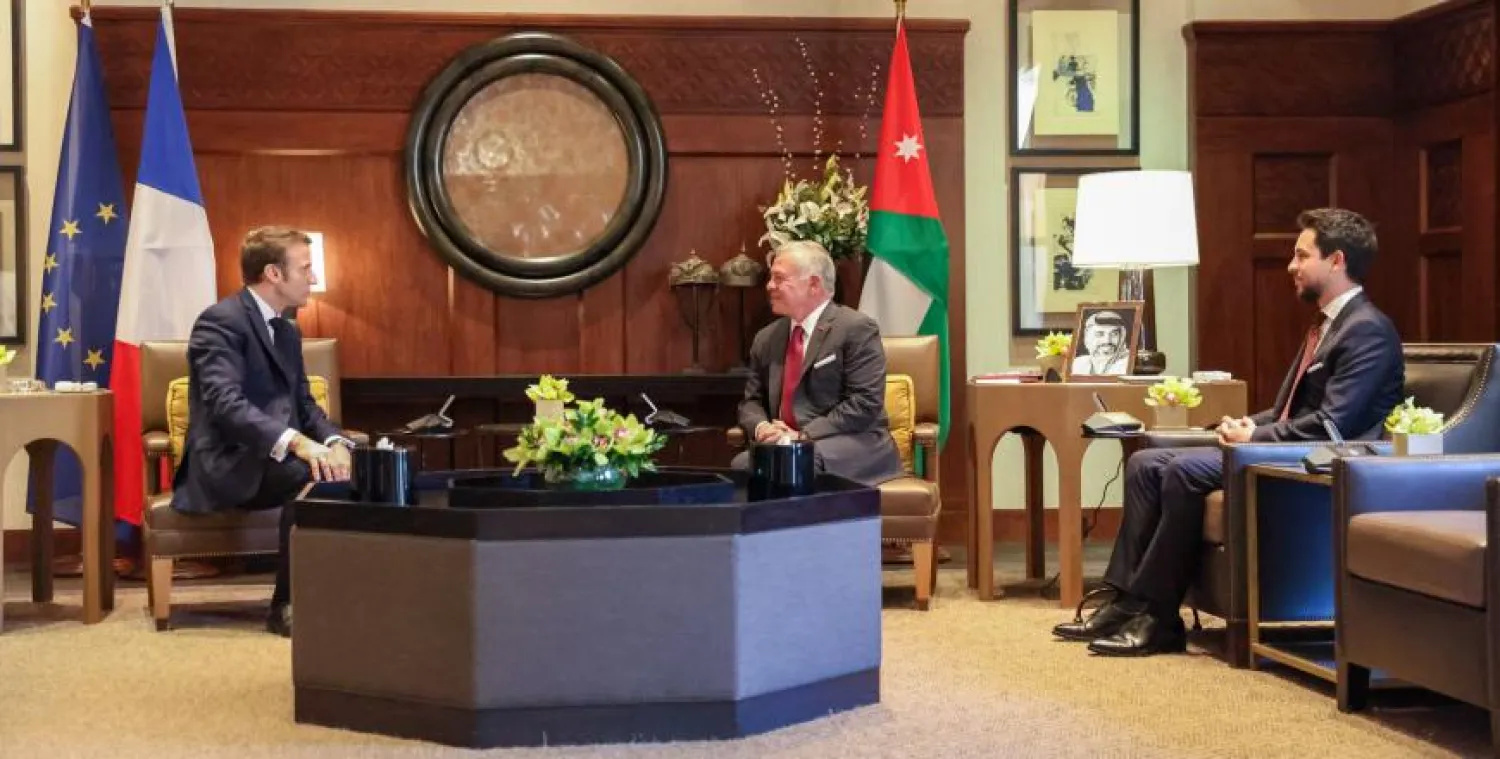
Jordan's King Abdullah during talks with France President Emmanuel Macron at al-Husseiniya Palace on Wednesday (Royal Court)
TT

Jordan's King Asserts Importance of France's Support of Two-State Solution

Jordan's King Abdullah during talks with France President Emmanuel Macron at al-Husseiniya Palace on Wednesday (Royal Court)

The Jordanian monarch, King Abdullah II, stressed the importance of the supporting positions of France and the European Union for peace efforts based on the two-state solution.

King Abdullah stressed that Jordan would continue to exert all efforts to safeguard Jerusalem's Islamic and Christian sites under Hashemite guardianship, reiterating the importance of supporting refugees and UNRWA.

King Abdullah held talks with French President Emmanuel Macron on Wednesday at al-Husseiniya Palace, covering bilateral ties and the latest regional and international developments.

The French President arrived in Jordan on Tuesday to participate in the Baghdad conference at the Dead Sea.

At bilateral talks that were followed by an expanded meeting attended by Crown Prince Hussein, the two leaders stressed the deep-rooted ties of friendship between Jordan and France, as well as keenness to advance them further, according to a Royal Court statement.

Abdullah II appreciated France's support for the Baghdad Conference for Cooperation and Partnership, saying there were "successful."

"We look at France as an integral part of our history in the region," the King continued, adding, "This is an amazing relationship that we have always had with France politically, more so militarily, unfortunately, because of issues in our region."

The two leaders addressed the challenges in Iraq, Syria, and Lebanon, as well as the Palestinian cause, noting that the French President's "role in being able to focus on the issues and the challenges that we have has been of tremendous help."

Macron stressed the importance of cooperation with Jordan, and the outcomes of his talks with the King, highlighting the importance of the meetings on the sidelines of the conference.

"I think the bilateral relations are delivering great results, and we want to do more," Macron said, expressing France's desire to support Jordan's projects.

The President lauded Jordan's role in the region, saying the bilateral cooperation and coordination on vital issues for the security and stability of the area are essential for France.

Macron stressed that under King Abdullah II, Jordan was France's partner, ally, and friend in the region.

Macron described the second Baghdad conference as a success, commending Jordan and the King for their "convening power and the ability to gather all these countries around the table and then sharing the same agenda, framing the discussion in the region and supporting Iraqi sovereignty and the different prospects."

"I want to thank you and congratulate you because I think it was not a done deal, and a few months ago, all of the people probably doubted the collective ability to organize such a conference, and you did it, so thank you very much," Macron added.

The talks also covered international developments and challenges, including ways to cooperate in ensuring food security and mitigating the impact of climate change while maintaining efforts to counter terrorism within a holistic approach.



Iraqi Oil Ministry Says It Began Exporting Fuel Oil Via Syria

A worker performs checks at Türkiye's Mediterranean port of Ceyhan, February 19, 2014. REUTERS/Umit Bektas
TT

Iraqi Oil Ministry Says It Began Exporting Fuel Oil Via Syria

A worker performs checks at Türkiye's Mediterranean port of Ceyhan, February 19, 2014. REUTERS/Umit Bektas

Iraq's oil ministry said on Thursday it began exporting fuel oil via Syria after ‌disruptions ‌to the Strait ‌of ⁠Hormuz caused by the ⁠Iran war.

The oil will be trucked overland ⁠and export ‌operations ‌would gradually increase ‌to ‌boost the Iraqi economy, the ministry added.

Reuters reported ‌in an exclusive on Tuesday ⁠that ⁠the land route, which Iraq has not used for decades, became its best option.


Israel Expands Warnings to Hezbollah-linked Money Changers

Lebanese security personnel at the site of an Israeli strike targeting senior military commander Youssef Hashem in the Jnah area on the outskirts of Beirut (Reuters). 
TT

Israel Expands Warnings to Hezbollah-linked Money Changers

Lebanese security personnel at the site of an Israeli strike targeting senior military commander Youssef Hashem in the Jnah area on the outskirts of Beirut (Reuters). 

The Israeli army said it has killed a senior Hezbollah commander, Youssef Ismail Hashem, in a naval strike, as it widened its warnings in Lebanon to include individuals it accuses of handling the group’s finances.

The military described Hashem as Hezbollah’s “southern front commander”, adding he had more than 40 years of experience and was one of Hezbollah’s “major pillars”.

A security source told AFP that Hashem, also known as Sayyed al-Sadeq, was responsible for Hezbollah’s military and security file in Iraq and was killed in a strike on the Jnah area of Beirut. Lebanon’s health ministry said the attack killed seven people.

The source noted that Hashem “was in a meeting with other party members inside a tent near several vehicles” at the time of the attack.

A source close to Hezbollah confirmed the killing, describing him as “the most senior official targeted since the start of the war”. Hezbollah also announced the death of one of its members, Mohammad Baqer al-Nabulsi, who was killed in the same strike.

US sanctions

Hashem has been under US sanctions since 2018 for working for or on behalf of Hezbollah, according to the US Treasury.

The Treasury noted that he oversaw Hezbollah’s operational activities in Iraq and was responsible for protecting the group’s interests there.

It added that he managed relations with armed groups in Iraq, including coordinating the deployment of fighters to Syria.

Senior figure

Hashem is the most senior military figure killed since the start of the war, succeeding Ali Karaki, who was assassinated in an Israeli strike that targeted former Hezbollah secretary-general Hassan Nasrallah in Beirut’s southern suburbs on Sept. 27, 2024.

Israel had previously targeted lower-ranking commanders, including Hassan Salameh, head of Hezbollah’s “Nasr Unit”, who was killed on March 10.

According to Israeli media, Hezbollah’s southern front is divided into three sectors — the Nasr, Aziz and Badr units — which operate independently, with Hashem overseeing all three.

Warnings broadened

Israel has expanded its warnings in Lebanon to include “money changers working in the service of Hezbollah”.

Israeli army spokesman Avichay Adraee said in a post on X that the military had targeted Hezbollah funding sources during the war, including the Al-Qard al-Hassan association and fuel networks.

“Another source that has been targeted is the network of money changers, which constitutes the main and most important financial source for this terrorist organization,” he added.

He named Mohammad Noureddine and Hussein Ibrahim as key money changers working for Hezbollah.

Addressing them directly, he said: “Due to your involvement in financing Hezbollah, the IDF warns you that continuing to fund Hezbollah puts you at risk.”

He also urged Lebanese citizens to avoid “any contact with Hezbollah money changers” and to “stay away from them” for their own safety.

Security zone plans

The intensified strikes come as Israeli Defense Minister Israel Katz said that “at the end of the operation, the Israeli army will establish a security zone inside Lebanon along a defensive line against anti-tank missiles”.

He added that Israel would maintain security control over the area up to the Litani River, about 30 kilometers from the border.

Lebanese Defense Minister Michel Menassa condemned the remarks, saying they “no longer constitute mere threats, but reflect a clear intention to impose a new occupation of Lebanese territory”.


US Embassy in Baghdad Warns of Attacks in City over Next 24-48 Hours

A view of the US Embassy in Baghdad (archival - Reuters)
TT

US Embassy in Baghdad Warns of Attacks in City over Next 24-48 Hours

A view of the US Embassy in Baghdad (archival - Reuters)

The US embassy in Baghdad warned Thursday that pro-Iran armed groups in Iraq may attack the city in the coming one or two days.

"Iraqi terrorist militia groups aligned with Iran may intend to conduct attacks in central Baghdad in the next 24-48 hours," the embassy said in a statement on X, again urging Americans in the country to leave immediately.