


Iran Executes British-Iranian Accused of Spying, Prompts Western Condemnation 

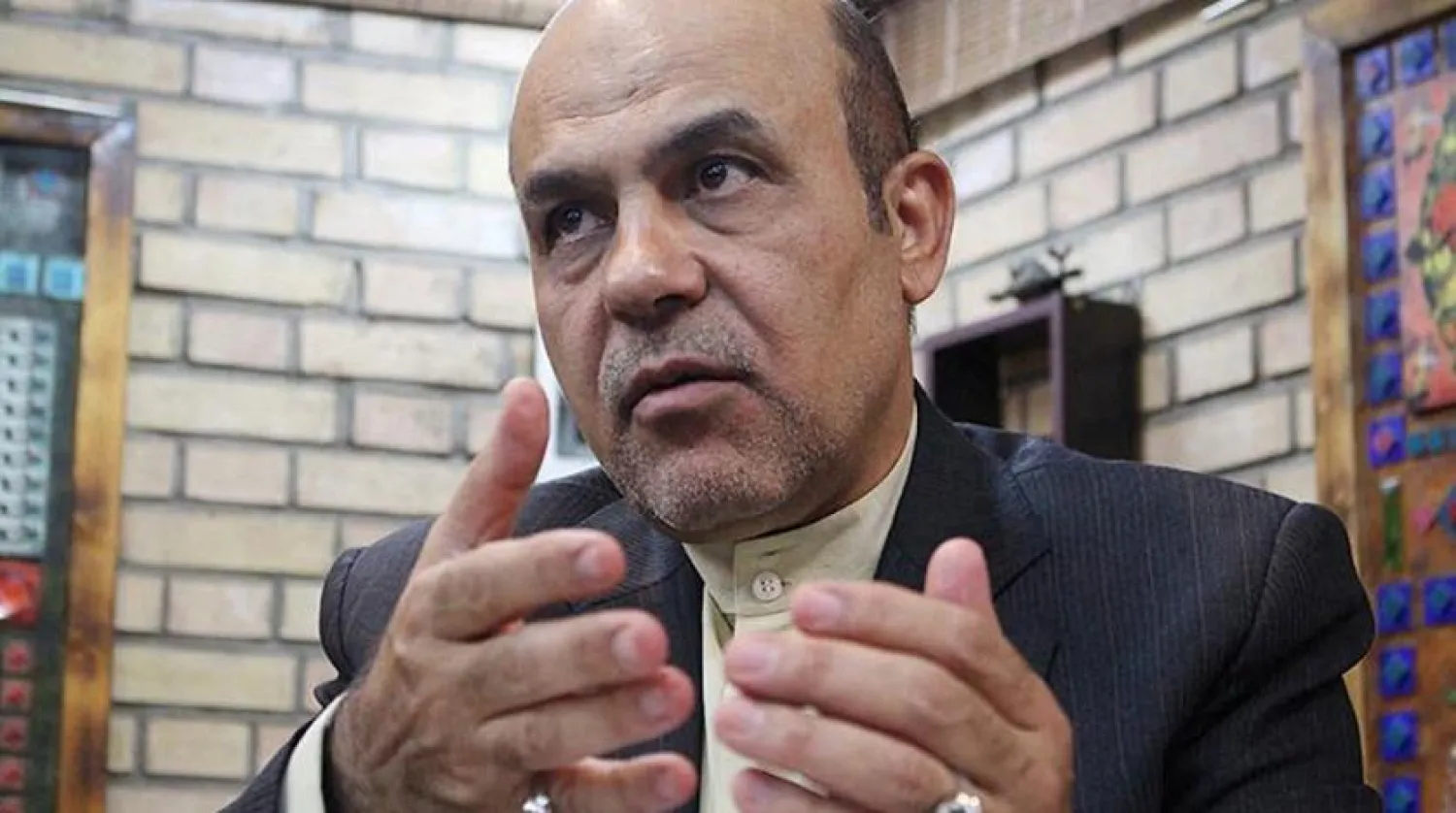
Alireza Akbari, Iran's former deputy defense minister, speaks during an interview with Khabaronline in Tehran, Iran, in this undated picture obtained on January 12, 2023. Khabaronline/WANA (West Asia News Agency)/Handout via Reuters
TT

Iran Executes British-Iranian Accused of Spying, Prompts Western Condemnation 

Alireza Akbari, Iran's former deputy defense minister, speaks during an interview with Khabaronline in Tehran, Iran, in this undated picture obtained on January 12, 2023. Khabaronline/WANA (West Asia News Agency)/Handout via Reuters

Iran has executed a British-Iranian national who once served as its deputy defense minister, its judiciary said, defying calls from London and Washington for his release after he was handed the death sentence on charges of spying for Britain. 

Britain, which had declared the case against Alireza Akbari politically motivated, condemned the execution, with Prime Minister Rishi Sunak calling it "a callous and cowardly act carried out by a barbaric regime". 

Akbari, 61, was arrested in 2019. 

The Iranian judiciary's Mizan news agency reported the execution without saying when it had taken place. Late on Friday, British Foreign Secretary James Cleverly had said Iran must not follow through with the sentence. 

The execution looks set to further worsen Iran's long-strained relations with the West, which have deteriorated since talks to revive its 2015 nuclear deal hit deadlock and as Tehran unleashed a deadly crackdown on protesters last year. 

France and the United States both condemned the execution. 

In an audio recording purportedly from Akbari and broadcast by BBC Persian on Wednesday, he said he had confessed to crimes he had not committed after extensive torture. 

"Alireza Akbari, who was sentenced to death on charges of corruption on earth and extensive action against the country’s internal and external security through espionage for the British government's intelligence service ... was executed," Mizan said. 

The Mizan report accused Akbari of receiving payments of 1,805,000 euros ($1.95 million), 265,000 pounds ($323,989.00), and $50,000 for spying. 

Sunak said on Twitter he was "appalled by the execution", saying Tehran had "no respect for the human rights of their own people".  

Cleverly said in a statement it would "not stand unchallenged", later announcing Britain had imposed sanctions on Iran's prosecutor general. 

US Ambassador to London Jane Hartley called the execution "appalling and sickening". 

The US State Department on Saturday described the execution as being politically motivated and unjust, adding it was working with the UK and other allies to hold Iran accountable for alleged human rights abuses. 

British statements on the case have not addressed the Iranian charge that Akbari spied for Britain. 

Iran's foreign ministry summoned the British ambassador on Saturday over what it called London's "meddling in Iran's national security realm", the state news agency IRNA reported. 

Iranian state media, which have portrayed Akbari as a super spy, broadcast a video on Thursday, which they said showed that he played a role in the 2020 assassination of Iran's top nuclear scientist, Mohsen Fakhrizadeh, killed in an attack outside Tehran which authorities blamed at the time on Israel. 

In the video, Akbari did not confess to involvement in the assassination but said a British agent had asked for information about Fakhrizadeh. 

Iran’s state media often airs purported confessions by suspects in politically charged cases. 

Reuters could not establish the authenticity of the state media video and audio, or when or where they were recorded. 

Akbari was a close ally of Ali Shamkhani, now the secretary of Iran’s Supreme National Security Council, who was defense minister from 1997 to 2005, when Akbari was his deputy as part of the administration of reformist President Mohammad Khatami. 

He fought during the Iran-Iraq war in the 1980s as a member of the Revolutionary Guards. 

It marks a rare case of the Islamic Republic executing a serving or former senior official. One of the last occasions was in 1984, when Iranian navy commander Bahram Afzali was executed after being accused of spying for the Soviet Union. 

‘3,500 hours of torture’ 

French President Emmanuel Macron said the execution was a "despicable and barbaric act". "His name adds to too long a list of victims of repression and the death penalty in Iran," he wrote on Twitter. 

Iran's ties with the West have also been strained by its support for Russia in Ukraine, where Western states say Moscow has used Iranian drones during the invasion. 

Britain, which has a long history of fraught ties with Iran, and other Western states have been fiercely critical of Tehran's crackdown on anti-government protests, sparked by the death in custody of a young Iranian-Kurdish woman in September. 

Iran has issued dozens of death sentences as part of the crackdown, executing at least four people. 

In the audio recording broadcast by BBC Persian, Akbari said he had made false confessions as a result of torture. 

"With more than 3,500 hours of torture, psychedelic drugs, and physiological and psychological pressure methods, they took away my will. They drove me to the brink of madness... and forced me to make false confessions by force of arms and death threats," he said. 

Amnesty International said the execution displayed again Tehran's "abhorrent assault on the right to life". 

In Akbari's case "it is particularly horrific given the violations he revealed he was subjected to in prison," it said in a Tweet. 

The Iranian authorities have not responded to accusations that Akbari was tortured. 

An Iranian state TV report - details of which Reuters could not independently verify - said he was arrested on espionage charges in 2008 before he was freed on bail and left Iran. 

It 2009 he went to Austria under the pretext of medical treatment, then to Spain and eventually to England, the report said. 

In an interview with BBC Persian broadcast on Friday, Akbari's brother Mehdi said he had returned to Iran in 2019 based on an invitation from Shamkhani. 


N. Korea Flexes Nuclear-capable Rocket Launcher Ahead of Key Congress

A photo released by the official Korean Central News Agency (KCNA) shows North Korean leader Kim Jong Un (C), accompanied by his daughter Kim Ju Ae (R), overseeing a test-fire of a large-caliber multiple-rocket launcher system at an unknown location in North Korea, 27 January 2026 (issued 28 January 2026). EPA/KCNA  EDITORIAL USE ONLY
A photo released by the official Korean Central News Agency (KCNA) shows North Korean leader Kim Jong Un (C), accompanied by his daughter Kim Ju Ae (R), overseeing a test-fire of a large-caliber multiple-rocket launcher system at an unknown location in North Korea, 27 January 2026 (issued 28 January 2026). EPA/KCNA EDITORIAL USE ONLY
TT

N. Korea Flexes Nuclear-capable Rocket Launcher Ahead of Key Congress

A photo released by the official Korean Central News Agency (KCNA) shows North Korean leader Kim Jong Un (C), accompanied by his daughter Kim Ju Ae (R), overseeing a test-fire of a large-caliber multiple-rocket launcher system at an unknown location in North Korea, 27 January 2026 (issued 28 January 2026). EPA/KCNA  EDITORIAL USE ONLY
A photo released by the official Korean Central News Agency (KCNA) shows North Korean leader Kim Jong Un (C), accompanied by his daughter Kim Ju Ae (R), overseeing a test-fire of a large-caliber multiple-rocket launcher system at an unknown location in North Korea, 27 January 2026 (issued 28 January 2026). EPA/KCNA EDITORIAL USE ONLY

North Korean leader Kim Jong Un has unveiled a battery of huge nuclear-capable rocket launchers ahead of a key congress of the nation's ruling party, state media said Thursday.

Kim is expected to detail the next phase in North Korea's nuclear weapons program when he opens a rare congress of the ruling Workers' Party in coming days.

The 600-mm multiple launch rocket system was front and center as preparations ramped up for the once-in-five-years gathering, widely viewed as North Korea's most important political event.

"When this weapon is used actually, no force would be able to expect God's protection," Kim said, according to the Korean Central News Agency.

"It is really a wonderful and attractive weapon."

Photos released by state media showed dozens of launch vehicles parked in neat rows on the plaza of Pyongyang's House of Culture, which will host the congress.

The weapon was "appropriate for a special attack, that is, for accomplishing a strategic mission", Kim told a ceremony on Wednesday, using a common euphemism for nuclear weapons.

He said the weapons system -- which was presented to the congress as a gift from munitions workers -- would deter unnamed enemies.

"There is no need to further explain about its destructive power and military value," AFP quoted Kim as saying.

"This is because it can reduce the aimed target to ashes through surprise and simultaneous attack by focusing its destructive energy."

The launch system could fire rockets with an estimated range of 400 kilometers (250 miles), covering all of South Korea, said analyst Hong Min from the Korea Institute for National Unification.

"Its primary purpose is to neutralize the combined air power of South Korea and the United States," he told AFP.

"If equipped with tactical nuclear warheads, a single battery firing four to five rounds could devastate an entire airbase."

South Korea's capital Seoul is less than 50 kilometers (30 miles) from the border at its nearest point.

Analysts believe North Korea would use its vast artillery arsenal to launch saturation strikes on the South should fighting break out.

Kim ordered the expansion and modernization of missile production in the months leading up to the Workers' Party congress.

Pyongyang has also significantly stepped up missile testing.


Iran Says No Country Can Deprive it of Enrichment Rights

A handout photo made available by Iran's Revolutionary Guard Corps (IRGC)'s official website Sepahnews on 17 February 2026 shows IRGC conducting a military drill in the Strait of Hormuz, in the Arabian gulf, southern Iran. EPA/SEPAHNEWS HANDOUT
TT

Iran Says No Country Can Deprive it of Enrichment Rights

A handout photo made available by Iran's Revolutionary Guard Corps (IRGC)'s official website Sepahnews on 17 February 2026 shows IRGC conducting a military drill in the Strait of Hormuz, in the Arabian gulf, southern Iran. EPA/SEPAHNEWS HANDOUT

Iran's atomic energy chief Mohammad Eslami said no country can deprive the Iranian republic of its right to nuclear enrichment, after US President Donald Trump again hinted at military action following talks in Geneva.

"The basis of the nuclear industry is enrichment. Whatever you want to do in the nuclear process, you need nuclear fuel," said Eslami, according to a video published by Etemad daily on Thursday.

"Iran's nuclear program is proceeding according to the rules of the International Atomic Energy Agency, and no country can deprive Iran of the right to peacefully benefit from this technology."

The comments follow the second round of Oman-mediated talks between Tehran and Washington in Geneva on Tuesday.

The two foes had held an initial round of discussions on February 6 in Oman, the first since previous talks collapsed during the 12-day Iran-Israel war in June.

The United States briefly joined the war alongside Israel, striking Iranian nuclear facilities.

On Wednesday, Trump again suggested the United States might strike Iran in a post on his Truth Social site.

He warned Britain against giving up sovereignty over the Chagos Islands in the Indian Ocean, saying that the archipelago's Diego Garcia airbase might be needed were Iran not to agree a deal, "in order to eradicate a potential attack by a highly unstable and dangerous regime".

Washington has repeatedly called for zero enrichment, but has also sought to address Iran's ballistic missile program and its support for militant groups in the region -- issues which Israel has pushed to include in the talks.

Western countries accuse the Iranian republic of seeking to acquire nuclear weapons.

Tehran denies having such military ambitions but insists on its right to this technology for civilian purposes.

Trump, who has ratcheted up pressure on Iran to reach an agreement, has deployed a significant naval force to the region, which he has described as an "armada".

After sending the aircraft carrier USS Abraham Lincoln and escort battleships to the Gulf in January, he recently indicated that a second aircraft carrier, the Gerald Ford, would depart "very soon" for the Middle East.

Separately, the Iranian and Russian navies were conducting joint drills in the Sea of Oman and the northern Indian Ocean on Thursday.


Karachi Building Collapse after Blast Kills 16

Rescue workers and people gather at the site of a residential compound following a suspected gas leakage blast in Karachi, Pakistan, 19 February 2026. EPA/REHAN KHAN
TT

Karachi Building Collapse after Blast Kills 16

Rescue workers and people gather at the site of a residential compound following a suspected gas leakage blast in Karachi, Pakistan, 19 February 2026. EPA/REHAN KHAN

A building collapse caused by an explosion in Pakistan's southern megacity of Karachi killed at least 16 people on Thursday, including children, officials said.

More than a dozen people were injured in the incident in the Soldier Bazaar neighborhood of Karachi at around 4:00 am, when Muslim families start preparing Sehri, the pre-sunrise meal eaten during Ramadan.
