


Syrian Govt Approves Aid Delivery across Frontlines

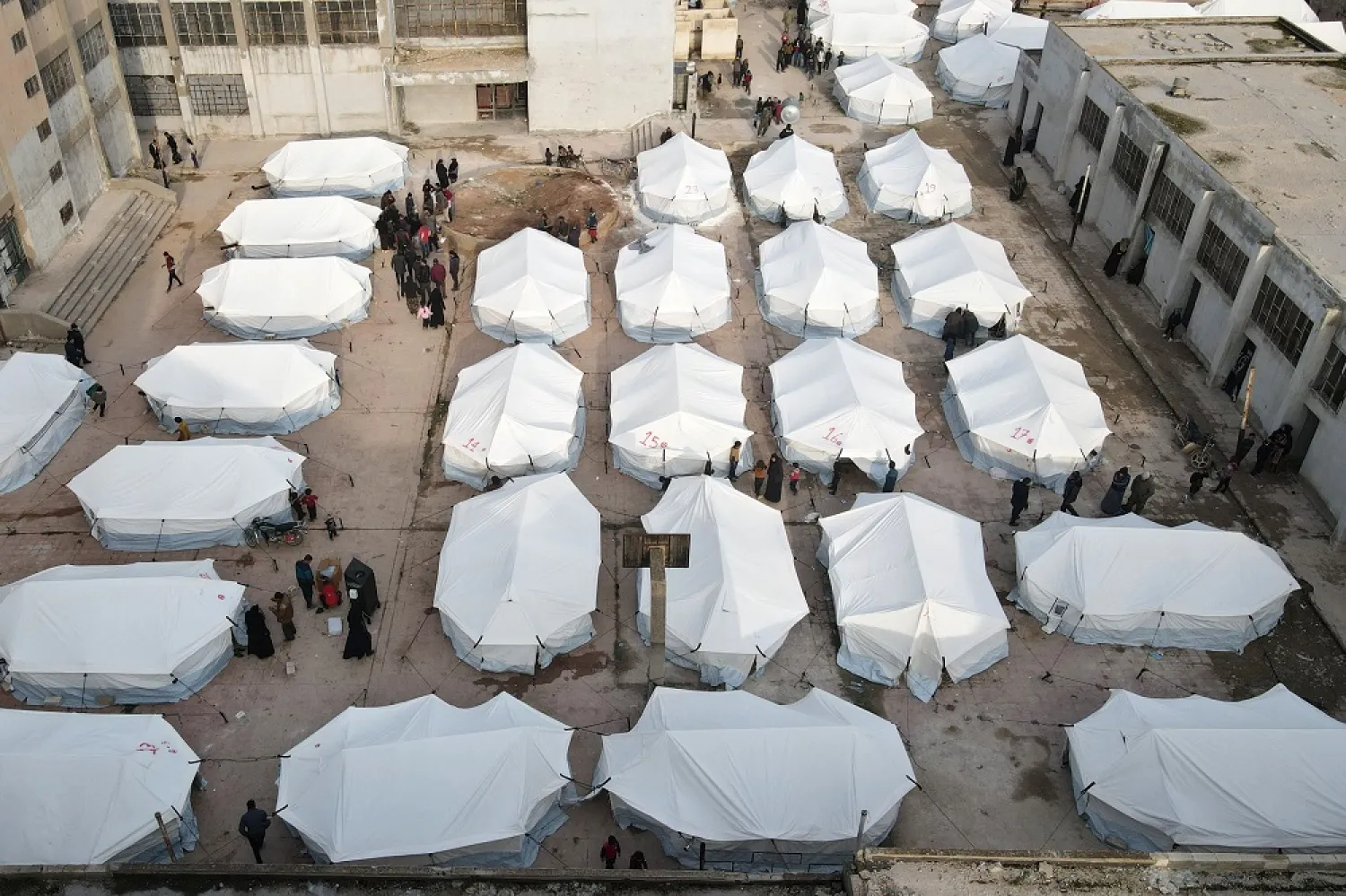
This aerial view shows a makeshift camp set up to temporarily host Syrians who were made homeless after a devastating earthquake hit their country, in a school in the town of Atareb in the opposition-held western countryside of Aleppo province, on February 10, 2023. (AFP)
TT

Syrian Govt Approves Aid Delivery across Frontlines

This aerial view shows a makeshift camp set up to temporarily host Syrians who were made homeless after a devastating earthquake hit their country, in a school in the town of Atareb in the opposition-held western countryside of Aleppo province, on February 10, 2023. (AFP)

Syria's government has approved humanitarian aid delivery across the frontlines of the country's 12-year-old war, state media said on Friday, a move that could speed up the arrival of help for millions of people affected by Monday's deadly quake.

Aid distribution will take place in cooperation with the United Nations, the International Committee of the Red Cross and the Syrian Arab Red Crescent, state media said, to "guarantee the arrival of this aid to those who need it".

It did not say when deliveries would take place.

The United Nations has pushed for aid to flow more freely into Syria, especially into the country's northwest - an area controlled by rebels opposed to President Bashar al-Assad - via frozen frontlines and through crossings with Türkiye.

The world body has delivered aid to the northwest since 2014 via Türkiye, bypassing territory controlled by Assad.

The Syrian government, which lost control over swathes of territory during the war including nearly all of its border with Türkiye, has long objected to the cross-border operation, saying it breaches Syrian sovereignty.

Aid has seldom moved from government-held territory to the northwest, where many Syrians fled to escape Assad's rule and some 4 million people were in need of aid before the earthquake made their predicament even worse.

More than 3,200 people have died in Syria from the earthquake, with many more injured and hundreds of thousands displaced. Turkish President Recep Tayyip Erdogan said on Friday that the death toll in Türkiye had risen to 19,388.

Dozens of planeloads of aid have arrived in areas held by Assad's government since Monday but little has reached the northwest, leading many residents to say they feel left alone.

State media reported that the government had also declared areas worst affected by the quake, Lattakia, Hama, Aleppo and Idlib, disaster zones and would set up a rehabilitation fund.



Hochstein in Beirut: No Time to Waste to Reach Diplomatic Solution

Lebanese Parliament Speaker Nabih Berri (R) meets with the Senior Advisor to US President, Amos Hochstein (L) in Beirut, Lebanon, 14 August 2024. (EPA)
TT

Hochstein in Beirut: No Time to Waste to Reach Diplomatic Solution

Lebanese Parliament Speaker Nabih Berri (R) meets with the Senior Advisor to US President, Amos Hochstein (L) in Beirut, Lebanon, 14 August 2024. (EPA)

US special envoy Amos Hochstein stressed from Beirut on Wednesday that there was no longer time to waste to reach a ceasefire in Gaza that would in turn lead to a diplomatic solution that would end the escalation between Hezbollah and Lebanon.

Hochstein, tasked with shuttle diplomacy between Lebanon and Israel, spoke to journalists after meeting Lebanese Parliament Speaker Nabih Berri, as the region anxiously anticipates retaliatory attacks from Iran and the allied Lebanese Hezbollah group on Israel.

Hochstein did not arrive to Lebanon from Tel Aviv, as was expected. Rather, he flew in on a Lebanese Middle East Airlines flight from a European country.

He met with Berri, caretaker Prime Minister Najib Mikati, army commander Joseph Aoun and a number of opposition MPs.

Berri, a key Hezbollah ally, told Asharq Al-Awsat that the meeting was Hochstein was “reassuring”, saying: “The situation today is better than yesterday.”

Hochstein’s visit is a message from US President Joe Biden that “he hasn’t forgotten about Lebanon.”

Berri did not divulge the details of the more than an hour-long meeting with Hochstein, but his comments align with information that said the envoy had requested during his meetings in Lebanon that escalation be avoided before the upcoming Gaza ceasefire talks.

Berri said: “Strong efforts are being exerted to reach a ceasefire.” He spoke of “very intense pressure to reach an agreement that should reflect positively on Lebanon.”

Speaking to reporters after his talks with Berri, Hochstein stated that they discussed the framework of the ceasefire and “we agreed that “there is no more time to waste and there's no more valid excuses from any party for any further delay.”

“The deal would also help enable a diplomatic resolution here in Lebanon,” the envoy added.

It is critical to take advantage of “this window for diplomatic action” to end the Israel-Hamas war in Gaza, he stressed, adding that now was the right time.

“The more time goes by of escalated tensions, the more time goes by of daily conflict, the more the odds and the chances go up for accidents, for mistakes, for inadvertent targets to be hit that could easily cause escalation that goes out of control,” Hochstein warned.

Moreover, he revealed he believed that a solution to the conflict could be reached “today”, adding that he realizes that some parties want to tie it to other conflicts. “This is not our position,” he noted.

"We continue to believe that a diplomatic resolution is achievable because we continue to believe that no one truly wants a full-scale war between Lebanon and Israel," Hochstein stressed.

For his part, Berri urged the need to end the Israeli war on Gaza and Lebanon, expressing his “great alarm” with Israel’s political and military escalation, citing the assassinations of Hamas politburo chief Ismail Haniyeh in Tehran and top Hezbollah military commander Fuad Shukr in Beirut last month.

He also cited its ongoing massacres against the Palestinian people, the latest of which took place at a school over the weekend and left scores dead.

“This policy demonstrates Israel’s determination to go ahead with the military escalation and scuttling any effort to stop the war,” remarked the speaker.

He added that Lebanon is committed to extending the term of the United Nations Interim Force in Lebanon (UNIFIL) in line with resolution 1701.

Lebanon has been demanding the full implementation of the resolution since its adoption in 2006, he declared.