
Hezbollah Pressure on Military Court Undermines Lebanon’s Weapons Ban

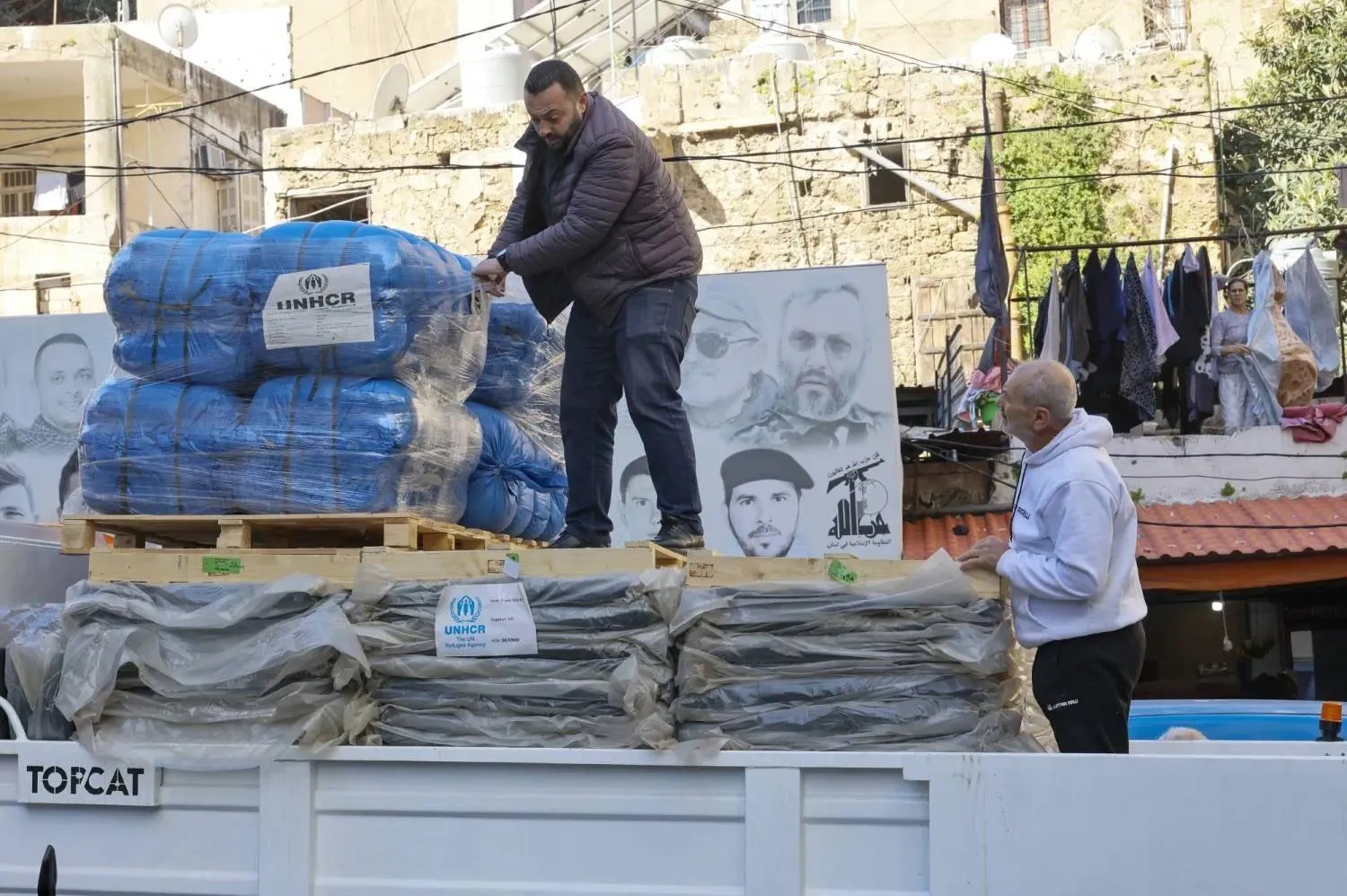
Blankets are distributed at a school converted into a shelter in Beirut, where a banner displaying images of leaders and members of Hezbollah can be seen (EPA). 
TT

Hezbollah Pressure on Military Court Undermines Lebanon’s Weapons Ban

Blankets are distributed at a school converted into a shelter in Beirut, where a banner displaying images of leaders and members of Hezbollah can be seen (EPA). 

Lebanon’s government decision to prohibit any military or security activity by Hezbollah has yet to translate into meaningful enforcement.

Hezbollah has continued to escalate its military operations, launching rockets and drones toward Israeli territory, while signs of deteriorating security have appeared inside Lebanon, particularly among displaced residents who have fled southern Lebanon and Beirut’s southern suburbs.

Security agencies have struggled to identify those responsible for launching rockets toward Israel. However, Lebanese forces recently recorded a notable development with the arrest of around 30 individuals affiliated with or supportive of Hezbollah.

The detainees were apprehended while fleeing alongside civilians from southern areas and the southern suburbs of Beirut after being found carrying individual weapons, including assault rifles, pistols and grenades.

The arrests appeared to signal a tentative shift in how Lebanon’s security and judicial institutions handle the issue of illegal weapons. Yet the move quickly ran up against what officials say is Hezbollah’s continuing influence over judicial decisions.

Last week, the military court tried three Hezbollah members detained days earlier. The court imposed a fine of 900,000 Lebanese pounds —about $10 — on each of them for possessing unlicensed military weapons and waived any prison sentence.

The ruling diverges sharply from typical sentences in similar cases, where possession or transport of unlicensed weapons usually carries at least a one-month prison term.

Judicial sources say the unusually lenient sentence reflects pressure exerted by Hezbollah on the military court to secure the release of its detained members.

According to the sources, the group sought their release last Thursday and pushed for their trial to be held the following day. The military prosecutor’s office objected, resulting in the hearing being postponed until Monday.

The verdict also drew criticism from the government commissioner to the military court, Judge Claude Ghanem, who promptly appealed the ruling before the Military Court of Cassation, requesting tougher penalties.

A judicial source told Asharq Al-Awsat that the ruling was “extremely lenient and failed to account for all the legal provisions under which the suspects were charged.” The source added that the commissioner had received preliminary investigation files concerning four additional detainees and was preparing to file charges against them in the coming hours while seeking stricter sentences.

Only hours after the verdict was issued, Lebanese Justice Minister Adel Nassar ordered that the civilian adviser to the military tribunal, Judge Abbas Jaha, be referred to the Judicial Inspection Authority for investigation.

A Justice Ministry source told Asharq Al-Awsat that the referral stemmed from “the circumstances surrounding the trial and his failure to object to this suspicious ruling.” The source noted that another member of the court panel, a military officer, had opposed the decision while Jaha approved it without reservation.

Weapons and rising tensions in host communities

Legally, the arrest of armed Hezbollah members represents a direct application of the government decision banning any military or security activity by the group. In principle, the ruling applies to anyone carrying weapons outside state authority and places them under threat of prosecution.

The more pressing challenge, however, lies in dealing with armed individuals among displaced populations.

Several neighborhoods in Beirut, including Hamra, Ras Beirut, Sakiat al-Janzir and Ain al-Remmaneh, as well as the towns of Aramoun and Kfarshima in Mount Lebanon, have witnessed repeated incidents involving gunfire, displays of weapons and confrontations with local residents.

Videos circulating on social media show armed men threatening residents, including footage recorded Sunday in Aramoun.

These incidents have heightened anxiety among host communities already grappling with mounting social and economic pressures.

Some residents say the security measures in place remain “below the required level,” arguing that the absence of deterrent action risks encouraging further incidents and creating the impression that the law is applied hesitantly when those involved are linked to Hezbollah.

A Lebanese security source, however, insisted that authorities treat all security incidents seriously. Delays in reaching certain locations, the source said, often result from limited personnel and the difficulty of maintaining coverage across all displacement areas.

Security forces maintain a near-permanent presence at the entrances of schools and facilities housing displaced people, the source added, while most incidents occur in nearby streets and neighborhoods. Patrols respond immediately to reports of gunfire or clashes, detaining suspects or pursuing them if they leave the scene.

Nevertheless, the official acknowledged that the continued incidents could lead to broader friction between displaced populations and local residents — particularly in densely populated areas — at a time when host communities are already under severe economic strain and displacement is expected to continue for months.



Arab League, Arab Parliament Condemn Closure of Al-Aqsa Mosque

A view of the Aqsa Mosque is pictured in Old City of Jerusalem on March 6, 2026.  (Photo by AHMAD GHARABLI / AFP)
A view of the Aqsa Mosque is pictured in Old City of Jerusalem on March 6, 2026. (Photo by AHMAD GHARABLI / AFP)
TT

Arab League, Arab Parliament Condemn Closure of Al-Aqsa Mosque

A view of the Aqsa Mosque is pictured in Old City of Jerusalem on March 6, 2026.  (Photo by AHMAD GHARABLI / AFP)
A view of the Aqsa Mosque is pictured in Old City of Jerusalem on March 6, 2026. (Photo by AHMAD GHARABLI / AFP)

The General Secretariat of the Arab League expressed deep concern over the continued measures by the Israeli occupation authorities to close Al-Aqsa Mosque to Muslim worshippers, particularly during the holy month of Ramadan, considering this a violation of freedom of worship and an infringement of the historical and legal status quo of the holy sites in the city of Jerusalem.

In a statement issued Thursday, the General Secretariat stressed that Al-Aqsa Mosque holds a special religious and historical status for Muslims around the world, and that any measures restricting access to it or hindering the performance of religious rituals there could lead to an escalation of tensions and undermine efforts to achieve calm and stability, SPA reported.

The Arab League called on the international community and concerned organizations to assume their responsibilities to protect the holy sites and preserve the historical and legal status quo in Jerusalem, stressing that respect for holy sites and freedom of worship are fundamental to maintaining stability and enhancing prospects for peace in the region.

Also, the speaker of the Arab Parliament Mohammed bin Ahmed Al-Yamahi condemned the Israeli occupation's ongoing measures that close the Al-Aqsa Mosque and the Haram Al-Sharif to Muslim worshippers, particularly during Ramadan. He described these actions as violations of the freedom of worship and an infringement on the historical status quo in occupied Jerusalem.

Al-Yamahi stated that restricting access to Al-Aqsa Mosque is a troubling escalation that provokes Muslims globally and reflects efforts to alter the city's Arab and Islamic identity. He emphasized that the Al-Aqsa Mosque, covering 144 dunams, is exclusively for Muslim worship.

He warned that such restrictions would heighten tensions in the region and expressed concern over violations at the Ibrahimi Mosque in Hebron. He called on the international community, including the United Nations, to protect the holy sites in Jerusalem and ensure respect for the historical status of Islamic and Christian sacred sites.


Iraq to Keep Crude Output at 1.4 million bpd amid Hormuz Tensions, Oil Minister Says

Technicians working at the Majnoon oil field in Basra, Iraq. (Reuters)
TT

Iraq to Keep Crude Output at 1.4 million bpd amid Hormuz Tensions, Oil Minister Says

Technicians working at the Majnoon oil field in Basra, Iraq. (Reuters)

Iraq will keep crude oil production at around 1.4 million barrels per day, Oil Minister Hayan Abdel-Ghani ​was quoted as saying on Thursday, less than a third of the level before the US-Israeli conflict with Iran.

According to the state news agency, the minister said that 200,000 bpd is being transported by truck through Türkiye, Syria, and Jordan ‌and that ‌Iraq has put in ​place ‌a ⁠plan ​to manage ⁠the current disruptions.

Oil production from Iraq's main southern oilfields, where most of its oil is produced and exported, has plunged 70% to just 1.3 million bpd, sources told Reuters on March 8, as the country ⁠is unable to export via the ‌Gulf due to ‌the war.

The drop in ​production and exports ‌is set to strain Iraq's already fragile finances ‌as the state relies on crude sales for nearly all public spending and more than 90% of its income.

Under pressure to mitigate ‌the losses, the oil ministry has asked the Kurdistan Regional Government (KRG) if ⁠it ⁠would pump at least 100,000 bpd from its state-managed Kirkuk oilfields to Türkiye's Ceyhan port, sources told Reuters on Wednesday. The ministry said the KRG has not yet responded to the request.

Abdel-Ghani was quoted as saying on Thursday that Iraq will sign an agreement on exporting oil through the Ceyhan pipeline, but he did not ​give further details. 


51 Crew Rescued, 1 Dead after Attack on Tankers Off Iraq

An oil tanker burns after being hit by an Iranian strike in the ship-to-ship transfer zone at Khor al-Zubair port near Basra, Iraq, late Wednesday, March 11, 2026. (AP Photo)
TT

51 Crew Rescued, 1 Dead after Attack on Tankers Off Iraq

An oil tanker burns after being hit by an Iranian strike in the ship-to-ship transfer zone at Khor al-Zubair port near Basra, Iraq, late Wednesday, March 11, 2026. (AP Photo)

More than 50 crew members were rescued after an attack on two oil tankers in Iraq's territorial waters, Farhan al-Fartousi of the port authorities told AFP.

Fartousi, from Iraq's General Company for Ports, said "all crew members of the two tankers were rescued," adding that the 51 workers were in good condition.

The attack killed at least one crew member, an Indian national.

Iran's Revolutionary Guards said Thursday they had struck a Marshall Islands-flagged ship, which they claimed was US-owned, in the north of the Gulf.

The vessel, Safesea Vishnu, came under attack March 11 while operating near Basra, India’s embassy said.

The remaining 15 Indian crew members were evacuated and are safe, the embassy added.