


US Still in Dark over Mystery Flying Objects, Rejects China Balloon Accusation

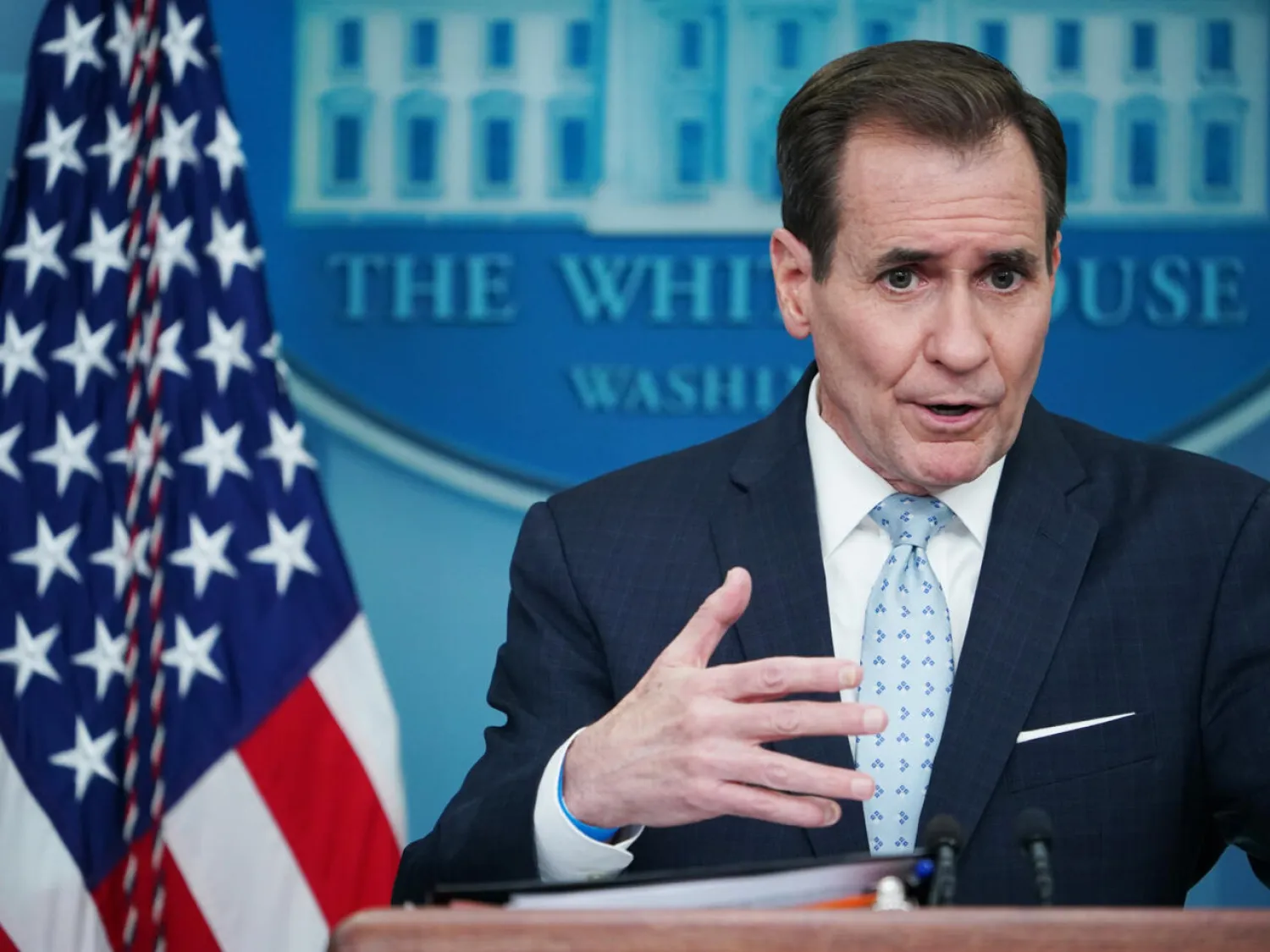
National Security Council spokesman John Kirby addressed growing speculation over the spate of unidentified objects shot down over North America. MANDEL NGAN / AFP
TT

US Still in Dark over Mystery Flying Objects, Rejects China Balloon Accusation

National Security Council spokesman John Kirby addressed growing speculation over the spate of unidentified objects shot down over North America. MANDEL NGAN / AFP

The White House responded Monday to growing and at times fevered speculation over the shooting down of unidentified aerial objects by saying the targets could be anything from commercial craft to espionage devices, while denying that US balloons spy on China.

After mounting pressure on President Joe Biden's administration to explain the unprecedented situation that has seen an alleged Chinese spy balloon and three mystery objects shot down in North America in just over a week, officials appeared sure of only one thing: It's not aliens, AFP said.

"I just wanted to make sure we address this from the White House," Biden's press secretary, Karine Jean-Pierre said at the top of the first full-blown briefing since the latest shoot-down of an unidentified object Sunday.

"There have been questions and concerns about this but there is no -- again, no -- indication of aliens or extraterrestrial activity."

What actually is going on, however, remains unclear.

According to the US government, the first of the four objects -- a sophisticated, high-altitude balloon shot down on February 4 off the coast of South Carolina -- was part of an ongoing, global "fleet" of Chinese espionage balloons.

China denied this, calling the huge balloon an errant weather research craft, and lashed out at Washington on Monday. Beijing said more than 10 US balloons entered Chinese airspace "without any approval" over the last year.

As for another high-altitude balloon spotted in Latin America, China says that was a civilian flight test device.

White House National Security Council spokesman John Kirby told reporters the US is "not flying surveillance balloons over China."

"I'm not aware of any other craft that we're flying over into Chinese airspace," he said.

- Uncertain origins, objectives -
The United States says the large Chinese balloon down on February 4 was obviously a spy craft and that the debris is currently being plucked from the Atlantic Ocean for analysis.

Crews have recovered important sensor and electronics parts from the balloon, as well as large parts of the structure, the US military said Monday.

The other three unidentified objects -- shot down Friday over Alaska, Saturday over the Yukon in Canada, and Sunday over Lake Huron on the US-Canadian border -- were much smaller, less sophisticated, and were flying lower than the Chinese balloon from earlier this month.

US officials know little about them -- not even to whom they belonged.

"Countries, companies, research and academic organizations operate objects at these altitudes for purposes that are not nefarious at all, including scientific research," Kirby said.

Whether they were spying also remains unknown.

"Even if we have no indications that any of these three objects were surveilling, we couldn't rule that out," he said.

Officials also say that the perceived increase in incidents could be due to an adjustment in radar settings after February 4, which means items once passing unseen are now caught.

"One of the reasons that we think we're seeing more is because we're looking for more," Kirby said.

The truth will not be clear until debris is collected and that is not simple, either.

In the case of the large Chinese balloon, sea conditions made diving impossible Monday, Kirby said, while the three subsequent craft were brought down in "pretty remote, difficult areas to reach."

Canadian Public Safety Minister Marco Mendicino called the location of the debris of the unidentified object shot down over the Yukon on Saturday "extremely challenging and difficult to access."

- China tensions -
In Washington, the extraordinary events are fueling already intense suspicion about China across both the Democratic and Republican parties -- a trend likely to grow as the 2024 presidential election approaches.

The diplomatic fallout has already been substantial, with Secretary of State Antony Blinken abruptly canceling a rare visit to Beijing.

China's accusations of US spying prompted National Security Council spokeswoman Adrienne Watson to allege that Beijing has a high-altitude spying program that has violated the airspace of "40 countries across five continents."

The State Department said China was "scrambling to do damage control" and that the communist government "has failed to offer any credible explanations for its intrusion into our airspace."

But over the weekend, Chinese state-affiliated media reported that an unidentified flying object had been spotted off the country's east coast and that the military was preparing to shoot it down.

Beijing on Monday declined to comment on that report, referring journalists to the defense ministry, which did not respond to requests for comment from AFP.



Kremlin Says Ukraine Not Joining in NATO Is a Fundamental Issue 

In this pool photograph distributed by the Russian state agency Sputnik, Kremlin spokesman Dmitry Peskov attends a meeting of Russia's President with Iranian President in Ashgabat on December 12, 2025. (Sputnik/AFP)
TT

Kremlin Says Ukraine Not Joining in NATO Is a Fundamental Issue 

In this pool photograph distributed by the Russian state agency Sputnik, Kremlin spokesman Dmitry Peskov attends a meeting of Russia's President with Iranian President in Ashgabat on December 12, 2025. (Sputnik/AFP)

The Kremlin said on Monday that Ukraine not joining the US-led NATO military alliance was a fundamental question in talks on a possible peace settlement and that it was the subject of special discussion.

"Naturally this issue is one of the cornerstones and, of course, it is subject to special discussion," Kremlin spokesman Dmitry Peskov told reporters.

Peskov said that Russia expects an update from the US after US talks with European countries and Ukraine in Berlin.

Russian President Vladimir Putin has repeatedly demanded Ukraine officially renounce its NATO ambitions and withdraw troops from the about 10% of Donbas which Kyiv still controls.

Moscow has also said Ukraine must be a neutral country and no NATO troops can be stationed in Ukraine.


Ukraine Peace Talks Stretch into Second Day at Start of Pivotal Week for Europe

Ukraine's President Volodymyr Zelenskiy shakes hands with US Special Envoy to the Middle East Steve Witkoff next to U.S. President Donald Trump's son-in-law Jared Kushner, German Chancellor Friedrich Merz and NATO Supreme Allied Commander Europe (SACEUR), US Air Force General Alexus Grynkewich, amid Russia's attack on Ukraine, in Berlin, Germany, December 14, 2025. Ukrainian Presidential Press Service/Handout via REUTERS
TT

Ukraine Peace Talks Stretch into Second Day at Start of Pivotal Week for Europe

Ukraine's President Volodymyr Zelenskiy shakes hands with US Special Envoy to the Middle East Steve Witkoff next to U.S. President Donald Trump's son-in-law Jared Kushner, German Chancellor Friedrich Merz and NATO Supreme Allied Commander Europe (SACEUR), US Air Force General Alexus Grynkewich, amid Russia's attack on Ukraine, in Berlin, Germany, December 14, 2025. Ukrainian Presidential Press Service/Handout via REUTERS

Ukrainian President Volodymyr Zelenskiy will resume talks with US President Donald Trump's envoys in Berlin on Monday, after the US side said a "lot of progress" had been made on ending Europe's deadliest conflict since World War Two.

Zelenskiy will again meet US envoy Steve Witkoff and Trump's son-in-law Jared Kushner after five hours of talks on Sunday, with other European leaders also holding meetings in the German capital throughout the day.

Ukraine said on Sunday it was willing to drop its ambition to join the NATO alliance in exchange for Western security guarantees. But it was not immediately clear how far talks had progressed on that or other vital issues such as the future of Ukrainian territory, and how much the talks in Berlin could persuade Russia to agree to a ceasefire.

EUROPEAN DIPLOMACY FACES CRUCIAL WEEK

The talks come at the start of a pivotal week for Europe, with an EU summit on Thursday set to decide whether it can underwrite a massive loan to Ukraine with frozen Russian central bank assets.

Europe has come under fire from the Trump administration in recent weeks over its policies on migration, security and regulating big tech. The European Union and national governments have struggled to find a unified response to the US criticism.

EU foreign ministers are meeting in Brussels on Monday to agree on new sanctions against Russia, although the possibility of an 11th-hour hitch to agreeing an EU trade deal with Latin America threatens to further undermine their attempts to put on a show of strength.

"We will continue to do everything we can to ensure that Ukraine can achieve the best possible negotiating position and, in the event of failure, that it has all the necessary means to retaliate against this war of aggression," German Foreign Minister Johann Wadephul told Deutschlandfunk radio.

Finnish President Alexander Stubb, who has been closely involved in the Ukraine talks and was meeting Zelenskiy on Monday morning ahead of the US negotiations, sounded a tentatively hopeful note.

"I think we are at a critical moment in negotiations for peace," he told Dutch TV program Buitenhof broadcast on Sunday.

"And at the same time, we're probably closer to a peace agreement than we have been at any time during these four years," said Stubb, who also met Kushner in Berlin on Sunday evening.

SECURITY GUARANTEES AMONG ISSUES IN FOCUS

Stubb said the sides were working on three main documents - the framework of a 20-point peace plan, one relating to security guarantees for Ukraine, and a third on reconstruction of the country.

"So we're looking at the details together with the Americans, Europeans, and the Ukrainians," he added.

European Commission President Ursula von der Leyen and the leaders of Britain, Italy, the Netherlands, Poland and Sweden were among those expected in the German capital on Monday.

Russian President Vladimir Putin has repeatedly demanded that Ukraine officially renounce its NATO ambitions and withdraw troops from the roughly 10% of the eastern Donbas region which Kyiv still controls.

Moscow has also said that Ukraine must be a neutral country and that no NATO troops can be stationed there.

Russian sources earlier this year said Putin wants a "written" pledge by major Western powers not to enlarge the US-led NATO alliance eastwards - shorthand for formally ruling out membership to Ukraine, Georgia, Moldova and other former Soviet republics.

EU foreign policy chief Kaja Kallas said on Monday that taking over Ukraine's Donbas region will "not be Putin's endgame".

"We have to understand that if he gets Donbas, then the fortress is down and then they definitely move on to taking the whole of Ukraine," Kallas, a former Estonian prime minister, told reporters.

"If Ukraine goes, then other regions are also in danger."


‘Hero’ Who Disarmed Bondi Gunman Recovering After Surgery, Family Says 

People gather around a tribute for shooting victims outside the Bondi Pavilion at Sydney's Bondi Beach, Monday, Dec. 15, 2025, a day after a shooting. (AP)
TT

‘Hero’ Who Disarmed Bondi Gunman Recovering After Surgery, Family Says 

People gather around a tribute for shooting victims outside the Bondi Pavilion at Sydney's Bondi Beach, Monday, Dec. 15, 2025, a day after a shooting. (AP)

A Sydney resident who wrestled a gun from one of the alleged attackers during the mass shooting at Bondi Beach is recovering in hospital after undergoing surgery for bullet wounds to his arm and hand, his family said.

Forty-three-year-old Ahmed al Ahmed was identified on social media as the bystander who hid behind parked cars before charging at the gunman from behind, seizing his rifle and knocking him to the ground.

Australian police on Monday said a 50-year-old father and his 24-year-old son carried out the attack at a Jewish celebration at Bondi Beach on Sunday afternoon, killing 15 people in the country's worst mass shooting in almost 30 years.

Jozay Alkanji, cousin of Ahmed al Ahmed, speaking while he was leaving the hospital in Sydney on Monday evening said: "He's done the first surgery. I think he's got two or three surgeries, that depends on the doctor, what he says."

Tributes have poured in from leaders both abroad and at home.

US President Donald Trump called Ahmed "a very, very brave person" who saved many lives. Chris Minns, the premier of New South Wales state where Sydney is located, has hailed him "a genuine hero" and said the video was "the most unbelievable scene I've ever seen".

A GoFundMe campaign has been set up for Ahmed with just over A$200,000 ($132,900) raised in a few hours. Billionaire hedge fund manager Bill Ackman was the largest donor, contributing A$99,999 and sharing the fundraiser on his X account.

Outside St George Hospital in the Sydney suburb of Kogarah where Ahmed is being treated, complete strangers came to show their support.

Misha and Veronica Pochuev came to the hospital with their seven-year-old daughter Miroslava to drop off flowers for Ahmed.

"My husband is Russian, my father is Jewish, my grandpa is Muslim. This is not only about Bondi, this is about every person," Veronica said.

Miroslava held the bouquet with a note that read: "To Ahmed: for courage and saved lives".

Yomna Touni, 43, is raising money to help Ahmed’s recovery.

"He potentially saved many people yesterday, and that, for us, from an Islamic perspective, is to have saved all of mankind, you know," Touni said.

"Killing one person is like killing all of mankind, and that's what those terrorists did."