


Anger Grows in Turkiye at Shoddy Construction of ‘Earthquake-proof’ Homes

Ronesans Rezidans complex after it collapsed in southern Turkiye - Reuters
TT

Anger Grows in Turkiye at Shoddy Construction of ‘Earthquake-proof’ Homes

Ronesans Rezidans complex after it collapsed in southern Turkiye - Reuters

Residents of a luxury housing complex in southern Turkiye thought their apartments were 'earthquake-proof' until the structure toppled like a domino in last week's devastating earthquake, leaving hundreds feared dead.

Now the wreckage of the Ronesans Rezidans, which was advertised as "a piece of paradise" when it opened a decade ago, has become a focus of public anger.

Survivors stand by the pile of debris that was the 249-apartment block waiting for news of loved ones as hopes of their survival fade.

"My brother lived here for ten years... It was said to be earthquake safe, but you can see the result," said 47-year-old jeweller Hamza Alpaslan.

"It was introduced as the most beautiful residence in the world. It's in horrible condition. There is neither cement nor proper iron in it. It's a real hell," he added.

Eleven days after the quake that killed more than 43,000 in Turkiye and Syria and left millions homeless, outrage is growing over what Turks see as corrupt building practices and deeply flawed urban developments.

Turkiye's Urbanisation Ministry estimates 84,700 buildings have collapsed or are severely damaged.

While the Ronesans Rezidans, which translates as "Renaissance Residence", crumbled, several older buildings near the block still stood.

"We rented this place as an elite place, a safe place," said Sevil Karaabduloglu, whose two daughters are under the rubble.

Missing Ghanaian international footballer Christian Atsu who played for local team Hatayspor is also believed to have lived in the complex.

Dozens of people Reuters interviewed in the city of Hatay, where the complex stood, accused contractors of using cheap or unsuitable material and authorities of showing leniency towards sub-standard building constructions.

"Who is responsible? Everyone, everyone, everyone," said Alpaslan, blaming local authorities and building inspectors.

The developer of the complex, Mehmet Yasar Coskun, was arrested at Istanbul Airport as he prepared to board a plane for Montenegro last Friday evening, according to Turkish state news agency Anadolu.

"The public is looking for a criminal, a culprit. My client was picked as this culprit," Coskun's lawyer Kubra Kalkan Colakoglu told prosecutors, according to court documents seen by Anadolu, adding he denied any wrongdoing.

According to Anadolu, Coskun told prosecutors the building was solid and held all necessary licences.

- ERDOGAN'S CONSTRUCTION BOOM

Turkiye has vowed to probe the collapse of buildings and is investigating 246 suspects so far, including developers, 27 of whom are now in police detention.

"No rubble is cleared without collecting evidence," said Justice Minister Bekir Bozdag.

"Everyone who had a responsibility in constructing, inspecting, and using the buildings is being evaluated."

President Tayyip Erdogan's ruling AK Party has put great emphasis on construction, which has helped drive growth during its two decades in years in power, although the sector suffered in the last five years as the economy struggled.

Opposition parties accused his government of not enforcing building regulations, and of mis-spending special taxes levied after the last major earthquake in 1999 in order to make buildings more resistant to quakes.

In the 10 years to 2022, Turkiye slipped 47 places in Transparency International's Corruption Perception Index to 101, having been as high as 54 out of 174 countries in 2012.

Erdogan claims the opposition tells lies to besmirch the government and obstruct investment.

Three kilometres away from the Renaissance Residence is a damaged state building connected to Turkiye's Urbanisation Ministry and where locals and activists said vital documents relating to building safety and quality control were scattered among the debris.

Omer Mese, a lawyer from Istanbul, said he had been keeping watch over the rubble and is trying to save what could be vital evidence although some documents had been destroyed as people left homeless looked for anything they could burn for warmth.

"There were a lot of official documents with original signatures. It was essential to save and protect them... so that those responsible for this disaster can be brought to justice," he said, adding the papers included data on concrete and earthquake resistance tests.

"I read the news about contractors arrested after the earthquake but when we think about this destruction and its extent... there should be more," he added.

The Urbanisation Ministry said documents would be moved to the ministry archive in the city and were stored digitally.

- BUILDING AMNESTY

Sector officials have said some 50% of the total 20 million buildings in Turkiye contravene building codes.

In 2018 the government introduced a zoning amnesty to legalize unregistered construction work, which engineers and architects warned could endanger lives.

Some 10 million people applied to benefit from the amnesty and 1.8 million applications were accepted. Property owners paid to register the buildings, which were then subject to various taxes and levies.

The government said it was needed to remove disagreements between the state and citizens and legalise structures.

"Unfortunately the zoning amnesty in our country is somehow considered a public blessing," Mese said.



US Military Tells Trump It's ‘Ready’ to Strike Iran as Soon as Saturday

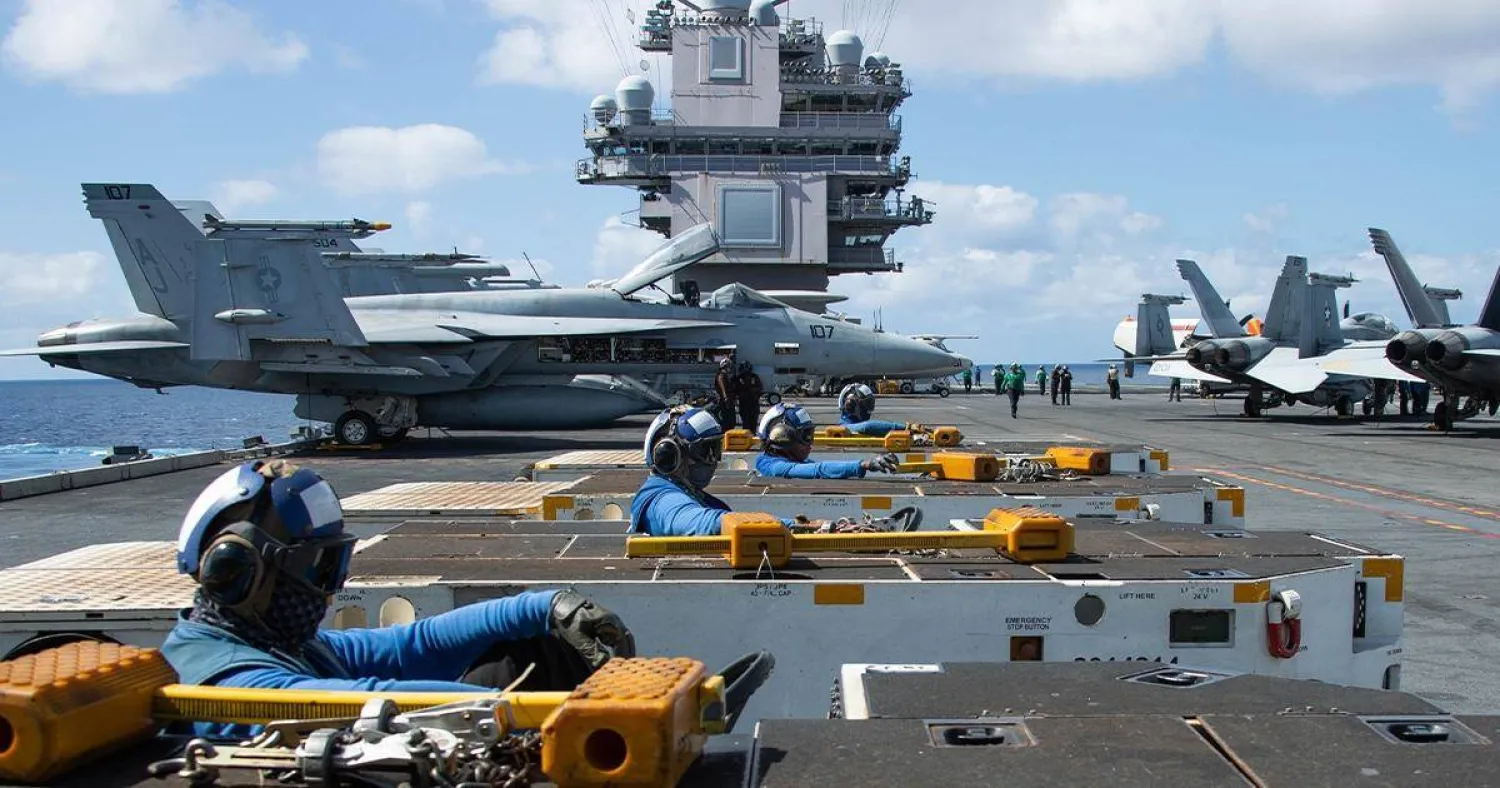
A shot showing personnel preparations aboard the US aircraft carrier "Gerald Ford" (US Navy)
TT

US Military Tells Trump It's ‘Ready’ to Strike Iran as Soon as Saturday

A shot showing personnel preparations aboard the US aircraft carrier "Gerald Ford" (US Navy)

Top national security officials have told President Trump the military is ready for potential strikes on Iran as soon as Saturday, but the timeline for any action is likely to extend beyond this weekend, sources familiar with the discussions told CBS News.

Trump has not yet made a final decision about whether to strike, said the officials, who spoke under condition of anonymity to discuss sensitive national matters.

The conversations have been described as fluid and ongoing, as the White House weighs the risks of escalation and the political and military consequences of restraint, added CBS.

Over the next three days, the Pentagon is moving some personnel temporarily out of the Middle East region — primarily to Europe or back to the United States — ahead of potential action or counterattacks by Iran if the US were to move ahead with its operation, according to multiple officials.

It's standard practice for the Pentagon to shift assets and personnel ahead of a potential US military activity and doesn't necessarily signal an attack on Iran is imminent, one of the sources told CBS.

Contacted by CBS News on Wednesday afternoon, a Pentagon spokesperson said they had no information to provide.

Iran was discussed in the White House Situation Room on Wednesday, a US official and a senior military official told CBS News. All military forces deployed to the region are expected to be in place by mid-March.

Axios had also said that a war between the United States and Iran is looming — and there are several factors suggesting President Trump might push the button soon.

On Wednesday, Iran's top diplomat Abbas Araghchi said that Tehran was "drafting" a framework for future talks with the United States, as the US energy secretary said Washington would stop Iran's nuclear ambitions "one way or another".


Satellite Images Show Iran Repairing and Fortifying Sites amid US Tensions

A satellite image shows tunnel entrances covered with soil at Isfahan nuclear complex, in Isfahan, Iran, February 10, 2026. Vantor/Handout via REUTERS
TT

Satellite Images Show Iran Repairing and Fortifying Sites amid US Tensions

A satellite image shows tunnel entrances covered with soil at Isfahan nuclear complex, in Isfahan, Iran, February 10, 2026. Vantor/Handout via REUTERS

Satellite images show that Iran has recently built a concrete shield over a new facility at a sensitive military site and covered it in soil, experts say, advancing work at a location reportedly bombed by Israel in 2024 amid tensions with the US.

Images also show that Iran has buried tunnel entrances at a nuclear site bombed by the US during Israel's 12-day war with Iran last year, fortified tunnel entrances near another, and has repaired missile bases struck in the conflict.

They offer a glimpse of Iranian activities at some of the sites at the center of tensions with Israel and the US, as Washington seeks to negotiate a deal with Tehran on its nuclear program while threatening military action if talks fail.

Some 30 km (20 miles) southeast of Tehran, the Parchin complex is one of Iran's most sensitive military sites. Western intelligence has suggested Tehran carried out tests relevant to nuclear bomb detonations there more than two decades ago.

Iran has always denied seeking atomic weapons. Israel reportedly struck Parchin in October 2024.

Satellite imagery taken before and after that attack shows extensive damage to a rectangular building at Parchin, and apparent reconstruction in images from November 6, 2024.

Imagery from October 12, 2025 shows development at the site, with the skeleton of a new structure visible and two smaller structures adjacent to it. Progress is apparent in imagery from November 14, with what appears to be a metallic roof covering the large structure.

But imagery from December 13 shows the facility partly covered. By February 16, it cannot be seen at all, hidden by what experts say is a concrete structure.

The Institute for Science and International Security (ISIS), in a January 22 analysis of satellite imagery, pointed to progress in the construction of a "concrete sarcophagus" around a newly built facility at the site, which it identified as Taleghan 2.

ISIS reported in November that imagery showed "ongoing construction and the presence of what appears to resemble a long, cylindrical chamber, maybe a high-explosives containment vessel, likely measuring approximately 36 meters long and 12 meters in diameter placed inside a building".

"High-explosive containment vessels are critical to the development of nuclear weapons," ISIS added, "but can also be used in many other conventional weapons development processes."

William Goodhind, a forensic imagery analyst with Contested Ground, said the roof had a similar hue to the surrounding area, adding: "It has most likely been covered with dirt to obscure the concrete color."

ISIS founder David Albright wrote on X: "Stalling the negotiations has its benefits: Over the last two to three weeks, Iran has been busy burying the new Taleghan 2 facility ... More soil is available and the facility may soon become a fully unrecognizable bunker, providing significant protection from aerial strikes."

TUNNEL ENTRANCES BURIED AT ISFAHAN NUCLEAR COMPLEX

The Isfahan complex is one of three Iranian uranium-enrichment plants bombed by the United States in June.

In addition to facilities that are part of the nuclear fuel cycle, Isfahan includes an underground area where diplomats say much of Iran's enriched uranium has been stored.

Satellite images taken in late January showed new efforts to bury two tunnel entrances at the complex, ISIS reported on January 29. In a February 9 update, ISIS said a third entrance had also been backfilled with soil, meaning all entrances to the tunnel complex were now "completely buried".

A February 10 image shows all three tunnels buried, Goodhind said.

ISIS reported on February 9 that "backfilling the tunnel entrances would help dampen any potential airstrike and also make ground access in a special forces raid to seize or destroy any highly enriched uranium that may be housed inside difficult".

TUNNEL ENTRANCES FORTIFIED AT COMPLEX NEAR NATANZ SITE

ISIS has reported that satellite images point to ongoing efforts since February 10 to "harden and defensively strengthen" two entrances to a tunnel complex under a mountain some 2 km (1.2 miles) from Natanz - the site that holds Iran's other two uranium enrichment plants.

Imagery shows "ongoing activity throughout the complex related to this effort, involving the movement of numerous vehicles, including dump trucks, cement mixers, and other heavy equipment", ISIS wrote.

Iran's plans for the facility, called Pickaxe Mountain, are unclear, ISIS said.

SHIRAZ SOUTH MISSILE BASE

About 10 km (6 miles) south of Shiraz in southern Iran, this is one of 25 primary bases capable of launching medium-range ballistic missiles, according to Alma Research and Education Center, an Israeli organization. Alma assessed the site had suffered light, above-ground damage in last year's war.

A comparison of images taken on July 3, 2025 and January 30 shows reconstruction and clearance efforts at the main logistics and likely command compound at the base, Goodhind said.

"The key takeaway is that the compound has yet to return to its full operational capacity from prior to the airstrikes."

QOM MISSILE BASE

Some 40 km north of the city of Qom, this base suffered moderate above-ground damage, according to Alma.

A comparison of images taken between July 16, 2025, and February 1 shows a new roof over a damaged building. The roof repairs appear to have begun on November 17 and were most likely complete 10 days later, Goodhind said.


Iranian Mourning Ceremonies Prompt New Crackdowns in Echo of 1979 Revolution

Iranians walk on a street in Tehran, Iran, 16 February 2026. (EPA)
TT

Iranian Mourning Ceremonies Prompt New Crackdowns in Echo of 1979 Revolution

Iranians walk on a street in Tehran, Iran, 16 February 2026. (EPA)

Iranians have returned to the streets this week to mourn those killed by security forces during last month's anti-government demonstrations, sparking some new crackdowns in an echo of the 1979 revolution that brought down the US-backed Shah.

The anti-Shah revolutionaries turned Shiite Muslim memorial processions 40 days after each death into new protests, which prompted renewed violence from the authorities and fresh "martyrs" for the cause.

The clerical establishment's opponents, deploying the same tactics after five decades, have yet to match the momentum of those times, but Iran's clerical rulers, threatened with military attack by US President Donald Trump over their nuclear and security policies, have demonstrated their concern.

They deployed security forces to some cemeteries and invited citizens to attend state-organized 40-day "Chehelom" ceremonies on Tuesday after apologizing to "all those affected" by violence they blamed on people described as "terrorists".

"They tried to prevent history repeating itself by holding these ceremonies in mosques across ‌the country. To ‌prevent any gatherings of angry families in cemeteries, but they failed," said one rights activist ‌in ⁠Iran who declined ⁠to be named for fear of retribution.

SECURITY FORCES CLASH WITH MOURNERS

Videos circulating on social media showed families holding their own memorials across Iran on Tuesday, 40 days after security forces began two days of widespread shooting that human rights groups say killed thousands of protesters.

Some of Tuesday's memorials turned into wider anti-government protests and some were met with deadly force.

In the Kurdish town of Abdanan in Ilam province, witnesses and activists said security forces opened fire on hundreds of mourners gathered at a cemetery.

Videos showed people scattering as gunfire rang out amid chants of "Death to the dictator", a reference to Iran's Supreme Leader Ali Khamenei.

Reuters journalists verified that ⁠the videos were filmed at the cemetery. They were unable to verify the date but ‌found no versions posted before Tuesday: eyewitnesses and activists said that was when ‌people gathered at the cemetery were fired upon.

Hengaw, a Kurdish Iranian rights group, said at least three people were injured and nine ‌arrested in Abdanan. Similar clashes were reported in Mashhad and Hamedan. Sources in Iran said internet access was heavily restricted ‌in those cities.

WEDNESDAY IS 40 DAYS SINCE HEIGHT OF JANUARY PROTESTS

More mourning ceremonies were expected to be taking place on Wednesday, 40 days since the deadliest two days of the January unrest, although communications restrictions meant that it was not immediately possible to tell how many or their outcome.

January's unrest grew from modest economic protests in December among traders in Tehran's Grand Bazaar into the gravest threat to ‌Iran's theocracy in nearly five decades, with protesters calling for ruling clerics to step down.

Authorities cut internet access, blaming "armed terrorists" linked to Israel and the United States ⁠for the violence, and have arrested ⁠journalists, lawyers, activists, human rights advocates and students, rights groups say.

Iranian officials have told Reuters the leadership is worried a US strike could erode its grip on power by fueling more protests. Repression, inequality, corruption and the sponsorship of proxies abroad are the main grievances.

"How long can they kill people to stay in power? People are angry, people are frustrated," said government employee Sara, 28, from the central city of Isfahan.

"The Islamic Republic has brought nothing but war, economic misery and death to my country".

Trump has deployed aircraft carriers, fighter jets, guided-missile destroyers and other capabilities to the Middle East for a possible attack if talks to limit Iran's nuclear program and weaken its foreign proxies do not yield results.

Even without a US attack, continued isolation from Western sanctions would likely fuel further public anger.

In 1979, the anti-Shah revolt in provincial towns and villages was amplified by oil workers whose strikes cut most of Iran's revenue, and bazaar merchants who funded the rebel clerics.

This time there have been no reports of either, but people have adopted some of the small-scale tactics, chanting “Allah is great” and “Death to the dictator”, often from rooftops, during nightly demonstrations, according to witnesses and social media posts.