


Gaza Fisherman Tests Waters in Legal Fight Over Israeli Blockade

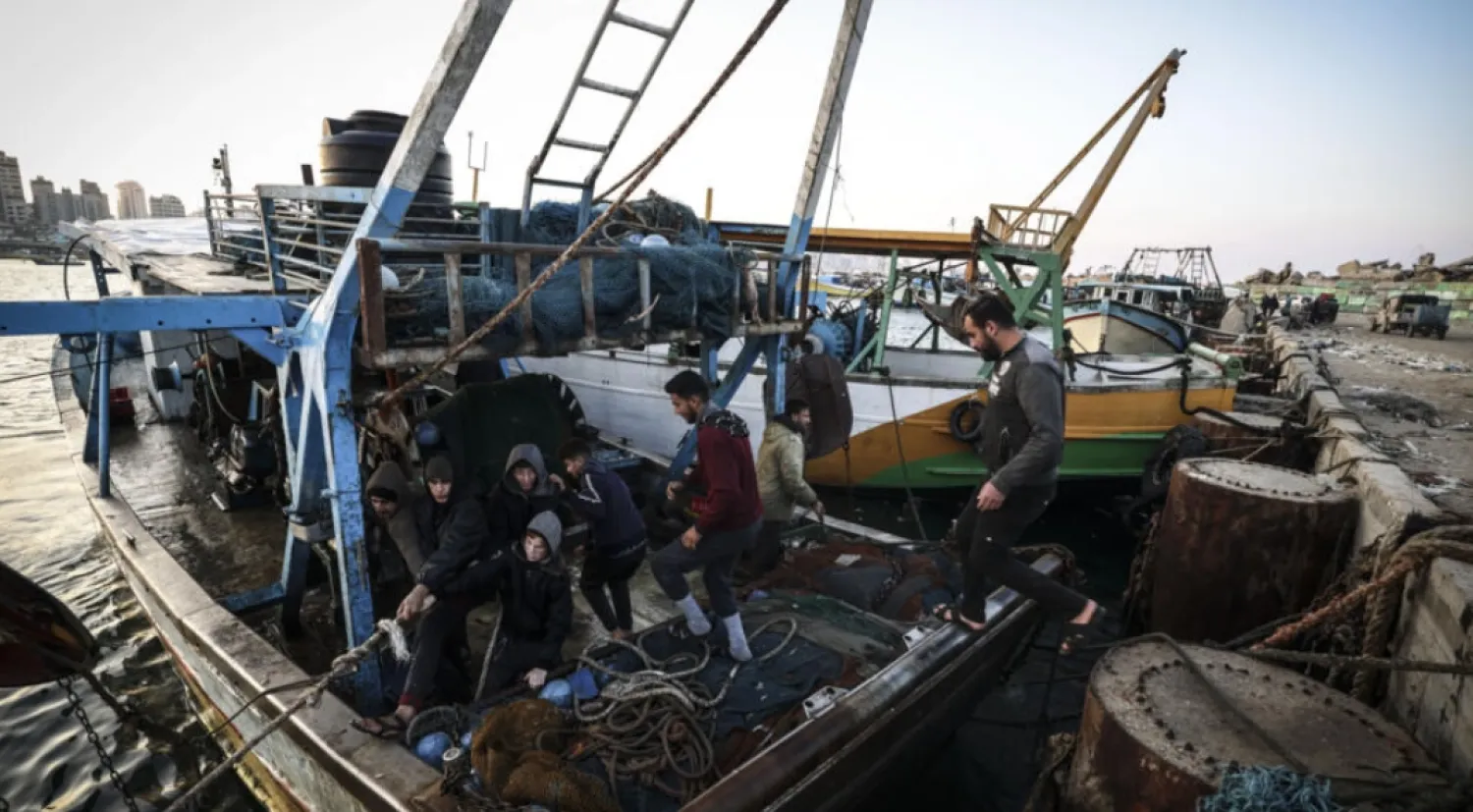
Palestinian fisherman Jihad al-Hissi and his sons aboard their boat at the seaport in Gaza City © MAHMUD HAMS / AFP
TT

Gaza Fisherman Tests Waters in Legal Fight Over Israeli Blockade

Palestinian fisherman Jihad al-Hissi and his sons aboard their boat at the seaport in Gaza City © MAHMUD HAMS / AFP

Gaza fisherman Jihad al-Hissi is used to rough waters but he now faces a new storm. An Israeli court may seize his boat after he breached the limits of the enclave's fishing zone.

The issue is crucial for thousands in the blockaded Palestinian territory of 2.3 million people, where fishing in the Mediterranean Sea remains one of the few economic lifelines.

Hissi, 55, with square shoulders and a scruffy beard, told his story at Gaza's dock early one morning as fishermen sold their overnight catch of sea bream, prawns and sardines.

For now he has his boat, but its fate is uncertain as Israeli authorities argue before a Haifa court that it should be permanently taken away.

The vessel, used to catch gamberi prawns off southern Gaza near Egypt, is named the "Hajj Rajab", but its owners have erased the name from its yellow hull.

"I don't want the Israelis to spot us and seize my boat," said Hissi, who had a violent encounter with an Israeli naval patrol boat more than a year ago, AFP reported.

Israel says its land, air and sea blockade of Gaza is needed to protect it from rocket and other attacks from Hamas and to prevent arms smuggling to the Islamist militant movement.

Palestinians argue it is an effective siege that has crippled Gaza's economy and further impoverished its people, while the fishing limits deny it crucial protein.

Last year's incident came on February 14 when Hissi's vessel ventured beyond the maritime zone that Israel declared in 2007, the year Hamas seized power in Gaza.

Jihad's brother Nihad, who was at sea that day, said that "100 meters beyond the area, we were surprised by three Israeli boats with commandos.

"They attacked our boat... tied us up and arrested us."

The boat's cabin is still damaged from the water cannon blasts and the rubber-encased bullets fired by the Israeli forces that day.

Israel, in documents presented to court, accuses Hissi of having "repeatedly violated the security restrictions imposed by the Israeli army in the maritime zone adjacent to Gaza".

The Israeli non-government group Gisha has helped defend Hissi and in September secured the boat's return, but Israeli authorities now demand the court "permanently confiscate" the vessel.

The fishing zone allowed by Israel currently extends only to the heavily fished areas between six and 15 nautical miles (about 11 to 28 kilometres) off the Gaza coast.

Hissi argues this is less than the maximum of 20 nautical miles agreed in the 1990s under the Israeli-Palestinian agreements in Oslo.

But he also admits to going even beyond that from time to time, in search of shrimp which nets around $21 per kilogram (2.2 pounds) and can make the difference between profit and loss.

The legal fight is closely watched by thousands of fishermen in Gaza.

If Hissi's boat is permanently confiscated, this would spell "a serious threat to the thousands of fishermen in Gaza, because it aims to put an end to fishing," charged Nizar Ayyash, president of the union representing the 4,000 fishermen in Gaza.

The court battle comes amid a rise in Israel's temporary seizures of fishing boats suspected of smuggling or breaching the fishing zone.

Last year saw 23 boat confiscations, the highest number since 2018, according to the Palestinian non-governmental group Al Mezan.

The group also recorded 474 security incidents involving Gaza fishermen last year, the most in five years.

Gisha lawyer Muna Haddad argued that the case was "outrageous" and came amid "an unprecedented escalation in targeting those fishermen".

Haddad accused Israel of misusing provisions of international law on armed conflict regarding the seizure of enemy ships by imposing them on civilians.

In the court documents seen by AFP, Israel claims Hissi "abused" legal protections and that his crew had "threatened" the safety of soldiers during the maritime seizure.

Israeli military officials assured AFP they wanted to support Gaza's economy -- but without compromising Israel's security.

"We fish to survive," said Hissi, whose family once lived in Jaffa, now part of Tel Aviv, before fleeing to Gaza during the 1948 war.

"And we will continue to fish even when our profits are low. I don't know how to do anything else in life anyway."



Sudanese Paramilitary Forces Kill at Least 28 People in an Attack in Darfur

FILE PHOTO: Displaced people ride a an animal-drawn cart, following Rapid Support Forces (RSF) attacks on Zamzam displacement camp, in the town of Tawila, North Darfur, Sudan April 15, 2025. REUTERS/Stringer/File Photo
TT

Sudanese Paramilitary Forces Kill at Least 28 People in an Attack in Darfur

FILE PHOTO: Displaced people ride a an animal-drawn cart, following Rapid Support Forces (RSF) attacks on Zamzam displacement camp, in the town of Tawila, North Darfur, Sudan April 15, 2025. REUTERS/Stringer/File Photo

An attack by the Sudanese paramilitary forces on a stronghold of a Darfur tribal leader left at least 28 people dead, a doctors group said on Tuesday.

The paramilitary Rapid Support Forces on Monday rampaged through the town of Misteriha in North Darfur province, according to the Sudan Doctors Network, which tracks the country’s ongoing war.

The town is a stronghold of tribal leader Musa Hilal who also hails from the Rizeigat tribe as the majority of the members of the paramilitary RSF.

At least 39 people, including 10 women, were wounded in the attack, the medical group said.

Sudan’s war erupted in 2023 after tensions between the Sudanese army and the rival RSF escalated into fighting that began in Khartoum and spread nationwide, killing thousands, triggering mass displacement, disease outbreaks, and severe food insecurity. Aid workers were frequently targeted.


Hamas Calls for Sanctions Against Israel Over New West Bank Moves 

A drone view shows Kedar Sheep farm, an Israeli outpost in the Israeli-occupied West Bank, January 20, 2026. (Reuters)
TT

Hamas Calls for Sanctions Against Israel Over New West Bank Moves 

A drone view shows Kedar Sheep farm, an Israeli outpost in the Israeli-occupied West Bank, January 20, 2026. (Reuters)

Hamas on Tuesday called for sanctions against Israel, welcoming a joint condemnation by nearly 20 countries of new Israeli measures aimed at tightening control over the occupied West Bank.

Israel has approved a series of initiatives this month backed by far-right ministers, including launching a process to register land in the West Bank as "state property" and allowing Israelis to purchase land there directly.

Late on Monday, 18 countries including Saudi Arabia, Egypt, and European powers France and Spain, slammed Israel over the recent moves.

They "are part of a clear trajectory that aims to change the reality on the ground and to advance unacceptable de facto annexation", the countries said.

"Such actions are a deliberate and direct attack on the viability of the Palestinian state and the implementation of the two-state solution."

Hamas hailed the condemnation as "a step in the right direction in confronting the occupation's expansionist plans, which flagrantly violate international law and relevant UN resolutions".

The group in a statement urged the countries involved "to impose deterrent sanctions and exert pressure on the fascist occupation government to halt its policies aimed at entrenching annexation, colonial settlement and forced displacement".

It said the Israeli measures were part of ongoing "aggression" against Palestinians in the West Bank and Gaza.

In addition to roughly three million Palestinians, more than 500,000 Israelis live in settlements and outposts in the West Bank, which are considered illegal under international law.

Israel's current government has accelerated settlement expansion, approving a record 54 settlements in 2025, according to activists.

The West Bank, which Israel has occupied since 1967, is envisioned as the core of a future Palestinian state, but many on Israel's religious right view it as part of Israel's historic homeland.


Israel Seeking Direct Military Coordination with Lebanon 

Lebanese soldiers and UNIFIL forces on patrol in Naqoura southern Lebanon. (Reuters file)
TT

Israel Seeking Direct Military Coordination with Lebanon 

Lebanese soldiers and UNIFIL forces on patrol in Naqoura southern Lebanon. (Reuters file)

Israel is seeking to alter the post-ceasefire coordination mechanism along the Lebanese border by establishing direct contact with the Lebanese army, bypassing the United Nations peacekeeping force deployed in the south, said Israeli media.

The proposal has reignited debate in Beirut over the future of UN Security Council Resolution 1701 and the role of international oversight in southern Lebanon, with Lebanese officials insisting that any modification must remain strictly within the United Nations framework.

Reports attributed to Israel’s security establishment say the United Nations Interim Force in Lebanon (UNIFIL) has recently adopted what Israeli officials describe as a “confrontational stance” toward the Israeli military.

Israeli media quoted officials as telling American counterparts that direct coordination between the Israeli military and the Lebanese army would be preferable to the current arrangement, which operates through UNIFIL. Some officials reportedly argued that the peacekeeping force now causes “more harm than benefit.”

The Israeli Public Broadcasting Corporation said Israel’s security establishment believes UNIFIL has grown increasingly “hostile” in recent weeks.

The force’s mandate in southern Lebanon is due to expire at the end of this year.

Lebanese officials have responded by underscoring that the country’s position remains anchored in international legality and UN authority.

Fadi Alame, head of the Foreign Affairs and Immigrants Committee in Lebanon’s parliament, said Israeli media discussions “do not bind Lebanon,” stressing that “Lebanon’s sole reference remains the international resolutions issued by the United Nations.”

Speaking to Asharq Al-Awsat, Alame reiterated Lebanon’s commitment to Resolution 1701 and expressed support for UNIFIL.

He said the force monitors implementation of the resolution and safeguards Lebanon’s rights and sovereignty within the UN framework.

“As long as there is a UN resolution in force, any amendment or termination must occur through the United Nations itself,” he stated. “International law requires an international monitoring body as long as the resolution remains in effect.”

Addressing speculation about replacing UNIFIL or shifting to direct coordination with the Lebanese army, Alame said Beirut’s official stance remains unchanged.

“Lebanon is committed to Resolution 1701 under a clear government decision,” he underlined. “For us, Resolution 1701 and other UN resolutions remain the foundation.”

He added that Lebanon is awaiting a report from the UN secretary-general in June that is expected to outline potential options. These could range from maintaining the current international force to introducing a European-led presence or increasing the number of international observers.

Any proposal, he stressed, would remain subject to UN approval.

Meanwhile, a Lebanese ministerial source told Asharq Al-Awsat that Israel’s proposal for direct coordination without UNIFIL “raises questions,” noting that the peacekeeping force is already embedded in the existing tripartite coordination mechanism.

Communication with Israel is conducted through UNIFIL under an established framework, the source explained, adding that Lebanon insists on maintaining an international sponsor and monitoring body as long as Resolution 1701 has not been fully implemented.

European proposals remain under discussion, including the possibility of a European-led force under French supervision or a mission focused on training and equipping the Lebanese army to assume expanded responsibilities. However, these ideas have yet to crystallize and remain tied to future political and security developments.

The debate follows a UN Security Council decision in August 2025 to extend UNIFIL’s mandate until December 31, 2026, with a coordinated drawdown planned to begin the following year.

UNIFIL has been deployed in southern Lebanon since 1978. It serves as a monitoring and buffer force, overseeing implementation of Resolution 1701 and supporting the Lebanese army’s deployment south of the Litani River.