

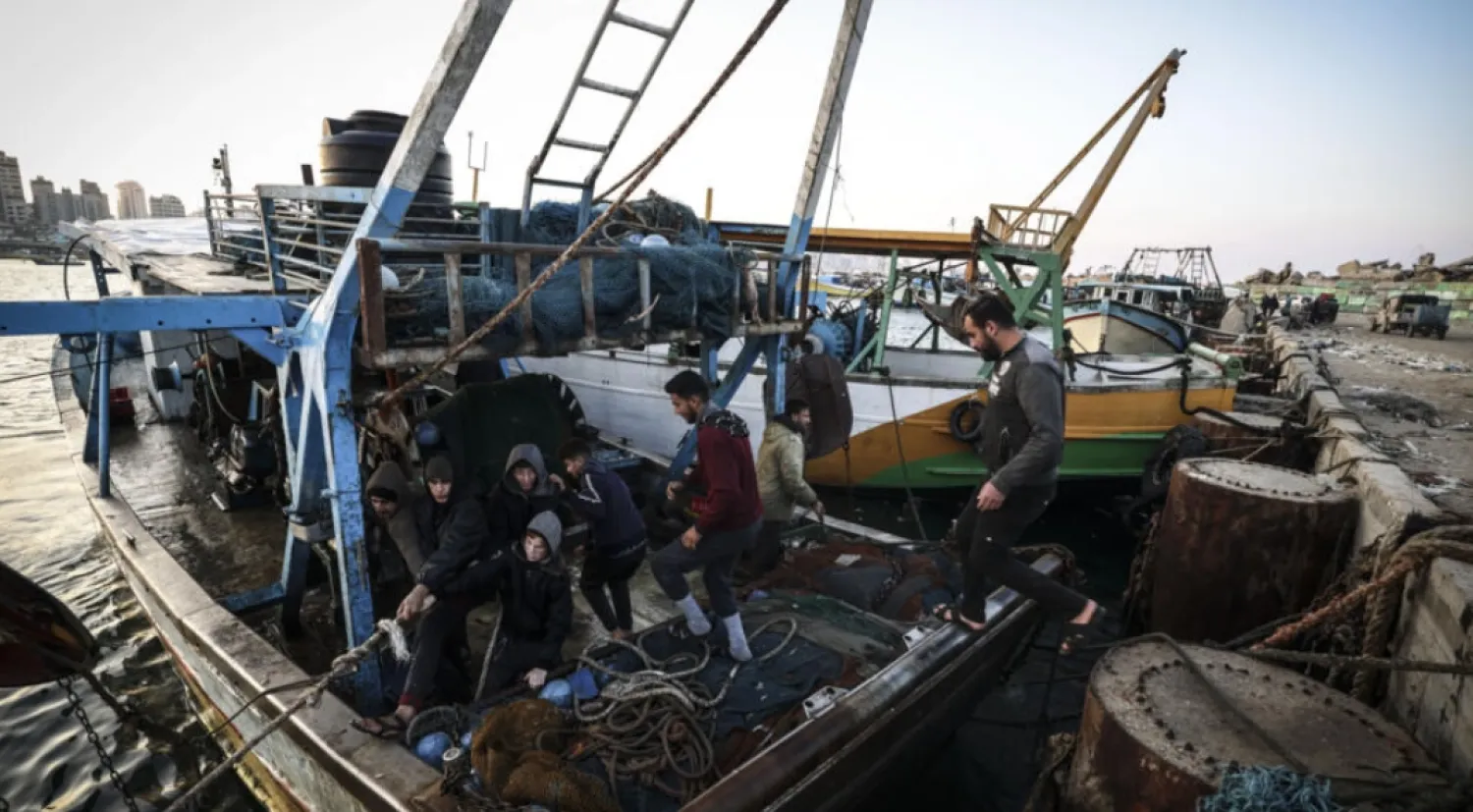

Gaza Fisherman Tests Waters in Legal Fight Over Israeli Blockade

Palestinian fisherman Jihad al-Hissi and his sons aboard their boat at the seaport in Gaza City © MAHMUD HAMS / AFP
TT

Gaza Fisherman Tests Waters in Legal Fight Over Israeli Blockade

Palestinian fisherman Jihad al-Hissi and his sons aboard their boat at the seaport in Gaza City © MAHMUD HAMS / AFP

Gaza fisherman Jihad al-Hissi is used to rough waters but he now faces a new storm. An Israeli court may seize his boat after he breached the limits of the enclave's fishing zone.

The issue is crucial for thousands in the blockaded Palestinian territory of 2.3 million people, where fishing in the Mediterranean Sea remains one of the few economic lifelines.

Hissi, 55, with square shoulders and a scruffy beard, told his story at Gaza's dock early one morning as fishermen sold their overnight catch of sea bream, prawns and sardines.

For now he has his boat, but its fate is uncertain as Israeli authorities argue before a Haifa court that it should be permanently taken away.

The vessel, used to catch gamberi prawns off southern Gaza near Egypt, is named the "Hajj Rajab", but its owners have erased the name from its yellow hull.

"I don't want the Israelis to spot us and seize my boat," said Hissi, who had a violent encounter with an Israeli naval patrol boat more than a year ago, AFP reported.

Israel says its land, air and sea blockade of Gaza is needed to protect it from rocket and other attacks from Hamas and to prevent arms smuggling to the Islamist militant movement.

Palestinians argue it is an effective siege that has crippled Gaza's economy and further impoverished its people, while the fishing limits deny it crucial protein.

Last year's incident came on February 14 when Hissi's vessel ventured beyond the maritime zone that Israel declared in 2007, the year Hamas seized power in Gaza.

Jihad's brother Nihad, who was at sea that day, said that "100 meters beyond the area, we were surprised by three Israeli boats with commandos.

"They attacked our boat... tied us up and arrested us."

The boat's cabin is still damaged from the water cannon blasts and the rubber-encased bullets fired by the Israeli forces that day.

Israel, in documents presented to court, accuses Hissi of having "repeatedly violated the security restrictions imposed by the Israeli army in the maritime zone adjacent to Gaza".

The Israeli non-government group Gisha has helped defend Hissi and in September secured the boat's return, but Israeli authorities now demand the court "permanently confiscate" the vessel.

The fishing zone allowed by Israel currently extends only to the heavily fished areas between six and 15 nautical miles (about 11 to 28 kilometres) off the Gaza coast.

Hissi argues this is less than the maximum of 20 nautical miles agreed in the 1990s under the Israeli-Palestinian agreements in Oslo.

But he also admits to going even beyond that from time to time, in search of shrimp which nets around $21 per kilogram (2.2 pounds) and can make the difference between profit and loss.

The legal fight is closely watched by thousands of fishermen in Gaza.

If Hissi's boat is permanently confiscated, this would spell "a serious threat to the thousands of fishermen in Gaza, because it aims to put an end to fishing," charged Nizar Ayyash, president of the union representing the 4,000 fishermen in Gaza.

The court battle comes amid a rise in Israel's temporary seizures of fishing boats suspected of smuggling or breaching the fishing zone.

Last year saw 23 boat confiscations, the highest number since 2018, according to the Palestinian non-governmental group Al Mezan.

The group also recorded 474 security incidents involving Gaza fishermen last year, the most in five years.

Gisha lawyer Muna Haddad argued that the case was "outrageous" and came amid "an unprecedented escalation in targeting those fishermen".

Haddad accused Israel of misusing provisions of international law on armed conflict regarding the seizure of enemy ships by imposing them on civilians.

In the court documents seen by AFP, Israel claims Hissi "abused" legal protections and that his crew had "threatened" the safety of soldiers during the maritime seizure.

Israeli military officials assured AFP they wanted to support Gaza's economy -- but without compromising Israel's security.

"We fish to survive," said Hissi, whose family once lived in Jaffa, now part of Tel Aviv, before fleeing to Gaza during the 1948 war.

"And we will continue to fish even when our profits are low. I don't know how to do anything else in life anyway."



Iraqi Government Seeks to Keep Country Out of Iran War Fallout

Al-Sudani chairs a meeting of the National Security Council (Prime Minister’s Office Media).
TT

Iraqi Government Seeks to Keep Country Out of Iran War Fallout

Al-Sudani chairs a meeting of the National Security Council (Prime Minister’s Office Media).

The government of outgoing Prime Minister Mohammed Shia Al-Sudani is working to distance Iraq from the escalating US-Israel war on Iran.

Tehran has responded to the military operation launched by the US and Israel with missile strikes on Gulf states and other locations, including Iraq, saying it is targeting American bases and interests.

Although Iraq has not been directly drawn into the conflict - unlike during the Iran-Iraq War (1980–1988), the 1990–1991 Gulf War, or the 2003 US-led invasion that toppled Saddam Hussein - fear is mounting as the country risks being caught between Iran and its local allies and the broader confrontation involving Washington and Tel Aviv.

There are also concerns that any disruption to Gulf shipping lanes could significantly curtail Iraq’s oil revenues.

Al-Sudani, who also serves as commander in chief of the armed forces, chaired on Monday an emergency meeting of the Ministerial Council for National Security, according to a statement from his office.

The premier instructed security agencies to prevent any actions that could undermine stability and to ensure that Iraq is not dragged into the conflict. Still, some observers say the government has been unable to stop missile attacks on Iraqi territory.

The government reiterated its commitment to protecting diplomatic missions and critical infrastructure, while affirming that freedom of expression and peaceful assembly remain constitutionally protected rights.

The statement stressed that security forces will continue safeguarding citizens, diplomatic facilities and public and private property, in line with national laws and international obligations.

The remarks appeared to reference attempts Sunday evening by groups linked to Iran-aligned armed factions to approach the US Embassy in Baghdad’s fortified Green Zone. Security forces stopped them from reaching the compound.

The council added that Iraq remains committed to preventing escalation and ensuring its territory is not used for external or internal conflicts, underscoring that decisions on national security and military action lie solely with the state and its constitutional institutions.

The council also reviewed the potential economic fallout of a prolonged and expanding conflict, particularly the risks associated with a possible closure of the Strait of Hormuz. The bulk of Iraq’s oil exports pass through the Gulf en route to the strategic waterway.

Given the country’s heavy dependence on oil income, any sustained disruption to maritime traffic would pose a serious threat to Iraq’s already fragile economy.


At Least 30,000 Displaced People in Shelters in Lebanon, Says UN Refugee Agency

Displaced residents from the southern suburbs sit along Corniche Al Manara in Beirut, Lebanon, 02 March 2026, after fleeing their homes following Israeli strikes. EPA/WAEL HAMZEH
TT

At Least 30,000 Displaced People in Shelters in Lebanon, Says UN Refugee Agency

Displaced residents from the southern suburbs sit along Corniche Al Manara in Beirut, Lebanon, 02 March 2026, after fleeing their homes following Israeli strikes. EPA/WAEL HAMZEH

At least 30,000 displaced people have sought protection in shelters in Lebanon since hostilities between Israel and ‌Hezbollah began ‌on Monday, ‌the United ⁠Nations refugee agency ⁠said on Tuesday.

"Conservative estimates suggest that nearly 30,000 people were ⁠hosted and ‌registered ‌at collective shelters," ‌said UNHCR spokesperson ‌Babar Baloch.

"Many more slept in their cars on ‌the side of roads or ⁠were still ⁠stuck in traffic jams on the roads," he added.

Israel launched more strikes on Hezbollah, the Iran-backed militia group. Explosions could be heard and smoke seen in a southern suburb of Beirut.

Israel also said its soldiers were “operating in southern Lebanon.”

Lebanon’s state-run National News Agency said the Lebanese army was evacuating some of its positions along the border.


Lebanese President Says Ban on Hezbollah’s Military Activity ‘Irreversible’

President Aoun meets with members of the Quintet at the presidential palace on Tuesday. (Lebanese Presidency)
TT

Lebanese President Says Ban on Hezbollah’s Military Activity ‘Irreversible’

President Aoun meets with members of the Quintet at the presidential palace on Tuesday. (Lebanese Presidency)

Lebanon's President Joseph Aoun said Tuesday that the decision to ban Hezbollah's military activities is "irreversible", as the Iran-backed movement claimed responsibility for new attacks targeting Israeli positions.

Speaking to members of the Quintet -- a committee made up of the French, US, Qatari, Saudi Arabian, and Egyptian ambassadors -- the president called the decision "final," after a Hezbollah statement on Monday night lambasted the state's "impotence in the face of the brutal Zionist enemy".

Aoun urged the Quintet members to "pressure Israel to stop its aggressions against Lebanon" as Israel continued launching intense strikes and authorized its troops to "take control of additional strategic positions in Lebanon".