


Over and Out: Germany Switches off Its Last Nuclear Plants

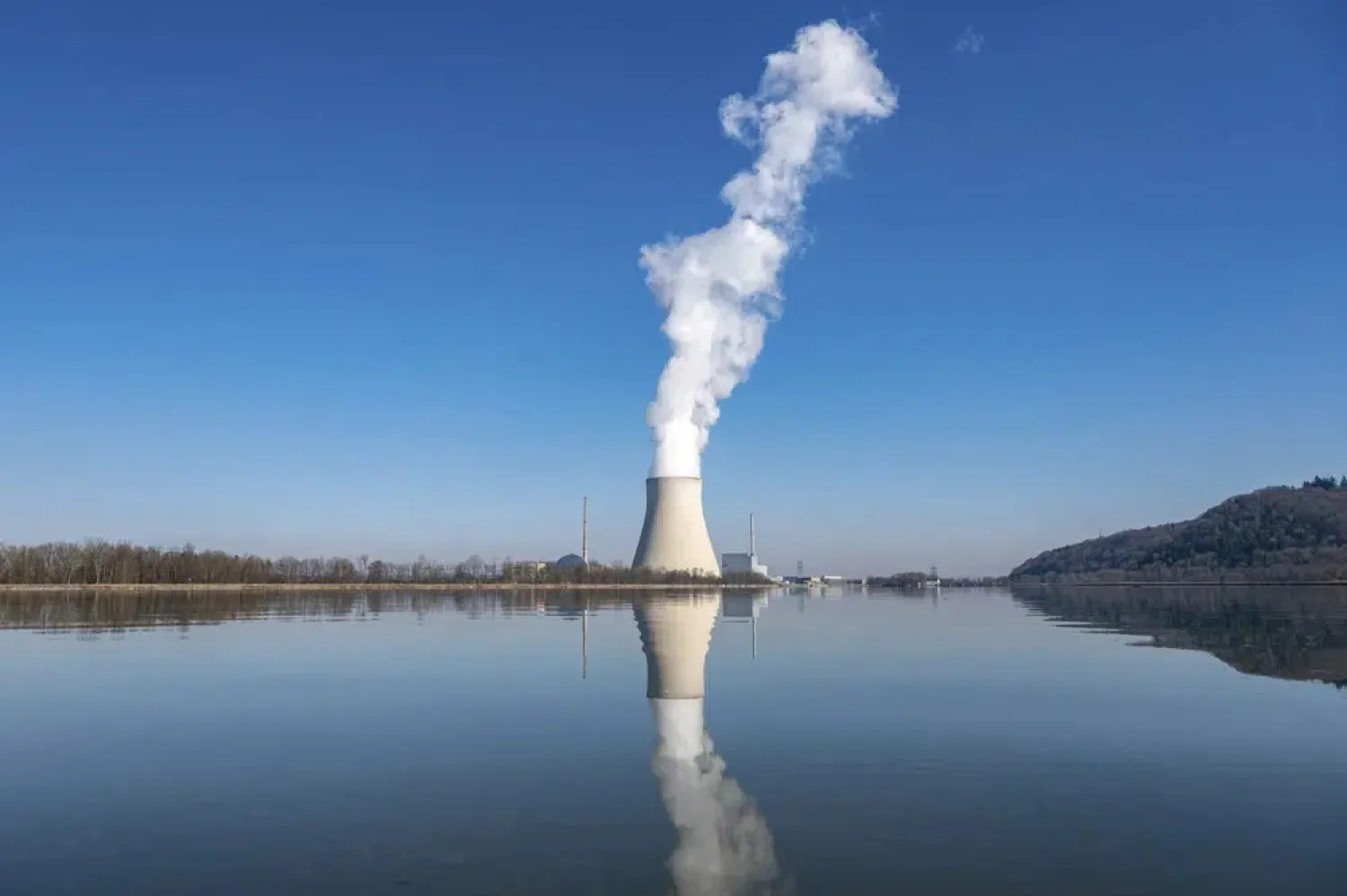
Water vapor rises from the nuclear power plant Isar II in Essenbach, Germany, March 3, 2022. (AP)
TT

Over and Out: Germany Switches off Its Last Nuclear Plants

Water vapor rises from the nuclear power plant Isar II in Essenbach, Germany, March 3, 2022. (AP)

“Nuclear power, no thanks!”

What was once a slogan found on the bumper of many a German car became a reality Saturday, as the country shut down its three remaining nuclear power plants in line with a long-planned transition toward renewable energy.

The shutdown of Emsland, Neckarwestheim II and Isar II shortly before midnight was cheered earlier in the day by anti-nuclear campaigners outside the three reactors and at rallies in Berlin and Munich. Inside the plants, staff held more somber ceremonies to mark the occasion.

Decades of anti-nuclear protests in Germany, stoked by disasters at Three Mile Island, Chernobyl and Fukushima, had put pressure on successive governments to end the use of a technology that critics argue is unsafe and unsustainable.

But with other industrialized countries, such as the United States, Japan, China, France and Britain, counting on nuclear energy to replace planet-warming fossil fuels, Germany’s decision to stop using both has drawn skepticism at home and abroad, as well as unsuccessful last-minute calls to halt the decision.

Defenders of atomic energy say fossil fuels should be phased out first as part of global efforts to curb climate change, arguing that nuclear power produces far fewer greenhouse gas emissions and is safe, if properly managed.

As energy prices spiked last year due to the war in Ukraine, some members of German Chancellor Olaf Scholz’s government got cold feet about closing the nuclear plants as planned on Dec. 31, 2022. In a compromise, Scholz agreed to a one-time extension of the deadline, but insisted that the final countdown would happen on April 15.

Still, Bavaria’s conservative governor, Markus Soeder, who backed the original deadline set in 2011 when Chancellor Angela Merkel was Germany’s leader, this week called the shutdown “an absolute mistaken decision.”

“While many countries in the world are even expanding nuclear power, Germany is doing the opposite,” Soeder said. “We need every possible form of energy. Otherwise, we risk higher electricity prices and businesses moving away.”

Advocates of nuclear power worldwide have slammed the German shutdown, aware that the move by Europe’s biggest economy could deal a blow to a technology they tout as a clean and reliable alternative to fossil fuels. On Friday, dozens of scientists including James Hansen, a former NASA climate expert credited with drawing public attention to global warming in 1988, sent a letter to Scholz urging him to keep the nuclear plants running.

The German government has acknowledged that, in the short term, the country will have to rely more heavily on polluting coal and natural gas to meet its energy needs, even as it takes steps to massively ramp up electricity production from solar and wind. Germany aims to be carbon neutral by 2045.

But officials such as Environment Minister Steffi Lemke say the idea of a nuclear renaissance is a myth, citing data showing that atomic energy’s share of global electricity production is shrinking.

At a recent news conference in Berlin, Lemke noted that new nuclear plants in Europe, such as Hinkley Point C in Britain, have faced significant delays and cost overruns. Funds used to maintain ageing reactors or build new ones would be better spent on installing cheap renewables, she said.

Energy experts such as Claudia Kemfert of the German Institute for Economic Research in Berlin say the 5% share of Germany’s electricity currently coming from nuclear can be easily replaced without risking blackouts.

The northwestern town of Lingen, home to the Emsland plant, plans to become a hub for hydrogen production using electricity generated from North Sea wind farms, Mayor Dieter Krone told The Associated Press in an interview this week.

The power plant’s operator, RWE, made clear that it is committed to the shutdown. The company still runs some of Europe’s dirtiest coal-fired power plants. It recently pushed through the destruction of a village for a mine expansion as part of a plan to increase short-term production before ending coal use by 2030.

Many of Germany’s nuclear power plants will still be undergoing costly dismantling by then. The question of what to do with highly radioactive material accumulated in the 62 years since the country’s first reactor started operating remains unsolved. Efforts to find a final home for hundreds of containers of toxic waste have faced fierce resistance from local groups and officials, including Soeder, the Bavarian governor.

“Nuclear power supplied electricity for three generations, but its legacy remains dangerous for 30,000 generations,” said Lemke, who also pointed to previously unconsidered risks such as the targeting of civilian atomic facilities during conflicts.

Finding a place to safely store spent nuclear fuel is a problem that other nations using the technology face, including the United States. Still, US Energy Secretary Jennifer Granholm has said that nuclear power will “play a critical role in America’s clean energy future.” This week, she welcomed Japan’s decision to restart many of its reactors.

With debate raging again in Germany about whether the shutdown is a good idea, the top official in charge of nuclear safety at the Environment Ministry, Gerrit Niehaus, was asked by a reporter to sum up in a single sentence what lessons should be learned from the country’s brief atomic era.

“You need to think things through to the end,” Niehaus said.


Pakistan PM Sharif to Seek Clarity on Troops for Gaza in US Visit

US President Donald Trump looks at Pakistan's Prime Minister Shehbaz Sharif speaking following the official signing of the first phase of the Gaza ceasefire agreement between Israel and Hamas, during a world leaders' summit on ending the Gaza war, in Sharm El-Sheikh, Egypt, October 13, 2025. REUTERS/Evelyn Hockstein/File Photo
TT

Pakistan PM Sharif to Seek Clarity on Troops for Gaza in US Visit

US President Donald Trump looks at Pakistan's Prime Minister Shehbaz Sharif speaking following the official signing of the first phase of the Gaza ceasefire agreement between Israel and Hamas, during a world leaders' summit on ending the Gaza war, in Sharm El-Sheikh, Egypt, October 13, 2025. REUTERS/Evelyn Hockstein/File Photo

Before Pakistan commits to sending troops to Gaza as part of the International Stabilization Force it wants assurances from the United States that it will be a peacekeeping mission rather than tasked with disarming Hamas, three sources told Reuters.

Pakistan's Prime Minister Shehbaz Sharif is set to attend the first formal meeting of President Donald Trump's Board of Peace in Washington on Thursday, alongside delegations from at least 20 countries.

Trump, who will chair the meeting, is expected to announce a multi-billion dollar reconstruction plan for Gaza and detail plans for a UN-authorized stabilization force for the Palestinian enclave.

Three government sources said during the Washington visit Sharif wanted to better understand the goal of the ISF, what authority they were operating under and what the chain of command was before making a decision on deploying troops.

"We are ready to send troops. Let me make it clear that our troops could only be part of a peace mission in Gaza," said one of the sources, a close aide of Sharif.

"We will not be part of any other role, such as disarming Hamas. It is out of the question," he said.

Analysts say Pakistan would be an asset to the multinational force, with its experienced military that has gone to war with arch-rival India and tackled insurgencies.

"We can send initially a couple of thousand troops anytime, but we need to know what role they are going to play," the source added.

Two of the sources said it was likely Sharif, who has met Trump earlier this year in Davos and late last year at the White House, would either have an audience with him on the sidelines of the meeting or the following day at the White House.

Initially designed to cement Gaza's ceasefire, Trump sees the Board of Peace, launched in late January, taking a wider role in resolving global conflicts. Some countries have reacted cautiously, fearing it could become a rival to the United Nations.

While Pakistan has supported the establishment of the board, it has voiced concerns against the mission to demilitarize Gaza's militant group Hamas.


Türkiye Pleased with Alignment Steps by Syria, Kurdish Forces, Erdogan Says

Turkish President Tayyip Erdogan delivers a speech during the opening ceremony of male and female dormitories at Bogazici University, in Istanbul, Türkiye, February 13, 2026. REUTERS/Umit Bektas
TT

Türkiye Pleased with Alignment Steps by Syria, Kurdish Forces, Erdogan Says

Turkish President Tayyip Erdogan delivers a speech during the opening ceremony of male and female dormitories at Bogazici University, in Istanbul, Türkiye, February 13, 2026. REUTERS/Umit Bektas

Turkish President Tayyip Erdogan said he is pleased to see steps taken in neighbouring Syria to integrate the Kurdish-led Syrian Democratic Forces (SDF) into state structures, after a US-backed ceasefire deal late last month between the sides.

In a readout on Wednesday of his comments to reporters on a return flight from Ethiopia, Erdogan was cited as saying Ankara is closely monitoring the Syrian integration steps and providing guidance on implementing the agreement.

Meanwhile, a Turkish parliamentary commission voted overwhelmingly on Wednesday to approve a report envisaging legal reforms alongside the militant Kurdistan Workers Party's (PKK) disarmament, advancing a peace process meant to end decades of conflict.

The PKK - designated a terrorist organization by Türkiye, the United States and European Union - halted attacks last year and said it would disarm and disband, calling on Ankara to take steps to let its members participate in politics.

The roughly 60-page report proposes a roadmap for the parliament to enact laws, including a conditional legal framework that urges the judiciary to review legislation and comply with European Court of Human Rights and Constitutional Court rulings.

The pro-Kurdish DEM Party, which has been closely involved in the process and held several meetings with PKK leader Abdullah Ocalan in prison, objected to the report's presentation of the Kurdish issue as a terrorism problem but generally welcomed the report and called for rapid implementation.

“We believe legal regulations must be enacted quickly,” senior DEM lawmaker Gulistan Kilic Kocyigit told Reuters. Parts of the report offered “a very important roadmap for the advancement of this process," she said.

Erdogan signaled that the legislative process would begin straight away. “Now, discussions will begin in our parliament regarding the legal aspects of the process,” he said.


Turkish FM to Attend Trump’s Board of Peace Meeting in Washington, Italy as ‘Observer’ 

28 November 2025, Berlin: Turkish Foreign Minister Hakan Fidan during a joint press conference with German Foreign Minister Wadephul. (dpa)
TT

Turkish FM to Attend Trump’s Board of Peace Meeting in Washington, Italy as ‘Observer’ 

28 November 2025, Berlin: Turkish Foreign Minister Hakan Fidan during a joint press conference with German Foreign Minister Wadephul. (dpa)

‌Turkish Foreign Minister Hakan Fidan will travel to Washington in lieu of President Recep Tayyip Erdogan for the inaugural meeting of US President Donald Trump's "Board of Peace" on Thursday, the foreign ministry said on Wednesday.

A Turkish diplomatic source told Reuters ‌that Fidan, during the ‌talks, would call ‌for ⁠determined steps to ⁠resolve the Palestinian issue and emphasize that Israel must end actions to hinder the flow of aid into Gaza and stop its ceasefire violations.

Fidan ⁠will also reiterate Türkiye's ‌readiness ‌to contribute to Gaza's reconstruction and its ‌desire to help protect Palestinians ‌and ensure their security, the source said.

He will also call for urgent action against Israel's "illegal ‌settlement activities and settler violence in the West Bank", ⁠the ⁠source added.

According to a readout from Erdogan's office, the president separately told reporters on Wednesday that he hoped the Board of Peace would help achieve "the lasting stability, ceasefire, and eventually peace that Gaza has longed for", and would focus on bringing about a two-state solution.

The board, of which Trump is the chairman, was initially designed to oversee the Gaza truce and the territory's reconstruction after the war between Hamas and Israel.

Meanwhile, Italy will be present at the meeting as an "observer", Italian Foreign Minister Antonio Tajani said Wednesday.

"I will go to Washington to represent Italy as an observer to this first meeting of the Board of Peace, to be present when talks occur and decisions are made for the reconstruction of Gaza and the future of Palestine," Tajani said according to ANSA news agency.

Italy cannot be present as anything more than an observer as the country's constitutional rules do not allow it to join an organization led by a single foreign leader.

But Tajani said it was key for Rome to be "at the forefront, listening to what is being done".

Since Trump launched the Board of Peace at the World Economic Forum in Davos in January, at least 19 countries have signed its founding charter.
