Future Bloc: Bassil-Moallem Meeting is an Attempt to Annex Lebanon to Iranian, Syrian Axis

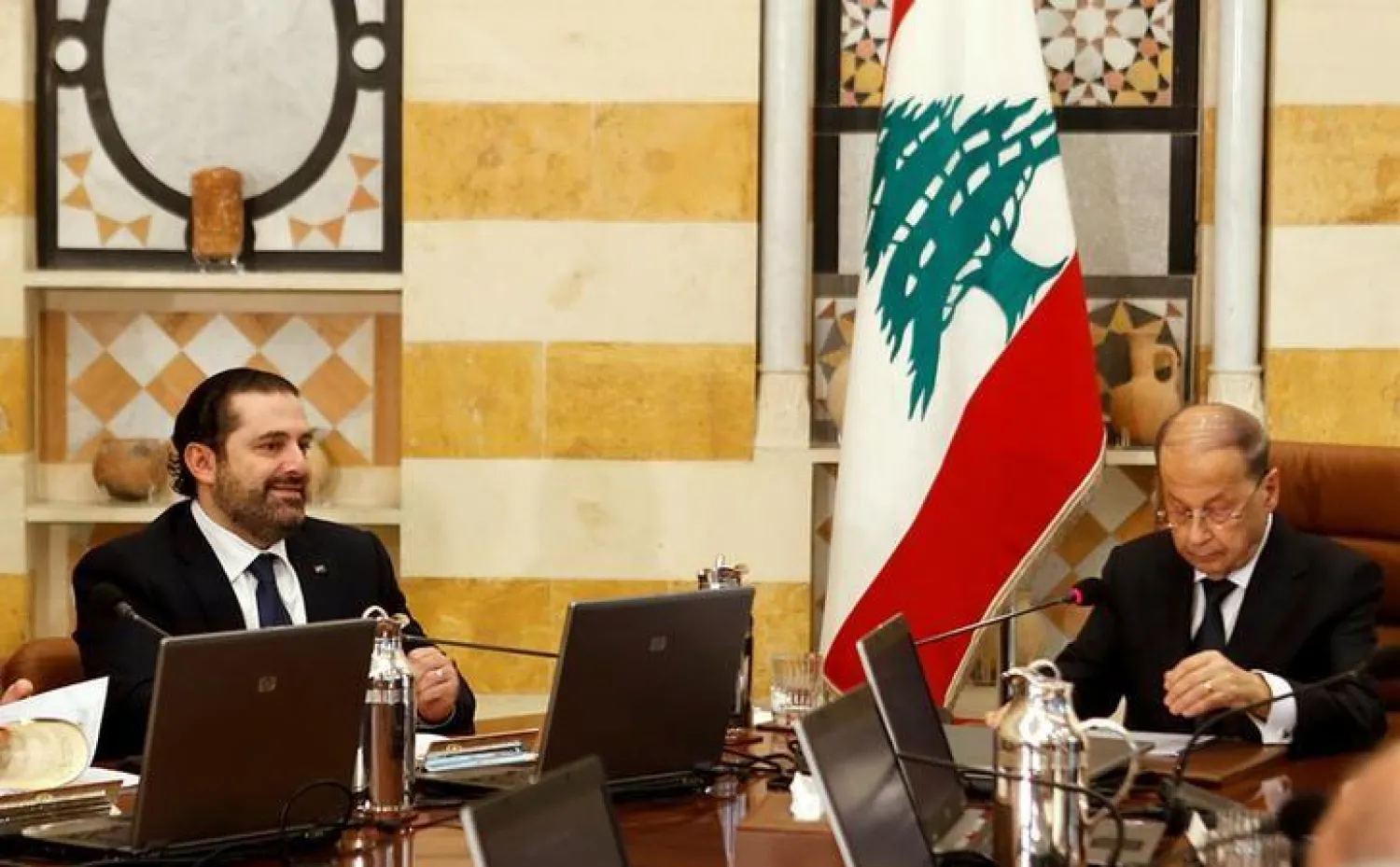
Lebanon’s President Michel Aoun and Prime Minister Saad Hariri (L) attend the first meeting of the new cabinet at the presidential palace in Baabda, Lebanon January 4, 2017. REUTERS/Mohamed Azakir
TT

Future Bloc: Bassil-Moallem Meeting is an Attempt to Annex Lebanon to Iranian, Syrian Axis

Lebanon’s President Michel Aoun and Prime Minister Saad Hariri (L) attend the first meeting of the new cabinet at the presidential palace in Baabda, Lebanon January 4, 2017. REUTERS/Mohamed Azakir

The Future Movement’s parliamentary bloc led by Prime Minister Saad Hariri warned of attempts to trap Lebanon into the Iranian-Syrian alliance.

The bloc criticized what it described as “unilateral steps” made by Foreign Minister Jebran Bassil through his recent meeting with Syrian Foreign Minister Walid al-Moallem.

In a statement issued following its weekly meeting on Tuesday, the bloc warned of attempts to push Lebanon to communicate with the Syrian regime, in violation of national political agreements.

“This was manifested recently in the unilateral step made by Foreign Minister Jebran Bassil through his meeting with the Foreign Minister of the Syrian regime Walid al-Moallem,” the statement said.

The Future bloc lashed out at Bassil for holding talks with his Syrian counterpart, without obtaining a prior permission from the government.

“The bloc considers this behavior as an attempt to push Lebanon into the Iranian-Syrian axis,” it noted.

“They are trying to justify this step through several excuses, such as revealing the fate of the kidnapped soldiers, which proved to be false, and accelerating the return of Syrian refugees to Syria,” the bloc added, noting that terrible crimes committed by the Syrian regime against the people were preventing refugees from returning home.

The bloc said that the working paper submitted by the government to the Brussels’ Donors Conference stipulated the commitment of the Lebanese government to the international laws sponsoring the return of displaced Syrians to their countries, considering that safe areas in Syria are those guaranteed by the international community for the safe return of the displaced to their homes.

The Future Bloc expressed its support to Interior Minister Nohad al-Mashnouq, who decided not to accompany President Michel Aoun on his official visit to Paris, in protest at Bassil’s meeting with Moallem on the sidelines of the UN General Assembly session in New York.


Syrian Army Enters Latakia, Tartus after Attacks by Regime Remnants

Syrian Security forces stand atop a military vehicle in the city of Latakia, Syria, 28 December 2025. (EPA)
TT

Syrian Army Enters Latakia, Tartus after Attacks by Regime Remnants

Syrian Security forces stand atop a military vehicle in the city of Latakia, Syria, 28 December 2025. (EPA)

The Syrian Defense Ministry announced on Sunday the deployment of military forces in the coastal cities of Latakia and Tartus in wake of an armed attack against security forces and civilians during recent protests.

Syrian television said the deployment was happening after "outlawed groups" carried out attacks against security forces and the people.

The military will work on preserving security and restoring calm in cooperation with the internal security forces, it added.

Earlier, local media reported that three people were killed and 48 wounded when gunmen affiliated with the ousted regime opened fire at civilians and security forces during protests in Latakia and Tartus.

State television said a member of the security forces was killed and others were injured while they were protecting protests in Latakia.

Head of the security forces in the Latakia province Abdulaziz al-Ahmed said the attack was carried out by terrorist members of the former regime.

The protests in Latakia were called for by Ghazal Ghazal.

Al-Ahmed added that masked gunmen were spotted at the protests and they were identified as members of Coastal Shield Brigade and Al-Jawad Brigade terrorist groups, reported the official SANA news agency.

The groups were responsible for bombings on the M1 highway and extrajudicial killings, it added.

A member of the groups was arrested in the Jableh countryside during a security operation, announced the Interior Ministry. Three other members were killed, while explosives and various weapons and ammunition were seized during the operation.

The Al-Jawad Brigade is affiliated with Suheil al-Hassan, a notorious former Syrian military officer.

In a statement, the Interior Ministry said the group was involved in assassinations, bombings and attacks against the Interior Ministry forces and the army.

It was planning attacks on New Year celebrations, it revealed. The detainee also revealed the locations of weapons caches used by the group.


Hezbollah Chief Accuses Lebanese Authorities of Working ‘in the Interest of What Israel Wants’

Hezbollah leader Naim Qassem
TT

Hezbollah Chief Accuses Lebanese Authorities of Working ‘in the Interest of What Israel Wants’

Hezbollah leader Naim Qassem

Hezbollah leader Naim Qassem on Sunday said moves to disarm the group in Lebanon are an "Israeli-American plan,” accusing Israel of failing to abide by a ceasefire agreement sealed last year.

Under heavy US pressure and fears of expanded Israeli strikes, the Lebanese military is expected to complete Hezbollah's disarmament south of the Litani River -- located about 30 kilometers from the border with Israel -- by the end of the year.

It will then tackle disarming the Iran-backed movement in the rest of the country.

"Disarmament is an Israeli-American plan," Qassem said.

"To demand exclusive arms control while Israel is committing aggression and America is imposing its will on Lebanon, stripping it of its power, means that you are not working in Lebanon's interest, but rather in the interest of what Israel wants."

Despite a November 2024 ceasefire that was supposed to end more than a year of hostilities between Israel and Hezbollah, Israel has kept up strikes on Lebanon and has maintained troops in five areas it deems strategic.

According to the agreement, Hezbollah was required to pull its forces north of the Litani River and have its military infrastructure in the vacated area dismantled.

Israel has questioned the Lebanese military's effectiveness and has accused Hezbollah of rearming, while the group itself has rejected calls to surrender its weapons.

"The deployment of the Lebanese army south of the Litani River was required only if Israel had adhered to its commitments... to halting the aggression, withdrawing, releasing prisoners, and having reconstruction commence," Qassem said in a televised address.

"With the Israeli enemy not implementing any of the steps of the agreement... Lebanon is no longer required to take any action on any level before the Israelis commit to what they are obligated to do."

Lebanese army chief Rodolphe Haykal told a military meeting on Tuesday "the army is in the process of finishing the first phase of its plan.”

He said the army is carefully planning "for the subsequent phases" of disarmament.


Israel Army Ends Crackdown on West Bank Town after Attack

Smoke rises following an explosion detonated by the Israeli army, which said it was destroying buildings used by Palestinian militants in the West Bank Jenin refugee camp, Sunday, February 2, 2025. © Majdi Mohammed, AP
TT

Israel Army Ends Crackdown on West Bank Town after Attack

Smoke rises following an explosion detonated by the Israeli army, which said it was destroying buildings used by Palestinian militants in the West Bank Jenin refugee camp, Sunday, February 2, 2025. © Majdi Mohammed, AP

The Israeli military said on Sunday it had ended its operation in a town in the occupied West Bank that it had sealed off after a Palestinian from the area killed two Israelis.

Around 50 residents of Qabatiya were briefly detained during the two-day operation, the official Palestinian news agency Wafa reported, quoting the town's mayor Ahmed Zakarneh.

The attacker's father and two brothers remained in custody, it added.

The military launched the operation on Friday, shortly after a 34-year-old Palestinian fatally stabbed an 18-year-old Israeli woman and ran over a man in his sixties with his vehicle.

When contacted by AFP on Sunday morning, the military confirmed the end of its operation in the area.

Defense Minister Israel Katz previously said the army had completely sealed off the town.

Wafa also reported that Israeli troops had withdrawn from Qabatiya, near the city of Jenin.

Zakarneh said the town had been in a state of "total paralysis" during the military activity.

Israeli army bulldozers tore up pavement on several streets and erected roadblocks to halt traffic, he said, adding that around 50 houses were searched.

Wafa reported that a school had been turned into a detention and interrogation center.

AFPTV footage filmed on Saturday showed Israeli soldiers carrying automatic rifles and patrolling the streets, where several armoured vehicles were deployed.

Shops were closed, though men and children were seen walking through the village.

On Sunday, the Israeli army said it had sealed off the assailant's home and was finalising "the procedures required for its demolition".

Israeli authorities argue that demolishing the homes of Palestinians who carry out attacks against Israelis has a deterrent effect.

Critics, however, condemn the practice as collective punishment that leaves families homeless.