
Banned Catalan Vote Continues Despite Crackdown

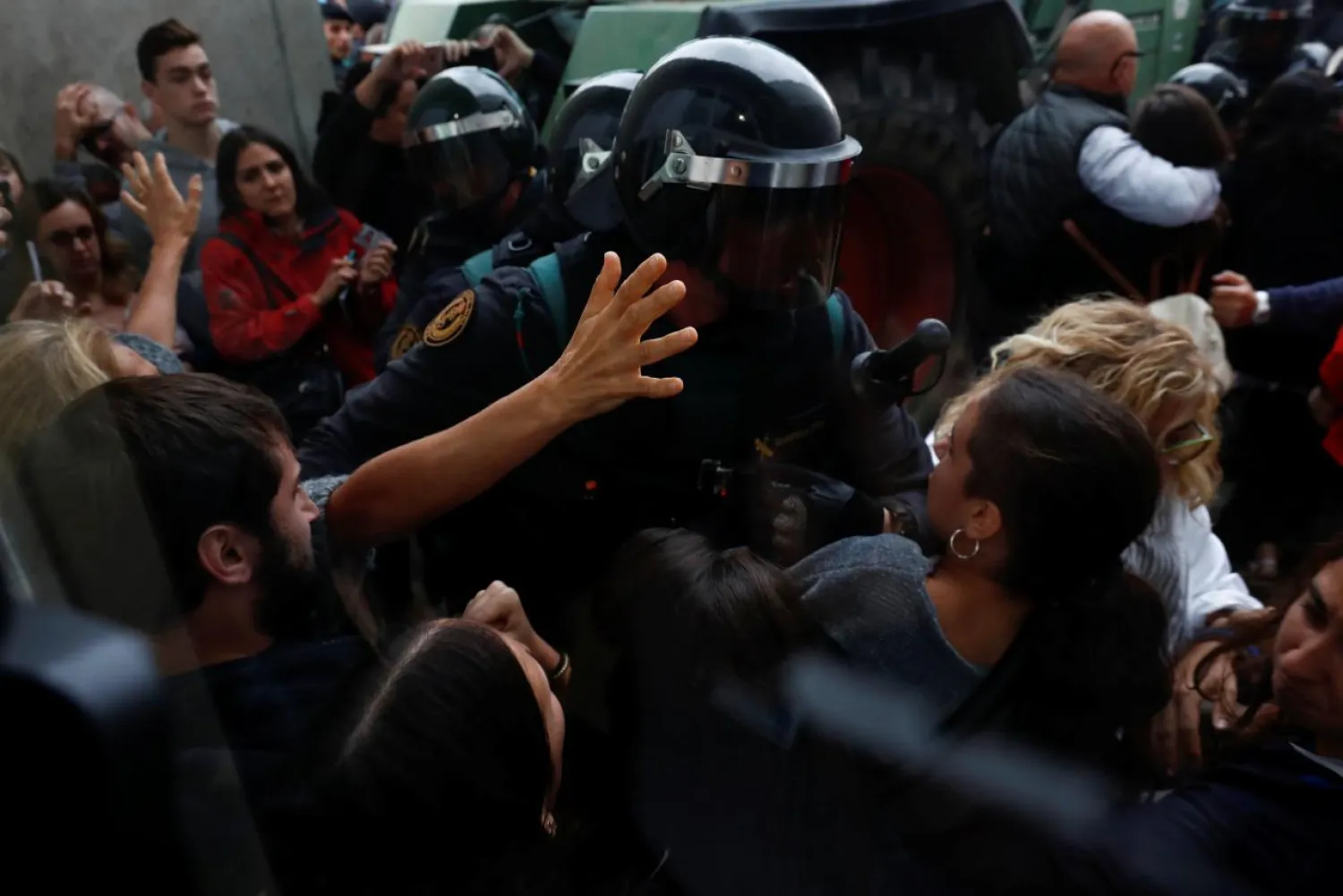
Scuffles break out as Spanish Civil Guard officers force their way through a crowd and into a polling station for the banned independence referendum where Catalan President Carles Puigdemont was supposed to vote in Sant Julia de Ramis, Spain October 1, 2017. REUTERS/Juan Medina
TT

Banned Catalan Vote Continues Despite Crackdown

Scuffles break out as Spanish Civil Guard officers force their way through a crowd and into a polling station for the banned independence referendum where Catalan President Carles Puigdemont was supposed to vote in Sant Julia de Ramis, Spain October 1, 2017. REUTERS/Juan Medina

Catalan officials say at least 337 people have been injured in clashes as Spanish riot police tried to halt a banned referendum on a split from Spain as Madrid asserted its authority over the rebel region.

The Spanish government has pledged to stop a poll that was declared illegal by the country's constitutional court.
Police officers were preventing people from voting, and seizing ballot papers and boxes at polling stations, whereas defiant Catalans shouted ‘Out with the occupying forces!” and sang the anthem of the wealthy northeastern region.

In the regional capital Barcelona, police used batons and fired rubber bullets during pro-referendum protests.
Despite the police action, hundreds-strong queues of people formed in cities and villages throughout the region to cast their votes. At one Barcelona polling station, elderly people and those with children entered first.

The latest injury toll was confirmed by a spokesman for the Catalan regional government, as well as the region's health department.

Separately, the Spanish interior ministry said 11 police officers had been hurt.
At a press conference, Spain's Deputy Prime Minister Soraya Saenz de Santamaria said police had "acted with professionalism and in a proportionate way".

Catalan leader Carles Puigdemont condemned the action of the national police and Guardia Civil, who were sent into Catalonia in large numbers to prevent the vote from taking place.

“The unjustified, disproportionate and irresponsible violence of the Spanish state today has not only failed to stop Catalans’ desire to vote ... but has helped to clarify all the doubts we had to resolve today,” he told reporters.

Spanish Interior Minister Juan Ignacio Zoido blamed Puigdemont for what he termed the day's senseless events.
And the Guardia Civil tweeted (in Spanish) that it was "resisting harassment and provocation" while carrying out its duties "in defense of the law".

Around 70 polling stations had been raided by police, Zoido said.

The aim of the raids was to seize referendum material and not to target people wanting to vote, another senior government official said.

The ballot papers contain just one question: "Do you want Catalonia to become an independent state in the form of a republic?" There are two boxes: Yes or No.

Ahead of the polls opening, the Catalan government said voters

In Girona, riot police smashed their way into a polling station where Puigdemont was due to vote.

Television footage showed them breaking the glass of the sports center's entrance door and forcibly removing those attempting to vote.

However, Puigdemont was still able to cast his ballot at another polling station.


Netanyahu Skeptical of an Iran Breakthrough

Israel's Prime Minister Benjamin Netanyahu leaves after a meeting with US President Donald Trump at the White House February 11, 2026, in Washington, DC. (Photo by Brendan Smialowski / AFP)
TT

Netanyahu Skeptical of an Iran Breakthrough

Israel's Prime Minister Benjamin Netanyahu leaves after a meeting with US President Donald Trump at the White House February 11, 2026, in Washington, DC. (Photo by Brendan Smialowski / AFP)

Israeli Prime Minister Benjamin Netanyahu said he was skeptical that US nuclear talks with Iran will lead to a breakthrough but described his meeting with US President Donald Trump at the White House as “excellent.”

Speaking to reporters Thursday in Washington before boarding a plane to return to Israel, Netanyahu said Trump’s terms and Iran’s “understanding that they made a mistake the last time when they did not reach an agreement, may lead them to agree to conditions that will enable a good agreement to be reached.”

While he said he did “not hide my general skepticism” about any deal, he stressed that any agreement must include concessions about Iran’s ballistic missiles program and support for militant proxies.

He added that the conversation Wednesday with Trump, which lasted more than two hours, included a number of other subjects, including Gaza and regional developments but focused on the negotiations with Iran.


German Court Rejects Palestinian's Claim over Weapons Exports

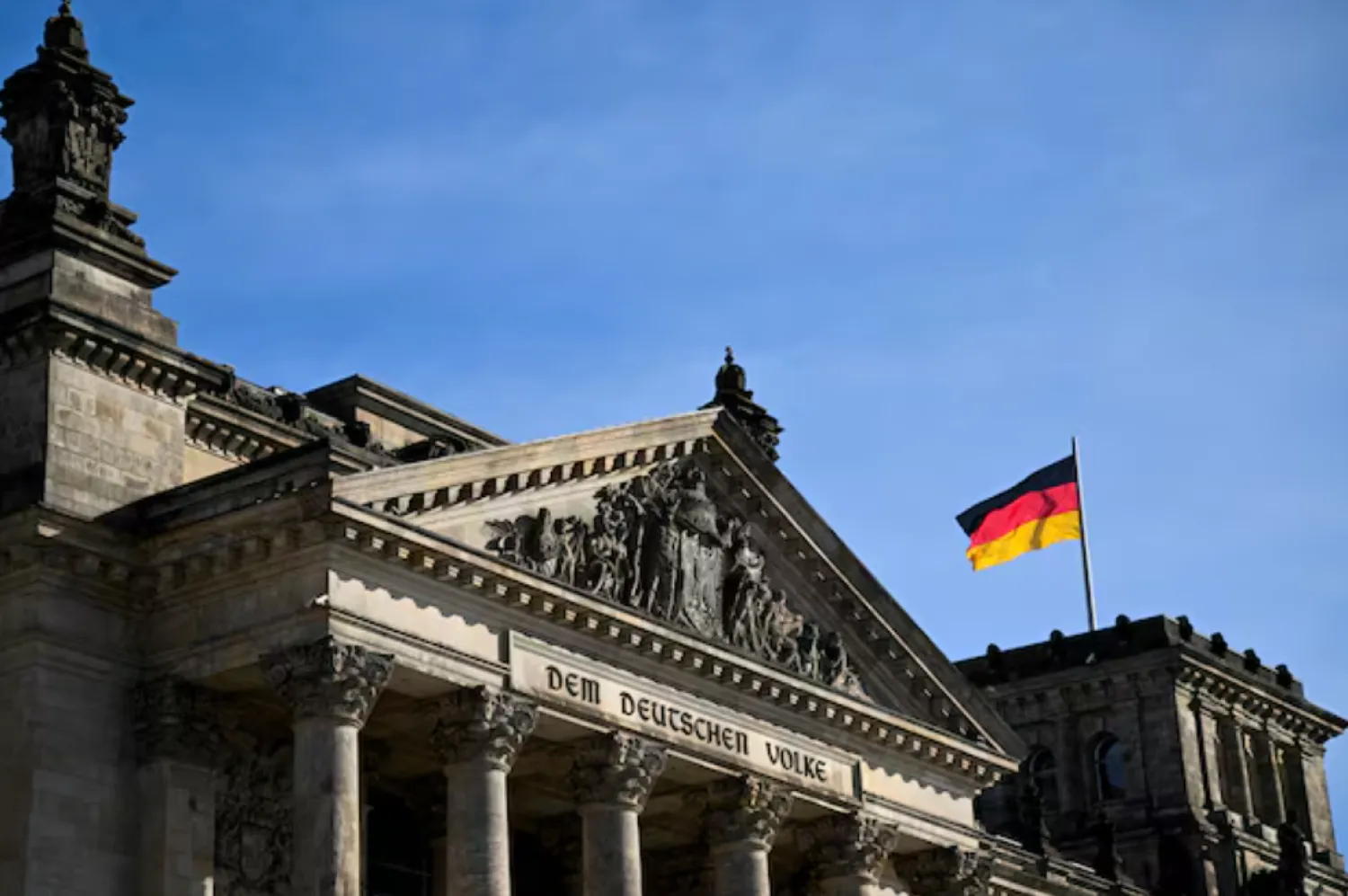
A view shows the front of the Reichstag building, the seat of the German parliament, the Bundestag, in Berlin, Germany March 5, 2025. REUTERS/Annegret Hilse/File Photo
TT

German Court Rejects Palestinian's Claim over Weapons Exports

A view shows the front of the Reichstag building, the seat of the German parliament, the Bundestag, in Berlin, Germany March 5, 2025. REUTERS/Annegret Hilse/File Photo

Germany's highest court on Thursday threw out a case brought by a Palestinian civilian from Gaza seeking to sue the German government over its weapons exports to Israel.

The complainant, supported by the European Center for Constitutional and Human Rights (ECCHR), had been seeking to challenge export licences for German parts used in Israeli tanks deployed in Gaza.

After his case was rejected by lower courts in 2024 and 2025, he had appealed to the Federal Constitutional Court.

But the court in Karlsruhe dismissed the case, stating that "the complainant has not sufficiently substantiated that the specialized courts misjudged or arbitrarily denied a possible duty to protect him", AFP reported.

While Germany is obliged to protect human rights and respect international humanitarian law, this does not mean the state is necessarily obliged to take specific action on behalf of individuals, the court said.

"It is fundamentally the responsibility of the state authorities themselves to decide how they fulfil their general duty of protection," it added.

The ECCHR called the decision "a setback for civilian access to justice".

"The court acknowledges the duty to protect but only in the abstract and refuses to ensure its practical enforcement," said Alexander Schwarz, co-director of the NGO's International Crimes and Legal Accountability program.

"For people whose lives are endangered by the consequences of German arms exports, access to justice remains effectively closed," he said.

The ECCHR had been hoping for a successful appeal after the Constitutional Court ruled last year that Germany had "a general duty to protect fundamental human rights and the core norms of international humanitarian law, even in cases involving foreign countries".

In that case, two Yemenis had been seeking to sue Berlin over the role of the US Ramstein airbase in a 2012 drone attack.

The complainant was one of five Palestinians who initially brought their case against the German government in 2024.


2 Israelis Charged with Using Classified Military Information to Place Bets

The Israeli Iron Dome air defense system intercepts missiles during an Iranian attack on Tel Aviv, Israel, June 18, 2025. (AP Photo/Leo Correa, File)
TT

2 Israelis Charged with Using Classified Military Information to Place Bets

The Israeli Iron Dome air defense system intercepts missiles during an Iranian attack on Tel Aviv, Israel, June 18, 2025. (AP Photo/Leo Correa, File)

Two Israelis have been charged with using classified military information to place bets on how future events will unfold, Israeli authorities said Thursday, accusing the individuals of “serious security offenses.”

A joint statement by the Israeli Ministry of Defense, domestic security service Shin Bet and police said that a civilian and a reservist are suspected of placing bets on the US-based prediction market Polymarket on future military operations based on information that the reservist had access to, The AP news reported.

Israel’s Attorney General’s Office decided to prosecute the two individuals following a joint investigation by police, military intelligence and other security agencies that resulted in several arrests. The two face charges including bribery and obstruction of justice.

Authorities offered no details on the identity of the two individuals or the reservist's rank or position in the Israeli military but warned that such actions posed a “real security risk” for the military and the Israeli state.

Israel’s public broadcaster Kan had reported earlier that the bets were placed in June ahead of Israel’s war with Iran and that the winnings were roughly $150,000.

Israel's military and security services “view the acts attributed to the defendants very seriously and will act resolutely to thwart and bring to justice any person involved in the activity of using classified information illegally,” the statement said.

The accused will remain in custody until the end of legal proceedings against them, the Prosecutor's Office said.

Prediction markets are comprised of typically yes-or-no questions called event contracts, with the prices connected to what traders are willing to pay, which theoretically indicates the perceived probability of an event occurring.

Their use has skyrocketed in recent years, but despite some eye-catching windfalls, traders still lose money everyday. In the US, the trades are categorized differently than traditional forms of gambling, raising questions about transparency and risk.