


Cholera Outbreak in Yemen Drops Sharply

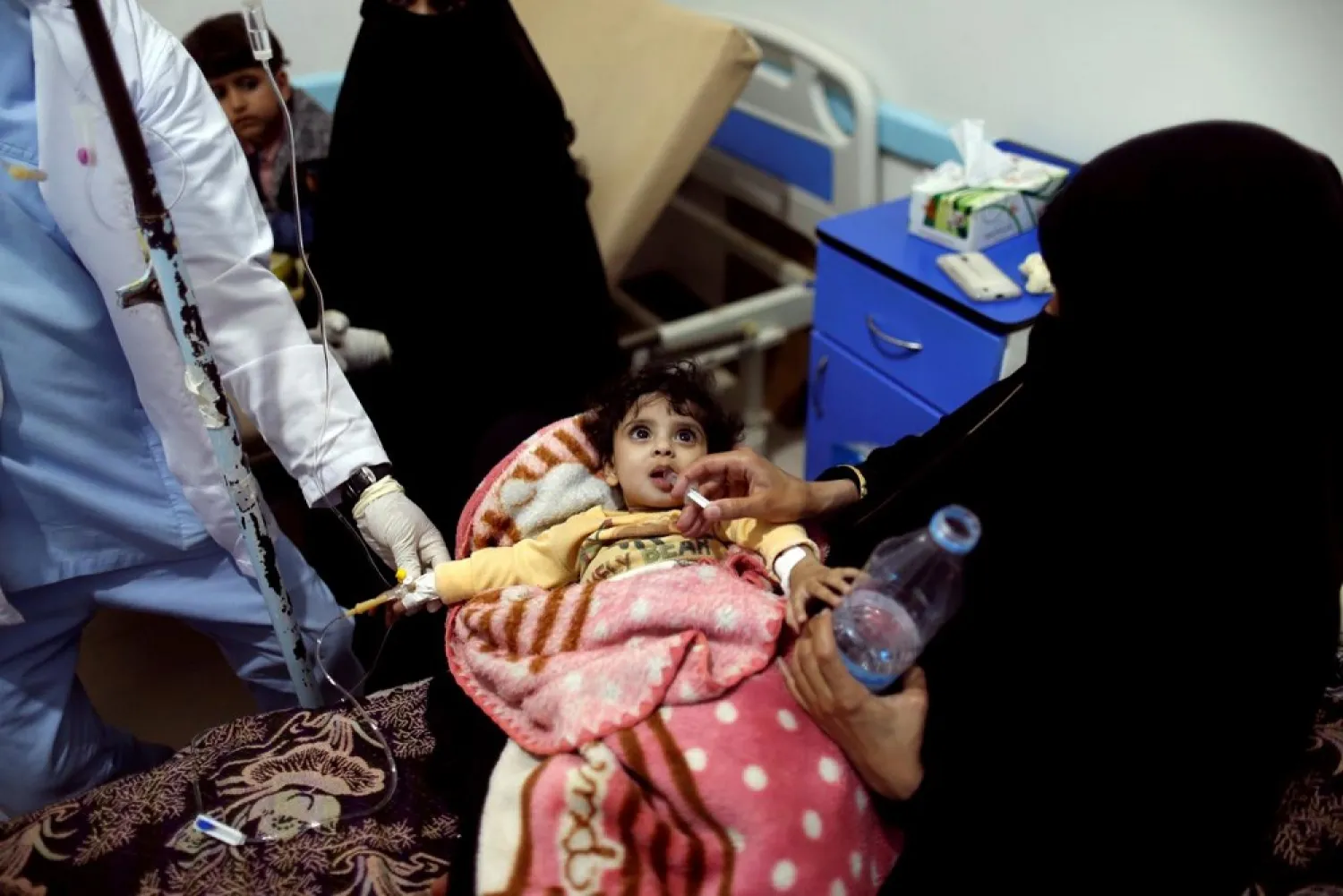
A woman gives her daughter re-hydration fluid at a cholera treatment center in Sana’a, Yemen. (Reuters)
TT

Cholera Outbreak in Yemen Drops Sharply

A woman gives her daughter re-hydration fluid at a cholera treatment center in Sana’a, Yemen. (Reuters)

The number of cholera cases reported in Doctors without Borders (MSF) treatment centers has significantly decreased since the peak of the outbreak, said a statement published on Monday on its official website.

As a result, the medical organization is closing the majority of its cholera treatment centers or reducing their capacity.

The weekly number of admissions in MSF cholera treatment centers in Yemen shrank from 11,139 in the third week of June – at the peak of the outbreak – to 567 in the second week of October.

Only nine percent of patients admitted by MSF last week needed to be hospitalized and a limited number of patients have symptoms that correspond with the cholera case definition (acute watery diarrhea with or without vomiting).

The remaining cases are believed to be due to other pathogens.

“In some locations, such as Khamir, where cultures were performed in a laboratory, no positive cases have been confirmed since the beginning of September,” explained Ghassan Abou Chaar, MSF head of mission in Yemen.

“The cholera outbreak is not over, but it is no longer our medical priority in Yemen. However, this should not eclipse the dire health situation of millions of Yemenis who are unable to access basic primary healthcare.”

Since the beginning of the outbreak, MSF has admitted more than 103,000 patients to 37 cholera treatment centers and oral re-hydration points. At the peak of the outbreak, MSF was employing or distributing financial compensations to 685 additional health workers to treat cholera patients.

“It is now essential to implement a proper monitoring system with an acute surveillance of the trend of cholera cases and an increased capacity for confirming them. Without appropriate and timely efforts from humanitarian actors, a resurgence of the cholera outbreak could occur,” said Chaar.

Thirty months of war, high prices of consumer goods and unemployment have had dramatic consequences for the population. Many patients only reach medical facilities when their health conditions are critical because they cannot afford to pay for transport. Women often deliver babies at home, particularly in remote areas, and only seek support in case of complications. In addition, the number of severely malnourished children is high.

The non-payment of public health workers’ salaries over the past 13 months has deeply affected the health system, forcing many doctors, nurses and other health professionals to seek alternative sources of income. Preventable illnesses and deaths are increasing in Yemen, and this can be partly attributed to the salary crisis.

Yemen is one of MSF’s largest country programs worldwide. The organization employs almost 1,600 Yemeni staff and gives financial support to 1,160 Ministry of Health staff, as well as casual daily workers.



Al-Alimi Says Will Not Allow Forceful Fait Accompli in Yemen’s Hadhramaut, al-Mahra

Yemen’s Presidential Leadership Council Chairman Rashad al-Alimi meets with members of the advisory body (SABA)
TT

Al-Alimi Says Will Not Allow Forceful Fait Accompli in Yemen’s Hadhramaut, al-Mahra

Yemen’s Presidential Leadership Council Chairman Rashad al-Alimi meets with members of the advisory body (SABA)

Yemen’s Presidential Leadership Council Chairman Rashad al-Alimi on Saturday set out firm red lines against any attempts to impose a new military reality in the eastern provinces of Hadhramaut and al-Mahra, warning that developments there are not a political disagreement but a calculated course of unilateral steps that challenge the foundations of the transitional phase.

Speaking at an expanded meeting with the council’s advisory body, al-Alimi said protecting civilians is a core responsibility of the state, adding that the political leadership formally requested the intervention of the Saudi-led coalition supporting legitimacy, which he said responded immediately to contain the escalation, prevent bloodshed, and restore the situation to its natural course.

According to official media, al-Alimi reviewed developments in the eastern provinces, saying the state had acted with “a high degree of responsibility” in dealing with what he described as a dangerous escalation driven by military moves by the Southern Transitional Council, aimed at imposing a fait accompli by force and undermining the foundations of the transitional phase, foremost among them the transfer of power declaration and the Riyadh Agreement.

He stated that the escalation in Hadhramaut had expanded from administrative decisions into military movements, which included the districts of Ghayl Bin Yamin, Al Shihr, and Al Dis Al Sharqiya. He added that claims of fighting terrorism had been used as a pretext to alter the balance of power on the ground.

Al-Alimi stressed that counterterrorism is an exclusive responsibility of state institutions, warning that any actions outside this framework do not contain extremism but instead create dangerous security vacuums that threaten social cohesion and civil peace.

He also pointed to accompanying humanitarian violations, citing field and rights reports documenting civilian casualties and attacks on public and private property, as well as the erosion of the Yemeni state’s legal standing.

Coalition move and mediation support

Al-Alimi briefed the advisers on the outcomes of a meeting of the National Defense Council, which concluded that the escalation constituted a clear breach of the transitional references and an act of rebellion against legitimate state institutions, underscoring the state’s duty to protect civilians, impose de-escalation, and prevent bloodshed.

He stated that the political leadership, acting on the council’s recommendations, submitted a formal request to the coalition, seeking legitimacy to take immediate measures to protect civilians in Hadhramaut. The joint forces command responded promptly, he added, in a bid to prevent bloodshed and restore stability.

Al-Alimi warned that any military movements that undermine de-escalation efforts or endanger civilians would be dealt with directly, in a manner that safeguards lives and supports mediation efforts led by Saudi Arabia and the United Arab Emirates.

He stated that this included the withdrawal of Southern Transitional Council forces from camps in Hadhramaut and al-Mahra, their handover to the National Shield forces, and the enabling of local authorities to exercise their constitutional powers.

He reiterated his full support for mediation led by Riyadh and Abu Dhabi, praising the two countries’ role in supporting Yemen’s unity and stability, and welcoming the remarks by Saudi Defense Minister Prince Khalid bin Salman, which he said reflected sincere fraternal concern for restoring Yemen's state institutions.

Al-Alimi also reaffirmed that resolving the southern issue remains a firm commitment through consensus and confidence-building measures, warning against unilateral actions that serve only Yemen’s enemies. He stressed the need to keep dialogue channels open and to mobilize efforts to confront the Houthi militias backed by Iran.


Arab-Islamic Statement Rejects Link Between Israel’s Recognition of Somaliland and Attempts to Expel Palestinians

People walk along a street before the opening of polling stations for voting in the municipal elections in Hodan district of Mogadishu, Somalia December 25, 2025. REUTERS/Feisal Omar
TT

Arab-Islamic Statement Rejects Link Between Israel’s Recognition of Somaliland and Attempts to Expel Palestinians

People walk along a street before the opening of polling stations for voting in the municipal elections in Hodan district of Mogadishu, Somalia December 25, 2025. REUTERS/Feisal Omar

A growing number of countries are rejecting Israel's recognition of Somalia’s breakaway region of Somaliland as an independent nation, the first by any country in more than 30 years.

A joint statement by more than 20 mostly Middle Eastern or African countries and the Organization of Islamic Cooperation on Saturday rejected Israel's recognition “given the serious repercussions of such unprecedented measure on peace and security in the Horn of Africa, the Red Sea and its serious effects on international peace and security as a whole.”

The joint statement also noted “the full rejection of any potential link between such measure and any attempts to forcibly expel the Palestinian people out of their land.”

Israeli Prime Minister Benjamin Netanyahu’s office said Friday that he, Israeli Foreign Minister Gideon Saar and Somaliland’s president, Abdirahman Mohamed Abdullahi, signed a joint declaration “in the spirit of the Abraham Accords.”

Somalia’s federal government on Friday strongly rejected what it described as an unlawful move by Israel, and reaffirmed that Somaliland remains an integral part of Somalia’s sovereign territory.

African regional bodies also rejected Israel's recognition. African Union Chairperson Mahmoud Ali Youssouf said that any attempt to undermine Somalia’s sovereignty risks peace and stability on the continent.

East African governing body IGAD said in a statement that Somalia’s sovereignty was recognized under international law and any unilateral recognition “runs contrary to the charter of the United Nations” and agreements establishing the bloc and the African Union.

The US State Department on Saturday said that it continued to recognize the territorial integrity of Somalia, "which includes the territory of Somaliland.”


Italian Authorities Arrest 9 for Allegedly Funding Hamas Through Charities

Palestinian Hamas members secure the area as Egyptian workers accompanied by members of the International Committee of the Red Cross (ICRC) search for the remains of the last Israeli hostage in the Zeitoun neighborhood of Gaza City on December 8, 2025. (Photo by Omar AL-QATTAA / AFP)
TT

Italian Authorities Arrest 9 for Allegedly Funding Hamas Through Charities

Palestinian Hamas members secure the area as Egyptian workers accompanied by members of the International Committee of the Red Cross (ICRC) search for the remains of the last Israeli hostage in the Zeitoun neighborhood of Gaza City on December 8, 2025. (Photo by Omar AL-QATTAA / AFP)

Italian authorities arrested nine people linked to three charitable organizations on suspicion of raising millions of euros in funds for the Palestinian group Hamas, anti-terrorism prosecutors said in a statement Saturday. 

The suspects are accused of sending about 7 million euros ($8.2 million) to “associations based in Gaza, the Palestinian territories, or Israel, owned, controlled, or linked to Hamas,” the statement said. 

Among those arrested was Mohammad Hannoun, president of the Palestinian Association in Italy, prosecutors said, describing him as the “head of the Italian cell of the Hamas organization.” 

The European Union has Hamas listed on its terror list. 

According to Italian prosecutors, who collaborated with other EU countries in the probe, the illegal funds were delivered through “triangulation operations” via bank transfers or through organizations based abroad to associations based in Gaza, which have been declared illegal by Israel for their ties to Hamas. 

Interior Minister Matteo Piantedosi wrote on X that the operation “lifted the veil on behavior and activities which, pretending to be initiatives in favor of the Palestinian population, concealed support for and participation in terrorist organizations.” 

There was no immediate comment from the suspects or the associations. 

In January 202, the European Council decided to extend existing restrictive measures against 12 individuals and three entities that support the financing of Hamas and the Palestinian Islamic Jihad.