


Crosses Are Falling In The Premier League: Why The Focus On Target Men?

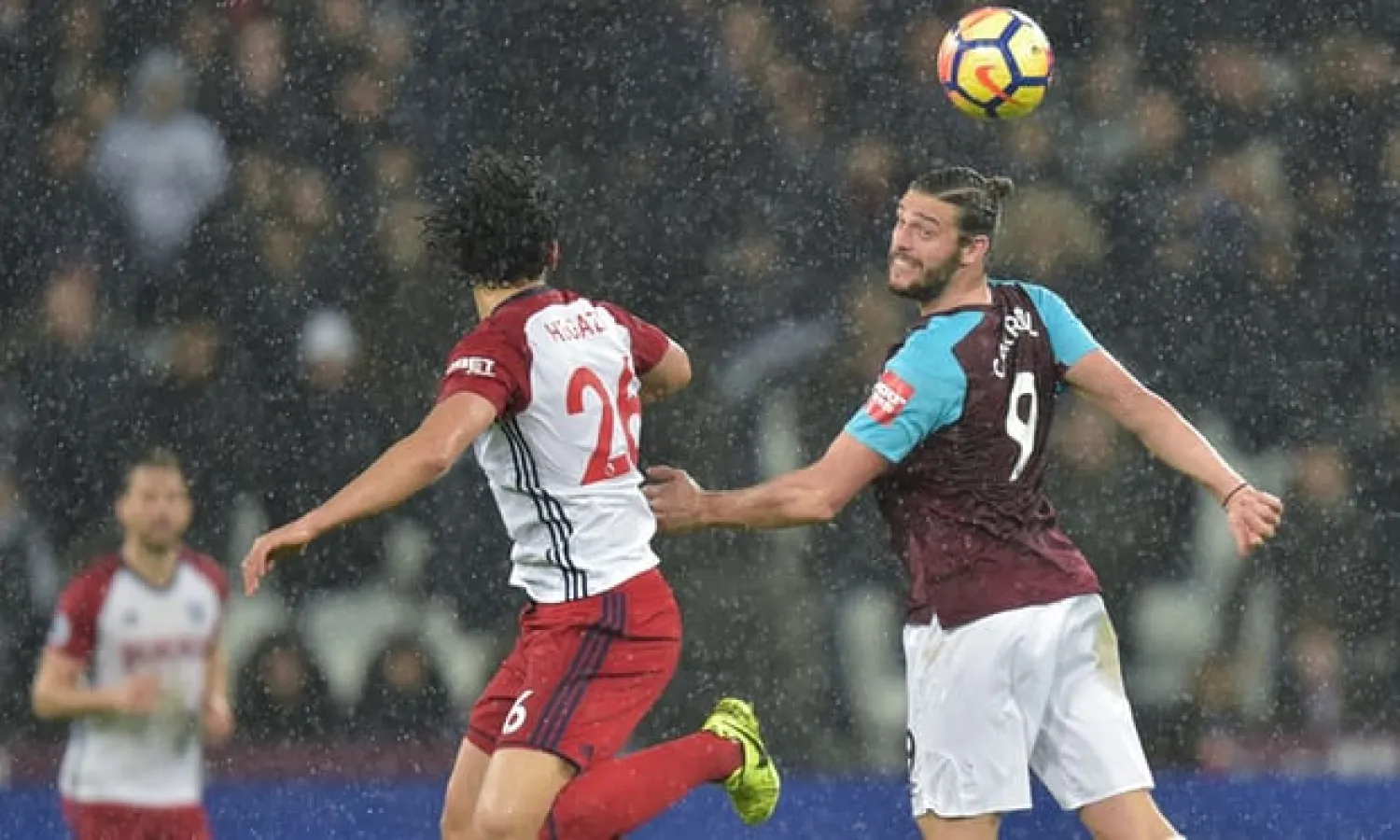
 Andy Carroll (right) in the air is a fearsome sight but his injuries and teams’ worse crossing makes him less effective than he once was. Photograph: Joe Toth/BPI/Rex/Shutterstock
Andy Carroll (right) in the air is a fearsome sight but his injuries and teams’ worse crossing makes him less effective than he once was. Photograph: Joe Toth/BPI/Rex/Shutterstock
TT

Crosses Are Falling In The Premier League: Why The Focus On Target Men?

 Andy Carroll (right) in the air is a fearsome sight but his injuries and teams’ worse crossing makes him less effective than he once was. Photograph: Joe Toth/BPI/Rex/Shutterstock
Andy Carroll (right) in the air is a fearsome sight but his injuries and teams’ worse crossing makes him less effective than he once was. Photograph: Joe Toth/BPI/Rex/Shutterstock

How times change. At the dawn of the Premier League the news that Chelsea wanted a rugged English striker to hurl himself at crosses, preferably after smashing through a centre-half in the brusque style of Kerry Dixon or Mick Harford, would barely have caused a ripple. Yet when it emerged last week that they were lining up a £20m bid for Andy Carroll – and then started making eyes at Peter Crouch – their fans were entitled to check their calendars to make sure it was not 1 April.

Reports on Sunday morning that Chelsea had turned their attention to the Roma striker Edin Dzeko suggested sanity had returned to the Stamford Bridge boardroom – until, that is, they were linked with Burnley’s journeyman forward Ashley Barnes hours later.

Carroll had eight injuries last season. Crouch turns 37 next week and has scored 10 league goals since the start of 2016-17. Barnes has 10 in 65 over the same period. They all have mixed records, to say the least. No wonder there has been bewilderment at Chelsea’s approach.

But perhaps there is something else here, beyond the players themselves – the question of why one of the world’s richest clubs seem hellbent on buying an ageing English meat-and-potatoes centre-forward to hold the ball up, create havoc, and get on the end of crosses speared into the mixer? Because in a game that gets faster and more fluid with every passing season, players such as Carroll – and to a lesser extent Crouch and Barnes – feel more of a curiosity than ever.

That narrative is reflected in the numbers. When Opta started collating records in 2003-04 there was an average of 51 crosses per Premier League game – a figure that was almost certainly much higher in previous decades. This season it is 38, the lowest on record. More intriguingly crossing accuracy, too, has plummeted to its lowest level. A 30% success rate in the Premier League used to be typical. This season it is below 22%.

One reason, as Opta’s Duncan Alexander points out, is that these figures include set pieces – and as teams increasingly play with only one, or even no, out-and-out striker, an increasing proportion of crosses will come from corners and free-kicks where defending teams have the opportunity to set themselves up.

But teams are more aware of the percentages, too. Data shows that only one out of 92 crosses on average leads directly to a goal – although, as Garry Gelade, a statistical consultant who works with Premier League sides has shown, it is a bit more complicated than that. After analysing 35,000 crosses in the Premier League between 2013 and 2015 in more depth – and, in particular, looking at what happened in the six seconds afterwards – he found that one in every 47 crosses leads to a goal.

Of course the location of the cross, along with a player’s delivery, will radically alter the chances of its success. Even so, when you compare the leading goalscorers in the 1992-93 Premier League with those this season, the difference is notable.

Twenty-five years ago, Les Ferdinand topped the scoring charts, with other big men such as Alan Shearer, Paul Wilkinson, Brian Deane, Mark Hughes, Lee Chapman, Ian Olney and Iain Dowie in the top 20. This season – with the honourable exceptions of Harry Kane, Romelu Lukaku, Wayne Rooney and Álvaro Morata – the list is dominated by nimble speed merchants.

So why have Chelsea considered Carroll, Crouch and Barnes? Most put it down to the need for a Plan B at the end of games, when necessity dictates that a more cultured approach gives way to caveman football. But, putting aside the question of whether a side as good as Chelsea need a Plan B if Plan A is executed well enough – look at Manchester City – would Carroll, Crouch or Barnes really make a difference?

Carroll has scored only six times in 64 substitute appearances for West Ham, while Crouch’s record of 15 goals in 146 is not much better. Both men are a long way behind Arsenal’s Olivier Giroud, who has scored a staggering 17 goals in 60 Premier League games as a sub – better than one in every four appearances off the bench.

There is another reason to be cautious about a crude Plan B. Gelade’s data shows that, while the chance of a goal from a cross climbs as the second half goes on, after about 85 minutes the success rate plummets. Arguably that is because teams protecting a lead defend deep and in numbers – while those attacking get more desperate.

Yet while Carroll’s and Crouch’s playing style is fading out of fashion, the numbers clearly show they improve West Ham’s and Stoke’s goals and chance creation when they play. The stats for Carroll, in particular, are startling. Since the start of the 2015‑16 season West Ham have averaged 1.51 goals per 90 minutes with Carroll in the team – but only 1.13 without him. That equates to better than one extra goal every three matches or more than 14 in the course of a Premier League season.

Yet it is one thing improving West Ham and Stoke – quite another doing it at Chelsea. And, while the switch to Dzeko over the past 24 hours is a clear upgrade, Chelsea should have been targeting players of the future, not throwbacks to a different era all along.

The Guardian Sport


Tottenham Hotspur Sack Head Coach Thomas Frank

(FILES) Tottenham Hotspur's Danish head coach Thomas Frank gestures on the touchline during the English Premier League football match between Burnley and Tottenham Hotspur at Turf Moor in Burnley, north-west England on January 24, 2026. (Photo by Oli SCARFF / AFP)/
TT

Tottenham Hotspur Sack Head Coach Thomas Frank

(FILES) Tottenham Hotspur's Danish head coach Thomas Frank gestures on the touchline during the English Premier League football match between Burnley and Tottenham Hotspur at Turf Moor in Burnley, north-west England on January 24, 2026. (Photo by Oli SCARFF / AFP)/

Thomas Frank was fired by Tottenham on Wednesday after only eight months in charge and with his team just five points above the relegation zone in the Premier League.

Despite leading Spurs to the round of 16 in the Champions League, Frank has overseen a desperate domestic campaign. A 2-1 loss to Newcastle on Tuesday means Spurs are still to win in the league in 2026.

“The Club has taken the decision to make a change in the Men’s Head Coach position and Thomas Frank will leave today,” Tottenham said in a statement. “Thomas was appointed in June 2025, and we have been determined to give him the time and support needed to build for the future together.

“However, results and performances have led the Board to conclude that a change at this point in the season is necessary.”

Frank’s exit means Spurs are on the lookout for a sixth head coach in less than seven years since Mauricio Pochettino departed in 2019.


Marseille Coach De Zerbi Leaves After Humiliating 5-0 Loss to PSG 

Marseille's Italian coach Roberto De Zerbi looks on from the technical area during the French Cup round of 32 football match between FC Bayeux and Olympique de Marseille (OM) at the Michel-d'Ornano Stadium in Caen on January 13, 2026. (AFP) 
TT

Marseille Coach De Zerbi Leaves After Humiliating 5-0 Loss to PSG 

Marseille's Italian coach Roberto De Zerbi looks on from the technical area during the French Cup round of 32 football match between FC Bayeux and Olympique de Marseille (OM) at the Michel-d'Ornano Stadium in Caen on January 13, 2026. (AFP) 

Marseille coach Roberto De Zerbi is leaving the French league club in the wake of a 5-0 thrashing at the hands of PSG in French soccer biggest game.

The nine-time French champions said on Wednesday that they have ended “their collaboration by mutual agreement.”

The heavy loss Sunday at the Parc des Princes restored defending champion PSG’s two-point lead over Lens after 21 rounds, with Marseille in fourth place after the humiliating defeat.

De Zerbi's exit followed another embarrassing 3-0 loss at Club Brugge two weeks ago that resulted in Marseille exiting the Champions League.

De Zerbi, who had apologized to Marseille fans after the loss against bitter rival PSG, joined Marseille in 2024 after two seasons in charge at Brighton. After tightening things up tactically in Marseille during his first season, his recent choices had left many observers puzzled.

“Following consultations involving all stakeholders in the club’s leadership — the owner, president, director of football and head coach — it was decided to opt for a change at the head of the first team,” Marseille said. “This was a collective and difficult decision, taken after thorough consideration, in the best interests of the club and in order to address the sporting challenges of the end of the season.”

De Zerbi led Marseille to a second-place finish last season. Marseille did not immediately announce a replacement for De Zerbi ahead of Saturday's league match against Strasbourg.

Since American owner Frank McCourt bought Marseille in 2016, the former powerhouse of French soccer has failed to find any form of stability, with a succession of coaches and crises that sometimes turned violent.

Marseille dominated domestic soccer in the late 1980s and early 1990s. It was the only French team to win the Champions League before PSG claimed the trophy last year. It hasn’t won its own league title since 2010.


Olympic Fans Hunt for Plushies of Mascots Milo and Tina as They Fly off Shelves 

Fans take selfies with the Olympic mascot Tina at the finish area of an alpine ski, slalom portion of a women's team combined race, at the 2026 Winter Olympics, in Cortina d'Ampezzo, Italy, Tuesday, Feb. 10, 2026. (AP)
TT

Olympic Fans Hunt for Plushies of Mascots Milo and Tina as They Fly off Shelves 

Fans take selfies with the Olympic mascot Tina at the finish area of an alpine ski, slalom portion of a women's team combined race, at the 2026 Winter Olympics, in Cortina d'Ampezzo, Italy, Tuesday, Feb. 10, 2026. (AP)

For fans of the Milan Cortina Olympic mascots, the eponymous Milo and Tina, it's been nearly impossible to find a plush toy of the stoat siblings in Milan and Cortina d’Ampezzo.

Many of the official Olympics stores in the host cities are already sold out, less than a week into the Winter Games.

“I think the only way to get them is to actually win a medal,” Julia Peeler joked Tuesday in central Milan, where Tina and Milo characters posed for photos with fans.

The 38-year-old from South Carolina is on the hunt for the plushies for her niece. She's already bought some mascot pins, but she won't wear them on her lanyard. Peeler wants to avoid anyone trying to swap for them in a pin trade, a popular Olympic pastime.

Tina, short for Cortina, is the lighter-colored stoat and represents the Olympic Winter Games. Her younger brother Milo, short for Milano, is the face of the Paralympic Winter Games.

Milo was born without one paw but learned to use his tail and turn his difference into a strength, according to the Olympics website. A stoat is a small mustelid, like a weasel or an otter.

The animals adorn merchandise ranging from coffee mugs to T-shirts, but the plush toys are the most popular.

They're priced from 18 to 58 euros (about $21 to $69) and many of the major official stores in Milan, including the largest one at the iconic Duomo Cathedral, and Cortina have been cleaned out. They appeared to be sold out online Tuesday night.

Winning athletes are gifted the plush toys when they receive their gold, silver and bronze medals atop the podium.

Broadcast system engineer Jennifer Suarez got lucky Tuesday at the media center in Milan. She's been collecting mascot toys since the 2010 Vancouver Games and has been asking shops when they would restock.

“We were lucky we were just in time,” she said, clutching a tiny Tina. “They are gone right now.”

Friends Michelle Chen and Brenda Zhang were among the dozens of fans Tuesday who took photos with the characters at the fan zone in central Milan.

“They’re just so lovable and they’re always super excited at the Games, they are cheering on the crowd,” Chen, 29, said after they snapped their shots. “We just are so excited to meet them.”

The San Franciscan women are in Milan for the Olympics and their friend who is “obsessed” with the stoats asked for a plush Tina as a gift.

“They’re just so cute, and stoats are such a unique animal to be the Olympic mascot,” Zhang, 28, said.

Annie-Laurie Atkins, Peeler's friend, loves that Milo is the mascot for Paralympians.

“The Paralympics are really special to me,” she said Tuesday. “I have a lot of friends that are disabled and so having a character that also represents that is just incredible.”
