

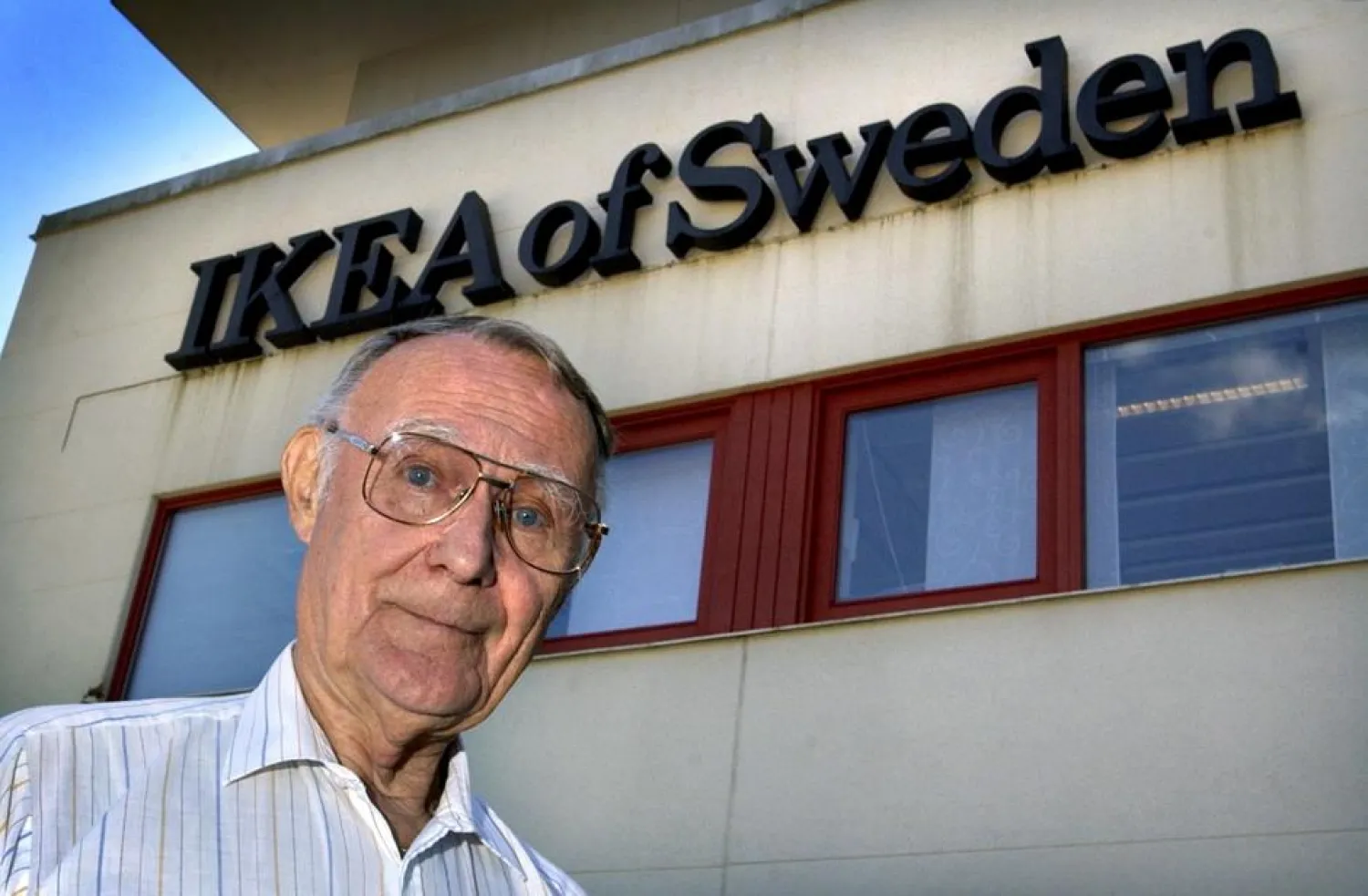

Swedish IKEA Founder Kamprad Dies at 91

Ingvar Kamprad, founder of Swedish multinational furniture retailer IKEA, is seen at company's head office in Almhult, Sweden August 6, 2002. TT News Agency/Claudio Bresciani via REUTERS/File photo
TT

Swedish IKEA Founder Kamprad Dies at 91

Ingvar Kamprad, founder of Swedish multinational furniture retailer IKEA, is seen at company's head office in Almhult, Sweden August 6, 2002. TT News Agency/Claudio Bresciani via REUTERS/File photo

Billionaire IKEA founder Ingvar Kamprad, who turned a business he launched as a teenager into one of the world’s best-known furniture brands, has died at the age of 91, the Swedish company said on Sunday.

IKEA’s simple but sturdy designs and self-assembly products are now familiar in homes around the globe and the retailer is aiming to generate 50 billion euros ($62 billion) in annual revenues by 2020.

Kamprad started IKEA in 1943 when he was just 17, but his big break came in 1956, when the company pioneered flat-pack furniture.

He got the idea when he watched an employee taking the legs off a table to fit it into a customer’s car and realized that it could be developed to save money on transport, storage and sales space.

The business now has around 400 stores, many of them cavernous warehouses in out-of-town malls and roughly 1 billion people visited them last year.

“One of the greatest entrepreneurs of the 20th century, Ingvar Kamprad, has peacefully passed away, at his home in Smaland, Sweden, on the 27th of January,” the company said.

Sweden’s Prime Minister Stefan Lofven praised Kamprad as an inspirational figure whose influence had reached far beyond his native land.

“Ingvar Kamprad was a unique entrepreneur who had a big impact on Swedish business and who made home design a possibility for the many not just the few,” national news agency TT quoted Lofven saying.

Born on March 30, 1926, in southern Sweden, Kamprad started off selling matches to neighbors at the age of five and soon diversified his inventory to include seeds, Christmas tree decorations, pencils and ball-point pens.

Despite his wealth, Kamprad prided himself on being frugal, driving an old car and encouraging staff to write on both sides of a sheet of paper to avoid waste.

Kamprad was also a controversial figure.

He was forced to apologize for his time as a member of the New Swedish Movement, a nationalist, far-right group that supported fascist parties around Europe, in the 1940s.

His decision to live abroad, mainly in Switzerland, to avoid Sweden’s high-income taxes was also widely criticized.

In recent years, Kamprad had stepped away from the day-to-day running of the empire he created, though he remained an advisor.

His sons -- Peter, Jonas and Mathias -- still sit on the boards of various IKEA entities, but the family is no longer at the helm.



UK Police Arrest Man after Toddler Ends Up in Crocodile Enclosure in Zoo

A crocodile swims in Bandia Conservation Park, in Mbour, Senegal June 14, 2026. REUTERS/Raghed Waked
TT

UK Police Arrest Man after Toddler Ends Up in Crocodile Enclosure in Zoo

A crocodile swims in Bandia Conservation Park, in Mbour, Senegal June 14, 2026. REUTERS/Raghed Waked

Police in eastern England on Thursday arrested a 30-year-old man on suspicion of attempted murder after a 3-year-old boy ended up in a crocodile enclosure at a zoo near the English university city of Cambridge.

Cambridgeshire Police said officers were called early afternoon to Johnsons Zoo in Old Hurst following “reports of an incident involving a 3-year-old boy, during which he ended up in the crocodile enclosure."

The boy was taken to Addenbrooke’s Hospital in Cambridge about 25 miles (40 kilometers) away. According to The Associated Press, police said he was in critical but stable condition, and that a man from the nearby county of Norfolk was arrested on suspicion of murder.

“We do not believe the man arrested and the child are known to each other," said Detective Inspector Verity McCann.

According to its website, the zoo is home to more than 100 animals, including lions, tigers, sloth bears, capybaras, meerkats and crocodiles.


King Abdulaziz Royal Reserve Records 34 New Bird Species for First Time

Among the notable species recorded for the first time were the Rüppell's Vulture - SPA
TT

King Abdulaziz Royal Reserve Records 34 New Bird Species for First Time

Among the notable species recorded for the first time were the Rüppell's Vulture - SPA

The King Abdulaziz Royal Reserve Development Authority announced a significant environmental achievement during the first half of 2026, recording 34 new bird species added for the first time to the reserve's biodiversity list, raising the total number of recorded bird species to 225—a 15% increase in the reserve's documented avian diversity.

The authority explained that this achievement stems from continuous improvement in field monitoring efficiency and comprehensive geographic coverage within the reserve's boundaries, enhancing the accuracy of biodiversity documentation, SPA reported.

Spokesperson of the authority Abdulaziz Al-Furaih stated that the new findings reflect the accelerating development of the reserve's environmental monitoring programs, noting that documenting this number of new species is an important scientific indicator of ecosystem health and habitat integrity within the reserve, reinforcing its standing as one of the region's leading environments supporting biodiversity and migratory bird routes, in line with Saudi Vision 2030 and the Saudi Green Initiative.

Among the notable species recorded for the first time were the Rüppell's Vulture, the rare Red Phalarope, and the Pectoral Sandpiper, alongside migratory and rare birds including the Rose-colored Starling, Yellow Wagtail, Eurasian Skylark, and Song Thrush, reinforcing the reserve's scientific value as an international biodiversity observatory.

The monitoring results also confirmed the documentation of species of high conservation value listed on the IUCN Red List, most notably the African Vulture, classified as critically endangered, alongside near-threatened species such as the Western Orphean Warbler and the White-winged Lark.


Satellite Observations Detect 'Urban Pulse' of Six Global Cities

General view of the Burj Khalifa and the downtown skyline in Dubai, United Arab Emirates, September 30, 2021. REUTERS/Mohammed Salem/File Photo Purchase
TT

Satellite Observations Detect 'Urban Pulse' of Six Global Cities

General view of the Burj Khalifa and the downtown skyline in Dubai, United Arab Emirates, September 30, 2021. REUTERS/Mohammed Salem/File Photo Purchase

While a city is not a living organism, it behaves very much like one. Its metabolic processes may be manifested in growth spurts, metamorphosis over time and even decay. Researchers using satellite imagery have tracked the vital signs of six major global cities, detecting a distinctive "urban pulse" in each.

The researchers looked at Dubai, Lagos, Mexico City, Mumbai, Seattle and Shenzhen using a new way to document dynamic changes unfolding in each of these cities in near real-time.

Historically, experts have relied upon aggregated and infrequent data to document urbanization, such as a yearly census, annual economic figures or a map showing how a city's footprint has changed over a decade - essentially using specific outcomes as metrics. But the scientists behind the new study said such an approach provides an incomplete understanding of a city and can miss the nuances as a metropolis evolves, Reuters reported.

"We got the inspiration from the human pulse, which tells us different information about our health than weight or height," said study lead author Zhe Zhu, a professor of remote sensing and director of the Global Environmental Remote Sensing Laboratory at the University of Connecticut's Department of Natural Resources and the Environment.

"The urban pulse measures the high-frequency process of development, and therefore we can spot early warning signs of economic stress or stagnation before they become full-blown crises," Zhu said. "We compare traditional metrics to looking at a heart attack - the outcome - whereas the 'urban pulse' is like monitoring the daily lifestyle and vital signs leading up to that heart attack - the process."

The biggest takeaway from the study, published in the journal Proceedings of the National Academy of Sciences, is that urbanization is not smooth and steady, the researchers said.

"Urbanization is actually 'spiky,' meaning that it happens in abrupt, intense bursts, or 'cyclical,' moving through boom-and-rest phases that don't match annual seasons, or 'asynchronous,' as different neighborhoods in the exact same city develop at completely different, uncoordinated times," said study senior author Karen Seto, a Yale University professor of geography and urbanization science.

"This is important because, for decades, researchers have characterized cities through static maps," Seto said.

CITIES WITH DIFFERENT CONDITIONS

The researchers used dense and high-frequency satellite imagery from the US space agency NASA's Landsat and the European Space Agency's Sentinel-2 satellites. They tracked physical changes in the cities such as new building construction, demolition, major infrastructure improvements and expansion into green spaces.

"We selected cities with a wide range of political-economic conditions including the state-led development of Shenzhen, the market-driven growth of Seattle, the informal expansion of Lagos and the megaprojects of Dubai," Zhu said.

Shenzhen, formerly a small fishing village near Hong Kong that has become a megacity, exhibited the highest magnitude and intensity of growth, characterized by massive and clustered spikes reflecting rapid, state-led mobilization of capital.

Dubai, the most populous city in the United Arab Emirates, also showed huge growth.

In Nigeria's largest city Lagos, the "pulse" was highly fragmented, with long periods of inactivity punctuated by brief and intense surges.

Seattle, the largest metropolis in the US Pacific Northwest, reflected a market-driven pulse of redevelopment and densification.

Mumbai, India's financial and commercial powerhouse, and Mexico City, North America's most populous city, proved to be highly resilient and showed less disruption during global shocks such as the COVID-19 pandemic than the others.

"Just as a human pulse reacts to illness, our data captured the exact moment COVID-19 triggered a synchronized 'cardiac arrest' in development worldwide. But the recovery was entirely unequal," Zhu said.

"Shenzhen saw a sharp, coordinated dip followed by a rapid rebound. Lagos experienced a muted pulse that transitioned into smaller, incremental changes. Meanwhile, cities like Mumbai and Mexico City showed much less of an impact. It showed us that global shocks don't manifest the exact same way in every city's 'body,'" Zhu said.

The researchers see practical applications for their method.

"For urban planners and policymakers, it functions as a diagnostic tool. Instead of reacting to a crisis after the fact, they can see exactly when and where a neighborhood's 'pulse' is slowing down and intervene early to prevent infrastructure collapse or economic decay. It also prevents cities from overheating their labor and material markets," Seto said.