

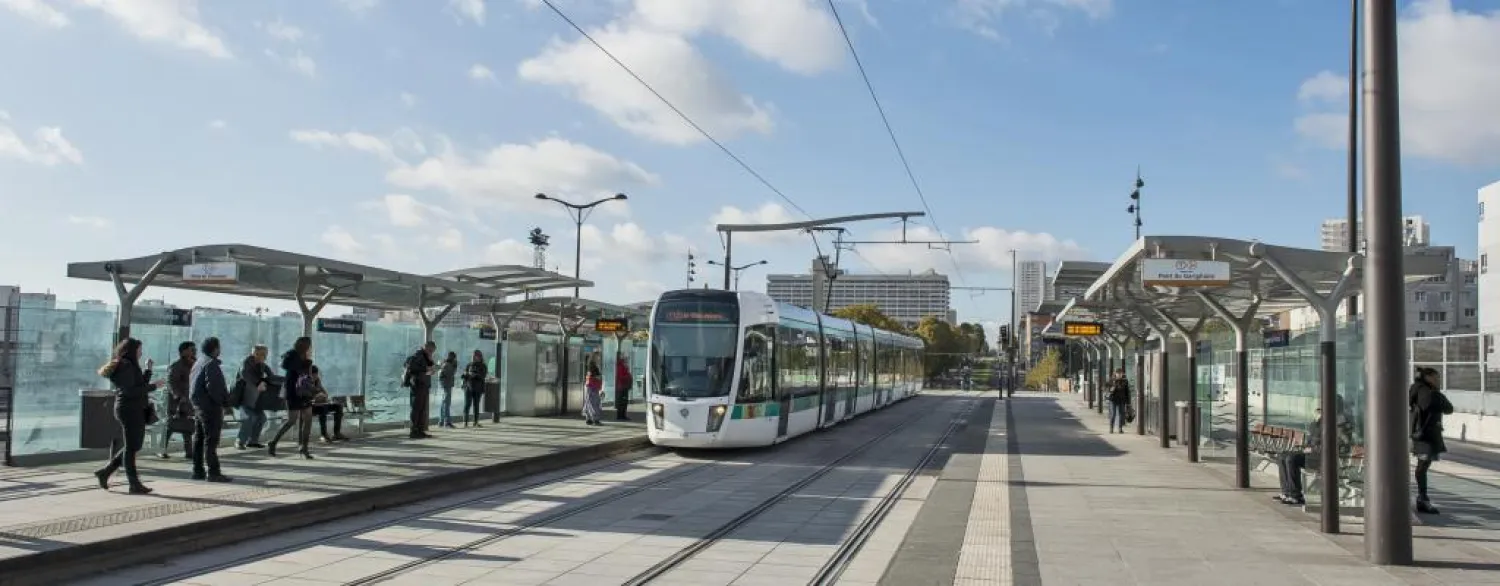

Saudi Arabia Metro Pivotal in French RATP's Foreign Growth Drive

RATP Group
RATP Group
TT

Saudi Arabia Metro Pivotal in French RATP's Foreign Growth Drive

RATP Group
RATP Group

French state-owned public transport firm RATP depends largely on public transport contracts in Asia, the Americas, and the Middle East- especially Saudi Arabia- for its plan to more than double its foreign revenue by 2025.
Over the past decade, RATP has become one of the world's top public transport operators, running bus, tram and metro systems.

In a presentation of RATP Group's strategy on Friday, CEO Catherine Guillouard said RATP aims to boost its revenue from 5.5 billion euros ($6.3 billion) in 2017 to seven billion by 2025, of which a third would come from outside its base in the Ile de France region around Paris.

"We are in an unprecedented expansion phase," she said.

RATP, which operates in 14 countries, has seen its foreign revenue grow from 110 million euros in 2007 to an expected 800 million in 2018.

The group earns revenue of 300 million euros per year in its main foreign market Britain, where it operates 1,000 red buses in London. It also operates bus, tram and metro systems in Italy, Algeria, Morocco, South Africa, the Middle East, the United States, Bombay, Hong Kong and Seoul.

Traditionally strong in buses, RATP is increasingly focusing on heavy transport such as trams and rail and competes with two other state-owned French public transport firms: railway operator SNCF-owned Keolis and bus operator Transdev. It has several joint ventures abroad with both.

RATP's biggest foreign projects include Saudi Arabia's capital Riyadh, a city of six million people. It won a 12-year, 1.7 billion euro contract to start up a bus network and a 12-year, two billion euro contract to operate two of six planned metro lines.

"Our first buses in Riyadh will ride in 2019," said Laurence Batlle, who heads the RATP Dev unit which spearheads RATP's expansion abroad and in France outside Paris.

RATP Dev will hire about 3,500 people in Saudi Arabia in coming months, of which 2,500 for the bus network, including 100 female drivers after the Kindom has lifted a driving ban against Saudi women earlier this year.

A year ago, RATP also signed a contract to operate Cairo's number 3 metro line and it is taking part in a tender for a concession to operate the Buenos Aires metro.

Other bidders include Transport for London, Keolis, French Alstom, Germany's Deutsche Bahn, Siemens and Canada's Bombardier, according to International Railway Journal.

RATP will also bid for the renewal of the Mumbai metro contract, which it operates with Transdev, with which it also operates Hong Kong's double-decker trams. ($1 = 0.8685 euros)



Saudi Index Extends Gains

An investor monitors the Saudi stocks (AFP)
TT

Saudi Index Extends Gains

An investor monitors the Saudi stocks (AFP)

Most Gulf stock markets rose in early trade on Sunday, with the Saudi index extending gains to a fifth session.

Saudi Arabia's benchmark index .TASI climbed 2%, with all of its constituents posting gains, led by energy and materials stocks.

Saudi Aramco advanced 4% and Yanbu National Petrochemical surged 10%.

The Qatari benchmark .QSI rose 0.1%, with Mesaieed Petrochemical Holding gaining 5.3% and telecommunications company Ooredoo adding 2.1%.

In Muscat, ⁠the ⁠share index .MSX30 was up 1.4% and Bahrain's index .BAX edged up 0.2%.

Kuwait's index .BKP eased 0.5%, with most stocks in negative territory.

Kuwait Petroleum Corporation began cutting oil output on Saturday and declared force majeure, adding to earlier oil and gas reductions from Iraq and Qatar as the US-Iran war blocked shipments from the Middle East for the eighth consecutive day.


Kuwait Makes Precautionary Cut in Oil Production

The Kuwait Petroleum Corporation (X)
TT

Kuwait Makes Precautionary Cut in Oil Production

The Kuwait Petroleum Corporation (X)

The Kuwait Petroleum Corporation (KPC) said on Saturday it has implemented a precautionary reduction in crude oil production and refining throughput as part of its risk management and business continuity strategy.

The decision came “in light of the ongoing aggression by Iran against the State of Kuwait, including Iranian threats against safe passage of ships through the Strait of Hormuz,” KPC said in a statement.

KPC affirmed the adjustment is strictly precautionary and will be reviewed as the situation develops.

“The corporation remains fully prepared to restore production levels once conditions allow. KPC stresses that all domestic market needs remain fully secured in accordance with established plans,” the statement said.

It added that KPC remains committed to prioritizing employee safety, safeguarding Kuwait's national assets, and promoting stability within global energy markets.

The statement said further updates will be provided as appropriate.

On Friday, West Texas Intermediate (WTI) crude futures climbed more than 10%, pulling closer to Brent as buyers sought available barrels, with Middle Eastern supply constrained by the effective closure of the Strait of Hormuz amid the expanding US-Israeli conflict with Iran.

Brent crude futures were up $5.42, or 6.35%, at $90.83 a barrel, while WTI was up $7.81, or 9.81%, at $89 a barrel.

Kuwait’s reduction in crude oil production will put pressure on crude prices, which analysts said could hit $100 per barrel as the security situation in the Middle East spirals.

Qatar Energy Minister Saad al-Kaabi told the Financial Times in an interview published on Friday that his country expects all Gulf energy producers to shut down exports within weeks if the Iran conflict continues and drives oil to $150 a barrel.

Qatar halted its production of liquefied natural gas on Monday, as Iran continued to strike Gulf countries in retaliation for Israeli and US attacks.

Oil supply equal to about 20% of world demand usually passes through the Strait of Hormuz each day. With the Strait now effectively closed for seven days, that means about 140 million barrels of oil — equal to about 1.4 days of global demand — has been unable to reach the market.


Mawani Adds Hapag-Lloyd’s SE4 Service to Jeddah Islamic Port

Mawani Adds Hapag-Lloyd’s SE4 Service to Jeddah Islamic Port
TT

Mawani Adds Hapag-Lloyd’s SE4 Service to Jeddah Islamic Port

Mawani Adds Hapag-Lloyd’s SE4 Service to Jeddah Islamic Port

The Saudi Ports Authority (Mawani) announced the addition of Hapag-Lloyd’s SE4 shipping service to Jeddah Islamic Port, a move designed to bolster the Kingdom's maritime competitiveness and global trade connectivity, reported the Saudi Press Agency on Saturday.

This new route links Jeddah to major international hubs, including Tianjin Xingang, Qingdao, Ningbo, and Shanghai in China, as well as Busan in Korea and Tanjung Pelepas in Malaysia.

Boasting a capacity of up to 17,000 TEUs, the service aligns with the National Transport and Logistics Strategy to establish Saudi Arabia as a leading global logistics hub connecting three continents.

Jeddah Islamic Port continues to expand its operational footprint, utilizing its 62 multi-purpose berths and specialized terminals to support a total handling capacity of 130 million tons.