


Libya's 'Green Gold' Olive Industry Hit by Export Ban

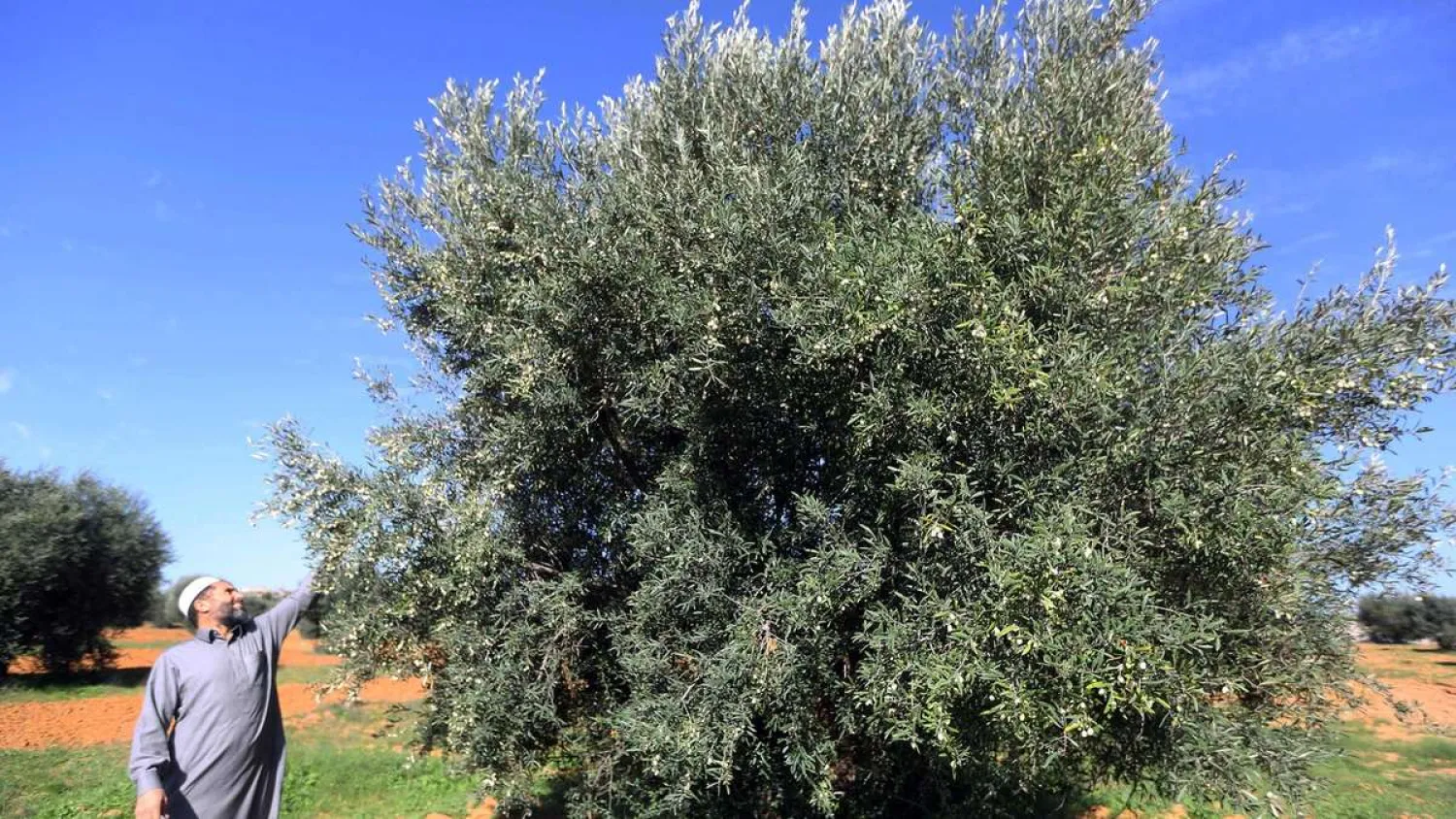
A Libyan man checks an olives tree in the Libyan town of Tarhuna (80 kms) south of Tripoli, on November 11, 2018. (AFP)
TT

Libya's 'Green Gold' Olive Industry Hit by Export Ban

A Libyan man checks an olives tree in the Libyan town of Tarhuna (80 kms) south of Tripoli, on November 11, 2018. (AFP)

Stretching as far as the eye can see, groves of gnarled olive trees in northwest Libya have proudly withstood the country's devastating conflicts.

But the industry of extracting olive oil, often dubbed "green gold", is now under threat after Libyan authorities halted exports in a bid to "protect" local produce, said an AFP report Wednesday.

Libya has depended heavily on exports of its ample crude oil reserves since the 2011 fall of ruler Moammar al-Gaddafi.

The North African nation, mired in bitter internal conflicts since Gaddafi’s ouster, has failed to diversify its economy despite the enormous potential of its tourism and fisheries industries.

Authorities repeatedly express their desire to develop the promising olive oil industry.

But in Tarhuna, farmers and workers at olive presses view such pledges with skepticism.

"We constantly have problems getting spare parts, which are getting expensive because of the collapse of the dinar against the dollar, but also because of the cost of the oil extraction process," said Zahri al-Bahri, owner of a press in Tarhuna.

On his farm, olives heavy with oil are harvested by hand in order not to damage the trees.

Laid out on huge sheets, the ripened crop is transported in flour sacks to the presses where their rich, redolent oil is carefully extracted.

"There is enough production in Libya," said Bahri. "I don't understand why we can't export anymore."

Exports of Libya's most emblematic products -- namely dates, honey and olive oil -- have been halted since 2017, said AFP.

A decree at the time said the suspension would be "temporary" to meet domestic market needs.

But no date has yet been set to resume exports.

Justifying the ban, an official in the agriculture ministry said produce had been "exported in bulk at low prices and without adding value for the Libyan economy", leaving domestic demand for oil to be met by expensive imports.

Frustrated farmers continue to grapple with a dearth of specialized bottling and packaging plants, leaving them unable to climb the value chain.

'Nourishing mother'

Although olive trees have grown on the Libyan coast for centuries, most of the current groves were planted by Italian settlers in the 1930s.

"My farm has existed for almost 90 years when Italians occupied Libya and brought the land back to life," Ali al-Nuri, a farm owner in Tarhuna, told AFP, posing proudly in a grove.

Libya, the 11th largest olive producer in the world, grows around 150,000 tons of the crop annually.

But only 20 percent is turned into oil, well behind neighbors Morocco, Tunisia and Algeria, according to the United Nations' Food and Agriculture Organization.

Nuri emphasizes the industry requires more attention and resources to prosper, beginning with better irrigation in this desert region, as well as state help to ensure quality control and set up bottling factories.

And while cheaper, imported alternatives to olive oil -- such as corn oil -- have become part of Libyan cuisine, "olive oil remains (the) paramount" choice among householders, Nuri said, according to AFP.

Olive trees, he recalled, had "saved" Libyans during lean periods before the discovery of crude oil in the late 1950s.

The olive tree was a "nourishing mother," he maintained.

Among the hundreds of olive trees on Nuri's vast farm, there is a particularly rare variety -- white olives.

Originating in Tuscany in northern Italy, the tree -- known as olea leucocarpa -- grows olives that keep their light color even when ripe.

But Tarhuna only has five or six specimens, planted by the Italians.

In the absence of scalable production, the white olives -- sweet, with a low acidic content and a distinct scent -- are mixed with their bog-standard cousins to produce oil.

Concrete threat

Only two percent of Libya's 1.7 million square kilometers (650,000 square miles) is arable land, in a country famed for vast swathes of desert.

It boasts more than eight million olive trees, according to the agriculture ministry.

To the east of Tarhuna lies the Msallata region known for its centuries-old olive trees that yield distinct sweet and strong-tasting oil.

But it has been hit by urbanization in recent decades.

Cutting down olive trees had been strictly forbidden before Gaddafi came to power in 1969, said Mokhtar Ali, whose farm includes 600-year-old specimens.

And the chaos that has engulfed the country since Gaddafi’s fall has further diminished the stock of trees.

Nowadays "olive trees are torn up with impunity to make charcoal or to replace with concrete," Ali said.

But he remains optimistic, seeing a silver lining in attempts by several farmers to preserve the country's heritage, by either planting native species or importing new trees from Spain.



From Poplars to Pistachios, Afghans Rediscover the Value of Trees

A forest near Qargha lake in Paghman district, Kabul province. Wakil KOHSAR / AFP
TT

From Poplars to Pistachios, Afghans Rediscover the Value of Trees

A forest near Qargha lake in Paghman district, Kabul province. Wakil KOHSAR / AFP

Under the shade of recently planted poplars in northeastern Afghanistan, village leader Ghulam Ali Poya is proud to see residents rediscover the value of trees after years of wartime deforestation.

"There were forests of pistachio trees," he told AFP, gesturing to the bare mountains that surround Char Bagh's mud homes.

"During the conflicts and the civil war, they were destroyed; no one could stop the logging."

From the 1979 Soviet invasion until the fall of the first Taliban government in the early 2000s, "around 50 percent of Afghanistan's forest cover was lost", said Mohammad Nasir Shalizi, a researcher at North Carolina State University.

In eastern Afghanistan, timber smuggling to Pakistan drove massive logging, while in the more arid central and northern "pistachio belt", residents used wood for heating and cooking.

But in the last two decades, deforestation has slowed "substantially", Shalizi said.

Forest cover has increased 35 percent nationwide since 2011, according to the National Statistics and Information Authority, though just 2.5 percent of Afghanistan was forested in 2025 and cover is still shrinking in some areas.

But experts say communities are working to improve forest cover. Both the US-backed government, in place until 2021, and the current Taliban administration have supported tree-planting campaigns.

In Char Bagh, the Aga Khan Development Network funded a kilometer-square grove which includes poplars, paulownias, pomegranates and persimmons.

- 'A model' -

The land belongs to farmer Bas Begum Ahmadi, who hopes to sell fruit and homemade jam, but it is also open to the community of 350 families.

"Having these trees makes me feel good; my environment is green, and we breathe fresh air," said the 45-year-old, who tends the trees with her husband to support their four children.

This "micro-forest" follows Japanese botanist Akira Miyawaki's principles: dense planting of mostly local species of varying heights.

It is noticeably cooler than the surrounding bare fields and offers twigs for stove fuel and leaves that feed livestock.

Micro-forests "restore ecosystems, improve soil fertility, help climate resilience, and support community livelihood," said Parisa Malikzada, Afghanistan agriculture coordinator for the organization, which has planted 500 micro-forests in seven provinces.

Poya said the forest, next to a river, prevents soil erosion during flooding and offers "a model for people".

"Everyone comes to have a look, and they'd like to have one too," he told AFP.

In Afghanistan, where many places are hard to reach and the state has limited funds, community-based forest management is the most effective approach to reforestation, experts told AFP.

- Penalties for tree cutting -

Afghan authorities have set a goal of planting 200 million trees between 2023 and 2030, relying partly on NGOs, the United Nations and the private sector.

"Last year, the target was eight million, but in the end, 17 million were planted," said Rohullah Amin, head of climate change at the General Environmental Protection Agency, where he has worked for more than a decade.

This year's goal is nine million.

Challenges include selecting native, climate-adapted species, water scarcity, and livestock damaging saplings.

Some forests have struggled with "lack of care or water", Amin acknowledged, including one site where drought killed 70 percent of the planted pines.

In some places, tribal councils protect forests and penalize residents who damage them. Elsewhere, "forest management associations" run by elected villagers and farmers have been set up.

The UN Food and Agriculture Organization has helped them plant five million trees since 2019, according to its climate change chief, Muhammad Safi.

- Birds coming back -

The government created nurseries to grow local species in places such as Paghman on state land on Kabul's outskirts.

Head gardener Mahmood Khwajazada carefully tends almond, pine nut and walnut trees, as well as deodar cedars, for distribution nationwide.

"Our Prophet said, 'Even if you have only one day left, plant a tree," he told AFP.

In Charikar, northeastern Afghanistan, where thousands of saplings were planted this year along streets, in parks and on hillsides, the municipality sees "a change" in people's attitude towards trees.

Ahmad Khalid Sabiri, a resident, said he volunteered to help plant "because it's beneficial for the environment".

Experts said more work is needed to protect the remaining old growth, as well as planting in forests rather than just in urban areas.

"There's good work happening, but far more needs to be done" to address the impact of global warming, according to Apoorva Oza, head of climate change at the Aga Khan Foundation.

In Char Bagh, Poya sees a beneficial effect of trees in biodiversity, with the return of long-absent birds.

"Don't build a cage for a bird; plant a tree near your house," he said.


Nepali Climber Alive after Six Days Missing on Everest

This photograph taken on May 20, 2026, shows mountaineers on Everest. Furte Sherpa / AFP
TT

Nepali Climber Alive after Six Days Missing on Everest

This photograph taken on May 20, 2026, shows mountaineers on Everest. Furte Sherpa / AFP

A Nepali climbing guide who went missing on Mount Everest for six days and was feared dead has been found alive after crawling back to Base Camp, officials told AFP on Thursday.

The experienced Hillary Dawa Sherpa vanished on the upper reaches of the world's highest mountain early on May 30.

He was found on Thursday morning close to Base Camp by the Sagarmatha Pollution Control Committee (SPCC), a Nepali team that helps set routes on Everest and clean up waste left behind.

"He was crawling down," Pemba Sherpa of 8K Expeditions, which was overseeing search and rescue efforts, told AFP.

"A helicopter has been sent to bring him to a hospital in Kathmandu."

Climber Chris Thrall, a former British Royal Marine, said he successfully summited the 8,849-meter (29,032-foot) peak with Sherpa around 5:00 pm on May 29.

He posted a video message on Instagram on Wednesday morning what he thought was the death of Sherpa.

He called Sherpa an "absolute gentle giant of a man and a true 'tiger of the mountains'", in a post that assumed the worst.

Thrall described how on May 30 he had begun to descend from Camp Four -- at around 7,950m -- and just below the low-oxygen "death zone".

He said that as he descended, Sherpa stopped.

"He sat down for a rest with his backpack, these guys carry huge loads," he said.

"And I turned and I said, 'Hillary, are you okay, brother?' He said, 'Yes, yes, fine Chris, please go, go!' This is nothing new, you know, I'd go ahead, he'd go ahead."

As Thrall went down he found a Polish climber who was struggling after running out of supplementary oxygen and had suffered frostbite.

"It had been a long summit push. What should have been five days to the summit and back took us 11 days, that's how challenging the conditions were," said Thrall.

"So, do I go back for Sherpa, who's probably going to rock up and be fine, as he has done hundreds of times before?" he added.

"Or do I help my fellow climber, who's got no oxygen, frostbite in his fingers, and obviously you're never far off hypothermia up there?"

Thrall described tough conditions, sharing his oxygen cylinder with the Pole as they descended, taking 11 hours to get to Camp Three. It would usually take two hours.

He said: "I realized we had a really serious situation."

Search teams set out to find Sherpa but he was not seen again until Thursday morning, having made his way down on his own.

The climb was one of the last of the season, meaning that there were few other mountaineers on the peak.

At least five people have died this season -- two Indians and three Nepali climbers involved in Everest preparations.

More than one thousand climbers reached the summit of Everest this season, according to initial tallies by Nepali officials, making it the busiest season on record.


Canadian Government Endorses Plan to Move Whales from Shuttered Park to US, Spain

FILE - Beluga whales swim in a tank at Marineland amusement park in Niagara Falls, Ontario, Canada, June 9, 2023. (Chris Young/The Canadian Press via AP, File)
TT

Canadian Government Endorses Plan to Move Whales from Shuttered Park to US, Spain

FILE - Beluga whales swim in a tank at Marineland amusement park in Niagara Falls, Ontario, Canada, June 9, 2023. (Chris Young/The Canadian Press via AP, File)

Canada's government endorsed a plan Wednesday to move the last remaining captive whales from a shuttered theme park in Ontario to aquariums in the United States and Spain — a plan that could save them from mass euthanasia if the deal goes through.

There are 30 belugas and four dolphins left in the Marineland park and zoo in Niagara Falls, Ontario, which announced in early 2023 that it was for sale and closed to the public in late summer 2024. No sale has yet been announced, The Associated Press reported.

The former tourist attraction has since worked to move the park’s remaining animals and sell the sprawling property near Horseshoe Falls.

In 2024, Marineland was found guilty under Ontario’s animal cruelty laws in a case related to its care of three black bears.

The Department of Fisheries and Oceans has issued the first batch of permits to move the whales and is set to issue different permits closer to the move, expected to take place in the next few months. It recently issued permits for the whales and dolphins under the Convention on International Trade in Endangered Species of Wild Fauna and Flora, otherwise known as CITES permits.

“I think this is a positive step forward,” Fisheries Minister Joanne Thompson said. “There’s still more work to be done, but it’s a step forward.”

Twenty whales — 19 belugas and one killer whale — have died at Marineland since 2019, according to provincial government data obtained through freedom-of-information laws and official statements.

Thompson's office said the ministry is coordinating with the Canada Border Services Agency, Health Canada and other ministries to “ensure all requirements are met for a safe and timely transfer.”

Marineland said it is “fully committed to the safe and timely relocation of our beluga whales, and we want to be clear: this is our top priority.”

“Relocating these animals is an extraordinarily complex undertaking,” the park said in a statement.

The Canadian government has not decided whether it will provide taxpayer dollars to help move the whales.

The belugas and dolphins are set to head to five marine parks: Shedd Aquarium in Chicago, Georgia Aquarium in Atlanta, SeaWorld locations in San Antonio and San Diego, and Oceanografic Valencia.

Mystic Aquarium in Connecticut, where Marineland sent five belugas to in 2021, will also help with the move, the American consortium said.

Marineland's founder, John Holer, died in 2018. His wife, Marie Holer, took over operations of the park and put it up for sale in 2023, before she died in 2024.

The estate has been working since to dismantle the park, which features roller-coasters and other rides.