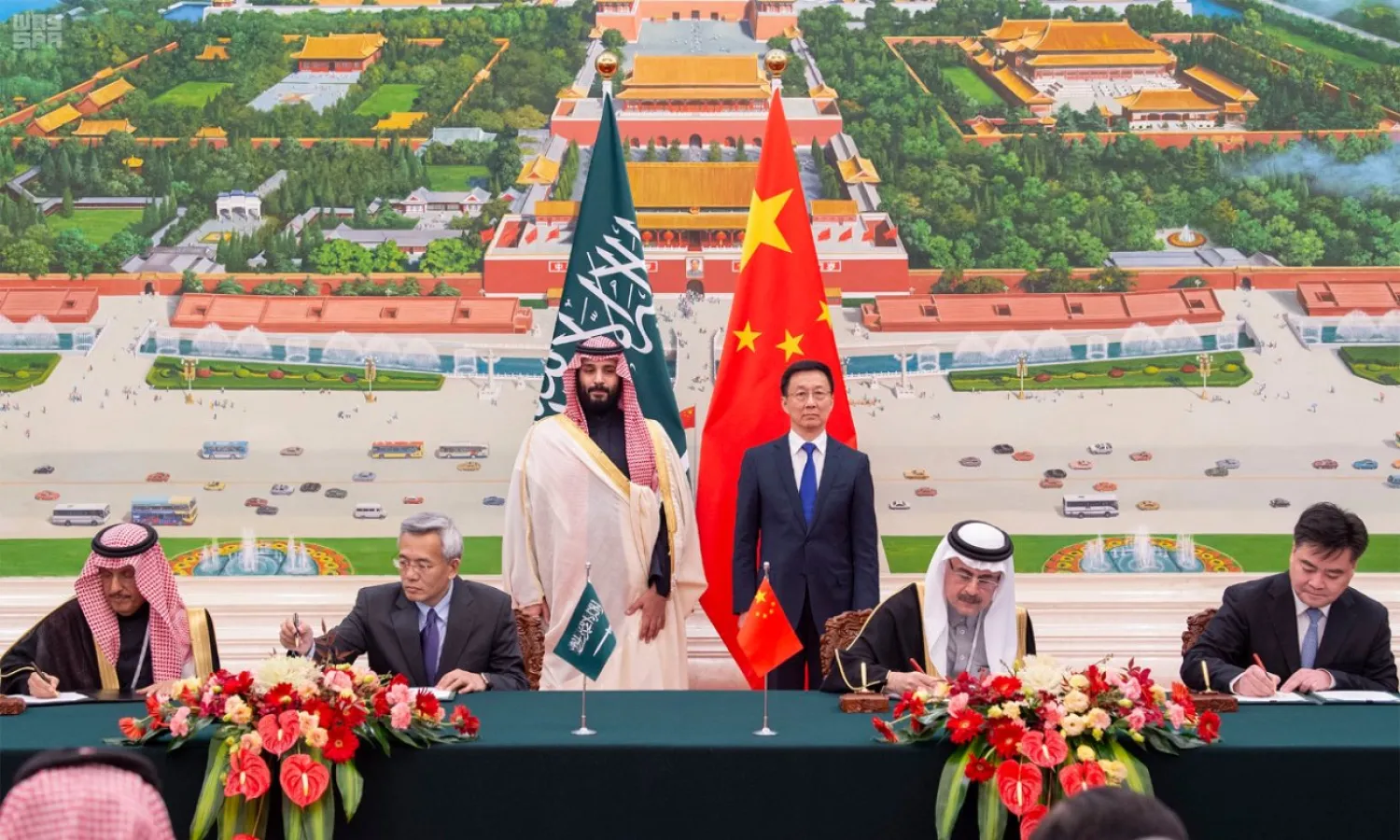
Riyadh and Beijing signed numerous agreements during Crown Prince Mohammed's visit to China last week. (SPA)
ACWA Power signed Memorandums of Understanding (MoU) with China’s Silk Road Fund and Huawei, laying the ground for collaboration in further investments, technological advancements of power generation and desalinated water production plants that ACWA Power develops and operates.
The MoUs were signed in the presence of Crown Prince Mohammed bin Salman during his official visit to China last week. ACWA Power Chairman Mohammad Abunayyan signed the MoU with Silk Road Fund CEO Wang Yanzhi.
Under the agreement, the Silk Road Fund will partner with the company to invest in ACWA Power Renewable Energy Holding Ltd in Belt and Road countries including South Africa, the United Arab Emirates, Jordan and Egypt.
Following the first signing, at the Saudi China Investment and Cooperation Forum, ACWA Power also entered into an agreement with Huawei, a leading global ICT and energy network solutions provider.
The two companies will be collaborating on utilizing ICT to increase efficiency and improve performance of solar photovoltaic energy projects owned and operated by ACWA Power including the Sakaka PV IPP, the first utility scale solar plant in Saudi Arabia. The collaboration also extends to digitalization of power plant management.
Abunayyan said that the company’s growing relationships with major Chinese companies is a reflection of the strong and friendly ties between Saudi Arabia and China.
As a leading developer of power and water assets in the region committed to reducing cost and investing in several countries within the Belt and Road Initiative corridor, ACWA Power has the unique position of being able to support the economic transformation envisioned by both, he asserted.
“We look forward to playing a vital role in both these national agendas which complement each other.”
President of ACWA Power Paddy Padmanathan said: “Over the last few years we have been privileged to work with an increasing number of Chinese investors, financial service providers, technology providers and EPC contractors on our rapidly expanding portfolio and we are eager to nurture and expand these very successful collaborations.”
He added that the synergies created through these agreements will allow ACWA Power to maintain its cost leadership reputation, creating immense value to the ultimate beneficiaries of the electricity and desalinated water it provides.
Rapid Recovery of Oil Facilities Reinforces Saudi Arabia’s Reliability as a Global Energy Supplierhttps://english.aawsat.com/business/5261531-rapid-recovery-oil-facilities-reinforces-saudi-arabia%E2%80%99s-reliability-global-energy
Rapid Recovery of Oil Facilities Reinforces Saudi Arabia’s Reliability as a Global Energy Supplier
Two Aramco employees at one of the company's facilities (Aramco)
Saudi Arabia demonstrated exceptional readiness and a rapid response in containing the fallout from the recent attacks on some of its oil facilities, restoring operations in record time. It swiftly repaired damage and brought production systems back online with high efficiency.
The Kingdom’s success in restoring full crude throughput via the East–West pipeline, returning the Manifa facility to full operating capacity, and countering attempts to disrupt critical infrastructure underscores its technical and professional capabilities.
This was achieved through a highly professional emergency response system that thwarted attempts to cut off a key artery of global energy supply.
Saudi Arabia’s Ministry of Energy announced on Sunday the full restoration of crude throughput via the East–West pipeline to approximately 7 million barrels per day, along with the return of the Manifa facility to its full operating capacity of around 300,000 barrels per day. This came just days after assessing damage from the attacks. Efforts are still ongoing to restore the full production capacity of the Khurais field, estimated at 300,000 barrels per day.
The East–West pipeline (Petroline) stretches 1,200 kilometers from Abqaiq in the east to Yanbu on the Red Sea coast and serves as a primary alternative route for crude exports in light of the closure of the Strait of Hormuz.
The Kingdom activated an emergency plan to increase exports via this pipeline to the Red Sea amid the effective closure of the strait due to ongoing regional conflict, which has constrained a major export route for Gulf producers. As a result, oil tankers were rerouted to Yanbu port to load shipments, providing a critical supply artery for global markets.
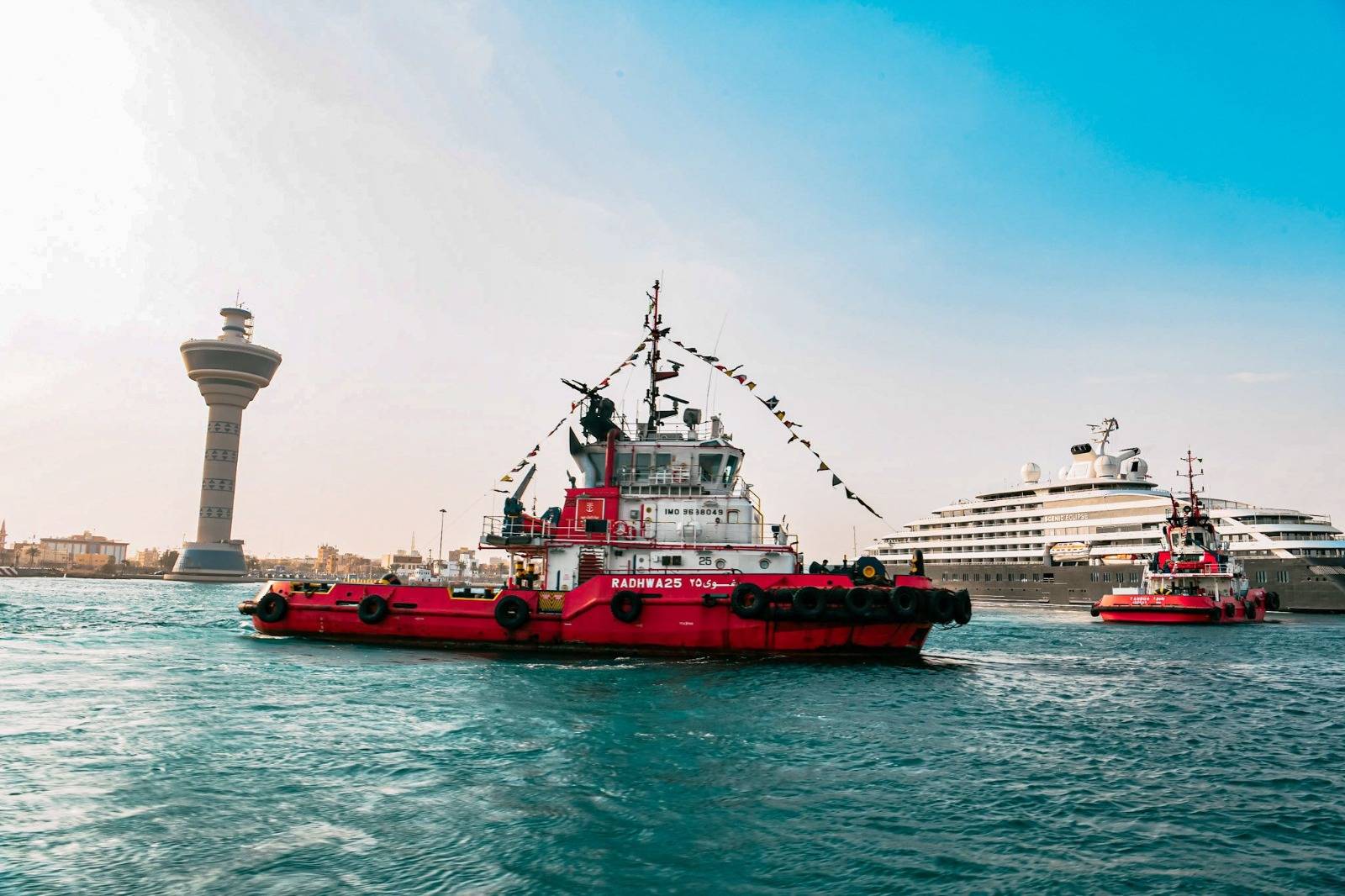
Yanbu Commercial Port, one of Saudi Arabia's important seaports in the current period (Ports)
Operational Flexibility and a Global Safety Valve
The operational flexibility demonstrated by Saudi Aramco and the broader energy system reflects a qualitative shift, underscoring the Kingdom’s ability to protect its assets through advanced engineering and technical infrastructure capable of rapid recovery.
This response extended beyond the technical dimension, reaffirming Saudi Arabia’s firm commitment to ensuring the stability of oil supplies and strengthening its position as a reliable supplier capable of managing crises with high efficiency.
The swift restoration of operations also sends a reassuring signal to global markets that Saudi energy security remains a stabilizing force for the international economy, regardless of the severity of threats. It reinforces the Kingdom’s leadership role in supporting global stability and the reliability of its supplies under the most challenging geopolitical conditions.
In remarks to Asharq Al-Awsat, energy expert and former adviser to the Saudi oil minister, Dr. Mohammad Al-Sabban, said the Kingdom has, for decades, particularly since the 1970s, proven itself a dependable source of global oil supplies under all circumstances.
He noted that Saudi Aramco’s response reflects a high level of efficiency and preparedness, successfully addressing the impact of attacks that disrupted around 300,000 barrels per day in production, in addition to damage affecting the East–West pipeline.
He added that the company was able within a short period to restore affected refined products, repair faults, and resume operations efficiently, highlighting the Kingdom’s strong resilience and Aramco’s accumulated expertise in crisis management and navigating global market fluctuations.
Al-Sabban said restoring throughput to around 7 million barrels per day via the East–West pipeline, as announced by the Ministry of Energy, sends a clear reassurance to global markets regarding the stability of Saudi supplies.
He stressed that these developments confirm Saudi Arabia’s ability to remain a reliable energy supplier, particularly amid ongoing geopolitical challenges in the Gulf region, including tensions surrounding the Strait of Hormuz.
The East–West pipeline, built in the last century, has become a strategic and vital corridor for Saudi oil exports to global markets.
Russia Ready to Supply Gas to the EU if it Has a Surplushttps://english.aawsat.com/business/5261506-russia-ready-supply-gas-eu-if-it-has-surplus
Kremlin spokesman Dmitry Peskov looks on as Russia's President Vladimir Putin (not pictured) and Togo's President of the Council of Ministers Faure Gnassingbe (not pictured) meet at the Kremlin in Moscow, Russia November 19, 2025. REUTERS/Ramil Sitdikov/Pool/File Photo
Russia Ready to Supply Gas to the EU if it Has a Surplus
Kremlin spokesman Dmitry Peskov looks on as Russia's President Vladimir Putin (not pictured) and Togo's President of the Council of Ministers Faure Gnassingbe (not pictured) meet at the Kremlin in Moscow, Russia November 19, 2025. REUTERS/Ramil Sitdikov/Pool/File Photo
Russia is ready to continue supplying gas to the European Union if there are volumes remaining after supplies to alternative markets, Russian state news agency TASS reported on Sunday.
"There is plenty of it for now. But alternative markets are very voracious, there are a great many requests for supplies," Kremlin spokesman Dmitry Peskov was quoted as saying, Reuters reported.
However, Europe will find a way to buy gas even if Russia does not supply it, Peskov said.
"There are so many gas liquefaction plants, both in Europe and in the Middle East, that this process, this spot market, functions like a living organism," Peskov added.
Saudi Energy Companies in 2025: Billion-Dollar Profits Defy Market Volatilityhttps://english.aawsat.com/business/5261467-saudi-energy-companies-2025-billion-dollar-profits-defy-market-volatility
Saudi Energy Companies in 2025: Billion-Dollar Profits Defy Market Volatility
Saudi and foreign investors stand in front of the logo of the giant Saudi oil company Aramco during the 10th Global Competitiveness Forum (AFP)
In 2025, the Saudi energy sector demonstrated a superior ability to fortify its financial gains and navigate global market fluctuations, achieving a net profit exceeding $92.5 billion (347.2 billion riyals). Despite pressures imposed by the global supply-and-demand equation and supply chain disruptions, the financial results of listed companies revealed a strategic shift in performance. Price momentum for oil was no longer the sole driver; instead, operational efficiency and smart hedging emerged as safety valves that ensured the continuity of massive cash flows, with revenues exceeding $430 billion.
While profits recorded a relative decline of approximately 11.5 percent compared to the exceptional year of 2024, when they reached $104.62 billion (392.58 billion riyals), the results showed a positive variance for logistics and drilling companies such as "Bahri" and "ADES." This indicates a new phase of operational maturity and diversification of income sources within the region's most vital sector.
This decline in sector profits is attributed to the falling earnings of "Saudi Aramco," the heaviest weight in the Saudi market index. Other sector companies were also affected by multiple challenges, including declining revenues, lower sales, and reduced dividend distributions from investment portfolios.
Variance in Company Profits
Financial results for energy sector companies showed a variance in performance: profits rose for two companies, declined for one, and another narrowed its losses. Additionally, one company continued its losses, while another shifted to a loss after recording profits during 2024.
In detail, "Saudi Aramco" achieved the highest profit margin among sector companies, reaching $92.75 billion (348.04 billion riyals) during 2025, despite a decline of 11.64 percent compared to the previous year. The company attributed this decline to lower revenues and sales-related income, though this was partially offset by a decrease in operating costs and lower income taxes and Zakat. "Bahri" ranked second with profits of $647.58 million (2.43 billion riyals) during 2025, a growth of 0.12 percent compared to the previous year's profits of $578.29 million (2.17 billion riyals). The company attributed its profit growth to higher total quarters for the oil transport sector and improved operational performance and global freight rates.
"ADES" came in third with profits reaching $218.13 million (818.5 million riyals), achieving a growth of 2 percent compared to the previous year. The company stated that the rise in net profit reflected an increase in depreciation and interest expenses relative to revenues, in addition to gains recorded in the third quarter under "profits from equity instruments at fair value through profit or loss," the impact of which was largely dissipated by costs related to an acquisition deal.
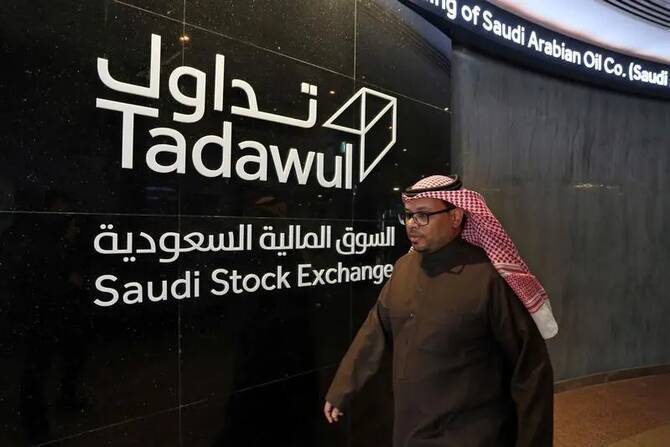
A man passes by the Saudi Stock Exchange logo (Reuters)
Sector Revenues
At the revenue level for sector companies during 2025, there was a decline of approximately 4.74 percent, recording revenues of about $430.12 billion (1.61 trillion riyals) compared to $450.4 billion (1.69 trillion riyals) in 2024, a decrease of $21.44 billion (80.45 billion riyals).
Commenting on these results, Dr. Sulaiman Al-Humaid Al-Khaldi, financial market analyst and member of the Saudi Economic Association, told Asharq Al-Awsat that the energy sector is strategic and vital to the Saudi economy, and these results reflect the continued high profitability of sector companies despite the relative decline. He described this decline as "natural" following the exceptional levels of 2024, reflecting the moderation of oil prices compared to the previous year, alongside the OPEC+ alliance's commitment to production cut policies to support balance.
He noted the decline in revenues resulted from lower prices and volumes despite remaining at strong levels, as well as rising operational and investment costs for some companies, particularly in expansion and renewable energy projects. Conversely, companies like "Bahri" and "ADES Holding" showed positive performance supported by growth in demand for maritime transport and drilling services, reflecting a diversification of profitability sources within the sector.
Al-Khaldi expected the sector to remain stable in the near term with a slight inclination toward growth, supported by several factors including continued global oil supply management to support prices within a balanced range, and Aramco’s expansion into gas, clean energy, and petrochemicals, reducing reliance solely on crude oil. He also noted the improved performance of service companies (drilling and transport) with the increase in regional projects.
Over the medium to long term, he expected the future of sector companies to carry a strategic shift toward focusing on diversifying energy sources through hydrogen and renewables, enhancing operational efficiency, and reducing costs. He highlighted that companies would benefit from Saudi Vision 2030 in supporting investments and infrastructure, noting that the sector remains strong and profitable, and the current decline is a healthy correction after a historical peak, while the trend toward diversification and sustainability will be the primary driver for growth in the coming years.
Operational Factors
For his part, Mohammed Hamdi Omar, CEO of "G-World," told Asharq Al-Awsat that the economic reading of these figures indicates the Saudi energy sector has not lost its strength but has entered a more complex phase than merely achieving high profits.
He added: "We are facing a sector that is still achieving massive profitability levels exceeding 347 billion riyals, but the more important picture is that growth is no longer based on price momentum alone; it has become more sensitive to operational factors, global demand, refining margins, and the variance in performance of companies within the sector."
He explained that the reasons for the decline in sector profits "stem from the exceptional weight of 'Aramco' within the sector; it is not just a company within the sector, but the main driver of the entire financial picture, and any decline in its revenues or profits is automatically reflected in the overall index. Furthermore, the sector did not move as a single bloc; some companies benefited from improved activity or the strength of their business models, such as 'Bahri' and 'ADES,' while others faced clear operational or market pressures. This reflects that the challenge is no longer just in the sector as a whole, but in the quality of positioning within it."
Omar noted that the "decline in total sector revenues indicates that the global energy market has entered a more volatile phase, where high prices alone are no longer sufficient to ensure a balanced improvement in results. Today, operational management, the ability to hedge, diversification of income sources, and supply chain efficiency have become factors no less important than the price itself. Therefore, those who read these results as merely an annual decline in profits are oversimplifying the picture; more accurately, it is an expression of the sector's transition from a phase of easy rents to a phase of more complex operational competition."
Regarding the future financial results of energy companies, he indicated that the sector "will remain a fundamental pillar of the Saudi economy and financial market, but the difference in the coming phase will be between companies that have the ability to adapt to global volatility and those that remain captive to the price cycle. In other words, the future belongs not just to those with scale, but to those with flexibility, financial discipline, and the ability to turn volatility into opportunity."
He viewed the outlook for the coming period as "positive" at the sector level, "but more precise at the company level, as gains will not be distributed equally, but will instead gravitate toward the most efficient, integrated companies that are best able to manage risks in a global environment that remains turbulent."
لم تشترك بعد
انشئ حساباً خاصاً بك لتحصل على أخبار مخصصة لك ولتتمتع بخاصية حفظ المقالات وتتلقى نشراتنا البريدية المتنوعة