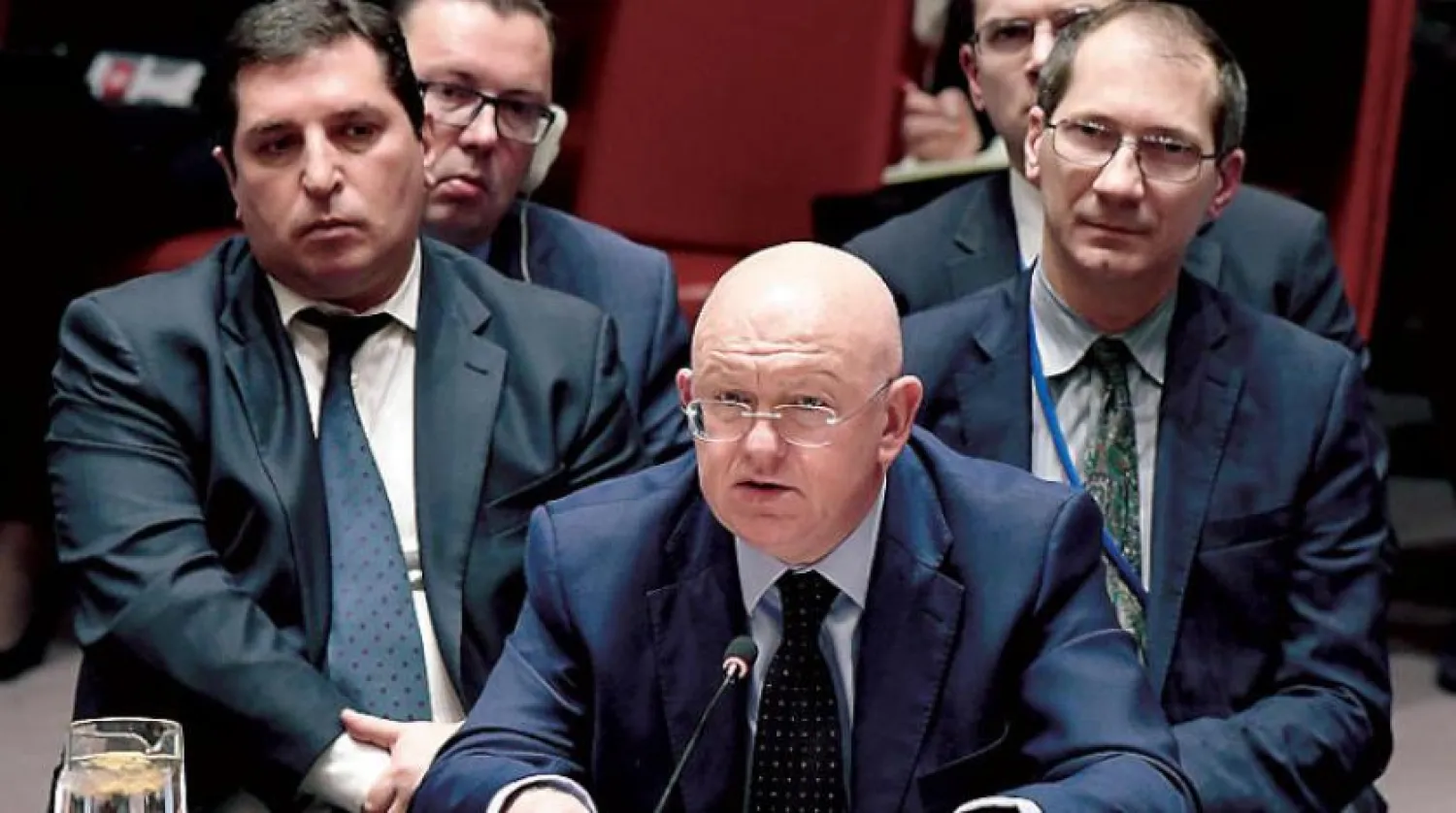

In his first ever interview with an Arab media outlet, Russian Permanent Representative to the United Nations Vasily Nebenzya said that the world order "has been the same" since its inception following the Second World War despite the emergence of "new centers of power." However, he acknowledged "new challenges and threats" such as terrorism, drug trafficking and uncontrolled migration.
While defending the "legitimacy" of the Russian presence in Syria, he stressed that everyone, including the Iranians, Turks and others, should eventually leave that country. He asserted that the current situation in Idlib "cannot be held frozen forever," adding that the Astana process is "the only effective mechanism to achieve stability" in Syria, and expecting that the UN Special Envoy Geir Pedersen will "soon" announce the composition of the Constitutional Committee.
He said that Moscow had called for a "platform" to discuss regional problems in the Middle East and North Africa, and that will happen "sooner or later". He noted that UN Secretary-General Antonio Guterres has been advocating an idea similar to the "Helsinki process."
He revealed that intensive political contacts between the Russian and Saudi leaderships show that both Moscow and Riyadh consider that "the potential of conflict... has a very negative impact, not only on regional security, but also on global security and stability." He asserted the Russian Federation's appreciation to the role played by Saudi Arabia "as one of the most influential countries in the Middle East and the Gulf region" in many issues, particularly in Yemen, Syria and other countries in the region, pointing out that the Kingdom has a "very constructive role" in the Yemeni crisis.
In an interview with Asharq al-Awsat about the return of Russia in the last ten years as a superpower, the Russian diplomat, whose country has veto power, has spoken about other issues such as Libya, Venezuela and other crises in the world.
* Russia has reemerged in the past 10 years as a global superpower, including in the Middle East. We hear people talking about going back to the Cold War. Others may say: we’re heading towards a new world order. What are your insights?
- The central element of the system of global relations that emerged in the aftermath of the Second World War is the UN and its Charter.
A new world order was born every time after devastating wars. That was the case with the Peace of Westphalia, the Vienna Congress and the Concert of Nations or the United Nations. I would hate even to contemplate another similar reason for a new world order. As Albert Einstein once said: I don’t know what the weapons of a Third World War will be, but in the Fourth they will fight with sticks and stones.
We had tectonic events in the past, like crumbling down of a colonial system, the end of the Cold War and associated ideological divide. Yet nobody was saying that we entered a new world order then. And history didn’t end as Francis Fukuyama claimed.
Of course, things change. Balances of power shift. New centers of power emerge.
This is reflected in the debate on the reform of the UN Security Council where we advocate its manageable expansion with the developing countries of Africa, Asia and Latin America, which are clearly underrepresented. However, there is another troubling trend. The art of compromise has been severely compromised in recent years. The unwillingness and inability to recognize that the world is not unipolar anymore, that it is not one-bloc dominated lead to attempts to create various “coalitions of the willing”, alliances of like-minded that pay lip service to international law while acting with total disregard to it. A new concept has been invented – “a rules-based order” which provides for the establishment of some “rules” cherished in a like-minded group, but unaccepted by a large part of the international community, let alone adopted anywhere.
Besides, new challenges and threats emerge, like terrorism, drug trafficking, uncontrolled migration. New political technologies are employed, like naming and shaming states whereby the accusation itself becomes the verdict. We live in what many call a “post-truth” world.
Still, regardless of this, the world order remains the same as it was created after World War II.
* Syria probably has been the clearer manifestation on Russia’s rise in today’s world. Have you accomplished your mission in Syria’s war? Do you expect Iran, Turkey, the US and others to leave Syria?
- Russia’s presence in Syria is legal. It is there on the request of the legitimate government to assist it in countering the terrorist threat. Iran, by the way, is present there legally too. No one else was invited, as we all know. All those who are present in Syria without invitation, should eventually leave the country.
Despite severe damage caused to ISIS in Syria, the terrorist threat is not completely eradicated and remains significant. Another terrorist group, Hay'at Tahrir al-Sham (aka Nusra), has strengthened its positions in the North of Syria. It is now enclaved in Idlib, where Nusra militants established their rules and basically assumed the functions of local authorities. The situation cannot be held frozen forever. It should be addressed. That is why recently we have intensified contacts with our Turkish partners on the Idlib de-escalation zone. We fully realize that Idlib is home to a large civilian population, including IDPs from other parts of Syria. We know that they suffer under the rule of terrorists and dream to be spared of their “authority”. But of course, civilians should not become “collateral damage” of the legitimate fight against terrorists.
Our partners are urging the Syrian authorities and Astana guarantors to honor their agreements and spare civilians, alarming of a humanitarian disaster in case of large-scale hostilities. At the same time, they are not as consistent when they conduct military operations against terrorists in the Northeast of Syria where, as you know, a large number of civilians fell victim to aerial bombing of the Coalition.
* What do you expect specifically from the new UN special Envoy Geir Pedersen?
- We maintain dialogue with Special Envoy Geir Pedersen on the political settlement in Syria both bilaterally and through the Astana process. Astana format turned out to be the only effective mechanism to achieve stabilization “on the ground” in Syria. We stand ready to further assist the Special Envoy in making the political settlement sustainable. We expect that soon he will be able to announce the conclusion of the composition of the Constitutional Committee and to start its work. We count on the Special Envoy and hope he will establish trust with all the stakeholders while remaining impartial. This is the key to success for any mediator.
* You said that the Astana Process turned out to be the only effective mechanism on the ground. Do you want the Special Envoy to embrace the Astana Process?
- The Astana Process is part of a larger settlement, starting with UNSC resolution 2254 and through the Congress of National Dialogue, which gave birth to the Constitutional Committee. Special Envoy Pedersen is willing to participate in Astana, because this process discusses important issues, which he in particular is interested in, like prisoners exchange for example. As far as I know, he is planning to participate in the upcoming meeting in Astana, Nur Sultan now, on the 25-26 of this month.
* Mentioning the name of Kazakhstan capital, is the name of the process going to be changed?
- No, they are keeping the name as the Astana Process.
* You also mentioned that the Constitutional Committee will be formed soon, when should we expect that?
- There is no exact timeline, but the Special Envoy himself said there are a few little brush strokes that have to be applied before he can announce that the issue is closed, and start the work of the Committee.
* What would you say about what happened recently regarding the US recognition of Golan as part of Israel? Are you in Russia trying not to touch anything in relation with Israel, including when they hit targets deep in Syria? The Russian army is there but not protecting Syria’s sovereignty when it comes to Israel. You are asking all the uninvited to leave Syria except the Russians, the Iranians and the Israelis.
- I think we will eventually go too when time is right and when the conditions are ripe, and we will do this in consultation with the Syrian government. Iranians are there legitimately too because they were invited. They will go when the Syrian government decides their assistance is no longer necessary.
* They will leave?
- I think eventually all should leave when Syria is stabilized. But there are parties in Syria who were never invited there, like the US, the French and some others. Israel’s presence in the Golan began before the Syrian conflict. It is a long story. We never recognized Golan as part of Israel. It is part of Syria. We supported all the resolutions that say so. And indeed we condemned the US decision. But we are having good relations with Israel. Israel is our partner in the Middle East, as much as all the Arab states. We are lucky and proud that we are one of the major powers that enjoys good relations with anyone and everybody in the region without exception.
* What about Turkey?
- Yes, Turkey also was not invited. That’s true. But Turkey is an important partner in the Astana Process, in the process of the Syrian settlement. Turkey has its own concerns regarding its security. But, of course, we believe that eventually they will have to leave Syria as any other foreign presence in the country.
* What can you tell us about the remains of the Israeli soldier who what killed in Lebanon in 1982? What happened?
I don’t know the details but as President (Vladimir) Putin said openly; that was a Russian Special forces operation that made it possible to locate and excavate the remains…
* From Lebanon?
- Frankly, I don’t know where from. That was a great humanitarian gesture which was really much appreciated by the Israelis.
* How do you describe the situation of the Arab countries with Russia? How would Russia address the concerns regarding Iran’s meddling in the internal affairs of Arab countries?
- As I said Russia is in a privileged position among major powers to maintain close friendly relations with all Arab countries without exception. We interact both bilaterally and within such formats as “Russia-LAS” and “Russia- GCC”. We have established an effective political dialogue and exchange of views regarding the settlement of regional crises. Our commercial and economic ties are developing fast.
We are interested in the unity of the Arab world, which we advocate relentlessly. Power grows from unity. Regional problems can be effectively solved only on the basis of common approaches.
* There are a lot of questions about Iran’s role in the region. The US administration is raising its voice about Iran’s threats to other countries including Israel. Are you worried about any serious confrontations?
- Iran is a part of the region, not an alien entity. Iran has legitimate interests that go beyond its national borders and are aimed, among other things, at ensuring their national security. Arab States, Israel or Turkey – they all have such interests. The reason is in the transnational nature of global threats today.
You talk about threats that Iran poses. But don’t forget about the threats that Iran faces. Today they are clear and imminent. They are announced and proclaimed openly. Do you think Iran should not take them seriously? Unfortunately, recent steps and rhetoric from Washington, including withdrawal from the JCPOA and the initiation of large-scale sanction pressure only increase risks of escalating tensions and making further developments of the situation totally unpredictable.
As for the concerns about interference of Iran in the internal affairs of States in the Middle East, there are diverging views on this, even among the Arabs themselves.
Our approach can be described as very simple, even standard. All the countries of the region have their own interests. They should be taken into consideration. The only requirement is that those interests should be legitimate. If there are any concerns, they should be resolved by political and diplomatic means. For this, we need a convenient platform to discuss the whole range of existing problems.
Several years ago Russia proposed a security concept for the ... Gulf that envisages a dialogue platform for all the countries of the region, which would be eventually joined by other States of the Middle East and North Africa. This could be the first step towards establishing a regional security architecture that would help maintain peace and security in this part of the globe.
We are discussing this idea with our Arab friends. It has not been put into life yet, but it is going to happen sooner or later.
UN Secretary-General Antonio Guterres has been advocating a similar idea of a “Helsinki-type process” for the Middle East.
* Would you kindly describe the relations between Russia and Gulf countries, especially Saudi Arabia? How can the two countries cooperate to solve the current crises and strengthen the relationship politically and economically?
- Russia maintains friendly relations with all Arab States, including in the Gulf. Russia’s Foreign Minister Sergei Lavrov reiterated our commitment to step up interaction with these countries during his recent trip to KSA, Kuwait, Qatar and UAE.
Over recent years, we considerably increased our economic and political cooperation with Saudi Arabia. We coordinate our position on the situation on the world oil market through the “OPEC plus” process. Foreign Minister Lavrov discussed prospects of fostering cooperation during his visit to Saudi Arabia on March 4-5, where he was received by the Custodian of the Two Holy Mosques King Salman bin Abdulaziz Al Saud, met with Saudi colleagues (Ibrahim) Al-Assaf and (Adel) Al-Jubeir.
Intense political contacts between the Russian and Saudi leaderships show that both Moscow and Riyadh proceed from the assumption that the remaining conflict potential in the Middle East and North Africa has an extremely negative impact not only on regional, but also on global security and stability. Both of us are firmly committed to combat terrorism in all of its manifestations and to eradicate terrorist ideology.
Russian and Saudi views on the Middle East settlement coincide, which lays the groundwork for further interaction. We support the two-State solution of the Palestinian issue that would rest on the international legal basis and the Arab peace initiative.
We coordinate activities on regional crisis settlement. We appreciate efforts of Riyadh to facilitate political settlement in Syria, specifically with regard to unifying the Syrian opposition. We share the understanding that the Syrian political process should be based on UN Security Council resolution 2254. We respect the views of Saudi Arabia and keep our friends updated about the work of the guarantors to the Astana process, including activities to establish the Constitutional Committee.
From the very beginning of the crisis in Yemen, we have maintained constructive dialogue with KSA and other members of the Arab coalition. We have unleashed and continuously use the potential of working contacts that the Russian side established with the stakeholders of the conflict, including “Ansar Allah”, in order to bring peace back to the country. Both Moscow and Riyadh support efforts of Special Envoy of the Secretary-General Martin Griffiths. We hope he will manage to achieve progress soon.
We will be enhancing our cooperation on all tracks. Saudi Arabia is one of the most influential States of the Middle East and the Gulf region.
* Are you avoiding a condemnation to sending arms to the Houthis in Yemen, or even mentioning resolution 2216, or targeting Saudi Arabia with ballistic missiles by the Houthis?
- We condemn targeting Saudi Arabia with missiles. We say it every time it happens, as it is inadmissible. On 2216, if you remember, we abstained because we were not in total agreement with some parts of the resolution but the resolution was adopted. We did not block it. On the arms procurement, Yemen is a country which was full of arms since before the conflict started and nobody yet gave a hundred percent proof that they still continue to obtain weapons directly from Iran. They have other means to equip themselves. They are armed beyond their needs. Yemen is a country which was a market for arms even in the old times. Everybody was competing to procure arms to Yemen, including the Soviet Union. So they are not in dire need of arms.
* Are you hopeful the situation will be solved?
- It is all very difficult there, of course. But what plays favorably is the unity of the UN Security Council on it, the strong push from the Security Council to resolve the conflict politically. The way the coalition approached it, especially recently. We know that the coalition, Saudi Arabia in particular, plays a very constructive role. We support what Martin Griffiths is doing. It is a job next to impossible, mission impossible, but he is trying to navigate in those very difficult circumstances aggravated by complete and total mistrust by the parties, which is one of the reasons why the Stockholm agreements were not realized till the present day on Hodeidah and the other ports. Of course, it is very important to continue steps towards the political settlement. These steps should not be hostage to reach the implementation of the agreement on Hodeidah. But implementing Hodeidah is very important. We are working to make it happen.
* We saw media reports that Russia is supporting General (Khalifa) Haftar in Libya. Is that the case?
- Don’t believe the media (laughter). Russia supports Libya’s reconciliation and the national unity. Haftar is a very important player, but there are other parties in that country that play an important role. We are not siding with any particular party in Libya. We hope that recent developments will not lead to violence and be resolved peacefully through political dialogue.
* Russia has bitter memories in Libya because of how the Gaddafi regime was deposed by the west in 2011. There is this rift…
- There is not much rift between us and the West on Libya. There is a lot of uncertainty and lack of understanding on how to put the country back together. It was broken like a piece of glass, and now we have to put back together all those small pieces which were scattered. We do not have major contradictions on Libya with our colleagues in the Security Council today. But we have been saying continuously and consistently that what happens in Libya is a result of the policies that they implemented in 2011 when they basically cheated on us in the Security Council and bombed the country and let it be destroyed. Not only Libya suffered in the aftermath but the whole region south of it. What happened in Sahel and many countries in western and central Africa is a product of the intervention in Libya. Those jihadists went down south from Libya. That is openly recognized by the African leaders themselves.
* What are the Russian military advisers and experts doing in Venezuela?
- We have an agreement on military cooperation. They went to serve what we procured for them before. They are military specialists that came for the service of equipment that we earlier provided to the Venezuelans.
* The international multilateral system is being seriously challenged. Are the United Nations and the Security Council still relevant today? Why?
- There is no alternative to the UN and its Security Council that is the main body responsible for maintaining international peace and security. It is relevant today as before. We cannot always find solutions in the Council (although on majority of issues we can). But that is not because the Security Council is ineffective or irrelevant, but because this inability reflects the divides that the world is facing. However, there is no alternative to this mechanism. We should learn again the art of compromise and account of mutual interests, somewhat forgotten today.
We should base our work on the UN Charter and international law. All should realize and accept that the world is not unipolar anymore. It is multipolar with new centers of power willing to be recognized, heard and respected. This understanding will help bring multilateralism back to the center of international cooperation.
* What is your expectation from the new US ambassador to the UN?
- I never met her. But we are ready to work with any US ambassador who will be appointed to the UN. I am sure we will be able to work together to solve issues of common concern.
* You had tough moments with Nikki Haley…
- Tough moments with Nikki Haley in the Security Council. But we had our sweet moments outside the Security Council (Laughter).