


Houthis Exploit Legacy of Yemen’s Late President to Fund War

Yemen's former President Ali Abdullah Saleh | Reuters
TT

Houthis Exploit Legacy of Yemen’s Late President to Fund War

Yemen's former President Ali Abdullah Saleh | Reuters

Houthi militias, backed by Iran, have actively pursued destroying any worthwhile legacy left behind by the slain former Yemeni President Ali Abdullah Saleh, plundering most of the deceased’s assets and investing it in their war effort.

Sanaa-based members of the General People's Congress (GPC) party sources, the former ruling party which was founded by the late leader, told Asharq Al-Awsat Houthis raided and rebranded a mosque built by Saleh.

According to the sources, who spoke under conditions of anonymity due to security purposes, the mosque now is surrounded by militia outposts, is used as a boot camp for recruiting Yemeni youth plucked from schools and being brainwashed into Houthi-mounted war waged against the poor nation.

Sectarian teachers are spending tremendous time at the mosque Saleh once built for prayers to indoctrinate Yemeni youth into an Iran-inspired agenda.

Sources added that Houthi leadership had assigned group’s Sanaa-based supervisor Khalid al-Madani to overlook ongoing recruitment processes and to preside over management of the executive committee organizing coup-styled summer camps.

More so, a community center built by Saleh had its name changed from Al-Saleh Development Society to the People's Assembly. The renaming of such social facilities is interpreted by observers as a signal for a greater mission Iran-backed Houthis are seeking to accomplish: systematically destroying the memory of Saleh, who served as the first President of Yemen after the country’s unification in 1990.

Not only did Houthi militiamen slap a new name of the center and mosque, but they also plundered assets, accounts, and investments placed in banks under Saleh’s name.

It is estimated that billions of riyals have been pinched by the group.

According to GPC sources, Houthi leaders are hunting down all Saleh’s national achievements to transform them into a coup-serving tool that works to bring the group’s sectarian agenda into reality.

Houthis are actively seeking to polarize the masses, and are employing any podium available at their disposal to do so.

The mosque, for example, is being used to mold more than 500 schoolchildren into loyalists devoted to Tehran’s Khomeini ideology.

On December 4, 2017, the group seized all bank accounts, real estate properties, and assets that not only belong to Saleh, but also to his relatives. All of the pillaged gains are being channeled into financing the movement, paying off mercenaries and supporting to the nationwide coup led against then freely-elected government.



Israeli Strikes Kill 3 People in Gaza, Hospital Says

Makeshift tents of displaced Palestinian families next to the beach in Gaza City, Gaza Strip, 09 February 2026. (EPA)
TT

Israeli Strikes Kill 3 People in Gaza, Hospital Says

Makeshift tents of displaced Palestinian families next to the beach in Gaza City, Gaza Strip, 09 February 2026. (EPA)

Israeli military strikes on Monday killed three people west of Gaza City, according to the hospital where the casualties arrived.

Shifa Hospital reported the deaths amid the months-old ceasefire that has seen continued fighting. The Israeli army said Monday it is striking targets in response to Israeli troops coming under fire in the southern city of Rafah, which it says was a violation of the ceasefire. The army said it is striking targets “in a precise manner."

The four-month-old US-backed ceasefire followed stalled negotiations and included Israel and Hamas accepting a 20-point plan proposed by US President Donald Trump aimed at ending the war unleashed by Hamas’ Oct. 7, 2023, attack into Israel. At the time, Trump said it would lead to a “strong, durable, and everlasting peace.”

Hamas freed all the living hostages it still held at the outset of the deal in exchange for thousands of Palestinian prisoners held by Israel and the remains of others.

But the larger issues the agreement sought to address, including the future governance of the strip, were met with reservations, and the US offered no firm timeline.

Rafah crossing improving, official says

The Palestinian official set to oversee day-to-day affairs in Gaza said on Monday that passage through the Rafah crossing with Egypt is starting to improve after a chaotic first week of reopening marked by confusion, delays and a limited number of crossings.

Ali Shaath, head of the National Committee for the Administration of Gaza, told Egypt’s Al-Qahera News that operations at the crossing were improving on Sunday.

He said 88 Palestinians were scheduled to travel through Rafah on Monday, more than have crossed in the initial days since reopening. Israel did not immediately confirm the figures.

The European Union border mission at the crossing said in a statement Sunday that 284 Palestinians had crossed since reopening. Travelers included people returning after having fled the war and medical evacuees and their escorts. In total, 53 medical evacuees departed during the first five days of operations.

That remains well below the agreed target of 50 medical evacuees exiting and 50 returnees entering daily, negotiated by Israeli, Egyptian, Palestinian and international officials.

Shaath and other members of the committee remain in Egypt, without Israeli authorization to enter the war-battered enclave.

The Rafah crossing opened last week for the first time since mid-2024, one of the main requirements for the ceasefire between Israel and Hamas. It was closed Friday and Saturday because of confusion around operations.

Palestinian officials say nearly 20,000 people are seeking to leave Gaza for medical care unavailable in its largely destroyed health system.

Palestinians who returned to Gaza in the first days after the crossing reopened described hourslong delays and invasive searches by Israeli authorities and an Israeli-backed Palestinian armed group, Abu Shabab. Israel denied mistreatment.

Gaza's Health Ministry said on Monday that five people were killed over the previous 24 hours, bringing the death toll to 581 since the October ceasefire. The truce led to the return of the remaining hostages — both living captives and bodies — from the 251 abducted during the Oct. 7, 2023, attack that triggered the war.

Hamas-led fighters killed around 1,200 people, mostly civilians, in the attack. Israel’s military offensive has since killed over 72,000 Palestinians, according to the ministry, which operates under the Hamas-run government and is staffed by medical professionals. The UN and independent experts consider it the most reliable source on war casualties.


Residents of North Lebanon City Lose Neighbors, Livelihoods in Building Collapse

People stand at the site of the collapsed residential building in Tripoli, Lebanon, 09 February 2026. EPA/WAEL HAMZEH
TT

Residents of North Lebanon City Lose Neighbors, Livelihoods in Building Collapse

People stand at the site of the collapsed residential building in Tripoli, Lebanon, 09 February 2026. EPA/WAEL HAMZEH

Rubble is all that remains of the building once home to Adnan Mardash's grocery shop in north Lebanon's Tripoli after it collapsed, killing 14 people and shining a spotlight on the impoverished city's neglect.

Mardash, 54, said he shut the small ground-floor store where he worked for more than three decades and went to his nearby home shortly before the disaster on Sunday afternoon.

"Our neighbors and loved ones died... people lost their livelihoods," said the father of four, who has no other income.

"We felt the building's situation wasn't good and we contacted the municipality but got no response," he told AFP.

Only eight people were pulled out alive after the building, home to 12 apartments, collapsed in the Bab al-Tabbaneh neighborhood.

People were angry and grieving on Monday, some peering over balconies to watch emergency workers remove debris after the disaster, which came just over two weeks after another building in the city collapsed, killing two people.

"Officials come, put on a show then leave, they're all liars... nobody cares about the poor people. If an official had lived in this building, it would have been fixed in seconds," Mardash said.

Naser Fadel, 60, who has lived all his life in the neighborhood, stood at his small store weeping.

"We live here in extreme poverty. We've gone through wars... There are no words to express what we have been through," he said.

Those who died were "the best people, they were poor and humble," he said.

- 'Rich people' -

Even before a years-long economic crisis began in Lebanon in 2019, more than half of the city's residents lived at or below the poverty line, according to the United Nations.

The building that collapsed is on a crowded street that divides the predominantly Sunni Bab al-Tabbaneh neighborhood from the mainly Alawite Jabal Mohsen.

Buildings still bear the scars of recurring clashes between the two neighborhoods from 2007 to 2014.

The fighting, and a 2023 earthquake that hit Türkiye and neighboring Syria, not far from Tripoli, worsened the situation.

The Tripoli municipality on Sunday declared the city "disaster-stricken" and urged the Lebanese state to bear its responsibilities.

After an emergency cabinet meeting on Monday, Prime Minister Nawaf Salam said authorities had decided to evacuate 114 buildings at risk of collapse and provide a year of housing allowances for the affected families.

Tripoli Mayor Abdel Hamid Karimeh told AFP that at least 600 other buildings needed "direct intervention to reinforce them" but he warned that the real number could be much higher.

He said the municipality has recently evacuated 12 buildings and relocated residents to a hospitality institute.

In the Qubbeh neighborhood near to Bab al-Tebbaneh, Yousef Ahmed, 80, had moved in with his daughter after losing his home in last month's deadly building collapse.

"Nobody has given us any help... there are lawmakers and rich people" in the city but "nobody asks about our situation", he lamented.

- 'Without oversight' -

Lebanon is dotted with derelict buildings, and many inhabited structures are in an advanced state of disrepair.

Several buildings have collapsed before in Tripoli and other parts of the country over the years, with the authorities failing to take appropriate measures to ensure structural safety.

Many buildings were built illegally, especially during the 1975-1990 civil war, while some owners have added new floors to existing residential blocks without permits.

Abir Saksouk, co-founder of research and design firm Public Works Studio, said authorities had allowed buildings to fall into disrepair and noted a lack of oversight and legislative gaps.

She said a public safety decree dating to the early 2000s fails to provide a mechanism for restoring buildings constructed before it was issued.

Many buildings were also built "without oversight", she told AFP, while decrying neglect of the issue and "unjust housing policies".

Many residents have little choice but to stay in their dilapidated homes.

Mohammed al-Sayed, 56, has remained in his building despite pieces falling from a second-floor balcony.

He said the municipality had repeatedly warned about cracks after four additional floors were built on the original two.

But he said he was unable to leave the building where he has spent almost his whole life.

"I have no shelter or alternative place to live," he said.


UN: Israeli Measure in West Bank is ‘Unlawful,’ Erodes Two-State Solution

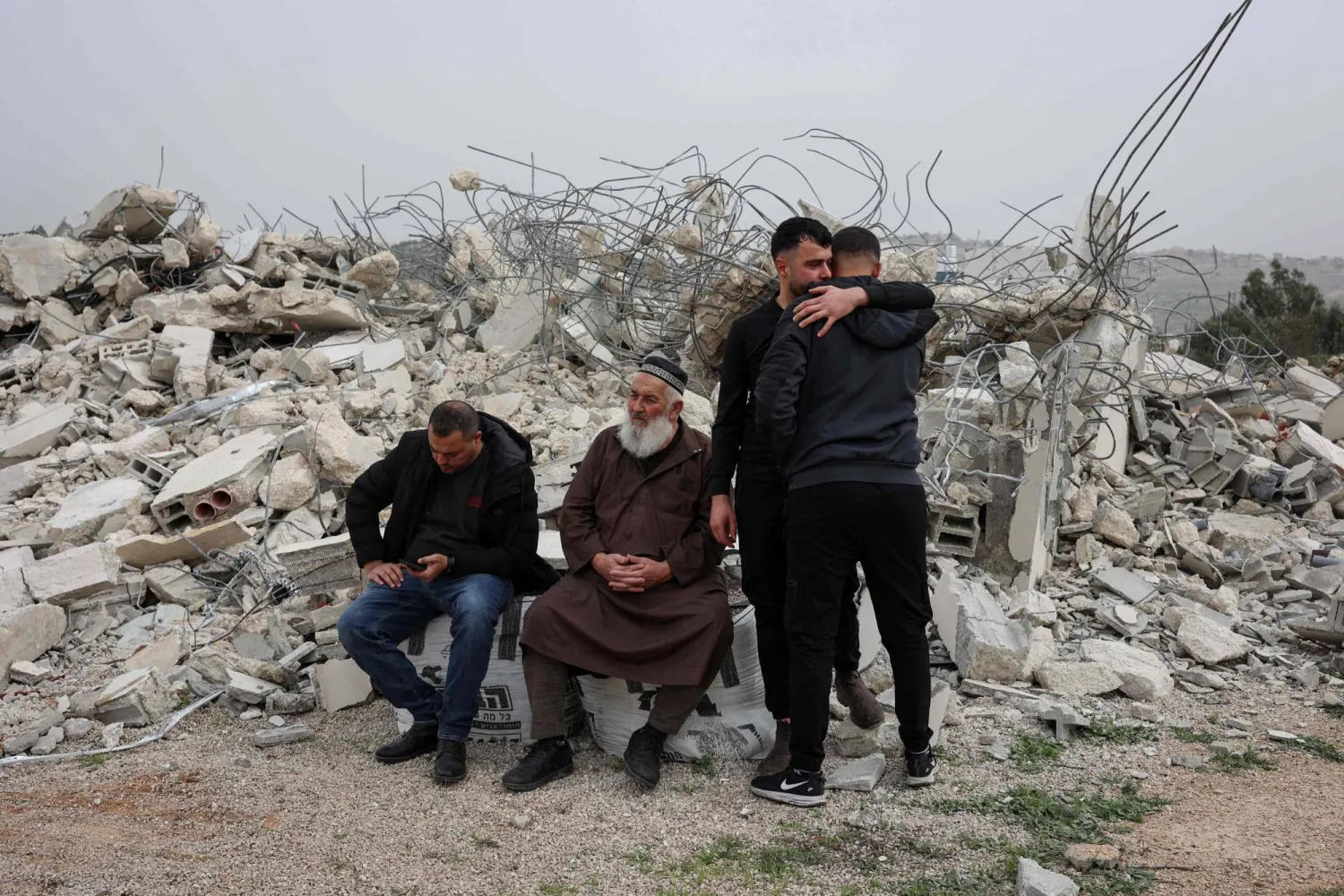
Palestinian men sit on the rubble as others console each other after a Palestinian home was demolished by the Israeli army in the village of Shuqba, west of the city of Ramallah, in the Israeli-occupied West Bank on February 9, 2026. (Photo by Zain JAAFAR / AFP)
TT

UN: Israeli Measure in West Bank is ‘Unlawful,’ Erodes Two-State Solution

Palestinian men sit on the rubble as others console each other after a Palestinian home was demolished by the Israeli army in the village of Shuqba, west of the city of Ramallah, in the Israeli-occupied West Bank on February 9, 2026. (Photo by Zain JAAFAR / AFP)

UN Secretary-General Antonio Guterres on Monday voiced grave concern over the reported decision by the Israeli security cabinet to authorize a series of administrative and enforcement measures in Areas A and B in the occupied West Bank, warning that such measure erodes the prospect for the two-State solution.

“Such actions, including Israel’s continued presence in the Occupied Palestinian Territory are not only destabilizing but – as recalled by the International Court of Justice – unlawful,” according to a statement issued by his spokesperson.

Guterres reiterated that all Israeli settlements in the occupied West Bank, including East Jerusalem, and their associated regime and infrastructure, have no legal validity and constitute a flagrant violation of international law, including relevant UN resolutions.

The Secretary-General called on Israel to reverse the measures. He also urged all parties “to preserve the only path to lasting peace, a negotiated two-State solution, in line with relevant Security Council resolutions and international law.”

On Sunday, the Ynet news website revealed that the Israeli cabinet is advancing a series of dramatic decisions aimed at deepening Israel’s de facto annexation of parts of the West Bank.

It said the measures, advanced by ministers Israel Katz and Bezalel Smotrich, are expected to bring far-reaching changes to land registration and property acquisition procedures in the West Bank, enabling the state to demolish Palestinian-owned buildings in Area A.

The decisions are also expected to significantly expand Jewish settlement across the West Bank.

In Ramallah, the Palestinian Presidency strongly denounced the dangerous decisions approved by the Israeli cabinet aimed at deepening attempts to annex the occupied West Bank, according to the Palestinian news agency, WAFA.

The Presidency considered the decisions “a continuation of the comprehensive war waged by the Israeli government against Palestinians, and an unprecedented escalation targeting the Palestinian presence and its national and historical rights throughout the Palestinian territory, especially in the occupied West Bank.”

It warned of the grave implications of these decisions, which represent the practical implementation of annexation and displacement plans.

“These decisions also violate all agreements signed between the Palestine Liberation Organization and Israel, as well as international law and resolutions of international legitimacy, and constitute a blatant violation of the Oslo Accords and the Hebron Agreement,” the Presidency said.