


Lebanon to Cut Ministers' Pay in Bid to Ease Protester Rage

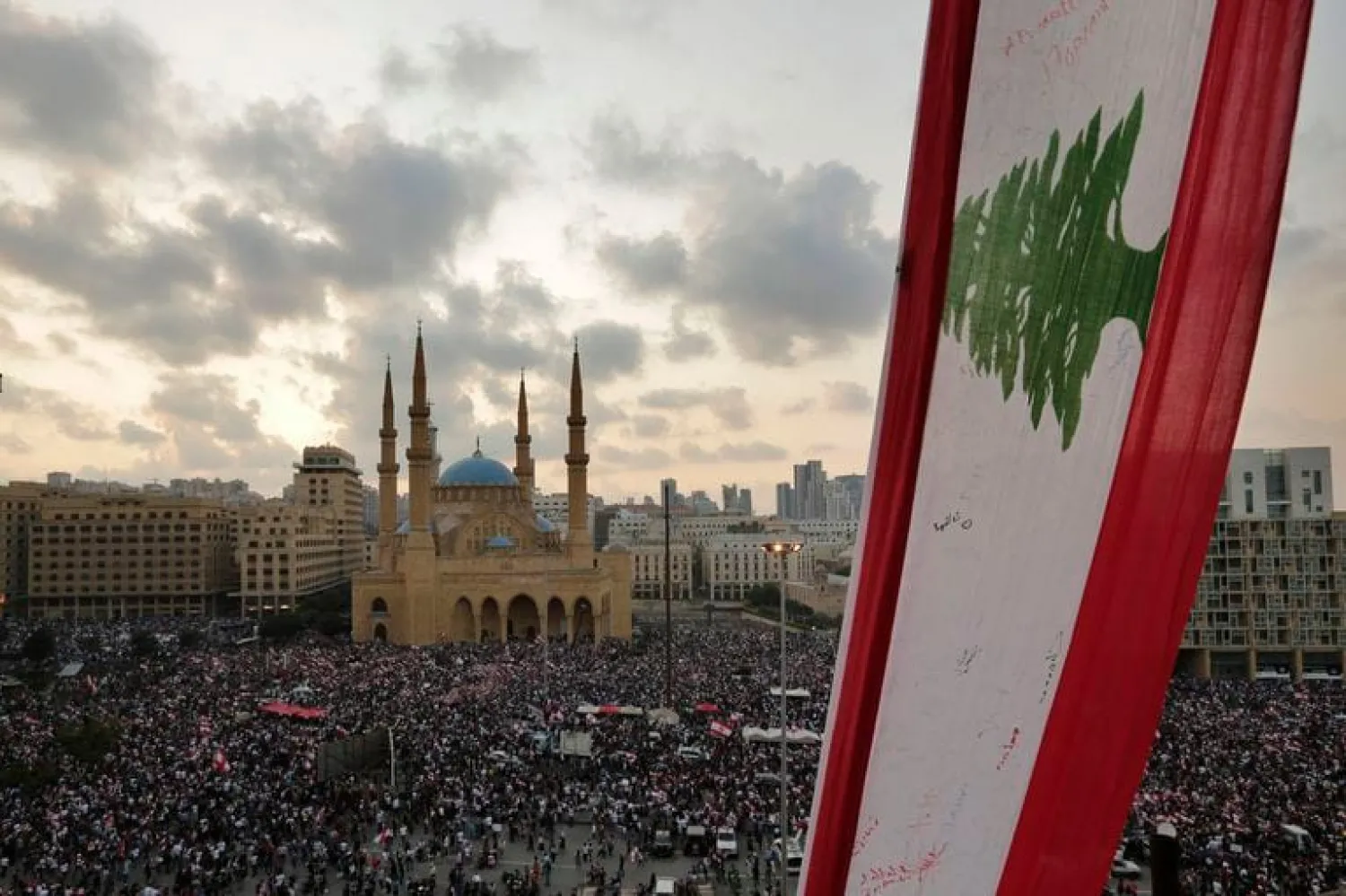
Anti-government protesters shout slogans in Beirut, Lebanon, Sunday, Oct. 20, 2019. Tens of thousands of Lebanese protesters of all ages gathered Sunday in major cities and towns nationwide, with each hour bringing hundreds more people to the streets for the largest anti-government protests yet in four days of demonstrations. (AP Photo/Hassan Ammar)
TT

Lebanon to Cut Ministers' Pay in Bid to Ease Protester Rage

Anti-government protesters shout slogans in Beirut, Lebanon, Sunday, Oct. 20, 2019. Tens of thousands of Lebanese protesters of all ages gathered Sunday in major cities and towns nationwide, with each hour bringing hundreds more people to the streets for the largest anti-government protests yet in four days of demonstrations. (AP Photo/Hassan Ammar)

Lebanon’s cabinet is expected to halve ministers’ wages on Monday among other reforms in a bid to ease an economic crisis and defuse the biggest protests against the ruling elite in decades.

Across the country, people blocked roads for a fifth day. Schools, banks and businesses closed. Hundreds of thousands of people have flooded the streets, furious at a political class they accuse of pushing the economy to the point of collapse.

Under pressure, Prime Minister Saad al-Hariri and top officials drew up a package of steps over the weekend, some seen as vital to reviving confidence which may alleviate strains in Lebanon’s financial system.

The reforms were under debate at a cabinet meeting that President Michel Aoun chaired at the Baabda palace on Monday.

In central Beirut, people prepared for another day in the streets. Soldiers barricaded the paths to parliament. Graffiti scrawled on building walls declared “Revolution”.

“If we get reforms, for a start it’s good, to calm down the storms, people are angry ... but in the long term, I don’t know if it will make a change,” said Rida Jammoul, a football coach.

Ziad Abou Chakra pledged to keep protesting until the government fell. “We will stay here and we won’t open the roads whatever happens,” he said, manning a roadblock north of Beirut.

Hariri, who leads a coalition mired in sectarian and political rivalries, gave his cabinet a 72-hour deadline on Friday to agree reform plans, hinting he might otherwise resign. The deadline expires on Monday evening.

The package includes a 50% cut in the salaries of current and former presidents, ministers and lawmakers, and benefit cuts for state institutions and officials, officials told Reuters.

It further provides for the central bank and private banks to contribute $3.3 billion to achieve a “near zero deficit” for the 2020 budget.

The government plans to privatize the telecommunications sector and overhaul the costly and crumbling electricity sector, both major strains on Lebanon’s finances.

Protesters have said this would not be enough to send them home, demanding the demise of politicians they accuse of rampant corruption. “This is not enough. We want early elections and justice from all those who stole from the state,” said George Raad, a public sector employee.

PEOPLE POWER

The rallies across Lebanon have been a historic outpouring of dissent against politicians, some of them civil war-era leaders, who are widely seen to have used state resources and influence for their own power and gain.

But Aoun said it was unfair to tarnish everyone with corruption charges, and that banking secrecy should be lifted from the accounts of current and future ministers.

“What is happening in the streets expresses people’s pain, but generalizing corruption (charges) against everyone carries big injustice,” he said.

A chorus of voices, from union leaders to politicians, has joined calls for Hariri’s government to resign.

Opponents of that include the powerful, heavily armed Shi’ite Hezbollah movement backed by Iran. Its leader said on Saturday Lebanon did not have time for such a move given the acute financial situation.

The Lebanese economy has been hit by political paralysis and regional conflicts, among other factors. Economic woes have been compounded by strains in the financial system that accumulated as capital flows into the country have slowed down.

These capital inflows are needed to finance the state deficit and the needs of its import-dependent economy.

Lebanon’s dollar-denominated sovereign bonds suffered hefty losses on Monday following sharp drops on Friday. Some bonds sank to record lows, indicating investors’ crumbling confidence.

The pressures have shown up in the real economy of late where it has become harder to obtain dollars at the official exchange rate. Dollars have become harder to find and the Lebanese pound has been under pressure.

“The message to the politicians is don’t ever underestimate the power of the people because once they unite they will explode - peacefully,” said Hiba Dandachli, 36, a social entrepreneur who was helping clean up central Beirut on Monday.

“There are children, families, all from different religions and backgrounds,” she said.


Australia Bars Citizen Held in Syria’s Roj Camp from Returning Home

Members of Australian families believed to be linked to ISIS leave Roj camp near Derik, Syria February 16, 2026. REUTERS/Orhan Qereman
TT

Australia Bars Citizen Held in Syria’s Roj Camp from Returning Home

Members of Australian families believed to be linked to ISIS leave Roj camp near Derik, Syria February 16, 2026. REUTERS/Orhan Qereman

Australia has barred one of its citizens from returning home from a Syrian detention camp because of security concerns, the government said Wednesday.

The unidentified person is among a group of 34 Australian women and children at the Roj camp related to suspected members of ISIS.

"I can confirm that one individual in this cohort has been issued a temporary exclusion order, which was made on advice from security agencies," Home Affairs Minister Tony Burke said in a statement sent to AFP.

"At this stage security agencies have not provided advice that other members of the cohort meet the required legal thresholds for temporary exclusion orders."

The minister can make temporary exclusion orders lasting up to two years to prevent terrorist activities or politically motivated violence.

The Australians were released from the camp on Monday but failed to reach the capital Damascus on their way home, a Kurdish official told AFP in Syria.

The official said they were turned back to the detention camp, citing "poor coordination" with the Syrian authorities.

Prime Minister Anthony Albanese underscored his government's refusal to help repatriate the women and children.

"You make your bed, you lie in it," he said, accusing the group of aligning with an ideology that seeks to "undermine and destroy our way of life".

"We are doing nothing to repatriate or to assist these people," he told reporters Wednesday.

"I think it's unfortunate that children are caught up in this. That's not their decision but it's the decision of their parents or their mother."

The humanitarian organization Save the Children Australia filed a lawsuit in 2023 on behalf of 11 women and 20 children in Syria, seeking their repatriation.

But the Federal Court ruled against Save the Children, saying the Australian government did not control their detention in Syria.


Saudi Intervention Ends Socotra Power Crisis

Socotra power generators restarted after Saudi intervention (X)
TT

Saudi Intervention Ends Socotra Power Crisis

Socotra power generators restarted after Saudi intervention (X)

Electricity has returned to Yemen’s Socotra archipelago after urgent Saudi intervention ended days of outages that disrupted daily life and crippled vital institutions, including the general hospital, the university and the technical institute.

The breakthrough followed a sudden shutdown of the power plants after the operating company withdrew and disabled control systems, triggering widespread blackouts and deepening hardship for residents.

The Saudi Program for the Development and Reconstruction of Yemen said its engineering and technical teams moved immediately after receiving an appeal from local authorities. Specialists were dispatched to reactivate operating systems that had been encrypted before the company left the island.

Generators were brought back online in stages, restoring electricity across most of the governorate within a short time.

The restart eased intense pressure on the grid, which had faced rising demand in recent weeks after a complete halt in generation.

Health and education facilities were among the worst affected. Some medical departments scaled back services, while parts of the education sector were partially suspended as classrooms and laboratories were left without power.

Socotra’s electricity authority said the crisis began when the former operator installed shutdown timers and password protections on control systems, preventing local teams from restarting the stations. Officials noted that the archipelago faced a similar situation in 2018, which was resolved through official intervention.

Local sources said the return of electricity quickly stabilized basic services. Water networks resumed regular operations, telecommunications improved, and commercial activity began to recover after a period of economic disruption linked to the outages.

Health and education rebound

In the health sector, stable power, combined with operational support, secured the functioning of Socotra General Hospital, the archipelago’s main medical facility.

Funding helped provide fuel and medical supplies and support healthcare staff, strengthening the hospital’s ability to receive patients and reducing the need to transfer cases outside the governorate, a burden that had weighed heavily on residents.

Medical sources said critical departments, including intensive care units and operating rooms, resumed normal operations after relying on limited emergency measures.

In education, classes and academic activities resumed at Socotra University and the technical institute after weeks of disruption.

A support initiative covered operational costs, including academic staff salaries and essential expenses, helping curb absenteeism and restore the academic schedule.

Local authorities announced that studies at the technical institute would officially restart on Monday, a move seen as a sign of gradual stabilization in public services.

Observers say sustained technical and operational support will be key to safeguarding electricity supply and preventing a repeat of the crisis in a region that depends almost entirely on power to run its vital sectors.


Egypt’s Prime Minister and FM Head to Washington for Trump Peace Council Meeting

Egyptian Foreign Minister Badr Abdelatty speaks during a joint press conference with Kenyan Prime Cabinet Secretary/Cabinet Secretary for Foreign Diaspora Affairs Musalia Mudavadi in Nairobi, Kenya, Monday, Feb. 16, 2026. (AP)
TT

Egypt’s Prime Minister and FM Head to Washington for Trump Peace Council Meeting

Egyptian Foreign Minister Badr Abdelatty speaks during a joint press conference with Kenyan Prime Cabinet Secretary/Cabinet Secretary for Foreign Diaspora Affairs Musalia Mudavadi in Nairobi, Kenya, Monday, Feb. 16, 2026. (AP)

Egypt's Prime Minister Mostafa Madbouly headed to Washington on Tuesday ‌to ‌participate in ‌the inaugural ⁠meeting of a "Board of Peace" established by US President Donald ⁠Trump, the ‌cabinet ‌said.

Madbouly is ‌attending ‌on behalf of President Abdel ‌Fattah al-Sisi and is accompanied by ⁠Foreign ⁠Minister Badr Abdelatty.

Foreign Minister Gideon Saar will represent Israel at the inaugural meeting, his office said on Tuesday.

Hamas, meanwhile, called on the newly-formed board to pressure Israel to halt what it described as ongoing violations of the ceasefire in Gaza.

The Board of Peace, of which Trump is the chairman, was initially designed to oversee the Gaza truce and the territory's reconstruction after the war between Hamas and Israel.

But its purpose has since morphed into resolving all sorts of international conflicts, triggering fears the US president wants to create a rival to the United Nations.

Saar will first attend a ministerial level UN Security Council meeting in New York on Wednesday, and on Thursday he "will represent Israel at the inaugural session of the board, chaired by Trump in Washington DC, where he will present Israel's position", his office said in a statement.

It was initially reported that Prime Minister Benjamin Netanyahu might attend the gathering, but his office said last week that he would not.

Ahead of the meeting, Hamas spokesman Hazem Qassem told AFP that the Palestinian movement urged the board's members "to take serious action to compel the Israeli occupation to stop its violations in Gaza".

"The war of genocide against the Strip is still ongoing -- through killing, displacement, siege, and starvation -- which have not stopped until this very moment," he added.

He also called for the board to work to support the newly formed Palestinian technocratic committee meant to oversee the day-to-day governance of post-war Gaza "so that relief and reconstruction efforts in Gaza can commence".

Announcing the creation of the board in January, Trump also unveiled plans to establish a "Gaza Executive Board" operating under the body.

The executive board would include Turkish Foreign Minister Hakan Fidan and Qatari diplomat Ali Al-Thawadi.

Netanyahu has strongly objected to their inclusion.

Since Trump launched his "Board of Peace" at the World Economic Forum in Davos in January, at least 19 countries have signed its founding charter.
