

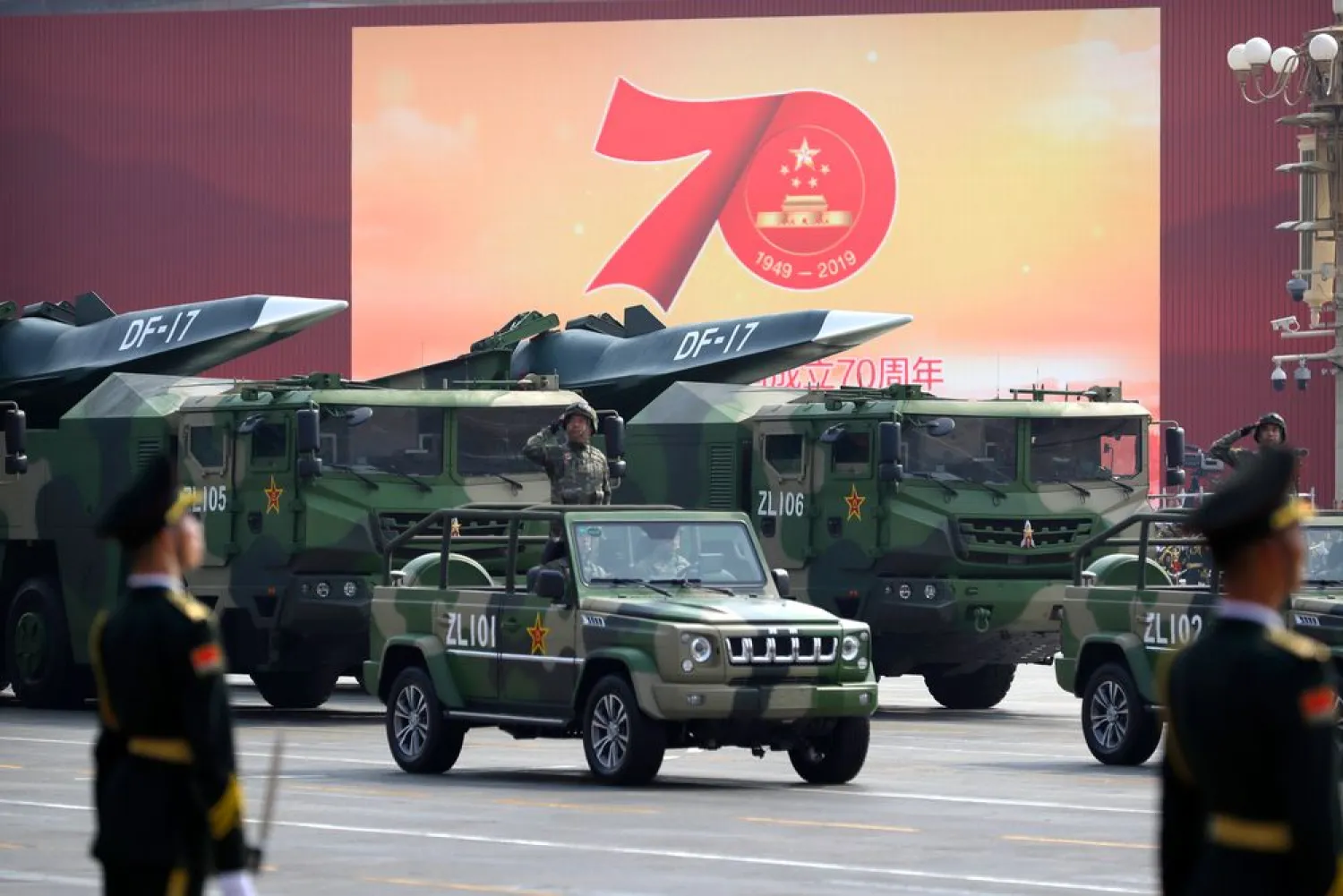

Global Defense Spending Up 4% in 2019

Chinese military vehicles carrying DF-17 ballistic missiles roll during a parade to commemorate the 70th anniversary of the founding of Communist China in Beijing, Tuesday, Oct. 1, 2019. (AP Photo/Mark Schiefelbein)
TT

Global Defense Spending Up 4% in 2019

Chinese military vehicles carrying DF-17 ballistic missiles roll during a parade to commemorate the 70th anniversary of the founding of Communist China in Beijing, Tuesday, Oct. 1, 2019. (AP Photo/Mark Schiefelbein)

The world's defense expenses rose 4% in 2019, compared to the previous year, a report released by the International Institute for Strategic Studies (IISS) revealed on Friday.

The report -- Military Balance 2020 --, which was revealed at the Munich Security Conference, showed the year 2019 posted the largest annual increase in defense spending during the last decade.

The institute prepares the report annually based on its global survey with 171 countries.

The report, of which Asharq Al-Awsat exclusively received a copy- starts by showcasing an unstable international security environment dominating defense debates. It reveals how key elements of the rules­based international order that characterized the post-­Second World War period are being challenged. The demise of the Intermediate­Range Nuclear Forces (INF) Treaty exemplifies this most clearly, with its collapse precipitated by Russian breaches as well as the Trump administration’s determination – with an eye to China’s military modernization – that the bilateral accord had outlived its usefulness. Nonetheless, Russia showed United States’ inspectors its new Avangard hypersonic glide vehicle in late November 2019 as part of its obligations under the New START treaty. Indeed, it is noteworthy that in the current climate, observers are looking nervously not just towards Moscow, but also anxiously in the direction of Washington for signs of interest in maintaining this remaining element of the strategic arms­control architecture when it comes up for renewal in 2021.

In its seventh chapter, the report featured defense strategies in the Middle East and North Africa region, where it pointed out that Egypt, Qatar, Oman, and Saudi Arabia are working on "recapitalizing elements of their combat-aircraft fleets." It noted that Iran's aggressive activity in the Strait of Hormuz and other areas has prompted the United States to try to build an international coalition under the name of the International Alliance for the Safety and Protection of Maritime Navigation and Insurance of the Safety of Seaways.

Furthermore, the report highlighted military capabilities- including those of land, maritime, and aerial armies- while also referring to cyber capabilities. The US ranked high on the scale of spending, followed by China, then Saudi Arabia, followed by Russia.

Today’s challenges
In this environment of continuous, evolving and even accelerating competition, the response options for Western states might include integrating increasingly novel technologies or spending more to stay ahead. Alternatively, they could accept a leveling playing field as a new norm and adapt their strategies instead. This relates not just to conventional mili­tary power but also to cyber capability and the consistently contested information environment.

A related challenge is that of competitor states now using strategies to achieve effect by operating below the threshold of war. Examples include Russia’s initial moves into Crimea and its denials over-involvement in eastern Ukraine, its use of chemical weapons in the UK and its alleged election meddling. Iran’s activities are another example. Its ability to conduct warfare through third parties has ‘given Iran a strategic advantage over adversaries reliant on conventional capabilities’, according to the IISS Strategic Dossier on Iran’s networks of influence.

Capabilities routed through third parties, disinforma­tion campaigns, or kinetic actions that are denied outright are hard to tackle with conventional military responses. They place a premium not just on developing the right military and intelligence capabilities, but on boosting the adaptability and resilience of equipment and military forces and, more broadly, of societies and political decision­making. The same holds true when dealing with developments in new mili­tary or militarily­ relevant technologies. In all cases, working effectively with partners, and making use of relevant interna­tional frameworks, have the potential to act as a force multi­plier. However, while conflict still involves hard military power, it is now more diffused than before. It now involves a greater number of actors and more capabilities, some of which are not traditionally ‘military’, and clear outcomes in peace, war, and the grey space between are, accordingly, less certain.

Defense economics
Global defense spending continued to rebound in 2019, with real-terms growth rising by 4.0% this year (when compared with 2018 and measured in constant 2015 US dollars). This was the highest year-on-year increase observed in the past ten years. Total defense spending, excluding US foreign military financing programs, reached US$1.73 trillion when measured in current dollars, against US$1.67trn in 2018.

In 2019, defense spending both in China and in the United States increased by 6.6%, when measured in real terms and compared to 2018. In nominal terms, the US increase alone (US$53.4 billion) almost equaled the United Kingdom’s 2019 defense budget (US$54.8bn), while China’s nominal increase (US$10.6bn) was just short of Taiwan’s entire 2019 defense budget (US$10.9bn).

After years of cuts, total defense spending in Europe, when measured in real terms, once again reached the levels seen before the financial crisis (US$277bn in 2008; US$289bn in 2019). This was an increase of 4.2%, when measured in real terms, compared to 2018. These spending increases are directed more and more towards procurements and research and development. Indeed, defense investments grew, as a share of total spending, from 19.8% in 2018 to 23.1% in 2019, for those countries where data is available.

However, this increase in European spending was modest when measured in nominal dollar terms, rising from US$290bn to US$291bn, because the euro depreciated against the dollar over the year.

When measured on a per capita basis, as well as in GDP terms, countries in the Middle East and North Africa spent the most on defense. Australia, Norway, Singapore, and the US are also in the top ten when spending is measured on a per capita basis. The UK, spending US$837 per person, is in 11th position.



UK PM's Top Aide Quits over Mandelson-Epstein Scandal

FILE PHOTO: British Prime Minister Keir Starmer talks with Britain's ambassador to the United States Peter Mandelson during a welcome reception at the ambassador's residence on February 26, 2025, in Washington, DC, US. Carl Court/Pool via REUTERS/File Photo
TT

UK PM's Top Aide Quits over Mandelson-Epstein Scandal

FILE PHOTO: British Prime Minister Keir Starmer talks with Britain's ambassador to the United States Peter Mandelson during a welcome reception at the ambassador's residence on February 26, 2025, in Washington, DC, US. Carl Court/Pool via REUTERS/File Photo

British Prime Minister Keir Starmer's chief of staff, Morgan McSweeney, quit on Sunday, saying he took responsibility for advising Starmer to name Peter Mandelson as ambassador to the US despite his known links to Jeffrey Epstein.

After new files revealed the depth of the Labour veteran's relationship with the late sex offender, Starmer is facing what is widely seen as the gravest crisis of his 18 months in power over his decision to send Mandelson to Washington in 2024, Reuters reported.

The loss of McSweeney, 48, a strategist who was instrumental in Starmer's rise to power, is the latest in a series of setbacks, less than two years after the Labour Party won one of the largest parliamentary majorities in modern British history.

With polls showing Starmer is hugely unpopular with voters after a series of embarrassing U-turns, some in his own party are openly questioning his judgment and his future, and it remains to be seen whether McSweeney's exit will be enough to silence critics.

The files released in the US on January 30 sparked a police investigation for misconduct in office over indications that Mandelson leaked market-sensitive information to Epstein when he was a government minister during the global financial crisis in 2009 and 2010.

In a statement, McSweeney said: "The decision to ⁠appoint Peter Mandelson was wrong. He has damaged our party, our country and trust in politics itself.
"When asked, I advised the Prime Minister to make that appointment and I take full responsibility for that advice."

The leader of the opposition Conservative Party, Kemi Badenoch, said the resignation was overdue and that "Keir Starmer has to take responsibility for his own terrible decisions".

Nigel Farage, head of the populist Reform UK party, which is leading in the polls, said he believed Starmer's time would soon be up.

Starmer has spent the last week defending McSweeney, a strategy that could prompt further questions about his own judgment. In a statement on Sunday, Starmer said it had been "an honor" working with him.

Many Labour members of parliament had blamed McSweeney for the appointment of Mandelson and the damage caused by the publication of the exchanges between Epstein ⁠and Mandelson. Others have said Starmer must go.

One Labour lawmaker, speaking on condition of anonymity, said McSweeney's resignation had come too late: "It buys the PM time, but it's still the end of days."

Starmer sacked Mandelson as ambassador in September over his links to Epstein.

The government agreed last week to release virtually all previously private communications between members of his government from the time when Mandelson was being appointed.

That release could come as early as this week, creating a new headache for Starmer just as he hopes to move on. If previously secret messages about how London planned to approach its relationship with Donald Trump are made public, it could damage Starmer's relationship with the US President.

McSweeney had held the role of chief of staff since October 2024, when he was handed the job following the resignation of Sue Gray after a row over pay and donations.

Starmer on Sunday appointed his deputy chiefs of staff, Jill Cuthbertson and Vidhya Alakeson, to serve as joint acting chiefs of staff.


Iran Sentences Nobel Laureate Narges Mohammadi to 7 More Years in Prison

(FILES) A handout photo provided by the Narges Mohammadi Foundation on October 2, 2023 shows an undated, unlocated photo of Iranian rights campaigner Narges Mohammadi. (Photo by Handout / NARGES MOHAMMADI FOUNDATION / AFP)
TT

Iran Sentences Nobel Laureate Narges Mohammadi to 7 More Years in Prison

(FILES) A handout photo provided by the Narges Mohammadi Foundation on October 2, 2023 shows an undated, unlocated photo of Iranian rights campaigner Narges Mohammadi. (Photo by Handout / NARGES MOHAMMADI FOUNDATION / AFP)

Iran sentenced Nobel Peace Prize laureate Narges Mohammadi to over seven more years in prison after she began a hunger strike, supporters said Sunday.

Mohammadi’s supporters cited her lawyer, who spoke to Mohammadi.

The lawyer, Mostafa Nili, confirmed the sentence on X, saying it had been handed down Saturday by a Revolutionary Court in the city of Mashhad. Such courts typically issue verdicts with little or no opportunity for defendants to contest their charges.

“She has been sentenced to six years in prison for ‘gathering and collusion’ and one and a half years for propaganda and two-year travel ban,” he wrote, according to The Associated Press.

She received another two years of internal exile to the city of Khosf, some 740 kilometers (460 miles) southeast of Tehran, the capital, the lawyer added.

Supporters say Mohammadi has been on a hunger strike since Feb. 2. She had been arrested in December at a ceremony honoring Khosrow Alikordi, a 46-year-old Iranian lawyer and human rights advocate who had been based in Mashhad. Footage from the demonstration showed her shouting, demanding justice for Alikordi and others.

Supporters had warned for months before her December arrest that Mohammadi, 53, was at risk of being put back into prison after she received a furlough in December 2024 over medical concerns.

While that was to be only three weeks, Mohammadi’s time out of prison lengthened, possibly as activists and Western powers pushed Iran to keep her free. She remained out even during the 12-day war in June between Iran and Israel.

Mohammadi still kept up her activism with public protests and international media appearances, including even demonstrating at one point in front of Tehran’s notorious Evin prison, where she had been held.

Mohammadi had been serving 13 years and nine months on charges of collusion against state security and propaganda against Iran’s government.

She also had backed the nationwide protests sparked by the 2022 death of Mahsa Amini, which have seen women openly defy the government by not wearing the hijab.

Mohammadi suffered multiple heart attacks while imprisoned before undergoing emergency surgery in 2022, her supporters say. Her lawyer in late 2024 revealed doctors had found a bone lesion that they feared could be cancerous that later was removed.

“Considering her illnesses, it is expected that she will be temporarily released on bail so that she can receive treatment,” Nili wrote.

However, Iranian officials have been signaling a harder line against all dissent since the recent demonstrations. Speaking on Sunday, Iranian judiciary chief Gholamhossein Mohseni-Ejei made comments suggesting harsh prison sentences awaited many.

“Look at some individuals who once were with the revolution and accompanied the revolution," he said. "Today, what they are saying, what they are writing, what statements they issue, they are unfortunate, they are forlorn (and) they will face damage.”


Nigeria's President to Make a Sate Visit to the UK in March

Nigeria’s President Bola Tinubu gives a joint statement with Brazil’s President Luiz Inacio Lula da Silva, at the Planalto presidential palace, in Brasilia, Brazil, Aug. 25, 2025. (AP Photo/Eraldo Peres, File)
TT

Nigeria's President to Make a Sate Visit to the UK in March

Nigeria’s President Bola Tinubu gives a joint statement with Brazil’s President Luiz Inacio Lula da Silva, at the Planalto presidential palace, in Brasilia, Brazil, Aug. 25, 2025. (AP Photo/Eraldo Peres, File)

Nigeria’s president is set to make a state visit to the UK in March, the first such trip by a Nigerian leader in almost four decades, Britain’s Buckingham Palace said Sunday.

Officials said President Bola Tinubu and first lady Oluremi Tinubu will travel to the UK on March 18 and 19, The AP news reported.

King Charles III and Queen Camilla will host them at Windsor Castle. Full details of the visit are expected at a later date.

Charles visited Nigeria, a Commonwealth country, four times from 1990 to 2018 before he became king. He previously received Tinubu at Buckingham Palace in September 2024.m

Previous state visits by a Nigerian leader took place in 1973, 1981 and 1989.

A state visit usually starts with an official reception hosted by the king and includes a carriage procession and a state banquet.

Last year Charles hosted state visits for world leaders including US President Donald Trump, French President Emmanuel Macron and German President Frank-Walter Steinmeier.