US Links Withdrawal of Troops in Iraq to ISIS Defeat

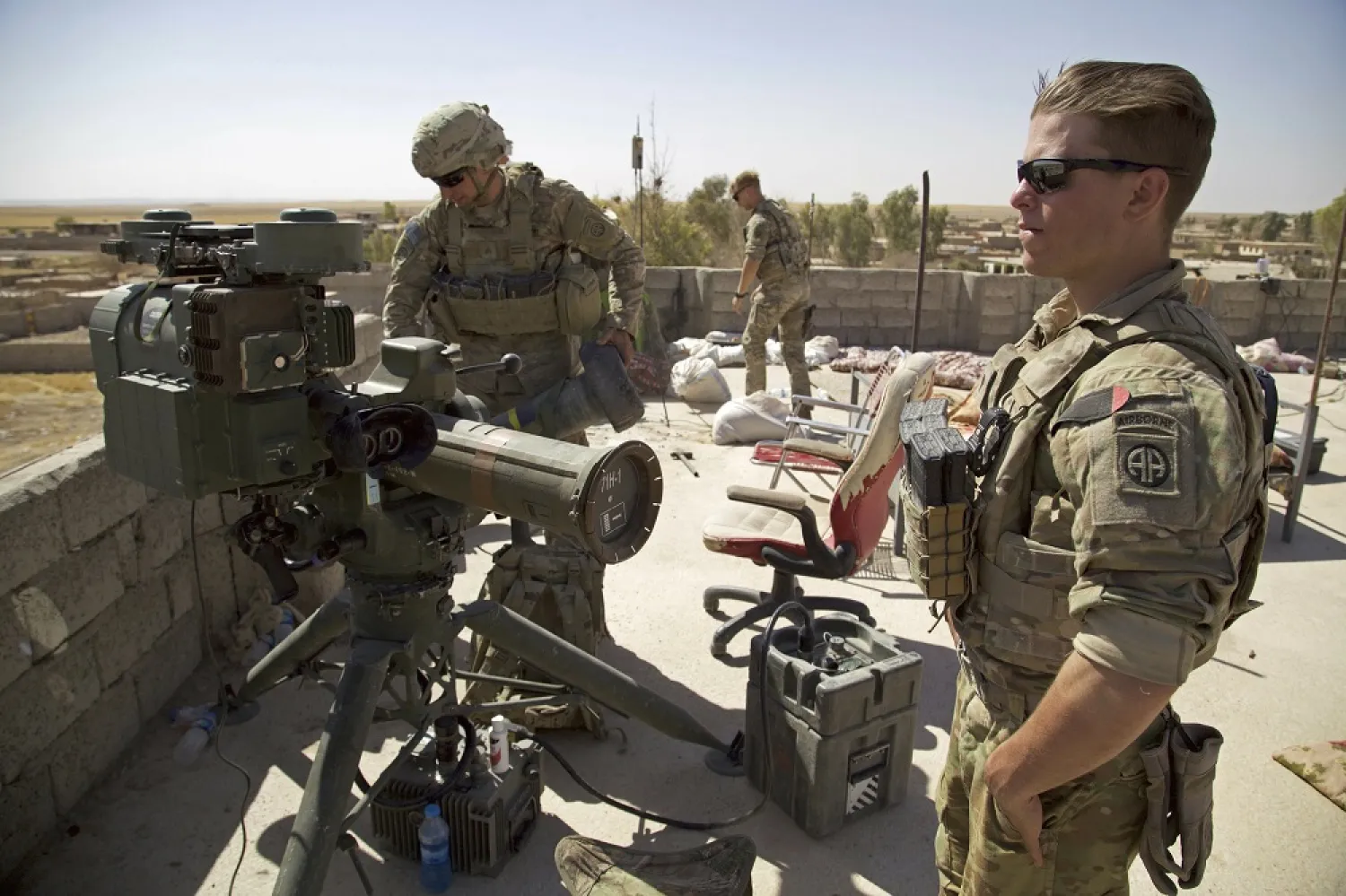
In this Aug. 20, 2017 file photo, US Army soldiers stands next to a guided-missile launcher in the village of Abu Ghaddur, east of Tal Afar, Iraq. (AP)
TT

US Links Withdrawal of Troops in Iraq to ISIS Defeat

In this Aug. 20, 2017 file photo, US Army soldiers stands next to a guided-missile launcher in the village of Abu Ghaddur, east of Tal Afar, Iraq. (AP)

Gabriel Soma, a member of the advisory board to US President Donald Trump, said that the deployment of US troops in Iraq is temporary, linking their presence to the threat of ISIS.

Soma, in a press release on Saturday, said that President Trump always affirms that the US will get out of Iraq and expresses his desire to withdraw troops from both Iraq and Syria.

“Our presence in Iraq is temporary and with the end of ISIS, we will withdraw,” he said, pointing out that US forces were present at 12 bases and have withdrawn from nine.

“What threatens Iraq today is ISIS and major Iranian influence,” he noted, adding that ISIS has some 10,000 fighters, most of whom are based in Iraq.

Soma's comments come one day after the end of the first round of the American-Iraqi dialogue, during which it was confirmed that Washington wishes to withdraw their forces from Iraq, but without setting a timeframe.

US and Iraq officials have agreed to reduce the number of American troops in the country in the coming months but, following resumption of dialogue, fell short of providing a timeframe.

The decision was announced on Thursday following the long-anticipated talks, the first strategic dialogue between the two countries in a decade.

Several Iraqi parties have voiced their desire to establish balanced relations with the US that are based on common interests, including a review of the Strategic Framework Agreement signed in 2008.

Iraqi parties, however, still link development on other tracks with Washington to its seriousness in withdrawing its forces from their country.


Al-Alimi: Iran Guards’ Flight out of Sanaa Is a Violation of Yemen’s Sovereignty

Chairman of Yemen’s Presidential Leadership Council Dr. Rashad Al-Alimi meets with the ambassadors on Monday. (SABA)
TT

Al-Alimi: Iran Guards’ Flight out of Sanaa Is a Violation of Yemen’s Sovereignty

Chairman of Yemen’s Presidential Leadership Council Dr. Rashad Al-Alimi meets with the ambassadors on Monday. (SABA)

Chairman of Yemen’s Presidential Leadership Council Dr. Rashad Al-Alimi slammed on Monday Iran’s Revolutionary Guards Corps (IRGC) for operating a flight out of Sanaa airport.

Meeting with ambassadors of countries that are sponsoring the political process in Yemen, he said the flight was a violation of Yemen’s sovereignty and an act of “defiance of international laws and relevant United Nations Security Council resolutions.”

The Iran-backed Houthis, who control Sanaa, claimed that the flight had a humanitarian purpose. Al-Alimi revealed, however, that reports indicate that military and security personnel, as well as experts in developing drones and rocket systems, were onboard.

He told the ambassadors that repeated cuts in aircraft tracing signals as the plane flew over Yemen contradict the Houthi claim that this was a humanitarian flight.

He urged an independent international probe to verify the purpose of the flight.

Moreover, he said the Mahan Air, which operated the flight, has been under international sanctions for years for providing logistic support to the IRGC.

Al-Alimi called for firmer international stances against “Iran’s flagrant meddling in Yemeni affairs and a strict implementation of Security Council resolutions and sanctions.”

He stressed that civilian flights and ports must not be used to transport military personnel and equipment.

Al-Alimi said that the stricter implementation of sanctions against the Houthi militias was a peaceful way to implement international resolutions. He also called for greater support to the legitimate Yemeni government, saying it was a “trusted partner in reviving state institutions, achieving peace, protecting waterways and combating terrorism and organized crimes.”

“Yemen is only asking that the international community defend the principles on which the international system is built on,” he went on to say.

“The threat will not stop at Yemeni borders should the armed factions get away with defying Security Council resolutions, violate sanctions, use civilian aircraft as cover for military operations, and threaten energy security and the global economy,” he warned.

“The issue in Yemen is today no longer an internal conflict, but a direct challenge to the international order and global economy that has become a hostage to the Iran’s militias in the region,” he stressed.

“The latest Iranian violation is a grave development and a deliberate attempt to test the international community’s ability to implement its decisions,” he added.

He accused Iran of seeking to shirk sanctions and impose a “new status quo by force”.

“As Iran continues to invest in militias and undermine the state, Saudi Arabia continues to invest in state institutions and development, improve Yemeni livelihoods and prepare the right conditions to achieve peace and stability in Yemen,” Al-Alimi said.

“The Yemeni republic harbors no animosity towards the Iranian people; it only seeks friendly relations between peoples. It, however, rejects the Iranian regime’s policies that are based on supporting militias and interfering in the internal affairs of nations,” he remarked.


Pakistan Mediating Libya Unity with US-led Push

Prime Minister Shehbaz Sharif receives Saddam Haftar in Pakistan in February last year (General Command)
TT

Pakistan Mediating Libya Unity with US-led Push

Prime Minister Shehbaz Sharif receives Saddam Haftar in Pakistan in February last year (General Command)

Pakistan has quietly begun mediating between Libya's rival eastern and western power centers, two Pakistani sources said, in a previously unreported Pakistani effort that would further raise its diplomatic profile if it succeeds.

The Pakistani involvement comes after observers have for months monitored a US-led push to find a diplomatic solution in Libya, which has been split between rival eastern and western administrations since a civil war that broke out in the years after the 2011 NATO-backed uprising toppled Muammar Gaddafi.

Pakistan has been central to separate mediation between the US and Iran this year, with its role repeatedly being credited by the Trump administration, and one of the Pakistani sources said the US was "fully aware and involved" in Islamabad's Libya role.

The effort was also being supported by Saudi Arabia, both sources said.

Both Pakistani sources said the efforts began late last year and both Libyan ‌sides ⁠requested its involvement. ⁠It was unclear to what extent Pakistan has been coordinating its efforts with other regional stakeholders.

UNITY PLAN

Any successful plan to reunify Libya would need to balance the vastly different interests of foreign patrons and resolve disputes over posts, election rules and oil revenues that have derailed past attempts, analysts said.

"The United States has been pushing hard in Libya," said Jalel Harchaoui, a contributor to Britain's Royal United Services Institute think tank, "but the format it ⁠is trying to impose is still loose and ill-defined."

A summary of a proposed "Libya Reunification ‌Plan", shared with Reuters, would set out a 36-month transitional power-sharing arrangement under ‌a body called the Government of National Consensus and Presidential Council.

The proposal – which one Pakistani source cautioned was still being discussed ‌in detail – would establish a transition period with Abdulhamid Dbeibah of the UN-recognized and western-based Libyan Government of National ‌Unity as prime minister and Saddam Haftar, deputy commander of the eastern-based Libyan National Army, as chairman of the Presidential Council.

The faction around Haftar's father, Khalifa Haftar, the commander-in-chief of the LNA, controls many of Libya's biggest oilfields and key infrastructure, and the proposed plan would hand him authority over the budget.

A Pakistani source said Pakistan would play "an active role in making sure this whole arrangement stays ‌in play", with details still being worked on.

PAKISTANI MEDIATION Last month, Pakistan's army chief Asim Munir met Saddam Haftar in Rawalpindi – a meeting that was followed days later by Haftar's ⁠visit to Washington, where ⁠he met with Secretary of State Marco Rubio.

The State Department said in a statement at the time that Rubio welcomed Libyan leaders' efforts to overcome divisions and reaffirmed US support for Libyan unity.

Pakistani officials have pursued defense ties with the eastern-based LNA, as Reuters reported in December, including the possible sale of JF-17 fighter jets and Super Mushshak trainer aircraft, despite a UN arms embargo.

But the rival western GNU also recently sought direct talks with Pakistan, according to an unreported document seen by Reuters.


Macron Arrives in Syria as First Major Western Leader to Visit Country Under New Leadership

France's President Emmanuel Macron (L) is welcomed by Syria's Foreign Minister Asaad al-Shaibani (R) as he arrives fo a state visit at the Damascus International Airport in Damascus on July 6, 2026. (AFP)
TT

Macron Arrives in Syria as First Major Western Leader to Visit Country Under New Leadership

France's President Emmanuel Macron (L) is welcomed by Syria's Foreign Minister Asaad al-Shaibani (R) as he arrives fo a state visit at the Damascus International Airport in Damascus on July 6, 2026. (AFP)

French President Emmanuel Macron arrived Monday in Syria, making him the first major western leader to visit the war-torn country since the ouster of Bashar al-Assad in 2024. 

Ukrainian President Volodymyr Zelenskyy visited April, but Macron is the first leader from western Europe or North America to do so. 

The French president’s visit comes during a period of relative calm in the Middle East after the monthlong war in Iran and Lebanon.  

He will travel next to Ankara, Türkiye, for the NATO summit, where Syrian President Ahmed al-Sharaa is also expected to attend and hold a high-profile meeting with US President Donald Trump. 

Syria’s state-run SANA news agency said Macron would visit with a business delegation to discuss regional security as well as business and investment opportunities. 

Macron was greeted at Damascus airport by Syrian Foreign Minister Asaad al-Shibani. 

Macron hosted al-Sharaa in Paris in May 2025, where he urged European and US leaders to lift longstanding sanctions on Damascus. Most of those sanctions had since been lifted.