


WHO Sees First Results from COVID Drug Trials within 2 Weeks

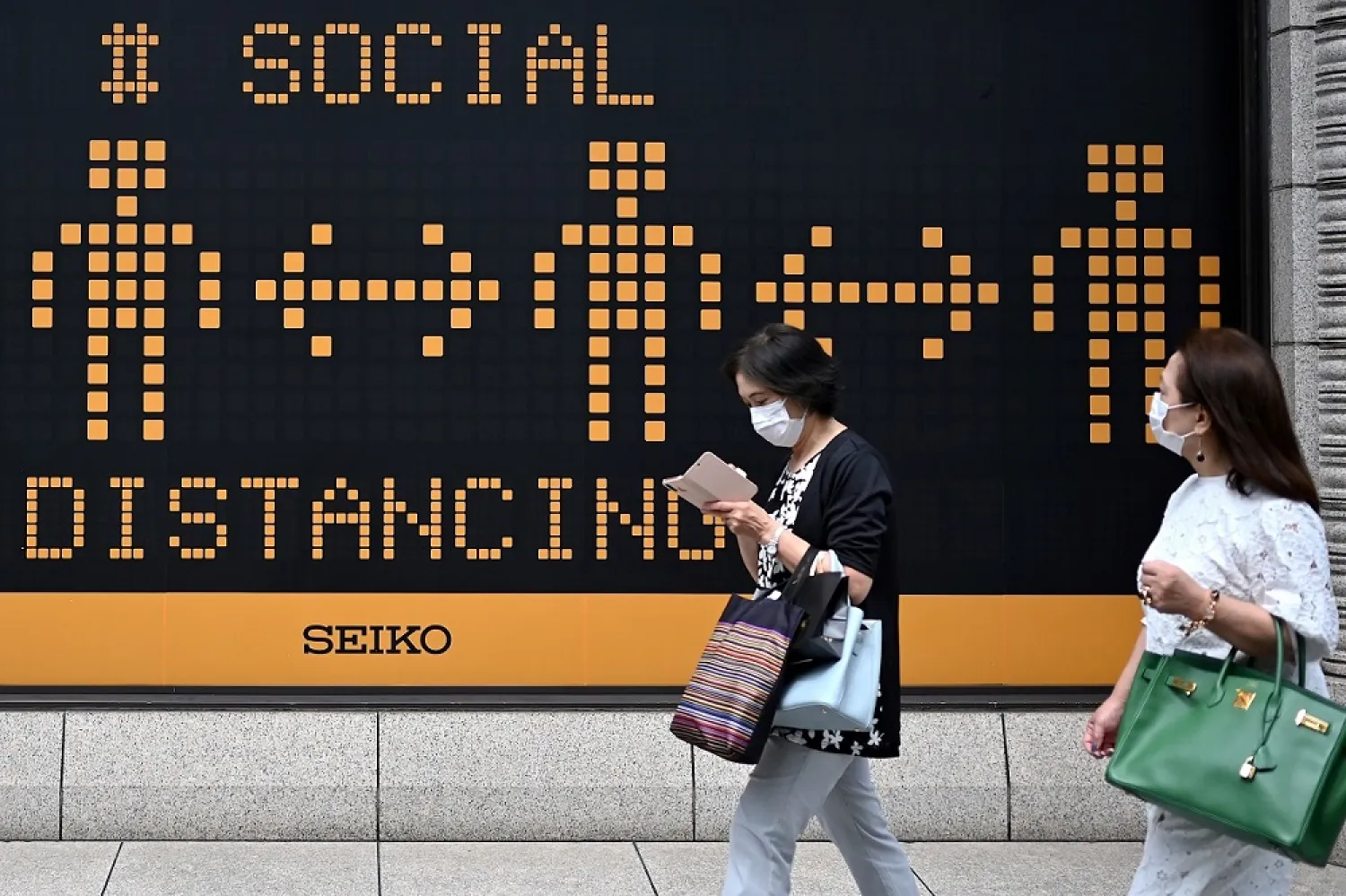
Masked pedestrians walk past a billboard reminding people on social distancing practices amid the COVID-19 coronavirus pandemic in Tokyo. (AFP)
TT

WHO Sees First Results from COVID Drug Trials within 2 Weeks

Masked pedestrians walk past a billboard reminding people on social distancing practices amid the COVID-19 coronavirus pandemic in Tokyo. (AFP)

The World Health Organization (WHO) should soon get results from clinical trials it is conducting of drugs that might be effective in treating COVID-19 patients, its Director General Tedros Adhanom Ghebreyesus said on Friday.

"Nearly 5,500 patients in 39 countries have so far been recruited into the Solidarity trial," he told a news briefing, referring to clinical studies the UN agency is conducting. "We expect interim results within the next two weeks."

The Solidarity Trial started out in five parts looking at possible treatment approaches to COVID-19: standard care; remdesivir; the anti-malaria drug touted by US President Donald Trump, hydroxychloroquine; the HIV drugs lopinavir/ritonavir; and lopanivir/ritonavir combined with interferon.

Earlier this month, it stopped the arm testing hydroxychloroquine, after studies indicated it showed no benefit in those who have the disease, but more work is still needed to see whether it may be effective as a preventative medicine.

Mike Ryan, head of the WHO's emergencies program, said it would be unwise to predict when a vaccine could be ready against COVID-19, the respiratory disease caused by the novel coronavirus that has killed more than half a million people.

While a vaccine candidate might show its effectiveness by year's end, the question was how soon it could be mass produced, he told the UN journalists' association ACANU in Geneva.

There is no proven vaccine against the disease now, while 18 potential candidates are being tested on humans.

WHO officials defended their response to the virus that emerged in China last year, saying they had been driven by the science as it developed. Ryan said what he regretted was that global supply chains had broken, depriving medical staff of protective equipment.

"I regret that there wasn't fair, accessible access to COVID tools. I regret that some countries had more than others, and I regret that front-line workers died because of (that)," he said.

He urged countries to get on with identifying new clusters of cases, tracking down infected people and isolating them to help break the transmission chain.

"People who sit around coffee tables and speculate and talk (about transmission) don't achieve anything. People who go after the virus achieve things," he said.



Iran's Supreme Leader Urges Iranians to Show 'Resolve' against Foreign Pressure

Iran's supreme leader Ali Khamenei on (File Photo/Supreme Leader's website).
TT

Iran's Supreme Leader Urges Iranians to Show 'Resolve' against Foreign Pressure

Iran's supreme leader Ali Khamenei on (File Photo/Supreme Leader's website).

Iran's supreme leader Ali Khamenei on Monday called on his compatriots to show "resolve" ahead of the anniversary of the 1979 Islamic revolution this week.

Since the revolution, "foreign powers have always sought to restore the previous situation", Ali Khamenei said, referring to the period when Iran was under the rule of shah Reza Pahlavi and dependent on the United States, AFP reported.

"National power is less about missiles and aircraft and more about the will and steadfastness of the people," the leader said, adding: "Show it again and frustrate the enemy."


UK PM's Communications Director Quits

British Prime Minister Keir Starmer delivers a speech at Horntye Park Sports Complex in St Leonards, Britain, February 05, 2026. Peter Nicholls/Pool via REUTERS
TT

UK PM's Communications Director Quits

British Prime Minister Keir Starmer delivers a speech at Horntye Park Sports Complex in St Leonards, Britain, February 05, 2026. Peter Nicholls/Pool via REUTERS

British Prime Minister Keir Starmer's director of communications Tim Allan resigned on Monday, a day after Starmer's top aide Morgan McSweeney quit over his role in backing Peter Mandelson over his known links to Jeffrey Epstein.

The loss of two senior aides ⁠in quick succession comes as Starmer tries to draw a line under the crisis in his government resulting from his appointment of Mandelson as ambassador to the ⁠US.

"I have decided to stand down to allow a new No10 team to be built. I wish the PM and his team every success," Allan said in a statement on Monday.

Allan served as an adviser to Tony Blair from ⁠1992 to 1998 and went on to found and lead one of the country’s foremost public affairs consultancies in 2001. In September 2025, he was appointed executive director of communications at Downing Street.


Road Accident in Nigeria Kills at Least 30 People

FILE PHOTO: A police vehicle of Operation Fushin Kada (Anger of Crocodile) is parked on Yakowa Road, as schools across northern Nigeria reopen nearly two months after closing due to security concerns, following the mass abductions of school children, in Kaduna, Nigeria, January 12, 2026. REUTERS/Nuhu Gwamna/File Photo
TT

Road Accident in Nigeria Kills at Least 30 People

FILE PHOTO: A police vehicle of Operation Fushin Kada (Anger of Crocodile) is parked on Yakowa Road, as schools across northern Nigeria reopen nearly two months after closing due to security concerns, following the mass abductions of school children, in Kaduna, Nigeria, January 12, 2026. REUTERS/Nuhu Gwamna/File Photo

At least 30 people have been killed and an unspecified number of people injured in a road accident in northwest Nigeria, authorities said.

The accident occurred Sunday in Kwanar Barde in the Gezawa area of Kano state and was caused by “reckless driving” by the driver of a truck-trailer, Gov. Abba Yusuf said in a statement. He did not specify what other vehicles were involved.

Yusuf described the accident as “heartbreaking and a great loss” to the affected families and the state. He did not provide more details of the accident, said The Associated Press.

Africa’s most populous country recorded 5,421 deaths in 9,570 road accidents in 2024, according to data by the country’s Federal Road Safety Corps.

Experts say a combination of factors including a network of bad roads, lax enforcement of traffic laws and indiscipline by some drivers produce the grim statistics.

In December, boxing heavyweight champion Anthony Joshua was in a deadly car crash that injured him and killed Sina Ghami and Latif “Latz” Ayodele, two of his friends, in southwest Nigeria.

Adeniyi Mobolaji Kayode, Joshua’s driver, was charged with dangerous and reckless driving and his trial is scheduled to begin later this month.

Africa has the highest road fatality rate in the world despite having only about 3% of the world’s vehicles, mainly due to weak enforcement of road laws, poor infrastructure and widespread use of unsafe transport.