

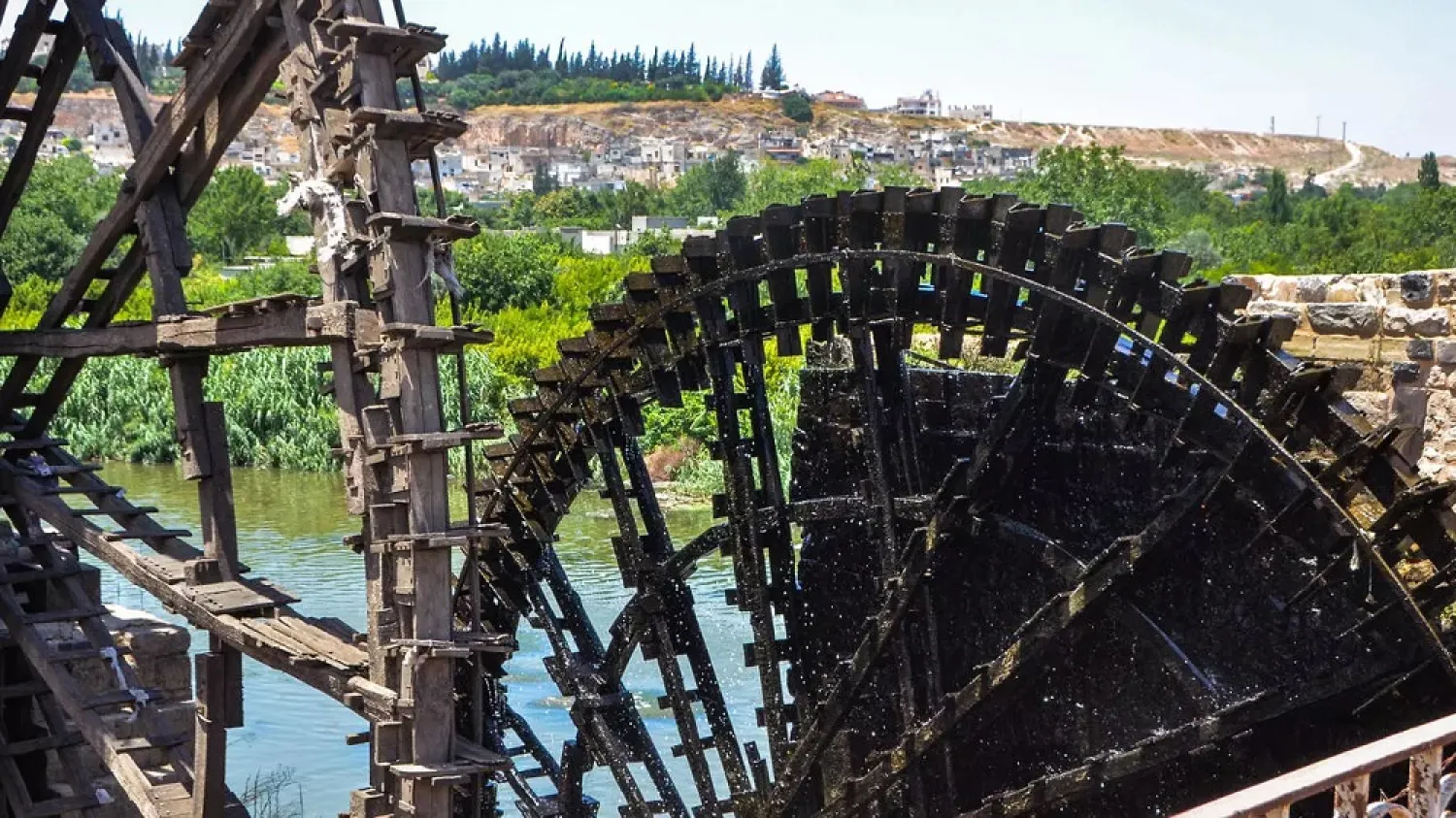

On Syria River, Craftsmen Revive Famed Water Wheels

The water wheels or ‘norias’ of Hama were used for centuries to bring water to gardens and buildings on the shores of the Orontes River. (AFP)
TT

On Syria River, Craftsmen Revive Famed Water Wheels

The water wheels or ‘norias’ of Hama were used for centuries to bring water to gardens and buildings on the shores of the Orontes River. (AFP)

On a riverbank in Syria's Hama, Mohammed Sultan tinkers away on a giant water wheel, one of a dwindling number of artisans able to restore the city's ancient wooden landmarks.

Used for centuries to bring water to gardens and buildings on the shores of the Orontes River, the water wheels or "norias" of Hama are believed to be unique worldwide, according to UNESCO.

The touristic landmarks have largely been spared by Syria's nine-year war, but some have fallen into disrepair or seen part of their timber stolen or burnt.

"It's our duty to bring them back to life," the 52-year-old said, sweat forming on his forehead after hammering a tenon into a freshly cut wood beam.

Nearby passers-by pose for pictures at the feet of the huge dark wooden wheel he is fixing, the city's largest and oldest, known as the Mohammadia.

Twenty-two meters (72 feet) in diameter, the wheel rises high above the water level and is believed to date back to the 14th century.

"The norias are Hama's spirit," Sultan told AFP, as children splash around in the Orontes.

"Without them, the city would be dead and drab."

'Giving back to my city'

Clambering up and down a stone staircase to the wheel's center, Sultan replaces some wood along one of its massive spokes.

"When I work with my colleagues to fix the norias, I feel like I'm giving something back to my city," said the artisan, who has 22 years of experience in his unique field.

"I forget how tired I am as soon as one starts turning again."

Hama city, north of the capital Damascus, was mostly spared fighting during the war, though battles did at times rage in the nearby countryside.

In other parts of Hama province, 10 of the region's 25 norias have in recent years stopped their slow, creaking rotation above the waterline.

The water wheels are believed to have originated in the Arab medieval era, but a mosaic dated 469 BC suggests they could have existed even earlier, UNESCO says.

Held together by an assortment of walnut, pine, poplar and oak wood, they once carried small wooden boxes that scooped up water each time they plunged into the river.

The wheels drew from the Orontes to irrigate nearby gardens, as well as supply water to mosques, public baths and homes on its banks.

Though no longer the case today, the wheels remain the pride of the city, drawing in droves of tourists before the war and featuring on Syrian banknotes.

"We continue to give great importance to restoring these historical relics in view of their symbolic value," Hama mayor Adnan Tayyar said.

"It's impossible to visit Hama without stopping by the norias," he added.

Last of the noria craftsmen

Ahd Saba al-Arab, head of the Hama noria authority, said he hoped visitors would soon flock back to the city.

But maintenance of the water wheels was becoming increasingly difficult, he said.

This was because the right wood had become expensive and in short supply, and there was now "a great scarcity of artisans with the right know-how".

The number of suitably skilled craftsmen has fallen from 35 to just nine, after many died or emigrated during the conflict.

Ismail, another of the last surviving experts, says he is proud to be able to carry on a tradition "all done by hand".

"The norias are the city's backbone," said the bespectacled man in his fifties.

But, moving agilely from one side of the Mohammadia to the other, he is worried about the next generation's lack of interest in the profession.

"Our craft is transmitted from father to son, but today we can no longer pass it on to our children," he said.




Annual Orchids Show Brings Vivid Color to Chicago Winter

Orchids adorn a Volkswagen Beetle as finishing touches are placed on the 12th annual Chicago Botanic Garden Orchid Show, Friday, Feb. 6, 2026, in Glencoe, Ill. (AP)
TT

Annual Orchids Show Brings Vivid Color to Chicago Winter

Orchids adorn a Volkswagen Beetle as finishing touches are placed on the 12th annual Chicago Botanic Garden Orchid Show, Friday, Feb. 6, 2026, in Glencoe, Ill. (AP)

A soft layer of white snow blankets the grounds of the Chicago Botanic Garden. The air is chilly, the sky gray.

Inside, however, the air is warm and lights illuminate more than 10,000 vividly colored orchids. Staff members move in and out of greenhouses, preparing to open the garden’s 12th annual Orchid Show on Saturday.

This year’s theme is “Feelin’ Groovy" with several installations calling back to the 1970s, including a yellow Volkswagen Beetle filled with orchids.

“It’s just a really great way to get out of the winter cold and come into our greenhouses,” said Jodi Zombolo, associate vice president of visitor events and programs. “I think people are really looking for something to kind of bring happiness and something that they will enjoy and find whimsy in.”

The orchid family is one of the largest in the plant world and some of the species in the show are rare, exhibits horticulturist Jason Toth said. One example is the Angraecum sesquipedale, also known as Darwin’s orchid, on display in the west gallery.

Toth said the orchid led Darwin to correctly conclude that pollinators have adapted in order to reach down the flower's very long end.

"It has a great story and it’s quite remarkable-looking,” said Toth.

Elsewhere, massive, gnarly roots dangle from purple, pink and yellow Vanda orchids in the south greenhouse. These epiphytic orchids grow on the surface of trees instead of in soil.

“I think everyone’s tired of the winter,” said Toth. “So having some kind of flower show at this point is what we’re all craving. And 'Orchids' fits the bill.”

The show is expected to draw 85,000 visitors this year.


UK Zoo Says Tiny Snail ‘Back from Brink’ of Extinction

This photo taken on February 2, 2026 shows a greater Bermuda snail, which is part of a breeding program, sitting under a microscope at Chester Zoo in Chester, north-west England. (AFP)
TT

UK Zoo Says Tiny Snail ‘Back from Brink’ of Extinction

This photo taken on February 2, 2026 shows a greater Bermuda snail, which is part of a breeding program, sitting under a microscope at Chester Zoo in Chester, north-west England. (AFP)

A minuscule snail once thought to have disappeared has been saved from the edge of extinction, a British zoo said Saturday.

The greater Bermuda land snail had not been spotted for years until a cluster of shells was caught slithering through an alleyway in the capital Hamilton in 2014.

Some were flown to Chester Zoo, where experts spent years building up the population before they released thousands back into the wild in 2019.

Unique to Bermuda, this type of snail traces its lineage back over a million years -- a relic of the island's ancient ecosystem.

Now "we can officially say the species is back from the brink", said Chester Zoo in a statement sent to AFP.

The snail "once thought lost has officially been saved from extinction by experts in Chester Zoo, London Zoo, and Bermuda," it said.

They confirmed this after a study in the Oryx biodiversity conservation journal found that six colonies of the re-wilded snails had settled successfully on the archipelago.

"The fact that the snails are firmly established in six areas is massive," said Gerardo Garcia, animal and plant director at Chester Zoo.

From specially designed pods in northwest England, they are now breeding and roaming freely in Bermuda, he said.

"Being able to say that the snails are now safe from extinction is amazing ... and something that conservationists might get to say once or maybe twice in their whole career."

At one point, keeper Katie Kelton said the zoo housed around 60,000 snails.

It was "a lot of snails to look after ... a lot of chopping lettuce, sweet potato and carrot," she told AFP.

- Conservation 'success' story -

The snails faced many threats, including habitat loss, pesticide use, and the cannibalistic "wolf snail".

They were rescued in a process Garcia described as "a war game" with growing numbers tracked by flags pinned across a map of Bermuda.

While they cannot say the species is safe forever, he noted they now knew how to rebuild the population quickly and effectively.

But long-term recovery, he said, would go hand in hand with nature regeneration projects carried out by the Bermudian government.

Chester Zoo has now turned its attention to the lesser Bermuda land snail -- even smaller and much harder to breed.

These snails, which can reach about 23 millimeters (0.9 inches) in length, may now be extinct in the wild.

"We're considering things like seasonality, how long it takes a colony to establish and the complexity of their environments," said expert Iri Gill.

But their experience with the greater Bermuda snail should point them "in the right direction", she said.

"These snails are tiny, but this has been one of the biggest success stories in conservation."


SpaceX Delays Mars Plans to Focus on 2027 Moon Landing

FILE PHOTO: SpaceX headquarters is shown in Hawthorne, California, US June 5, 2025. REUTERS/Daniel Cole/File Photo
TT

SpaceX Delays Mars Plans to Focus on 2027 Moon Landing

FILE PHOTO: SpaceX headquarters is shown in Hawthorne, California, US June 5, 2025. REUTERS/Daniel Cole/File Photo

Elon Musk's SpaceX told investors it will prioritize going to the moon first and attempt a trip to Mars at a later time, the Wall Street Journal reported on Friday, citing sources.

The company will target March 2027 ‌for a ‌lunar landing without ‌astronauts ⁠on board, the ‌report added. The news comes after SpaceX agreed to acquire xAI in a deal that values the rocket and satellite company at $1 trillion and the artificial intelligence outfit ⁠at $250 billion.

SpaceX did not immediately respond ‌to a Reuters request ‍for comment. Musk said ‍last year that he aimed ‍to send an uncrewed mission to Mars by the end of 2026.

SpaceX is developing its next-generation Starship rocket, a stainless steel behemoth designed to be fully reusable and ⁠serve an array of missions including flights to the moon and Mars.

The United States faces intense competition this decade from China in its effort to return astronauts to the moon, where no humans have gone since the final US Apollo mission in ‌1972.