

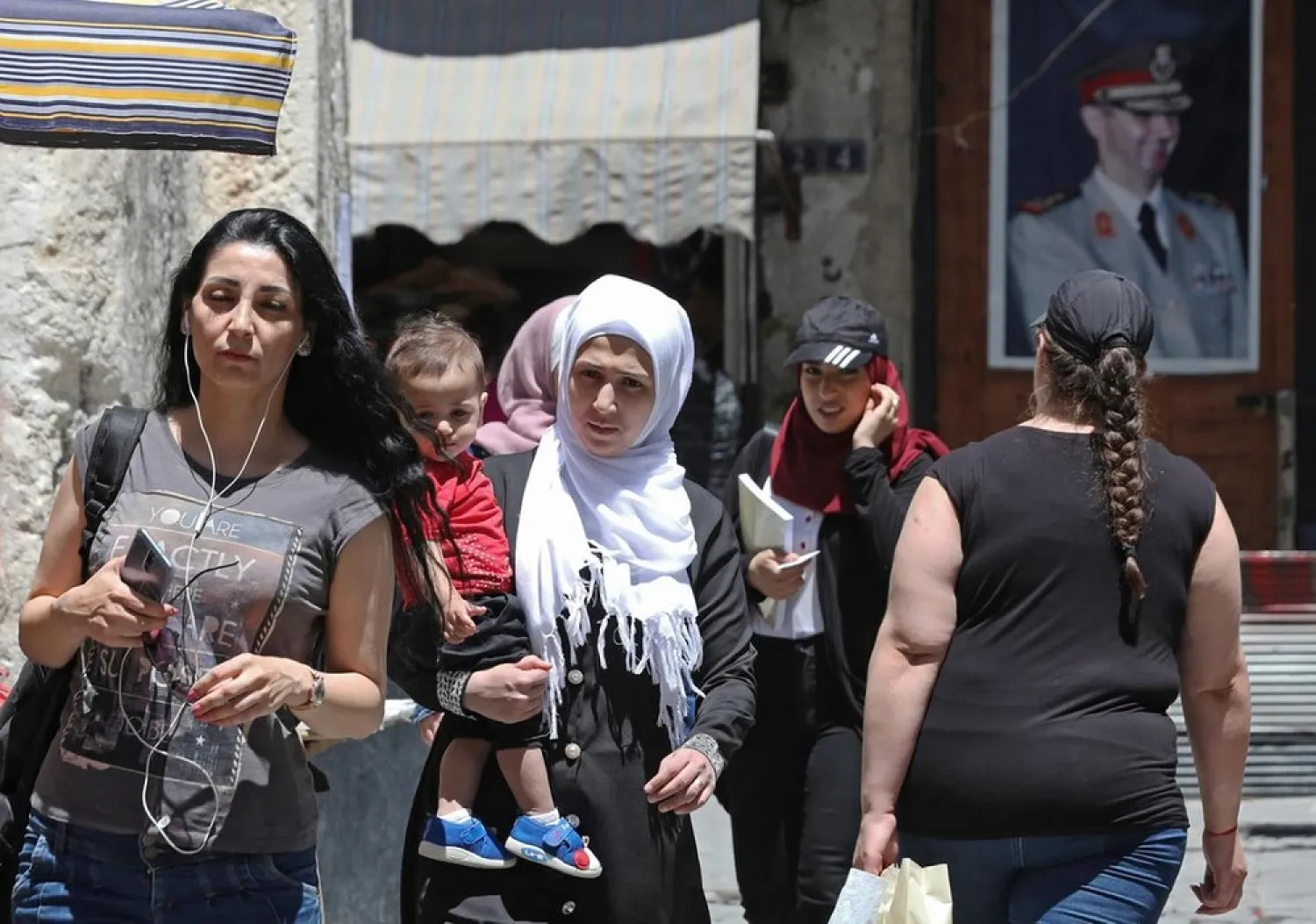

Syrian Baath Seeks Parliamentary Elections to Form ‘War Council

Syrians walk in old Damascus in front of a portrait of Syrian president Bashar Assad. (AFP)
TT

Syrian Baath Seeks Parliamentary Elections to Form ‘War Council

Syrians walk in old Damascus in front of a portrait of Syrian president Bashar Assad. (AFP)

Syria is bracing for parliamentary elections, which will be held on July 19. The ruling Baath Party’s decisions in the buildup to the polls have revealed three trends: The Baath leadership is keen on restoring state institutions and forming a “war council” to confront sanctions; the role of new businessmen and groups that fought alongside the army has grown; political money has taken centerstage amid the stifling economic crisis raging in the country.

The elections will be held in regime-held areas and partial polls will be staged in regions where it has some control, such as Hasakeh, Idlib and al-Raqqa.

It appears that Damascus is keen on holding the elections, as it did in 2012 and 2016, regardless of the course of the UN-led peace process aimed at implementing Security Council resolution 2254, which was approved in 2015. The resolution calls for holding constitutional reform that would pave the way for UN-supervised parliamentary and presidential elections.

Western countries do not recognize the results of Syrian elections and have instead been pushing for the implementation of resolution 2254. This has not deterred Damascus, which is forging ahead with its plans, regardless of the fact that it only controls 65 percent of Syrian territories. It is still a step up from 2015 when it only controlled 15 percent.

President Bashar Assad had relieved last month prime minister Imad Khamis of his duties, replacing him with Water Resources Minister Hussein Arnous. Former Homs governor Talal Barazi is seen as the favorite to be named premier after the election of the People’s Council.

Baath efforts
The Baath, which is supposedly no longer the ruling party after a 2012 constitutional amendment, has sought to give its members greater freedom in choosing their candidates for the 250-member council, which includes 65 independents. The Baath has lost a lot of its support during the conflict due to its handling of the crisis and the defection of several members.

Days ago, Assad chaired a Baath meeting, saying the negative and positive elements that the electoral process has revealed are significant not just for the party, but the whole country.

Electoral campaigns are underway in Syria with the Baath included in the National Progressive Front list that includes national, communist and Nasserite parties licensed by Damascus. Several pro-regime businessmen are in the running. They include Mohammed Hamsho, who is sanctioned by the West, and Samer al-Dibs in Damascus and Hussam Qaterji in Aleppo. The leaders of pro-Damascus armed factions are also running in the elections. They include Fadel Warda, leader of a factions in the Hama countryside and Bassel Sudan, leader of the “Baath Kataib”, who is running in Latakia.

Candidates have reached 8,735, running in 15 electoral districts. The Baath list boasts 166 candidates from the party and 17 from other parties.

‘Implicit’ quotas

Researchers Ziad Awad and Agnes Favier had compiled a report for the European University Institute on the elections. They wrote: “While the 2011 uprising deeply challenged the authoritarian regime in several regions, analysis of the parliamentary election in wartime is crucial to understanding how the regime attempted to renew its social base, which is assumed to have shrunk during the first years of the conflict.

“The last poll to elect the 250 MPs of the People’s Council took place in April 2016 in a country deeply divided, at a time when regime forces were still weak and controlled less than 40% of the territory. Despite the profound upheavals caused by the conflict, the Syrian authorities organized the election in a manner similar to the pre-war process. The Regional Command of the Baath Party played a key role in the pre-selection of candidates despite having lost its role as the leading party in society and the state in the 2012 constitution.

“The Baath Party increased the proportion of the seats (more than 67%) it has held in the council since 1973. The slight rise in the number of Baath Party seats came at the expense of both the other authorized political parties (only six of the National Progressive Front parties and one party newly established after 2012 won seats in 2016) and independents (the number of which has never been so low since 1990).

“Although the distribution of seats by sectarian and ethnic group and gender is not a recognized form of representation in the People’s Council, the implicit quotas for minorities which were applied in the pre-war decade were also much the same in 2016.

“However, the profiles of MPs show significant changes to the traditional categories which were usually represented in the People’s Council before the war and included active members of the Baath Party or of its affiliated popular and union organizations, notables and tribal elders, businessmen, clerics and public figures. Except for traditional Baathists, who still were the most numerous in 2016, the characteristics of representatives of other interest groups (such as businessmen, clerics and tribal leaders, who are traditionally elected as ‘independents’) profoundly changed and new social categories (such as militia leaders and families of martyrs) emerged,” said the report.

War council

“The common characteristic of these newcomer MPs is that they had participated in war efforts alongside the regime. Shifts were more visible in governorates which had experienced major military, political and demographic upheavals (Aleppo, Daraa, rural Damascus, Deir Ezzour and Raqqa) than in ones which had been spared from violence (Damascus, Latakia and Tartous) or retaken early by regime forces (Homs),” continued the report.

“The 2016-2020 Assembly looked like a ‘council of war’ and reflected three priorities of the regime in one of the most critical periods of the armed conflict. First, the regime needed to promote its most active supporters (involved in military or propaganda activities) all over the country at a time when its first objective was to win the military battle. Second, the large presence of traditional Baathists reveals a decision to restore the central role of the Baath Party in keeping alive state institutions after the internal crisis and shifts within the party in the first years of the uprising. Finally, the election of new actors (such as members of martyrs’ families) illustrates the need for the regime to maintain its social base, particularly among minorities,” it noted.



What Safe Havens Remain for the Islamic Jihad?

The late Iranian Supreme Leader Ali Khamenei receives the late «Hamas» leader Ismail Haniyeh and the leader of the «Jihad» movement, Ziad al-Nakhala, in Tehran, July 2024 (AFP)
TT

What Safe Havens Remain for the Islamic Jihad?

The late Iranian Supreme Leader Ali Khamenei receives the late «Hamas» leader Ismail Haniyeh and the leader of the «Jihad» movement, Ziad al-Nakhala, in Tehran, July 2024 (AFP)

The US-Israeli war against Iran has reshaped the landscape for Palestinian factions aligned with Tehran, with the Palestinian Islamic Jihad among the most affected. The group has faced financial and security setbacks in both Syria and Lebanon, even as fighting continues in the Gaza Strip.

Sources in the movement told Asharq Al-Awsat that the regional security changes and the war against Iran have further complicated the organization’s remaining safe havens.

While Hamas maintains close ties with Tehran, Islamic Jihad’s relationship with Iran runs deeper. The connection dates back to the group’s founding in the 1980s by Fathi Shaqaqi.

For decades, Islamic Jihad maintained a military and human presence in both Syria and Lebanon, gaining additional protection as Iranian influence expanded in the two countries over the past ten years.

However, the assassination of Ismail Haniyeh, the head of Hamas’ political bureau, in Tehran in July 2024, followed by an attempted attack on Hamas leaders in Doha in September, served as a major warning to Palestinian faction leaders, particularly Islamic Jihad.

Three countries

According to sources in the group, Secretary-General Ziad al-Nakhalah has sharply reduced his visits to Iran, traveling there only three times since Haniyeh’s assassination. One visit involved a joint delegation from Islamic Jihad and Hamas and lasted several days, while the other two were brief.

Previously, Nakhalah and several senior figures — particularly Akram al-Ajouri, who oversees the group’s armed wing, the Al-Quds Brigades — considered Iran a key safe haven, along with other capitals, such as Beirut. In recent years, however, the group has also expanded its contacts with Qatar and strengthened ties with Egypt.

A source close to Nakhalah said the leader has recently been moving between Doha and Cairo, staying for extended periods, especially in Doha, where his deputy Mohammed al-Hindi is based almost permanently.

Hindi also travels between Qatar, Egypt and Türkiye, with his role in Egypt largely focused on Gaza-related discussions with Egyptian intelligence officials.

Sources declined to confirm whether Ajouri, who had been based in Beirut’s southern suburbs in recent years, has left the area because of security concerns.

Israel recently killed Adham al-Othman, a commander in the Al-Quds Brigades in Lebanon, in a strike on an apartment used by Hezbollah in Beirut’s southern suburbs. He was known to be close to Ajouri.

Pressure in Syria

Israel had already tightened pressure on the Islamic Jihad in Syria before the fall of Bashar al-Assad’s government. A November 2024 airstrike on a group facility in Damascus killed senior figures Abdul Aziz al-Minawi and Rasmi Abu Issa, along with other members.

After the regime’s collapse in December 2024, the pressure intensified. Syria’s new authorities arrested the Islamic Jihad’s representative in the country, Khaled Khaled, and his deputy Abu Ali Yasser in April 2025, holding them for several months.

Movement sources say many of its members in Syria were detained and later released, with interrogations focusing on their weapons and where they were stored.

Some Israeli strikes in recent months have also targeted senior operatives, including field commanders in the Al-Quds Brigades who had previously been wounded in Gaza and remained in Damascus for treatment.

Facing continued Israeli pressure, some Islamic Jihad activists have relocated from Syria to Lebanon or Türkiye. Others have joined Hezbollah fighters in southern Lebanon.

All of this comes as the Islamic Jihad faces a severe financial crisis. Iranian support has largely stopped, affecting salary payments for fighters and limiting the group’s operational budgets both inside Gaza and abroad.


Syrians on Alert to Prevent Accommodation of Displaced Hezbollah Supporters from Lebanon

 Syrians living in Lebanon wait outside the Ministry of Interior Immigration and Passports Department, at the Syrian-Lebanese border, as they return to Syria due to ongoing hostilities between Hezbollah and Israeli forces, amid the US-Israeli conflict with Iran, in Jdaydet Yabous, Syria, March 3, 2026. (Reuters)
Syrians living in Lebanon wait outside the Ministry of Interior Immigration and Passports Department, at the Syrian-Lebanese border, as they return to Syria due to ongoing hostilities between Hezbollah and Israeli forces, amid the US-Israeli conflict with Iran, in Jdaydet Yabous, Syria, March 3, 2026. (Reuters)
TT

Syrians on Alert to Prevent Accommodation of Displaced Hezbollah Supporters from Lebanon

 Syrians living in Lebanon wait outside the Ministry of Interior Immigration and Passports Department, at the Syrian-Lebanese border, as they return to Syria due to ongoing hostilities between Hezbollah and Israeli forces, amid the US-Israeli conflict with Iran, in Jdaydet Yabous, Syria, March 3, 2026. (Reuters)
Syrians living in Lebanon wait outside the Ministry of Interior Immigration and Passports Department, at the Syrian-Lebanese border, as they return to Syria due to ongoing hostilities between Hezbollah and Israeli forces, amid the US-Israeli conflict with Iran, in Jdaydet Yabous, Syria, March 3, 2026. (Reuters)

Syrians in Damascus, its countryside, and western Homs countryside are on alert to prevent displaced Lebanese supporters of Hezbollah from entering Syrian territory or being hosted by locals.

The stance marks a sharp departure from previous Israeli wars on Lebanon, when Syrian cities received tens of thousands of Lebanese fleeing the fighting.

As Israel broadened its strikes in the region to include Hezbollah, not just Iran, displacement from southern Lebanon and Beirut's southern suburbs has resumed. This time, however, those fleeing include not only Lebanese but also Syrians who had been living as refugees in Lebanon.

The scene in and around Damascus appears markedly different from past years. No private cars carrying Lebanese displaced people have been seen in the capital Damascus and its outskirts, unlike during earlier Israeli wars on southern Lebanon under the rule of ousted leader Bashar al-Assad.

In previous waves of displacement, tens of thousands of Lebanese fled to Damascus. Some stayed in hotels, others rented apartments, while a small number were housed in shelters.

The same pattern now applies to Eastern Ghouta. Hezbollah and Iran had turned the area into a strategic rear base while fighting alongside Assad's government during the years of the Syrian uprising.

Hezbollah also housed large numbers of fighters' families there during its war with Israel.

Omar Mohammad Safi, known as Abu Firas, from the town of Beit Sahm in Eastern Ghouta, said the town has not seen the arrival of any Lebanese during the current war, whether Hezbollah supporters or others.

“When Israel attacked Hezbollah the last time, large numbers of fighters' families came and stayed in homes the party had seized in Ghouta, Sayeda Zeinab and elsewhere, but in this war, we have not seen any of them at all in any town,” he told Asharq al-Awsat.

Over the past two days, activists circulated a statement purportedly issued by residents of Damascus and its countryside, especially Eastern Ghouta, warning against renting property to or hosting strangers from southern Lebanon, or Lebanese individuals or families, particularly those linked to Hezbollah.

The statement said Hezbollah, during its support for the former regime, had “committed crimes and massacres,” adding: “We will not forget the massacres of Eastern Ghouta and the chemical massacre.

“Whoever dared to kill us and gloat over us will have no place among us, and we will expel him from the area immediately, along with anyone who shelters him, by all means,” it warned.

During the war in Syria, Hezbollah turned the western Qalamoun area in the Damascus countryside, adjacent to Lebanon's Bekaa region, into a strategic regional rear base.

During the previous war with Israel, the area also hosted tens of thousands of displaced people from Beirut's southern suburbs and southern Lebanon, with facilitation from Assad's government.

But Mahmoud Qusaibiya, known as Abu Alaa, from the town of Jarjir in western Qalamoun, said the town has not seen the arrival of any displaced Lebanese Hezbollah supporters.

“A warning was circulated by elders and prominent figures telling residents not to receive anyone from Hezbollah or their families, because we supported the revolution and they stood with the former government and its remnants,” he told Asharq al-Awsat.

The clearest development has been in the city of Qusayr in western Homs countryside, which Hezbollah seized during the Syrina war.

Rashid Jammoul, known as Abu Mohammad, who comes from the city, said Syrians at the border with Lebanon around Qusayr were on high alert to prevent Hezbollah members, their families, or people linked to them from entering Syrian territory.

“There have been some attempts, but there is an alert by the army and by residents at all legal and illegal crossings,” the man in his sixties told Asharq al-Awsat.

“We will not allow any of them or anyone linked to them to enter or be received after they committed massacres against us, destroyed our villages, and burned our homes.”

Since Israel launched its new war on southern Lebanon, more than 25,000 Syrians have returned to their country.

Syria’s General Authority for Ports and Customs denied that families of Hezbollah members were among those arriving from Lebanon.

Mazen Alloush, director of relations at the authority, said two days ago that since the first day families began fleeing from Lebanon to Syria, social media had been flooded with rumors claiming that families of Hezbollah fighters and supporters were entering Syrian territory through border crossings.

As the rumors spread, some buses leaving the Jousieh border crossing were stopped by young men in the city of Qusayr and attacked on that pretext.

Seeking to clarify the situation, Alloush said all the passengers on those buses were Syrians who had been living in Lebanon and who came from different Syrian provinces.

He said they had entered the country legally.


This Is How Ukraine Has Countered Russia’s Iran-Designed Drones

An Iranian Shahed exploding drone launched by Russia flies through the sky seconds before it struck buildings in Kyiv, Ukraine, on Oct. 17, 2022. (AP)
TT

This Is How Ukraine Has Countered Russia’s Iran-Designed Drones

An Iranian Shahed exploding drone launched by Russia flies through the sky seconds before it struck buildings in Kyiv, Ukraine, on Oct. 17, 2022. (AP)

Ukraine is preparing to dispatch military drone specialists to Gulf states to help them fend off Iranian-designed drones -- something the Ukrainian army has been doing since the start of Russia's invasion.

The military assault launched in February 2022 spawned a cat-and-mouse game of aerial drone warfare that has forced both sides to constantly innovate -- or perish.

Moscow has dramatically scaled-up the production and sophistication of its drones, based on Iranian-designed Shaheds drones that Tehran has launched at Israel and Gulf states over the last week.

That has forced Ukraine to develop cheap and versatile defense systems that allows it to down hundreds of drones in a single barrage -- experience Kyiv says is unmatched anywhere in the world.

- Interceptors vs Shaheds -

Private Ukrainian arms companies have spearheaded the development of drone interceptors -- cheap, light single-use drones that are designed to knock Russian unmanned aerial vehicles out of the sky.

The interceptors -- usually winged or propeller-like helicopters -- are mainly controlled with inbuilt cameras that beam real-time images to pilots on the ground.

Late last year, President Volodymyr Zelensky released grainy, black-and-white images recorded from interceptors as they crashed into Shaheds. He has instructed manufacturers to produce up to 1,000 a day.

This method of air defense is becoming increasingly prevalent: Ukraine's commander-in-chief Oleksandr Syrsky said this week that some 70 percent of all drones launched by Russia at Kyiv and its surrounding region in February were downed by interceptors.

Individual interceptors can cost around as little as $700 or as much as $12,000. But even the most expensive varieties are a fraction of the price of a single missile fired from US Patriot air defense batteries, which are estimated to cost more than $1 million.

"The warfare shifted a lot. First it was drones against humans, soldiers and tanks. Now it's mostly drones against drones," Konstantyn, a deputy commander of an anti-aerial unit deployed in eastern Ukraine recently explained to AFP.

- Anti-aircraft guns, pick-ups -

Ukrainian air defense units also deploy traditional, tried-and-tested weapons: anti-aircraft guns.

These come both in the form of heavy machine guns set on wheels, and make-shift solutions, where troops attach any high-caliber weapon they have onto the back of a pick-up truck.

AFP journalists in Kyiv have seen -- and heard -- these air defense units work during nighttime Russian attacks.

Ukrainian troops also deploy man-portable air-defense systems: guided surface-to-air missiles that are shoulder-launched and originally designed to take down low flying aerial targets.

These portable weapons are used alongside tracking and radar systems.

- F-16s, choppers, Yaks -

Ukraine lobbied its Western allies for supplies of advanced fighter jets for months before finally receiving its first batch of F-16s in mid-2024.

Kyiv has not received many F-16s and there have been reports of issues in training Ukrainian pilots but they are among the aerial arsenal that Ukraine uses to down Shaheds.

The Ukrainian air force also deploys ageing Soviet-era aircraft to down Russian drones, including helicopters like the Mi-24 and Mi-8 or the Yak-52 plane.

- Electronic jamming -

Ukraine has for years deployed a variety of electronic systems that disorientate the navigation systems used by Shaheds to lock onto and fly towards their targets.

By scrambling the networks used by Shaheds inside Ukraine's borders, these means of electronic warfare force Moscow's drones to alter their course and fly back towards Russia.

According to Ukraine air force data, the military has been consistently intercepting or shooting down more than 80 percent of all incoming Russian drones -- hundreds of which are fired every night.