


Iraqi PM Vows to Limit Weapons to State, Hold Elections

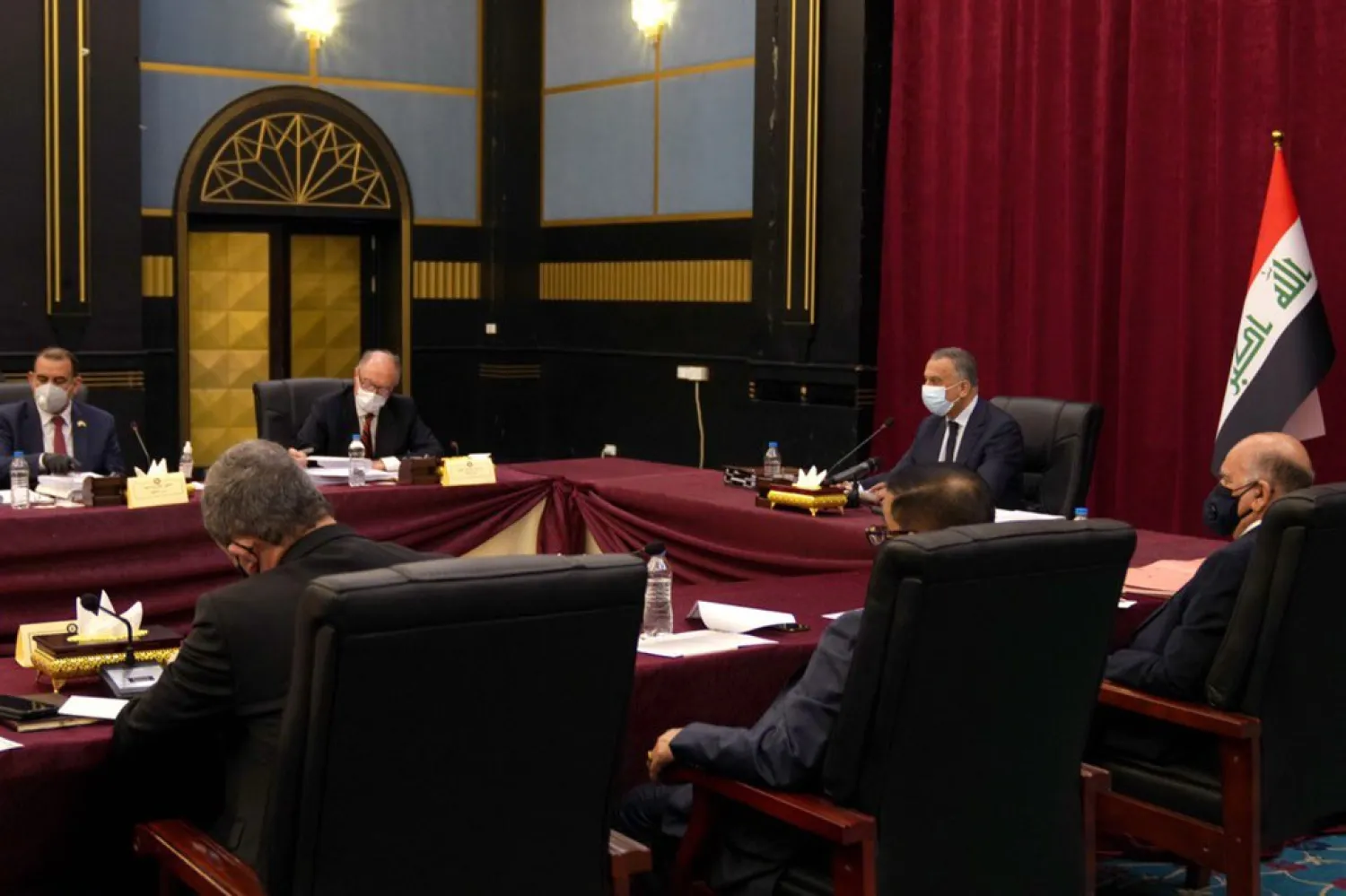
Iraqi Prime Minister Mustafa al-Kadhimi during cabinet meeting in Basra (Iraqi Government)
TT

Iraqi PM Vows to Limit Weapons to State, Hold Elections

Iraqi Prime Minister Mustafa al-Kadhimi during cabinet meeting in Basra (Iraqi Government)

Iraqi Prime Minister Mustafa al-Kadhimi held the weekly cabinet meeting in the southern Basra governorate and later toured border crossings, sending several messages on security, rule of law, the economy and politics.

Wednesday's meeting in Basra came to support the wealthiest governorate in Iraq which also houses the world’s largest oil field and the country’s only port.

The Prime Minister previously visited Diyala and Karbala as part of his tour to a number of governorates to discuss challenges and problems facing their residents.

During his press conference in Basra, Kadhimi stressed that weapons should be limited to the state, and border ports and crossings should be under the control of the authorities.

He also renewed his vow to resolve the country's economic and health crisis, and create the appropriate conditions for carrying out fair elections.

Kadhimi toured the northern Umm Qasr port and the Safwan border crossing with Kuwait, as part of the campaign to combat corruption in entry points.

He reiterated that the government wants to eliminate administrative corruption caused by the influence of militias and parties that control most Iraqi border crossings, and warned that any corrupt employee will be prosecuted.

Accompanied by customs officials, the premier also directed port military units to prevent any force or party from entering the premises by force.

The ports are one of the most important entry points in all countries of the world, as they constitute an essential pillar of the economy, Kadhimi said according to his office, adding that it is necessary to set plans to develop them.

“The country is going through a financial and economic crisis, and the most important non-oil financial revenues which can support the state treasury come from ports and customs,” said Kadhimi.

He admitted that it will be difficult to control the situation on the border in general and Basra in particular, but that despite the challenges there is an opportunity for law enforcement.

Basra has suffered for years from unemployment, poor municipal services, scarcity of drinking water and lack of electricity.

The water scarcity sparked last year a wave of angry protests after hundreds of people were hospitalized with typhoid or diarrhea.

The cabinet took on Wednesday a set of decisions that will help alleviate citizens' suffering, including going ahead with contracting procedures in relation to the Great Basra Water Project, which is considered one of the most strategic projects in the country.

The government also agreed to include the Basra governorate in the periodic follow-up of the project through specialized committees and in coordination with the Ministry of Construction, Housing and Municipalities.

The cabinet approved establishing an infrastructure implementation program to distribute residential plots to entitled groups through the Ministry of Construction, Housing and Municipalities which will work with the contractor of Basra governorate to review and update the designs of al-Sayyab Residential city.

In addition, the cabinet decided to refer all delayed projects in Basra to the ministerial council on services which will submit its recommendations to expedite them.

Al-Zubair Sewage Project will also be referred to the same council for recommendations of fast-tracking after inviting Basra's governor to take part in its deliberations.



Damascus Moves to Implement SDF Deal amid Regional and International Backing

Fighters from the Syrian Democratic Forces welcome a convoy of the Syrian Ministry of Interior heading to Qamishli in northeastern Syria. (AP)
TT

Damascus Moves to Implement SDF Deal amid Regional and International Backing

Fighters from the Syrian Democratic Forces welcome a convoy of the Syrian Ministry of Interior heading to Qamishli in northeastern Syria. (AP)

Damascus is pressing ahead with steps to implement its agreement with the Syrian Democratic Forces (SDF) on the gradual integration of its fighters, redeployment in northeastern Syria, and the return of key facilities to state control.

The deal is receiving regional and international support and is being framed as an opportunity to integrate Syria’s Kurds into state institutions and help build a “new Syria.”

On Friday, a delegation from the Syrian Ministry of Defense was in Hasakah to discuss practical measures for incorporating SDF personnel into the national military, said the ministry’s Media and Communications Directorate.

The move is in line with the agreement announced on Jan. 29 between the Syrian government and the SDF. The accord includes a ceasefire, the gradual integration of Kurdish military and administrative structures into state institutions, and the restoration of government control over vital installations in the province.

Interior Ministry spokesman Nour al-Din al-Baba said the deployment of Internal Security Forces in Qamishli, in northeastern Syria, is proceeding under a clear timeline and operational plan to complete the agreement’s implementation.

This includes taking over and managing strategic facilities such as border crossings, Qamishli International Airport, and oil fields, with the aim of reactivating them “in service of the Syrian people,” he said in statements carried by state television Al-Ikhbariya.

Al-Baba added that the deployment is being carried out “in coordination with the other side in the city,” referring to the SDF, following a similar security deployment in Hasakah.

The agreement is also expected to address the issue of foreign fighters and to integrate the local Kurdish internal security force, known as the Asayish, into the Interior Ministry.

Al-Baba stressed that the ministry welcomes “all Syrian national cadres who serve the people.”

French support

French diplomatic sources told Asharq Al-Awsat that French Foreign Minister Jean-Noel Barrot informed SDF commander Mazloum Abdi that Paris wants to the January 29 agreement implemented “clause by clause” over the long term.

Barrot, who visited Iraq, Syria and Lebanon this week, described the deal as a “historic opportunity” for Syria’s Kurds to take part in building a new Syria alongside other components of society, the sources said.

The FM also discussed developments in Syria with leaders of Iraq’s Kurdistan Region, acknowledging their role in securing the ceasefire between Damascus and the SDF and agreeing to maintain close coordination to ensure the agreement’s success.

On Friday, Kurdistan Democratic Party leader Masoud Barzani met with Abdi and urged both the Syrian government and SDF to commit to the agreement.

A statement from Barzani’s office said the talks focused on conditions in northeastern Syria and underlined coordination among all parties to safeguard Kurdish rights within the country’s constitutional framework.


Axios: US Plans Meeting for Gaza 'Board of Peace' in Washington on Feb 19

Trump and leaders and representatives of the countries participating in the signing of the founding charter of the “Peace Council” in Davos (AFP - Archive)
TT

Axios: US Plans Meeting for Gaza 'Board of Peace' in Washington on Feb 19

Trump and leaders and representatives of the countries participating in the signing of the founding charter of the “Peace Council” in Davos (AFP - Archive)

The White House is planning the first leaders meeting for President Donald Trump's so-called "Board of Peace" in relation to Gaza on February 19, Axios reported on Friday, citing a US official and diplomats from four countries that are on the board.

The plans for the meeting, which would also be a fundraising conference for Gaza reconstruction, are in early stages and could still change, Axios reported.

The meeting is planned to be held at the US Institute of Peace in Washington, the report added, noting that Israeli Prime ‌Minister Benjamin Netanyahu ‌is scheduled to meet Trump at the ‌White ⁠House on ‌February 18, a day before the planned meeting.

The White House and the US State Department did not respond to requests for comment.

In late January, Trump launched the board that he will chair and which he says will aim to resolve global conflicts, leading to many experts being concerned that such a board could undermine the United Nations, Reuters said.

Governments around ⁠the world have reacted cautiously to Trump's invitation to join that initiative. While some ‌of Washington's Middle Eastern allies have joined, many ‍of its traditional Western allies have ‍thus far stayed away.

A UN Security Council resolution, adopted in ‍mid-November, authorized the board and countries working with it to establish an international stabilization force in Gaza, where a fragile ceasefire began in October under a Trump plan on which Israel and Palestinian militant group Hamas signed off.

Under Trump's Gaza plan revealed late last year, the board was meant to supervise Gaza's temporary governance. Trump thereafter said ⁠it would be expanded to tackle global conflicts.

Many rights experts say that Trump overseeing a board to supervise a foreign territory's affairs resembled a colonial structure and have criticized the board for not including a Palestinian.

The fragile ceasefire in Gaza has been repeatedly violated, with over 550 Palestinians and four Israeli soldiers reported killed since the truce began in October.

Israel's assault on Gaza since late 2023 has killed over 71,000 Palestinians, caused a hunger crisis and internally displaced Gaza's entire population.

Multiple rights experts, scholars and a UN inquiry say it amounts to genocide. Israel calls its actions self-defense after Hamas-led ‌militants killed 1,200 people and took over 250 hostages in a late 2023 attack.


A Man Detonates Explosive Belt during Arrest Attempt in Iraq, Injuring 2 Security Members

A man wearing an explosives belt blew himself up Friday while a security force was trying to arrest him in western Iraq near the Syrian border, killing himself and wounding two security members, an Iraqi security official said. (Reuters/File)
TT

A Man Detonates Explosive Belt during Arrest Attempt in Iraq, Injuring 2 Security Members

A man wearing an explosives belt blew himself up Friday while a security force was trying to arrest him in western Iraq near the Syrian border, killing himself and wounding two security members, an Iraqi security official said. (Reuters/File)

A man wearing an explosives belt blew himself up Friday while a security force was trying to arrest him in western Iraq near the Syrian border, killing himself and wounding two security members, an Iraqi security official said.

The raid was being conducted in the al-Khaseem area in Qaim district that borders Syria, said the official who spoke on condition of anonymity in line with regulations.

The official added that “preliminary information” confirms that no members of the security forces were killed, while two personnel were injured and transferred for medical treatment, The Associated Press said.

Iraq’s National Security Agency said in a statement that its members besieged a hideout of an ISIS group security official and two of his bodyguards. One bodyguard ignited his explosives belt, killing him. It gave no further details.

ISIS once controlled large parts of Syria and Iraq and declared a caliphate in 2014. The extremist group was defeated on the battlefield in Iraq in 2017 and in Syria in 2019 but its sleeper cells still carry out deadly attacks in both countries.

In December, two US service members and an American civilian were killed in an attack in Syria that the United States blamed on ISIS. The US carried out strikes on Syria days later in retaliation.

US and Iraqi authorities in January began transferring hundreds of the nearly 9,000 ISIS members held in jails run by the US-backed and Kurdish-led Syrian Democratic Forces in northeast Syria to Iraq, where Iraqi authorities plan to prosecute them.