


Famous Paintings Go on Show, Without a Canvas in Sight

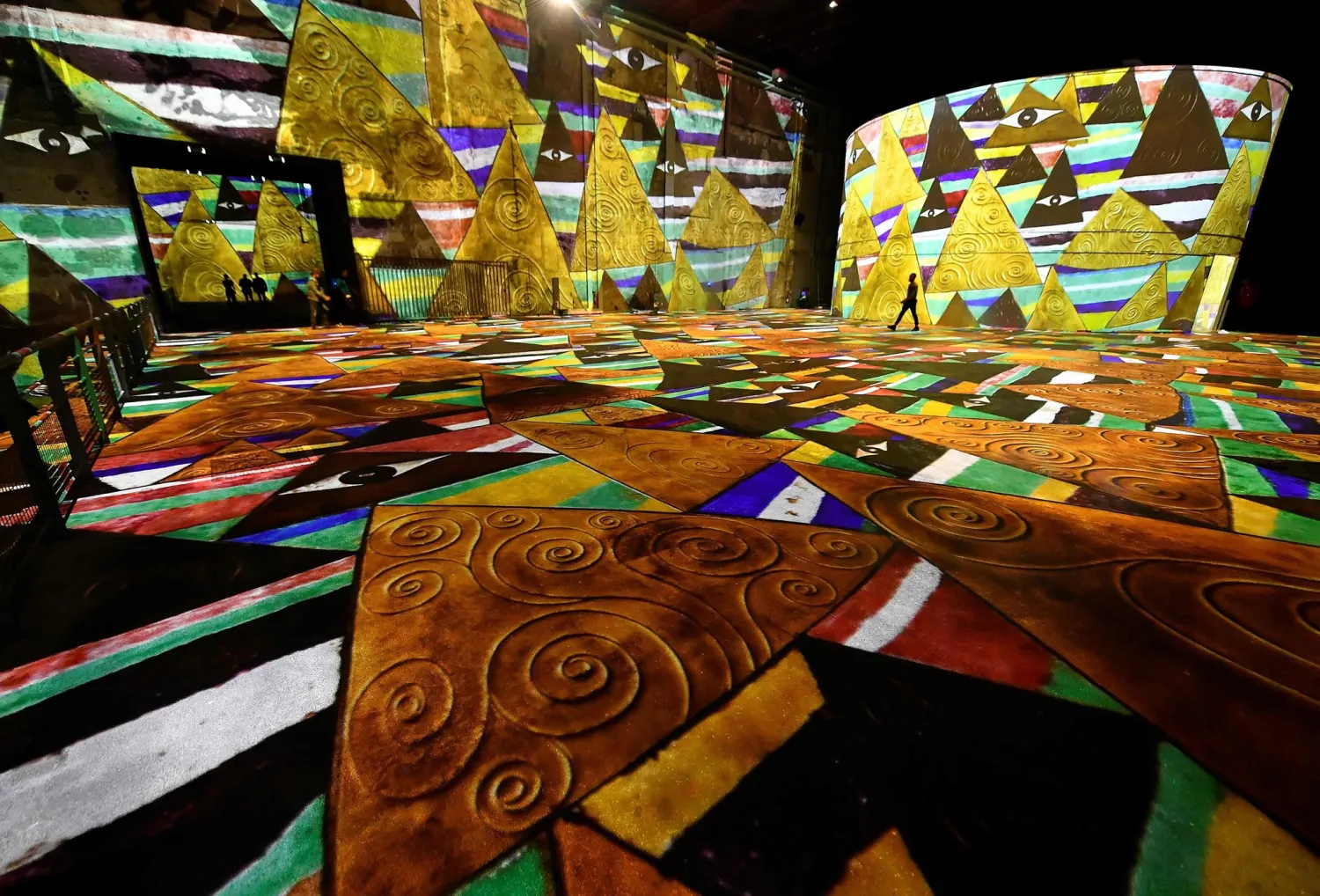
A scene from the “Gustav Klimt: Gold and Color” show at “Bassins de Lumières” in Bordeaux, France, in June.Credit...Georges Gobet/Agence France-Presse — Getty Images
TT

Famous Paintings Go on Show, Without a Canvas in Sight

A scene from the “Gustav Klimt: Gold and Color” show at “Bassins de Lumières” in Bordeaux, France, in June.Credit...Georges Gobet/Agence France-Presse — Getty Images

On the walls inside of a former World War II submarine base, a huge Gustav Klimt tree expands its branches and a gold Paul Klee fish floats by. The bright, changing colors of these projections are reflected by four saltwater pools. Visitors walk along gangways, watching the floor-to-ceiling digital animations based on famous works by Klimt, Klee and Egon Schiele.

The show, called “Bassins de Lumières,” or “Basins of Light,” opened on June 10 after a delay caused by France’s coronavirus lockdown. It is the fourth immersive art space created by Culturespaces, a Paris-based company that manages cultural sites and produces digital exhibitions. Its second, “L’Atelier des Lumières,” has been a huge hit in Paris, drawing 1.2 million visitors in 2018 and nearly 1.4 million the next year.

The formula is straightforward: Culturespaces finds a structure with a notable history, like a former foundry or a bunker; renovates it; and adds offices, control rooms and a reception area. Then the venue opens with a flashy exhibition of digitized works by famous artists, projected onto the walls and animated to a soundtrack. A team of producers has so far created 15 digital exhibitions for Culturespaces, using works by artists including Marc Chagall, Yves Klein, Claude Monet and Vincent van Gogh.

Sylvie Pflieger, an associate professor at the University of Paris who studies the cultural economy, said in an email that Culturespaces was “the true pioneer of ‘immersive art,’ which transports the individual to a dreamlike location.”

With its “Lumières” experiences, Culturespaces is pushing the boundaries between entertainment and art, and between real life and virtual reality. Gone are the frames and the meditative stillness viewers are used to in museums, replaced by huge images that transform to the music of artists as varied as Beethoven and Janis Joplin.

Culturespaces is used to operating outside the norm: For many years, the company’s business has been the management of cultural and heritage sites in France for profit, an unusual setup in a country where the arts rely on significant state funding.

Though Culturespaces can replicate its digital shows around the world without the financial burdens of handling real-life artworks, there are other major costs: Preparing the Bordeaux submarine base, for example, cost 14 million euros, about $15.9 million. Some of what this money paid for is 80 speakers, 90 projectors in climate-controlled boxes, 75 miles of optical fiber cables and on-site servers handling approximately 10 terabytes of data.

Digital shows are only one part of what Culturespaces does. Founded in 1990 by Bruno Monnier, who worked at France’s culture ministry before that, Culturespaces also manages arts and heritage sites across France, such as the Villa Ephrussi de Rothschild in the South of France and the amphitheater in the city of Nîmes. Often, the owners of these monuments, chateaus or museums are towns and regions and, by extension, the taxpayers who live there.

A private takeover of a public institution is unusual in France. On average, cities spend 8 percent of their budget on culture, said Dr. Pflieger, the University of Paris professor. But arts funding on the national and regional levels has stagnated since the early 2000s, she added.

“Cities are having to handle more and more burdens and are therefore reducing their cultural budgets,” Dr. Pflieger said.

When Culturespaces takes over, its goal is profitability: Owners receive 5 to 15 percent of any profit they turn. Mr. Monnier, the company’s president, explained the four streams of revenue that his team focuses on: “First, classic visitor activities like guides and ticketing services. Second, the library and the gift shop. Third, the restaurant. Fourth, events.”

“Events” include exhibitions, and for some of the venues Culturespaces runs, such as the Maillol Museum and the Musée Jacquemart-André in Paris, those are crucial. The Musée Jacquemart-André is currently showing paintings by J.M.W. Turner on loan from the Tate museums in Britain.

Mr. Monnier said that drawing visitors with exhibitions had become harder over the years as heavy hitters like the Louvre in Paris have spent a great deal to produce blockbuster shows: The museum’s once-in-a-lifetime Leonardo show, which ran from November through February, had 1.1 million visitors. Competition has also come from museums funded by the luxury-goods billionaires Bernard Arnault, whose Fondation Louis Vuitton opened in 2014, and François Pinault, who is set to open a showcase for his art collection next year.

“These large exhibitions are expensive,” Dr. Pflieger said. “It is necessary to obtain loans from museums, particularly foreign ones; ensure the transport of works in good condition, which implies gigantic insurance costs, and so on. It is clear that small museums cannot do this.”

When “L’Atelier des Lumières” opened in Paris, it brought in a broader demographic than Culturespaces’ other venues, Mr. Monnier said: “People who never go to museums, younger generations, guys and girls who are 16-year-olds walking around hand in hand, families, grandparents, young parents.”

So-called immersive experiences are not necessarily new. Constance DeVereaux, the director of arts leadership and cultural management at University of Connecticut, said they were “something you find at Disneyland,” adding, “I was going to those in the 1960s.” Dr. DeVereaux said that though there was nothing wrong with turning art into entertainment, the format of “Lumières” might prevent viewers from thinking too deeply about what they saw. “There’s so much going on when you observe a work of art that could be dimmed by the giant digital experience,” Dr. DeVereaux said.

But Mr. Monnier thinks the scale of the “Lumières” shows is exactly why they leave an impression.

“You are completely inside. It’s completely emotional. It’s not just paintings on the wall,” he said.

Over the years, some in the art world have expressed fear of creeping privatization in countries where funding the arts has long been the responsibility of the government, but Christiane Hellmanzik, a professor of economics at the Technical University of Dortmund, said that applying a more business-oriented mind set to art was smart.

“From a pure economic perspective, if you bundle several ventures, that makes a lot of sense,” Dr. Hellmanzik said, referring to Culturespaces’ strategy of diversifying streams of income and creating a digital experience that can be replicated around the world, as well as a museum management technique that can be applied at different venues.

“That’s how Google works,” she added. “Why should the art world not operate like that?”

The New York Times


Rapper Lil Jon Confirms Death of His Son, Nathan Smith

Lil Jon performs at Gronk Beach music festival during Super Bowl week on Saturday, Feb. 11, 2023, at Talking Stick Resort in Scottsdale, Ariz. (AP)
TT

Rapper Lil Jon Confirms Death of His Son, Nathan Smith

Lil Jon performs at Gronk Beach music festival during Super Bowl week on Saturday, Feb. 11, 2023, at Talking Stick Resort in Scottsdale, Ariz. (AP)

American rapper Lil Jon said on Friday that his son, Nathan Smith, has died, the record producer confirmed in a joint statement with Smith’s mother.

"I am extremely heartbroken for the tragic loss of our son, Nathan Smith. His mother (Nicole Smith) and I are devastated,” the statement said.

Lil Jon described his son as ‌an “amazingly talented ‌young man” who was ‌a ⁠music producer, artist, ‌engineer, and a New York University graduate.

“Thank you for all of the prayers and support in trying to locate him over the last several days. Thank you to the entire Milton police department involved,” the “Snap ⁠Yo Fingers” rapper added.

A missing persons report was ‌filed on Tuesday for Smith ‍in Milton, Georgia, authorities ‍said in a post on the ‍Milton government website.

Police officials added that a broader search for Smith, also known by the stage name DJ Young Slade, led divers from the Cherokee County Fire Department to recover a body from a pond near ⁠his home on Friday.

"The individual is believed to be Nathan Smith, pending official confirmation by the Fulton County Medical Examiner’s Office,” the post continued.

While no foul play is suspected, the Milton Police Department Criminal Investigations Division will be investigating the events surrounding Smith’s death.

Lil Jon is a Grammy-winning rapper known for a string ‌of chart-topping hits and collaborations, including “Get Low,” “Turn Down for What” and “Shots.”


Keke Palmer Is a Fish Out of Water in Horror-Comedy Series Based on Cult Movie ‘The ’Burbs’

Keke Palmer and Jack Whitehall attend Premiere Event Of Peacock's "The 'Burbs" at Universal Studios Backlot on February 05, 2026 in Universal City, California. (Getty Images/AFP)
TT

Keke Palmer Is a Fish Out of Water in Horror-Comedy Series Based on Cult Movie ‘The ’Burbs’

Keke Palmer and Jack Whitehall attend Premiere Event Of Peacock's "The 'Burbs" at Universal Studios Backlot on February 05, 2026 in Universal City, California. (Getty Images/AFP)

The suburbs are anything but bland in the new Peacock series “The 'Burbs,” where strange things are going on. Like how jokes mix with the dread.

Inspired by the 1989 Tom Hanks-led movie of the same name, “The 'Burbs” follows a new mom as she navigates a foreign world of white picket fences and manicured lawns while also investigating a possible murder.

“It’s got the comedy, it has the drama, it's got the mystery, it's got the horror, the thrills, the suspense — all of it,” says Celeste Hughey, the creator, writer and executive producer. All eight episodes drop Friday.

Hanks is replaced by Keke Palmer, who plays a newlywed and new mom who moves into her husband's family home in fictional Hinkley Hills, where everyone is in everybody else's business. “Suburbia is a spectator sport,” she is told.

Across the street is an abandoned home, where a local teen disappeared decades ago. Palmer's Samira soon joins forces with a band of off-beat suburbanites to help solve the case, even if her own husband had some sort of role.

“I really wanted to focus on that fish-out-of-water feeling, centering Samira as a Black woman in a white suburb who is a new mom, a new wife — new everything — and trying to figure out where she belongs in the environment,” says Hughey.

The cast includes Jack Whitehall as Samira's husband and the trio of Julia Duffy, Mark Proksch and Paula Pell as her wine-swilling, investigating neighbors who form a sort of found family.

“The movie came out when I was quite young, but I remember seeing it as a kid and it being like this terrifying movie to me,” says Hughey. “But revisiting it as an adult, it's just like the most timely movie.”

The scripts crackle with witty humor, from references to Marie Kondo to “Baby Reindeer,” and jokes often improvised by the actors. Chocolate brownies are described as “the Beyoncé of desserts” and there’s a joke about how white ladies love salad.

“The ’Burbs” also touches on more serious issues over its eight episodes — microaggressions, racial profiling, bullying and childhood trauma — but takes a kooky, off-beat approach.

“I always look at things with a sense of humor,” says Hughey. “I think comedy is a way to be able to examine all these pretty heavy subjects, but in a way that’s accessible, in a way that is clarifying.”

Palmer says she grew up watching Norman Lear shows and admired his ability to both entertain and address social tensions — something she found in “The 'Burbs.”

“When I read this script for the first time, then as we started doing the show, it started to become clear that we had an opportunity to do the same thing,” Palmer says. “We can expose cliches, we can lean into things, which is one of the greatest tools of satire and comedy in itself, and horror as well, because horror can play as a good allegory for the issues in our life.”

Whitehall, who grew up in the London suburb of Putney, says he appreciates that the social commentary never feels that heavy handed between the comedy and horror: “It was great to sort of be able to play in both genres.”

There are multiple nods to the original movie, like picking the last name Fisher after the late actor Carrie Fisher, who appeared in the Hanks-led version, and naming a dog Darla after the name of the pup who starred in the 1989 version. Hanks, himself, appears in a blink-or-you’ll-miss-it image.

There’s a scene where Samira steps onto her neighbor’s grass and leaves suddenly swirl around her feet menacingly, an echo to the original. And there’s a moment when sardines and pretzels are served, a riff off a classic moment in the movie. The creators even asked original actor Wendy Schaal to return to play the town librarian.

“I really wanted to honor the original fans of the movie and make sure that they see that someone who respects the original material and loves the movie had it in their hands,” says Hughey. “I see the fans.”

Hughey said she wrote the series with Palmer's voice in mind, a piece of manifesting that turned out to actually work when she first met Palmer over a year later.

The music ranges from Bill Withers' “Lovely Day” to Steve Lacy's “Dark Red” to Doechii’s “Anxiety” and Big Pun's “I'm Not a Player.”

“Music is very much a part of my creative process and something that I wanted to stand out in the show as well,” says Hughey. “I got to pull in so many of my inspiration songs.”


Kurt Cobain's 'Nevermind' Guitar Up for Sale

Guitars are displayed during a press preview of The Jim Irsay Collection at Christie's Los Angeles in Beverly Hills, California, on February 5, 2026. (Photo by VALERIE MACON / AFP)
TT

Kurt Cobain's 'Nevermind' Guitar Up for Sale

Guitars are displayed during a press preview of The Jim Irsay Collection at Christie's Los Angeles in Beverly Hills, California, on February 5, 2026. (Photo by VALERIE MACON / AFP)

The guitar played by late rock legend Kurt Cobain on the anthemic grunge track "Smells Like Teen Spirit" is going under the hammer next month.


The 1966 Fender Mustang is among a treasure trove of instruments and musical memorabilia that also includes the logo-emblazoned drum that announced The Beatles to the United States when the Fab Four played "The Ed Sullivan Show" in 1964.


The Jim Irsay collection -- put together by the one-time owner of the Indianapolis Colts NFL team -- includes guitars played by musicians who defined the 20th century, including Pink Floyd's Dave Gilmour, The Grateful Dead's Jerry Garcia, as well as Eric Clapton, John Coltrane and Johnny Cash.


But at the center of the collection are handwritten lyrics for The Beatles' smash "Hey Jude" as well as guitars played by John Lennon, Paul McCartney and George Harrison.


"I think it's fair to say that this collection of Beatles instruments...is the most important assembled Beatles collection for somebody who wasn't a member of the band," Amelia Walker, the London-based head of private and iconic collections at Christie's, told AFP in Beverly Hills.


"There are five Beatles guitars in his collection, as well as Ringo Starr's first Ludwig drum kit (and) John Lennon's piano, on which he composed several songs from Sergeant Pepper."


Also included is "the drum skin from Ringo's second Ludwig kit, which is the vision which greeted 73 million Americans who tuned in to watch 'The Ed Sullivan Show' on the ninth of February 1964 when the Beatles broke America."


The drum kit is expected to fetch around $2 million, while the guitars could sell for around $1 million at the auction in New York, Christie's estimates.

Perhaps the most expensive item in the collection is Cobain's guitar, which experts say might sell for up to $5 million.

"It's a talismanic guitar for people of my generation... who lived through grunge," said Walker.

"(Smells Like Teen Spirit) was the anthem of that generation. That video is so iconic.

"We're incredibly proud and privileged to have that here."
