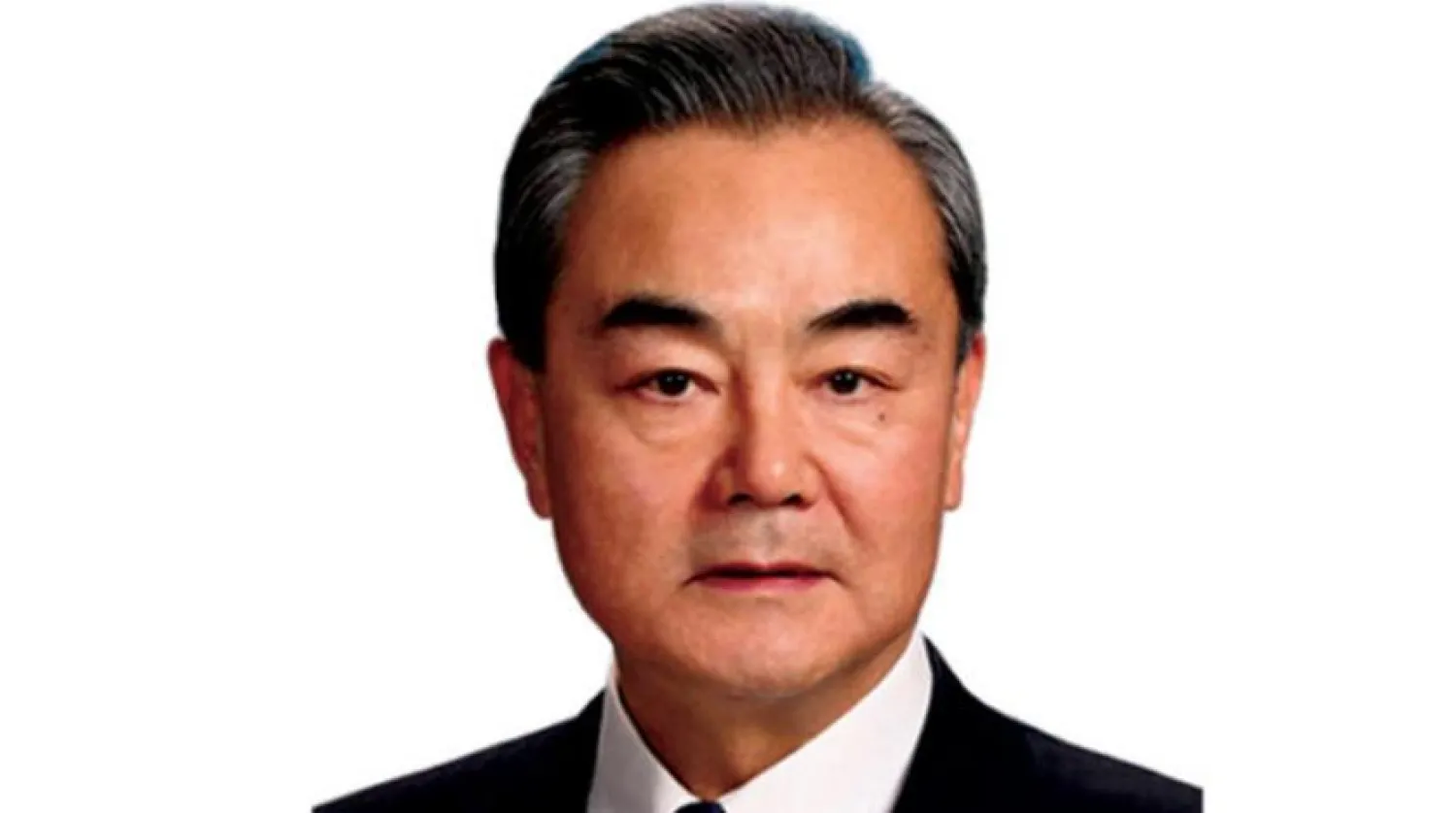

The Chinese government’s top diplomat, State Councillor Wang Yi, said the world is pinning high hopes on the G20 summit that is set to be held virtually on November 21-22 under the Saudi leadership.
In an interview with Asharq Al-Awsat, he said the Group of 20 major economies have achieved practical results in many fields, from coordinating policies on vaccine and macro-economy, addressing the debts of developing countries, to promoting trade and investment, digital economy and the flow of people.
A virtual G20 leaders summit chaired by Saudi Arabia in March consolidated the world’s confidence in fighting the pandemic, he told the newspaper.
"Viruses know no borders or races, and the only way to defeat them is for us to work together,” said Wang.
He added that the international community is following up with great interest the Riyadh summit amid hopes that it will send a positive message and reach a vision on cooperation in the fight against the pandemic and a review on the deficiencies exposed by the coronavirus in world governance.
"It is also hoped that the summit would work out a plan for reforming global governance in the post-COVID era,” he told his interviewer.
Wang denied accusations against China that it has not been transparent on the spread of the coronavirus.
He also rejected what he termed US bullying, its Cold War mentality and its attempts to politicize the pandemic.
Wang hoped that Washington will become reasonable and look at the development of China and other economies with a pragmatic view.
Asked about the war in Yemen, Wang said China backs the country’s sovereignty, independence and territorial integrity. He called for a ceasefire and resolving the crisis through political means.
He also called for the implementation of the Stockholm Agreement and the Riyadh Agreement through tangible steps.
As a Security Council member, China has exerted huge efforts for reconciliation and negotiation between Yemen’s rival parties, and has provided assistance to the country, he said.
On Libya, he said that only a political solution would resolve the country’s crisis, also calling for the respect of its sovereignty and territorial integrity.
Wang said Beijing rejects the interference of other countries in Libya’s affairs, adding that China backs the mediating role of the UN through countries neighboring Libya, the Arab League and the African Union.
Asked about war-torn Syria, he said China also believes that the country’s problems cannot be solved militarily.
He called for joint efforts to fight terrorism in Syria, saying a solution to the crisis will be in the interest of all states in the Middle East.
He hoped that Syria would once again enjoy stability, security and development.
“We will enhance our communication with Middle East countries and play a constructive role together in bringing about an early settlement of the Syrian issue,” Wang added.
Here is the full text of the interview:
1. What are the most urgent issues and important challenges facing the upcoming G20 Summit?
Wang Yi: In the global context, the pandemic is compounding the once-in-a-century changes unfolding in our world. The rise of unilateralism, protectionism and headwinds against globalization have aggravated volatility in the international situation. The world economy is in its worst recession since the Great Depression, and people’s livelihoods are greatly undermined. Where is the world heading? Shall we go it alone, or even opt for a beggar-thy-neighbor approach, or shall we stand together to tide over the difficulties? At this important crossroads, the G20, as a premier forum for global crisis response and international economic cooperation, is expected by the international community to once again voice its support for multilateralism, solidarity and mutual assistance, to forge global synergy in fighting COVID-19 and revitalizing the world economy, and to lead the way in the direction of the trend of our times and the progress of history.
Thanks to the capable leadership of Saudi Arabia over the past year, the G20 responded to the epidemic with unity, and achieved practical results in many fields, from coordinating policies on vaccine and macro-economy, addressing the debts of developing countries, to promoting trade and investment, digital economy and the flow of people. The success of the Extraordinary Leaders’ Summit in March has injected new confidence and charted the course for the global fight against COVID-19, and was highly commended by the international community. As President Xi Jinping stressed at the Summit, the interests of all countries are closely connected and we humankind share a common future. Viruses know no borders or races, and the only way to defeat them is for us to work together.
The world is still being ravaged by COVID-19, and many countries are facing a second wave of the virus, making it even more challenging to fight the epidemic, protect people’s livelihoods and stabilize the economy. The Riyadh Summit is attracting much attention from the international community which expects the Summit to produce positive signals and practical initiatives of cooperation. At the same time, as all parties reflect on the weaknesses and deficiencies in global governance exposed by COVID-19, it is also hoped that the Summit would work out a plan for reforming global governance in the post-COVID era.
The Riyadh Summit, according to our view, will not only review G20’s cooperation over the past year and make future plans; more importantly, it presents an important opportunity to set the direction for improving global governance in the post-COVID era. To this end, we hope the Summit will enhance cooperation in the following areas, as a response to the most vital and urgent concerns of the international community.
First, upholding multilateralism and improving global governance. We need to strengthen the UN-centered international system, and address the inadequacies exposed by the epidemic by improving the governance architecture for globalization and enhancing the capability to respond to global challenges such as public health, climate change, and data security.
Second, putting life first and building a global community of health for all. We need to support the leadership and coordinating role of the World Health Organization (WHO), speed up the research, production and distribution of COVID-19 vaccines as a global public good, and make them more accessible and affordable.
Third, enhancing macro-economic policy coordination and promoting global economic recovery. We need to develop a more positive perception of the close links among countries, and protect open and stable industrial chains. We also need to ensure people’s basic living needs, and foster new drivers of growth. In particular, efforts should be made to unlock the potential of the digital economy, and to build an open, fair, just and non-discriminatory business environment.
Fourth, placing development front and center in international cooperation. We need to give particular attention to the challenges confronting developing countries, and step up support for those hardest hit by the coronavirus and under heavy financial stress through the debt suspension initiative. We must earnestly deliver on the UN 2030 Agenda for Sustainable Development, and help developing countries realize the Sustainable Development Goals at an early date.
With the virus effectively under control, China is working actively to foster a new development paradigm, and will soon begin implementing its 14th Five-Year Plan. China will work with other G20 members to support Saudi Arabia’s leadership as the holder of the G20 presidency, ensure the success of the Riyadh Summit, boost international confidence in overcoming the difficulties, and join hands in building a community with a shared future for mankind.
2. What are COVID-19’s economic and social implications for the world and for China? What is your take on countries rushing for vaccine development?
Wang Yi: COVID-19, which caught us all by surprise and has remained unabated, has become the most severe global public health emergency since the end of World War II. It has seriously impacted all countries, posing an enormous threat to people’s life and health and presenting formidable challenges to global public health security. Confronted by the ravages of COVID-19, the international community has not flinched. People across the world have looked out for each other and responded in solidarity, demonstrating the courage, resolve and compassion that define humanity in times of major disasters, and lighting up this dark moment. As President Xi Jinping noted at the opening ceremony of the third China International Import Expo, humanity has always been able to forge ahead despite risks, disasters and headwinds, and humanity shall and will continue to march forward.
In the face of COVID-19, the Chinese government has put people first, given top priority to saving lives, made parallel progress on epidemic response and social and economic development, and achieved strategic gains. The Chinese economy is steadily picking up, as evidenced by the fact that its growth turned positive in the first three quarters of this year. People’s well-being is effectively protected. China will soon complete the building of a moderately prosperous society in all respects and eradicate absolute poverty.
The just concluded Fifth Plenary Session of the 19th CPC Central Committee adopted an overall plan for China’s development in the 14th five-year plan period. China will begin a new journey toward fully building a modern socialist country and enter a new stage of development. China is set to foster at a faster pace a new development paradigm with domestic circulation as the mainstay and domestic and international circulations reinforcing each other. We will build an even more open economy underpinned by the massive Chinese market. We will pursue deeper and wider opening-up in more sectors to turn the Chinese market into a market for the world, a market shared by all, and a market accessible to all, and let China’s development bring opportunities for all countries, for win-win cooperation and for a better future.
Viruses know no borders. People of all countries are entitled to have access to vaccines and medicines. We sincerely welcome and look forward to contributions made by countries across the globe to vaccine development. President Xi Jinping made the full commitment at multiple international occasions that China’s COVID-19 vaccines, once developed and deployed in China, will be made a global public good. This will be China’s contribution to ensuring vaccine accessibility and affordability in developing countries. China will honor its words and faithfully act on its commitment.
China’s vaccine development companies are going all out and working around the clock to develop vaccines in strict accordance with scientific laws and regulatory requirements and have made encouraging progress. Eleven of their vaccines have entered clinical trials, among which four have got the green light for phase-3 clinical trials abroad. Statistics have so far shown that these vaccines are safe and immunogenic. Such pace of progress is among the fastest in the world.
China has always been committed to international cooperation on vaccine development and has joined a number of multilateral initiatives such as WHO’s Access to COVID-19 Tools (ACT) Accelerator and COVAX. We will continue to engage in active discussions with all parties on international cooperation on vaccine development.
3. What would you say to accusations from the United States that China has spread the coronavirus to the world? And how would you respond to the criticism over China’s lack of transparency on the spread of the disease?
Wang Yi: The COVID-19 pandemic is the sudden onslaught of a previously unknown virus on humanity. It could break out at any time, in any place. Under the personal direction and instructions of President Xi Jinping, the Chinese government has taken the most prompt, comprehensive, rigorous and thorough measures to effectively cut the chains of transmission at the earliest time possible. We curbed the spread of the virus in just over a month’s time, brought the daily number of newly confirmed cases in China to single digit in two months, and secured a decisive victory in the battle of safeguarding Wuhan City and Hubei Province in three months. These powerful actions have effectively protected the lives and health of our people.
In June, China released a white paper titled Fighting COVID-19: China in Action. It is a comprehensive documentation of China’s fight against the virus, with solid facts, hard data and a clear timeline that could stand scrutiny both now and in the future.
As the first country to report cases, China has taken an open, transparent and responsible attitude from the very beginning. We have speedily provided updates on the disease and worked closely with the international community. Our strong and effective measures have been fully recognized by professionals around the world, including WHO experts.
I want to reiterate one point. Once scientific evidence emerged pointing to human-to-human transmission, China immediately closed off outbound transportation routes from Wuhan on January 23, and imposed strict nationwide restrictions on people’s movement. By taking these rigorous steps, China sounded the alarm to the world as loudly as it could. By then, there were only nine confirmed cases outside China, including one in the US. When US borders were closed to all Chinese citizens on February 2, only a dozen of confirmed cases were reported in the US. Some people in the US, however, have chosen to ignore these facts and groundlessly accuse China of spreading the virus to the US and to the whole world. Such attempts to stigmatize and politicize the virus and defame China are entirely driven by self-serving political manipulation. They are doing this to deflect attention and shirk responsibilities for their own mishandling of the disease. These acts have met growing opposition and rejection from the international community.
More and more research and evidence are suggesting that this pandemic probably broke out in different parts of the world. We call on all parties to respect facts and science, focus on their domestic fight against the disease, and actively engage in international cooperation.
4. What will China do to uphold international peace, security and global governance in the post-COVID era?
Wang Yi: The world today is undergoing unprecedented changes, and COVID-19 is accelerating this process. We will not be able to go back to the past when the pandemic is over. We must look beyond the horizon and open up a new future. At the high-level meetings marking the 75th anniversary of the United Nations held in September this year, President Xi Jinping unequivocally reiterated China’s firm commitment to multilateralism, the authority of the UN, the path of peaceful development, win-win cooperation, and the vision of building a community with a shared future for mankind. The President also announced a set of new major initiatives and measures, showing further China’s sense of responsibility for peace and development of the world.
We will always uphold world peace, contribute to global development, and safeguard the international order. We will make greater efforts, in closer cooperation with Saudi Arabia and the whole international community, to uphold multilateralism, support the role of the UN, maintain international peace and security, promote common development, and improve global governance.
5. What is your view on protecting digital security in the context of balancing security and development?
Wang Yi: A new round of technological revolution and industrial transformation is sweeping across the globe, taking humanity into the digital era. The deep integration of digital technology with the real economy is nurturing new business forms and models, and giving new impetus to economic growth. Most notably, exponential growth and aggregation of data provides a new source of energy for economic development and industrial transformation around the world. On the other hand however, data security risks are growing. Massive network surveillance against other countries takes place from time to time. Violations of privacy are more prevalent. Supply chain security is drawing wide attention.
Security and development, like the two wings of a bird and the two driving wheels of a vehicle, rely on and support each other. Seeking absolute security with no regard to development will lead to missed opportunities in digital economy, and such security is like “a river without source” or “a tree without roots”. Yet, a certain country has been abusively invoking “national security” to crack down on better-performing companies of other countries. This is dimming the prospects of global cooperation on digital economy, and will ultimately hamper that country’s own development. In a similar vein, development should not come at the expense of security. Without necessary security regulations, digital economy can hardly grow in a sound, robust way.
In order to protect global data and cyber security and promote digital economic development and cooperation, China has proposed to the world the Global Initiative on Data Security. The Initiative calls on all states to maintain an open, secure and stable global supply chain, oppose using ICT activities to impair other states’ critical infrastructure or steal important data, put an end to activities that infringe upon personal information or conduct mass surveillance against other states and desist from coercing domestic companies into storing data generated and obtained overseas in one’s own territory. The Initiative also calls on all countries to avoid asking companies or individuals to provide data located in other states without the latter’s permission, not install backdoors in their products and service, and not seek illegitimate interests by taking advantage of users’ dependence on their products.
The Initiative has received wide international attention since its release. Countries all recognize the need for rules for global data security, and appreciate China’s efforts to protect global data security. China is prepared to discuss relevant issues with all parties within the G20 framework. We welcome comments from other parties so as to add more reasonable ideas to the Initiative. China is ready to work with all parties to make a set of rules on the security of the global data and network that reflect the will and respect the interests of all countries and build a peaceful, secure, open and cooperative cyberspace.
6. Since President Trump took office, China-US relations strained. The two sides even traded with threats, and imposed economic and trade sanctions on each other. The United States banned TikTok and other apps from China. What has led to all this?
Wang Yi: The root cause of the serious difficulties in the China-US relations is that some US politicians view this bilateral relationship with a Cold-War mentality and from a zero-sum game lens, they refuse to recognize and respect China’s legitimate rights to development, and that they do not want to see emerging economies succeed. Such mindset, sporting unilateralism and bullying, violates the basic norms governing international relations, runs counter to market rules of fair competition, and goes against the underlying trend of human development. It is not supported by the general public, and it is not viable. In today’s globalized world, all countries are part of a community with interwoven interests. Any attempt to rip off the development achievements of other countries or squeeze other countries’ development space is doomed to fail. We hope that the United States will return to reason, take an objective and rational view of the development of China and other emerging economies, and work with China to bring China-US relations back to the right track of healthy and stable development as soon as possible.
7. Some observers believe that the clash between China and the United States as well as some Western countries was caused by the issue of Uygur Muslims. What is your take on this view?
Wang Yi: The accusations by the United States and some Western countries against China about Xinjiang-related issues are completely groundless. Xinjiang-related issues are not about human rights, ethnicity, or religion. They are matters of fighting terrorism and separatism. Over some years in the past, international terrorists infiltrated China through Xinjiang. Terrorists, separatists and extremists ran rampant in Xinjiang, and committed thousands of violent and terrorist attacks. They killed many innocent lives, and caused heavy property losses. To safeguard national security, maintain stability and development in Xinjiang, and protect people’s safety and property, the government of the Xinjiang Uygur Autonomous Region acted to meet the strong call of all ethnic groups. It took counter-terrorism and deradicalization measures in accordance with the law and drew on the counter-terrorism experience of the international community. These preventive measures have proved effective. There have been no violent or terrorist cases in Xinjiang for nearly four years in a row. Thanks to these measures, we are able to protect most effectively people’s rights to life, health and development, ensure a safe and happy life for all the people in Xinjiang, and safeguard sovereignty, unity and security of our country. At the same time, the rights of all ethnic groups in Xinjing to participate equally in the administration of state affairs and to independently manage the ethnic affairs in the region are ensured as prescribed by the law. Their normal religious activities are protected by the law, and the freedom of religious belief is guaranteed in accordance with the law.
Our preventive measures against terrorism in Xinjiang do not differ fundamentally at all from the counter-terrorism and deradicalization efforts taken by Saudi Arabia and many other countries. The international community has widely given positive assessment to China’s policy on Xinjiang-related issues. Since the end of 2018, Saudi Arabia’s Ambassador to China and over 1,000 delegates from more than 90 countries have visited Xinjiang. They saw first-hand that Xinjiang enjoys social stability, ethnic harmony and economic growth. At the General Debate of the Third Committee of the 75th UN General Assembly last October, 48 countries, including Saudi Arabia, spoke up in a joint statement to support China’s Xinjiang-related policy. Their righteous voice shows that only fairness and justice can prevail in the international community.
Rumors, however fabricated and packaged, will fail the test of facts. A lie is a lie, even if repeated one thousand times. We welcome all fair-minded people to Xinjiang to see for themselves the joyful life of all ethnic groups in Xinjiang.
8. What is your comment on the Yemen crisis and the Riyadh Agreement? How do you see the situations in Libya and Syria?
Wang Yi: We follow the Yemen situation closely. We support safeguarding Yemen’s sovereignty, independence, unity and territorial integrity. We support the legal government of Yemen, a political settlement to the issue, and a ceasefire between the conflicting parties. And we support the UN as the main channel of mediation.
We hope that the parties concerned will put the greater good of their country and people first, earnestly implement the Stockholm Agreement and the Riyadh Agreement, and continue to push forward the political settlement process.
As a permanent member of the UN Security Council and a friend of Yemen, China has endeavored to advise peace and talks, and provided assistance. We will continue to work together with the international community for an early settlement of the Yemen issue.
On Libya, there have been positive developments recently: Military representatives from the two conflicting parties have signed a ceasefire agreement, and held a series of political and military dialogues. China welcomes these developments. We always believe that military means will not solve the problem, and that political settlement is the only solution to the Libya issue.
First, it is important to respect Libya’s sovereignty, independence and territorial integrity, and oppose external interference in Libya’s internal affairs. Second, it is important to stick to a political solution. China supports the good offices by the UN, and welcomes the participation of Libya’s neighbors, the Arab League and the African Union in the political settlement process. Third, it is important to pursue political talks and counter-terrorism at the same time and prevent cross-border flows of Foreign Terrorist Fighters.
It is China’s sincere hope that the parties concerned in Libya will work in the same direction, implement the ceasefire on the ground, and restart talks as soon as possible. We call on the international community to form synergy and play a positive role for the return of peace and tranquility in Libya. China will continue to work with the relevant parties and make active efforts for the political settlement of the issue and the early realization of peace in Libya.
On Syria, the situation on the whole is easing at the moment, giving a new opportunity for a political settlement. China always believes that a political solution is the only way out, and that Syria’s independence, sovereignty and territorial integrity should be maintained. We also believe that the process toward a political settlement should be advanced under the “Syrian-led, Syrian-owned” principle, and that all sides should join in the effort to stamp out the terrorist forces in Syria.
An early and proper solution to the Syrian issue serves the interests of all Middle East countries. We hope that the Syrian people will be free from this crisis to enjoy security, stability, peace and development at an early date. We will enhance our communication with Middle East countries and play a constructive role together in bringing about an early settlement of the Syrian issue.
9. What is your take on the current state and future evolution of the Azerbaijan-Armenia conflict? How do you see the current tension between Turkey and Greece?
Wang Yi: The international community has been watching closely the armed conflict between Azerbaijan and Armenia in the Nagorno-Karabakh region since it broke out in late September. With Russia’s active mediation, the two sides agreed to a new ceasefire on 10 November. China welcomes and applauds the agreement. We hope the relevant parties will honor the agreement, return to the track of political negotiations as early as possible, resolve their differences and disputes by peaceful means, and address their issues through dialogue and consultation. We will work with the international community and continue to play the constructive role for the settlement of the Nagorno-Karabakh issue.
Turkey and Greece are important countries in the Eastern Mediterranean. A good relationship between them serves regional peace and stability as well as the common interests of the region and beyond. We are glad to see that both sides expressed readiness to settle disputes through negotiation. China hopes that the two countries will keep in mind regional peace, stability and development, resolve their issues left over from history through dialogue and negotiation, and jointly promote development and prosperity in the region.