

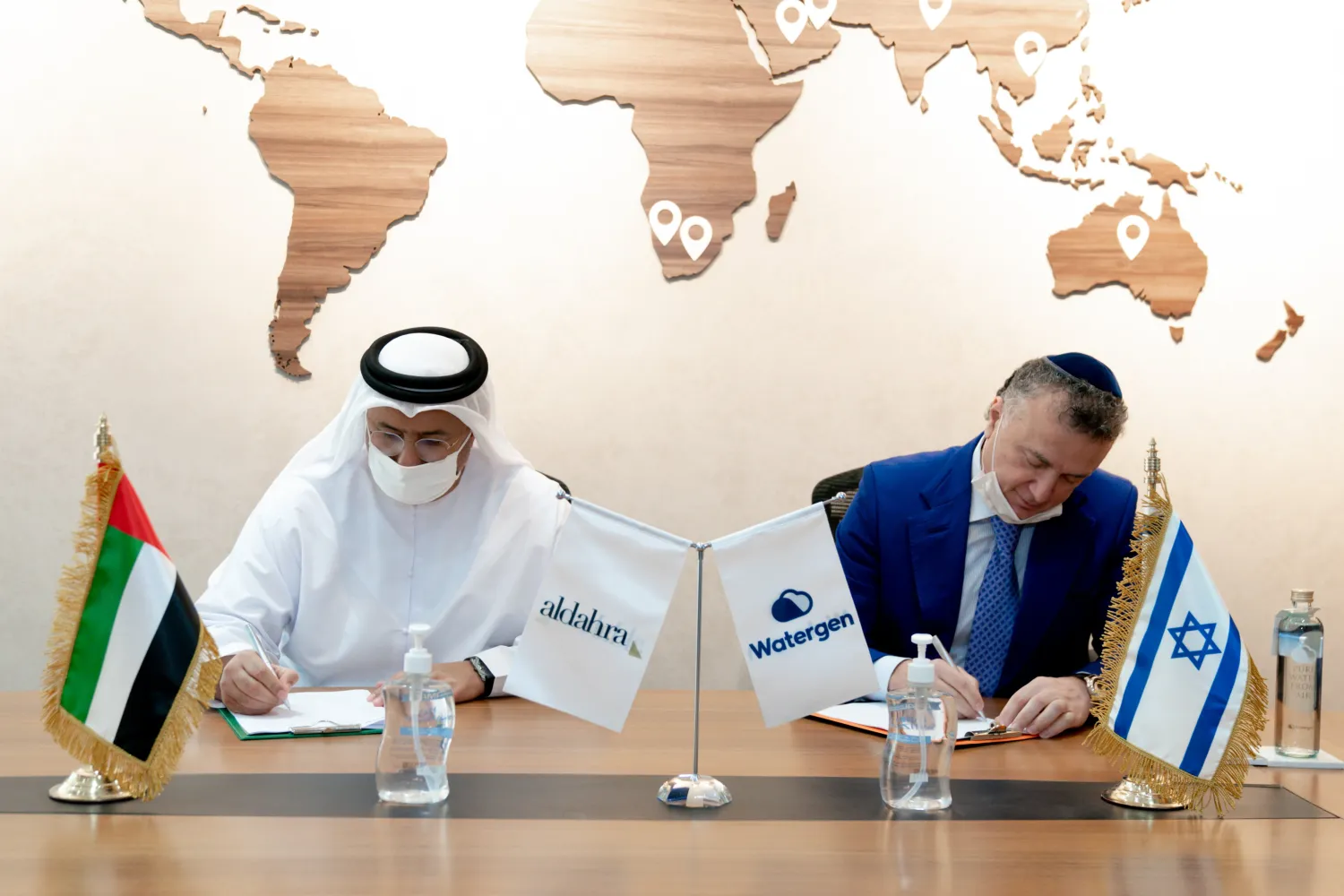

UAE, Israel Sign Strategic Partnership in Water Security

Khadim Al Darei, Vice-Chairman and Co-founder of Al Dahra Holding Company, and Michael Mirilashvili, CEO and President of Watergen signing UAE-Israeli water security deal. WAM
TT

UAE, Israel Sign Strategic Partnership in Water Security

Khadim Al Darei, Vice-Chairman and Co-founder of Al Dahra Holding Company, and Michael Mirilashvili, CEO and President of Watergen signing UAE-Israeli water security deal. WAM

Abu Dhabi-headquartered Al Dahra Agricultural Company and Israel’s Watergen have signed a strategic partnership in the field of water security.

The agreement was signed Friday in Abu Dhabi by Khadim Al Darei, Vice-Chairman and Co-founder of Al Dahra Holding Company, and Michael Mirilashvili, CEO and President of Watergen.

The deal aims to establish a strategic partnership between the two sides to produce water from the air, creating a renewable source of pure water for human and agricultural consumption, state news agency WAM reported.

The two sides agreed to establish a permanent center in Abu Dhabi for manufacturing and distributing drinking and irrigation water production equipment.

The agreement was concluded after the UAE company delegation visited Israel in October 2020, following the peace accord between the UAE and Israel, to encourage cooperation and strategic partnerships between the two countries, Al Darei said, noting that the company’s delegation met with representatives of Israeli companies operating in the sectors of agriculture, water and technology.

During the visit, Al Dahra signed a Memorandum of Understanding, MoU, with Watergen covering an advanced technology for producing water from the air, while will help provide large quantities of drinking water, as well as water used in the irrigation of farms, parks, reserves, ranches and remote areas, he added.

"Amidst the concern for environmental issues around the world, especially in the UAE, environmental indexes are now being prioritized by developed countries. Therefore, Al Dahra aims to find sustainable and comprehensive environmental solutions that will protect the environment and support sustainable development programs in the UAE," he stressed.

He explained that the technology will enable many sectors to benefit from a renewable water source and create promising economic solutions for providing environment-friendly water, instead of digging wells or water desalination.

"Our visit to Abu Dhabi is due to the long-awaited Abraham Accord, which was signed by the UAE and Israel to establish stability in the region and normalize the ties between the two countries," Mirilashvili said.

Watergen will showcase its technology in the UAE, to be promoted in the rest of the region, he added, stressing that Watergen’s products will reduce the use of plastics and directly affect the environments of the UAE and other countries.

Watergen, which was founded in 2009, is operates in many countries around the world and aims, through its collaboration with Al Dahra Holding Company, to advance its strategic project to increase productivity and decrease cost. The five-year collaborative project will developed and adjusted to accommodate the UAE desert environment.

Watergen has three main atmospheric water generators, AWGs, depending on the requirements of the situation. Each unit contains an internal water treatment system and can operate without any special infrastructure, which only require an electricity source except a source of electricity.

The large scale AWG is an industrial scale atmospheric water generator designed for towns, villages, factories, off-grid settlements and rural communities, which can produce up to 5,000 litres of water per day. They can also be installed on rooftops, helping to decentralize the supply of safe-drinking water in municipalities that have insufficient water infrastructure.

AWGs of up to 800 litres of water per day and 30 litres of water per day are used in households and offices respectively.



Japan PM Reassures Markets with Fiscal Discipline in Next Year’s Budget

Japan's Prime Minister Sanae Takaichi delivers a speech at the 14th Council Meeting of the Japan Business Federation, or Keidanren, in Tokyo on December 25, 2025. (AFP)
TT

Japan PM Reassures Markets with Fiscal Discipline in Next Year’s Budget

Japan's Prime Minister Sanae Takaichi delivers a speech at the 14th Council Meeting of the Japan Business Federation, or Keidanren, in Tokyo on December 25, 2025. (AFP)

Japanese Prime Minister Sanae Takaichi sought on Thursday to ease market concerns over her expansionary fiscal policy, saying the government's draft budget maintains discipline by limiting reliance on debt.

There has been growing investor unease about fiscal expansion under Takaichi's administration, which has driven super-long government bond yields to record highs and weighed on the yen.

The budget for the year starting in April, to be finalized on Friday and submitted to parliament early in 2026, ‌will total 122.3 trillion ‌yen ($785.4 billion), Takaichi told ruling coalition executives.

The huge ‌spending ⁠will come ‌on top of a 21.3 trillion-yen stimulus package, compiled in November and funded by a supplementary budget for the current fiscal year, that focused on cushioning the blow to households from rising living costs.

Despite the record size, new government bond issuance for the next fiscal year will be capped at 29.6 trillion yen, staying below 30 trillion yen for a second straight year, ⁠she said.

The reliance on debt will fall to 24.2% from 24.9% in the initial fiscal 2025 ‌budget, which dipped below 30% for the ‍first time in 27 years, she said. ‍The 24.2% debt dependence ratio would be the lowest since 1998.

"We ‍believe this draft budget strikes a balance between fiscal discipline and achieving a strong economy while ensuring fiscal sustainability," Takaichi said.

In a separate speech at Japanese business lobby Keidanren, Takaichi said that her "responsible, proactive" fiscal policy means strategic spending with a long-term perspective.

"It does not mean expanding expenditures indiscriminately based solely on scale," she said.

In a report to clients, Yusuke Matsuo, ⁠Mizuho Securities' senior market economist, said Takaichi would still need to promote proactive fiscal spending to avoid alienating her political base. He added that financial markets could be reassured if the government sticks to a less aggressive stance on spending.

Signaling a shift in the government's reflationary policy push, private-sector members of a government panel on Thursday called on the government to clearly show the public how the debt-to-gross domestic product ratio can be steadily reduced under Takaichi's government.

The four private-sector members include former Bank of Japan Deputy Governor Masazumi Wakatabe and economist Toshihiro Nagahama - known as reflationist aides of Takaichi.

Their proposals were discussed at ‌the Council on Economic and Fiscal Policy (CEFP), which oversees Japan's fiscal blueprint and long-term economic policies.


Asian Shares are Mixed after US Stocks Drift to More Records

Currency dealers monitor exchange rates as a screen (R) shows South Korea's benchmark stock index in a foreign exchange dealing room at the Hana Bank headquarters in Seoul on November 5, 2025. (Photo by Jung Yeon-je / AFP)
TT

Asian Shares are Mixed after US Stocks Drift to More Records

Currency dealers monitor exchange rates as a screen (R) shows South Korea's benchmark stock index in a foreign exchange dealing room at the Hana Bank headquarters in Seoul on November 5, 2025. (Photo by Jung Yeon-je / AFP)

Asian shares were mixed Thursday in thin holiday trading, with most markets in the region and elsewhere closed for Christmas.

In Tokyo, the Nikkei 225 edged 0.1% higher to 50,407.79. It has gained nearly 30% this year.

The dollar slipped to 155.85 Japanese yen from 155.94 yen. The euro climbed to $1.1786 from $1.1780.

Markets in mainland China advanced, with the Shanghai Composite index up 0.5% at 3,959.62. Hong Kong's exchange was closed, The Associated Press said.

Investors were encouraged by a statement by the People’s Bank of China, China’s central bank, promising to ensure adequate money supply to support financing, economic growth and inflation targets. Earlier in the week, the PBOC had opted to keep its key short-term lending rates unchanged.

Shares fell in Thailand and Indonesia.

On Wednesday, the S&P 500 index rose 0.3% to 6,932.05 and the Dow Jones Industrial Average added 0.6% to close at 48,731.16. The Nasdaq composite added 0.2% to 23,613.31

Trading was extremely light as markets closed early for Christmas Eve and will be closed for Christmas on Thursday. US markets will reopen for a full day of trading on Friday, though volumes will likely remain light this week with most investors having closed out their positions for the year.

The S&P 500 is up more than 17% this year, as investors have embraced the deregulatory policies of the Trump administration and been optimistic about the future of artificial intelligence in helping boost profits for not only technology companies but also for Corporate America.

Much of the focus for investors for the next few weeks will be on where the US economy is heading and where the Federal Reserve will move interest rates. Investors are betting the Fed will hold steady on interest rates at its January meeting.

The US economy grew at a surprisingly strong 4.3% annual rate in the third quarter, the most rapid expansion in two years, driven by consumers who continue to spend despite strong inflation. There have also been recent reports showing shaky confidence among consumers worried about high prices. The labor market has been slowing and retail sales have weakened.

The number of Americans applying for unemployment benefits fell last week and remain at historically healthy levels despite some signs that the labor market is weakening.

US applications for jobless claims for the week ending Dec. 20 fell by 10,000 to 214,000 from the previous week’s 224,000, the Labor Department reported Wednesday. That’s below the 232,000 new applications forecast of analysts surveyed by the data firm FactSet.

Dynavax Technologies soared 38.2% after Sanofi said it was acquiring the California-based vaccine maker in a deal worth $2.2 billion. The French drugmaker will add Dynavax’s hepatitis B vaccines to its portfolio, as well as a shingles vaccine that is still in development.

Novo Nordisk's shares rose 1.8% after the weight-loss drug company got approval from US regulators for a pill version of its blockbuster drug Wegovy. However, Novo Nordisk shares are still down almost 40% this year as the company has faced increased competition for weight-loss medications, particularly from Eli Lilly. Shares of Eli Lilly are up 40% this year.

US crude oil closed at $58.35 a barrel and Brent crude finished at $61.80 a barrel.


Saudi PIF Backs Multibillion-Dollar Projects to Boost Sustainability

A solar power project in Saudi Arabia (SPA)
TT

Saudi PIF Backs Multibillion-Dollar Projects to Boost Sustainability

A solar power project in Saudi Arabia (SPA)

Saudi Arabia’s Public Investment Fund has fully allocated the proceeds of its green bond issuance, directing $9 billion to eligible projects, in a move that highlights the sovereign wealth fund’s growing role in shaping a more sustainable future and delivering lasting positive impact worldwide.

According to a recent report issued by the Public Investment Fund, reviewed by Asharq Al-Awsat, the expected impact of the fund’s eligible green projects includes generating 427 megawatts of renewable energy, avoiding emissions equivalent to 5.1 million tons of carbon dioxide, and treating 4 million cubic meters of wastewater.

The Public Investment Fund aims to establish itself as an active participant in global debt markets, while also fostering the development of a dynamic domestic market. This would enable the fund to access short- or long-term liquidity through a diverse range of financing instruments.

Financing strategy

The fund’s capital markets program aims to further strengthen its financing strategy and execution capabilities, both at the level of the Saudi sovereign wealth fund and across its portfolio companies, while enabling deeper engagement with global and local debt markets.

The program will also support expanding the fund’s capacity to raise debt and deploy it as a source of investment financing, in line with its overall funding strategy. This approach is designed to instill greater discipline in cash flow management and enhance returns on equity for the fund and its portfolio companies.

The green bond issuance will provide the fund with access to a broader pool of investors who prioritize environmental, social, and governance considerations in their investment decisions. It will also allow investors to diversify their portfolios through green assets, a step expected to help accelerate the pace of green investment globally.

Climate change

The fund has taken concrete steps to advance governance and policy, focusing on sustainability, and is a founding member of the One Planet Sovereign Wealth Funds initiative. This international platform aims to accelerate the integration of climate change considerations into asset management decisions and investment opportunities.

As an investment vehicle, the Public Investment Fund operates through acquiring stakes in companies aligned with its mandate, including ACWA Power and Lucid.

It has also established the Saudi Investment Recycling Company, a leader in waste management and recycling, manages the National Energy Services Company, Tarshid, and supports the creation of a voluntary carbon market in the Middle East and North Africa.

These efforts aim to strengthen Saudi Arabia’s position as one of the world’s most energy-efficient countries.

The green bond issuance will finance tangible projects on the ground, helping to accelerate the green transition and advance the Kingdom’s core targets of achieving net zero emissions by 2060 and generating 50 percent of electricity consumption from renewable energy sources by 2030.

This forms a key pillar of the renewable energy program implemented by the fund, which involves developing 70 percent of renewable power generation capacity.