


Turkey's Banks Shy Away from Erdogan's 'Crazy' Canal

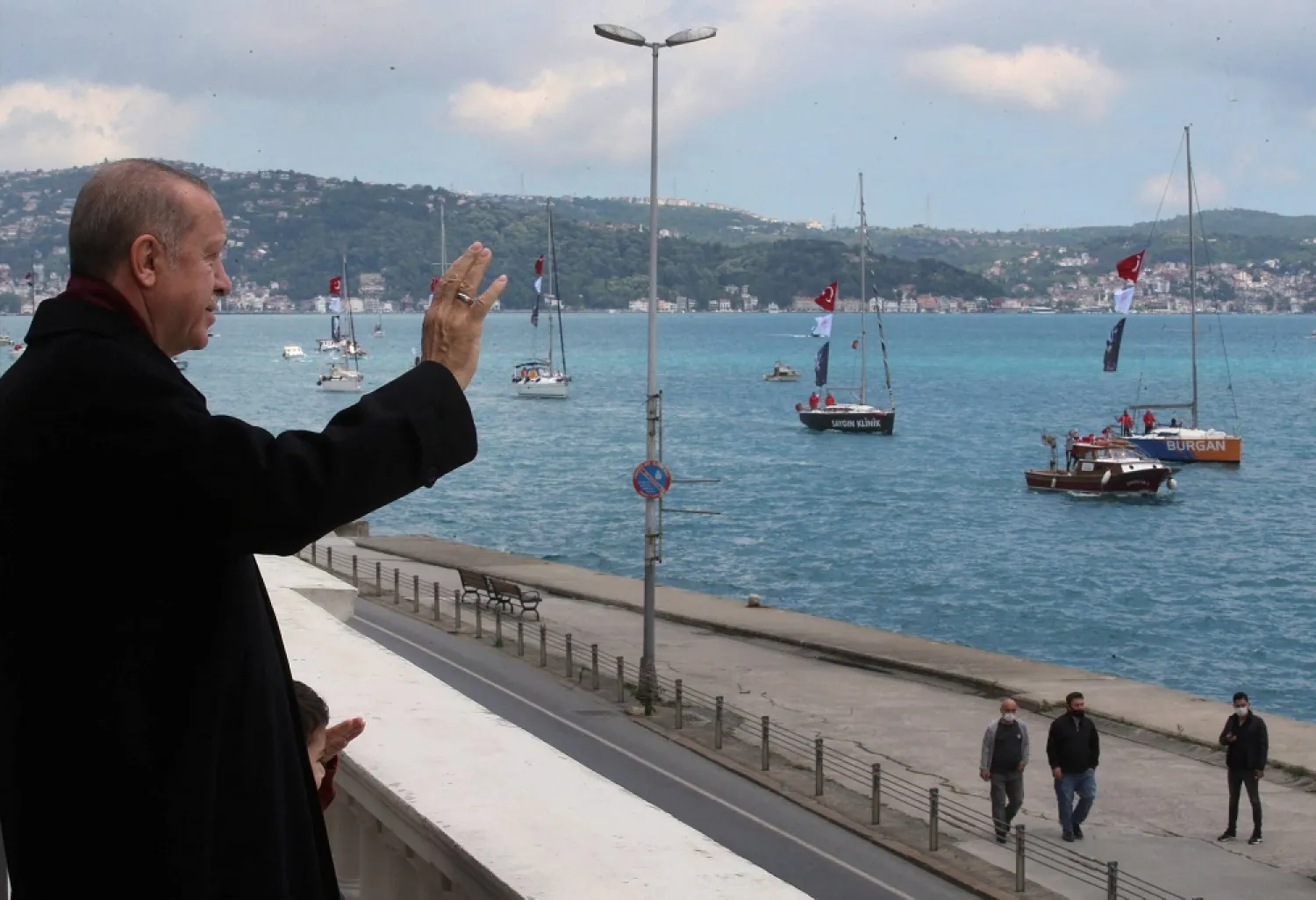
Turkey's President Recep Tayyip Erdogan salutes vessels as they sail the Bosphorus Strait in Istanbul last year. (AP)
TT

Turkey's Banks Shy Away from Erdogan's 'Crazy' Canal

Turkey's President Recep Tayyip Erdogan salutes vessels as they sail the Bosphorus Strait in Istanbul last year. (AP)

Some of Turkey's biggest banks are reluctant to finance President Recep Tayyip Erdogan's planned Istanbul canal due to environmental concerns and the investment risks hanging over the massive construction project, four senior bankers told Reuters.

Two of the sources said a global sustainability pact that six of Turkey's top banks have signed was a barrier to funding the Kanal Istanbul, which Erdogan dubbed his "crazy project" when he floated it a decade ago.

The government expects to break ground in June on the canal, which would connect the Black Sea to the north with the Marmara Sea to the south, running 45 km (28 miles) through marshland, farms and towns on the western edge of the city.

Erdogan says the canal would protect the Bosphorus Strait, which runs through the heart of Istanbul, by diverting traffic.

Yet Istanbul's mayor, engineers and, according to one poll, most citizens, oppose the project on environmental grounds, saying it would destroy a marine ecosystem and resources that supply almost a third of the city's fresh water.

Russia, meanwhile, has signaled unease about the project on security grounds as the canal would open a second passage to the Black Sea, which is home to a Russian naval fleet.

"I don't think we can take part in the funding of Kanal Istanbul," said a senior banker who requested anonymity. "It may trigger some environmental issues."

Six Turkish banks, including Garanti Bank, Is Bank and Yapi Kredi, have signed the UN-backed Principles for Responsible Banking framework which calls on signatories to avoid harming people and the planet.

"Definitely we don't want to give a loan to this kind of project because of the environmental issues," a second senior banker told Reuters, adding that signatory banks must abide by the UN-backed sustainability pact.

In 2019, the canal's price tag was estimated at 75 million lira - or $13 billion at the time - in a government report.

'Profitable project'
The reluctance of some Turkish lenders to finance the project makes it more likely state and foreign financing will have to play a bigger role for Erdogan's dream to come true.

A Finance Ministry spokesman did not immediately respond to a request for comment.

Asked whether Turkish banks would participate in the financing, Erdogan's spokesman and adviser, Ibrahim Kalin, told Reuters the project would "certainly" attract investors and creditors when tenders are held soon.

Garanti Bank declined to comment. Is Bank and Yapi Kredi did not immediately respond to requests for comment.

Denizbank and state-owned Vakifbank also declined to comment on the canal's financing while Akbank and state lenders Halkbank and Ziraat Bank did not immediately respond to requests for comment.

The cost of the canal would eclipse other mega projects such as Istanbul's vast new airport that have defined Erdogan's legacy of credit-driven growth.

Massive foreign short-term debt worth some $150 billion for banks and companies has dogged the lira and laid bare the risks of Turkey's depleted foreign exchange reserves.

A currency crisis in 2018 delayed the canal project but it is back on the agenda as the economy rebounds from the pandemic and the government approved development plans last month.

In an interview on Sunday, Erdogan's adviser Kalin said there was already interest in the bidding that would be open to all including Turkish, European, American and Chinese firms.

"It's a profitable project ... and we are positive it will move forward," he told Reuters.

'White elephant'
But for most of Turkey's banks, especially lenders with European backers and those involved in loan syndications, the risks would likely be too high, the sources said.

They said taking on such a large project could limit their capacity to carry out further loan syndications while there was also a risk the project could be torpedoed at a later stage.

"No Turkish bank, neither state nor private, could take that risk," said a former senior banker.

Turkey's environment ministry has carried out environmental assessments which cleared the way for the project to proceed.

But European backers of Turkish banks would probably not see a Turkish environmental stamp of approval as credible, the former banker said.

"This is one of those white elephants. Other than land price speculation, it is hard to see any value in it," he said.

The canal would destroy a marine ecosystem and basins that provide nearly a third of Istanbul's fresh water, according to the Union of Chambers of Turkish Engineers and Architects.

Moscow is concerned the canal might not be covered by the Montreux Convention that restricts foreign warships' access to the Black Sea through the Bosphorus Strait.

A Turkish official said in 2019 that the new canal would not be covered by the convention, which dates back to 1936.

This month, amid a build-up of Russia's navy near Ukraine, the Kremlin said President Vladimir Putin told Erdogan on a call that the convention must be observed.

A fourth banker also said that given opposition parties oppose the project, construction could halt if Erdogan's ruling AK Party is ousted. Presidential elections are set for 2023.

"The size of the project is tremendously big. It has reputational risks and loan risk," the person said. "It also still seems like government's pet project."



China Widens Foreign Investment Incentive List to Stem Falling Inflows

People visit a shopping center in Beijing on December 20, 2025. (AFP)
TT

China Widens Foreign Investment Incentive List to Stem Falling Inflows

People visit a shopping center in Beijing on December 20, 2025. (AFP)

China on Wednesday listed more sectors eligible for foreign investment incentives, from tax breaks to preferential ​land use, in its latest effort to stem a prolonged decline in overseas capital inflows.

Under the 2025 edition of the catalogue of industries for encouraging foreign investment, China added more than 200 and revised about 300, with a ‌focus on ‌advanced manufacturing, modern services and ‌green ⁠and ​high-tech ‌sectors, the list jointly issued by the National Development and Reform Commission and the commerce ministry showed.

The new catalogue, which takes effect on February 1, 2026, replaces the 2022 version and continues a policy framework ⁠that offers foreign-invested enterprises tariff exemptions on imported equipment, preferential ‌land pricing, reduced corporate income ‍tax rates in ‍designated regions and tax credits for reinvestment ‍of profits.

The catalogue also extends incentives to central and western regions, as well as the northeast and Hainan, as Beijing seeks to attract ​more foreign investment into less developed areas.

China has in recent months ⁠taken a raft of measures to boost foreign investment, including pilot programs in Beijing, Shanghai and other regions to expand market access in services such as telecoms, healthcare and education, amid trade tensions with the United States.

Foreign direct investment in China totaled 693.2 billion yuan ($98.84 billion) from January to November this year, down 7.5% from the ‌same period last year, data from the commerce ministry showed.


Environment Ministry Launches Saudi Citrus Season with Production Exceeding 158,000 Tons

The citrus production season in the Kingdom begins in July and continues through March each year. (SPA)
TT

Environment Ministry Launches Saudi Citrus Season with Production Exceeding 158,000 Tons

The citrus production season in the Kingdom begins in July and continues through March each year. (SPA)

The Saudi Ministry of Environment, Water and Agriculture launched on Wednesday the Kingdom’s citrus season in local markets as part of its efforts to support and develop the agricultural sector and enhance food security in the country, in line with the Saudi Vision 2030.

The is part of the ministry’s ongoing efforts to support national agricultural products, raise awareness of citrus varieties and their nutritional benefits and production areas, and highlight their year-round diversity across production seasons.

These efforts help in improving marketing efficiency, boost competitiveness, and achieve rewarding economic returns.

Citrus fruits are among the most widely cultivated crops in the Kingdom. They are grown in several regions that produce a variety of citrus types, most notably lemons, oranges, mandarins, grapefruit, citron, and kumquats.

The ministry said lemon production leads Saudi citrus output, with total production exceeding 123,000 tons and more than 1.5 million fruit-bearing trees. Orange production follows, with total output reaching 35,700 tons and more than 397,000 fruit-bearing trees.

The citrus production season in the Kingdom begins in July and continues through March each year, it added.

The ministry said the Saudi citrus season has been launched with a number of major retail markets across the Kingdom showcasing local products through innovative packaging and display methods. This boosts the quality and reliability of local products and increases consumer demand during production seasons.


SLB Awarded 5-Year Contract to Stimulate Unconventional Gas in Saudi Arabia

SLB has been awarded a five-year contract by Saudi Aramco to provide stimulation services for its unconventional gas fields. (Asharq Al-Awsat)
TT

SLB Awarded 5-Year Contract to Stimulate Unconventional Gas in Saudi Arabia

SLB has been awarded a five-year contract by Saudi Aramco to provide stimulation services for its unconventional gas fields. (Asharq Al-Awsat)

Global technology company, SLB, has been awarded a five-year contract by Saudi Aramco to provide stimulation services for its unconventional gas fields, the company said in a statement on Tuesday.

The move is part of a broader multi-billion contract, supporting one of the largest unconventional gas development programs globally, it said.

The contract encompasses advanced stimulation, well intervention, frac automation, and digital solutions, which are important to unlocking the potential of Saudi Arabia’s unconventional gas resources - a cornerstone of the Kingdom’s strategy to diversify its energy portfolio and support the global energy transition.

“This agreement is an important step forward in Aramco’s efforts to diversify its energy portfolio in line with Vision 2030 and energy transition goals,” said Steve Gassen, SLB executive vice president.

“With world-class technology, deep local expertise, and a proven track record in safety and service quality, SLB is well positioned to deliver tailored solutions that could help redefine operational performance in the development of Saudi Arabia’s unconventional resources,” he added.

These solutions provide the tools to work toward new performance benchmarks in unconventional gas development.

SLB is a global technology company that drives energy innovation for a balanced planet.

With a global footprint in more than 100 countries and employees representing almost twice as many nationalities, it works on innovating oil and gas, delivering digital at scale, decarbonizing industries, and developing and scaling new energy systems that accelerate the energy transition.